Ultrasensitive searches for the axion
DOI: 10.1063/1.2349730
Fifty years ago, Norman Ramsey and collaborators endeavored to make the first measurement of the electric dipole moment of the neutron. What they measured, to very high precision, was less than 5 × 10⁻²⁰ e·cm and consistent with zero. In the intervening half-century, the neutron electric dipole moment has become one of the most remarkable precision measurements in modern physics (see the article by Norval Fortson, Patrick Sandars, and Stephen Barr in Physics Today, June 2003, page 33 ). Currently the limit has been improved to a vanishingly small 10−26 e·cm, and upcoming experiments may reach 10−28 e·cm.
This result is puzzling because within the standard model of particle physics the strong interaction should violate time-reversal symmetry (T), and thus CP symmetry—symmetry under the combined operators of charge conjugation C and parity P. But such a symmetry violation would result in a neutron electric dipole moment 10 orders of magnitude larger than the current bound. In 1977, two young theorists at SLAC, Roberto Peccei and Helen Quinn, discovered a simple dynamical mechanism to enforce strong CP symmetry 1 which, as Steven Weinberg and Frank Wilczek independently realized, implies the existence of a new elementary particle, termed the axion. 2
The axion is a pseudoscalar—that is, it’s hypothesized as a negative-parity spin-zero particle—and thus is a very light cousin of the neutral pion π 0. Its mass and how strongly it interacts with other particles and fields are inversely proportional to the one key parameter of the Peccei–Quinn theory, a symmetry-breaking energy scale f a, whose value is unknown except that it must be extremely large. (For a fanciful account of how the axion arises in particle physics, see Pierre Sikivie’s article in Physics Today, December 1996, page 22 .) Peccei and Quinn originally assumed, for no good reason, that the symmetry breaking occurs at the electroweak scale. At that scale, axions of roughly 100-keV mass would couple strongly enough to have been observed in accelerator-based experiments. Such axions were quickly ruled out, but theorists found out how to construct axion models with much higher values of f a. Limits on its interactions with matter and radiation have been driven down proportionately by experiments and observations, to extraordinarily feeble levels—many orders below that of the weak scale. Consequently, the axion’s mass can be no more than an electron volt, and is likely less than a millielectron volt.
Axion–photon mixing
Nevertheless, over the past two decades, several experiments around the world have begun to approach the sensitivities required for detecting cosmological or astrophysical axions. In general, the axion couples widely across the particle spectrum: It interacts directly with quarks and leptons and indirectly with nucleons and photons. Interestingly, however, all the current searches are based on the axion–photon interaction. Why that is the approach researchers have adopted bears a little discussion.
Like the neutral pion, the axion couples to two photons, and one of the photons may be virtual. Specifically, a photon can interact in a classical electromagnetic field to produce a pseudoscalar, and vice versa. The first accurate analysis of the neutral pion lifetime (about 10−16 s) was made in 1951 by Henry Primakoff, who realized that the measurement of the π 0 lifetime was equivalent to the vastly easier measurement of its photoproduction cross section in the Coulomb field of a high-atomic-number nucleus, as they are both determined by the same coupling constant. Beginning in the 1980s, scientists searching for the axion introduced several theoretical calculations and proposals that were based on the Primakoff effect—the production of an axion from the interaction of a photon with a classical electromagnetic field. They realized that the coherent mixing of the axion and photon states over large spatial regions of high magnetic field could result in measurable conversion rates and make up for the exceedingly small coupling constant g aγγ . Moreover, the advent of large, high-field, superconducting magnets provided the technological basis for the proposals. Experiments promptly ensued.
Tuning in to dark matter
The axion also fits the bill as an ideal candidate to make up the five-sixths of all matter in the universe widely thought to be non-baryonic—stuff that is not ordinary protons and neutrons. The axion would have been produced as a zero-temperature Bose gas during the Big Bang, would never exist in thermal equilibrium with the rest of the universe, and would have a lifetime so great as to be effectively stable. Most important, sufficiently light axions would dominate the cosmological energy-density budget for matter. In fact, axions lighter than a microelectron volt would have been overproduced in the Big Bang and created a universe much more massive than scientists actually observe. Conversely, axions heavier than a millielectron volt produced in the 1987 supernova SN1987a would have dramatically foreshortened that supernova’s observed neutrino pulse. The axion must therefore lie between those two limits in a mass window of about 10−6 to 10−3 eV.
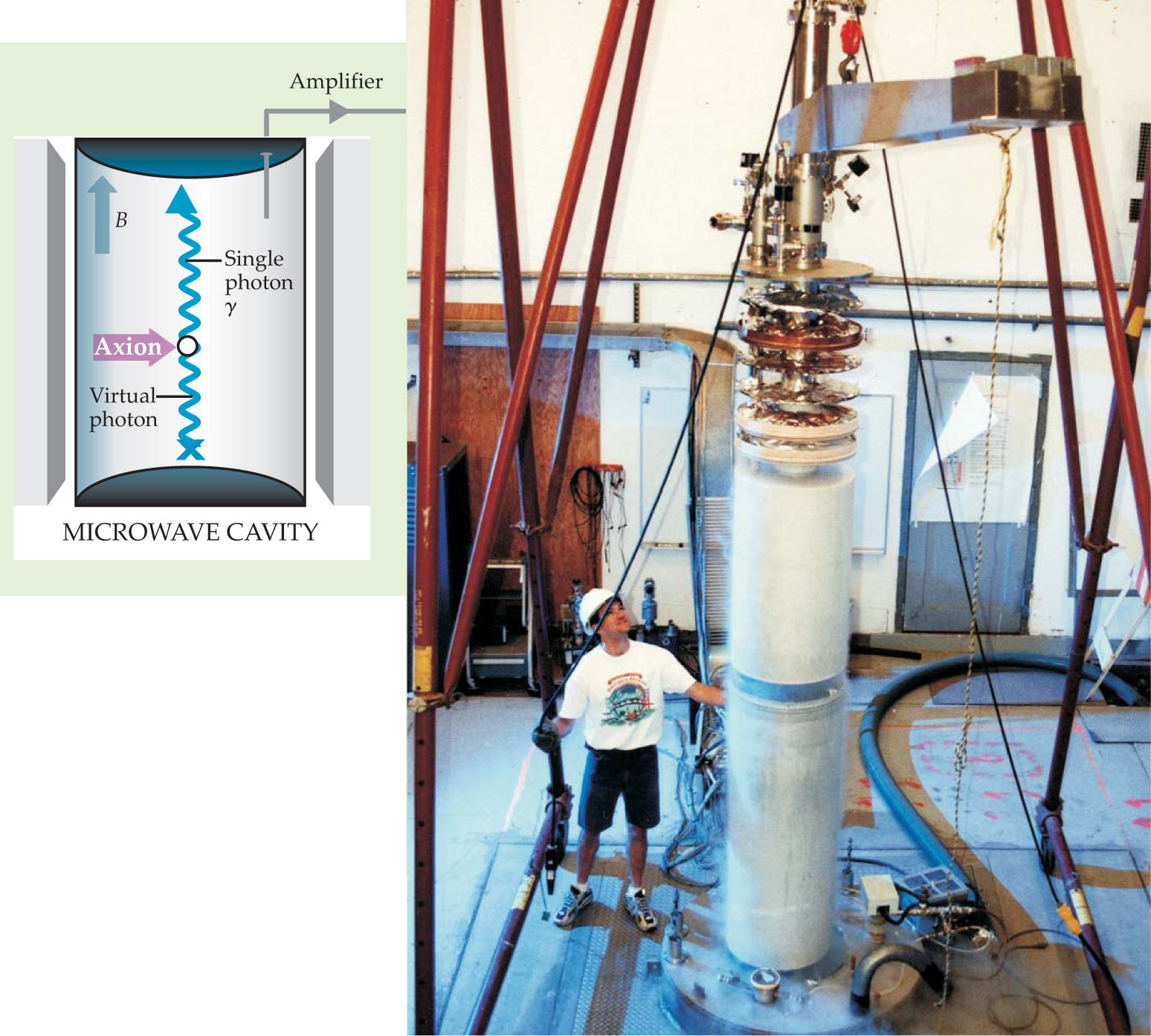
In 1983, Sikivie proposed an elegant and ingenious experiment to detect dark-matter axions by their resonant conversion to RF photons in a microwave cavity permeated by a strong magnetic field 3 (see figure 1). When the cavity is tuned to the resonant frequency, the conversion power is proportional to B 2 VQ, where B is the magnetic-field strength, V the cavity volume, and Q its quality factor, the figure of merit of how good the cavity is as a microwave resonator. The axion signal would appear as excess energy in a narrow peak above background with a width on the order of a part per million. The expected signal would also be model-dependent, but exceedingly tiny, measured in yoctowatts (10−24 W), currently the smallest SI unit of power. In comparison, the last signal ever received from the 7.5-W transmitter aboard Pioneer 10 in 2002, then 12.1 billion kilometers from Earth, was a prodigious 2.5 × 10⁻²¹ W. And unlike with the axion, physicists knew its frequency!

Figure 1. The Axion Dark Matter Experiment at Lawrence Livermore National Laboratory is designed to detect an axion by its decay into a single, real microwave photon in the presence of a magnetic field B. The experiment consists of three basic components: a powerful 8-tesla superconducting magnet, a high-Q and tunable cavity, and an ultrasensitive microwave amplifier as the front end of a radio receiver. The experimental tower is shown here being withdrawn from the magnet and cryostat, which extends 4 meters below floor level. The exposed disks are thermal shields to insulate the cavity and detector electronics held at 1.5 K. The challenge is to detect any slight excess in microwave photons in a narrow peak above thermal and electronic noise during a search.

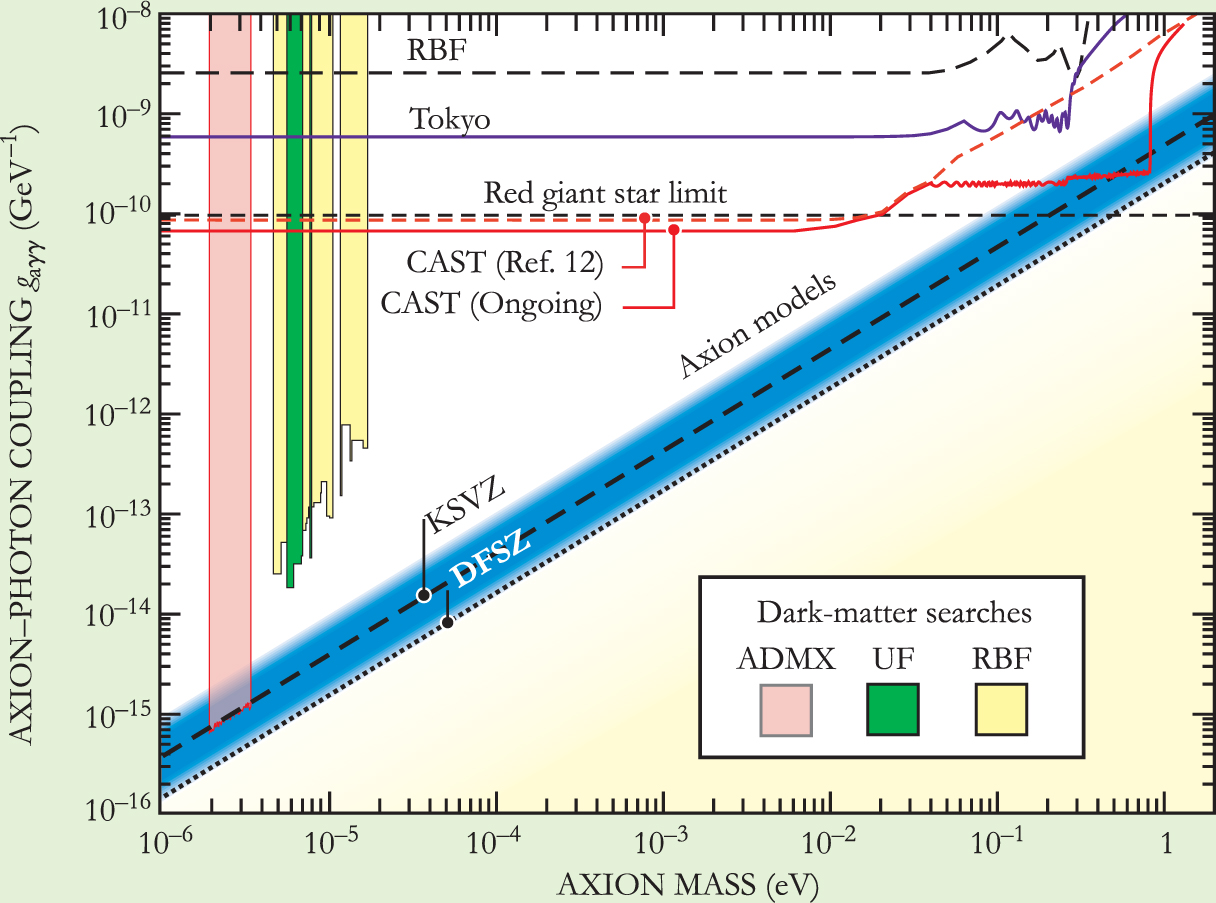
Fortunately, the photon couplings of quite different axion models cluster in a tight band. The band indicates the constraint between the axion’s mass and how strongly it couples to photons. Historically, the various models have served as goalposts for experimentalists. As pictured along the center of the blue band in figure 2, one prototypical example of a general class of axions is denoted KSVZ (for Kim-Shifman-Vainshtein-Zakharov); at the lower edge of the blue band is the most pessimistic model, the grand-unification-theory-inspired DFSZ (for Dine-Fischler-Srednicki-Zhitnitskii).

Figure 2. The coupling of axions to photons g aγγ is proportional to the mass of the axion. Different models predict the coupling strength to fall within a narrow (blue) band. The upper dashed line (KSVZ) signifies one prototypical estimate of the coupling, and the lower line (DFSZ) a much feebler one. Microwave-cavity experiments in the 1980s performed at the University of Rochester, Brookhaven National Laboratory, and Fermilab (RBF)

In the late 1980s, pioneering experiments performed in cavity resonators of just a few liters’ volume—one by a collaboration of the University of Rochester, Brookhaven National Laboratory, and Fermilab, and the other by the University of Florida—already achieved power sensitivities within a factor of 100 to 1000 of the model band over a narrow range in frequency. 4,5
In an actual search, however, signal power is one of only three factors that an experimenter can control. The ultimate signal-to-noise ratio, and hence detectability, of any signal is governed by the Dicke radiometer equation,
where s / n is the signal-to-noise ratio, Δv the bandwidth of the signal, t the integration time, and P s and P n the signal and noise power, respectively, and T n the system’s total noise temperature. Consider these practical issues: The size and cost of superconducting magnets limit increasing the signal power, and the need to scan decades in frequency within a finite number of years limits the integration time at each frequency. Therefore, reducing a system’s noise temperature—that is, the sum of the physical temperature and the equivalent electronic-noise temperature of the amplifier—is the best strategy.
Getting colder
By scaling up the cavity volume and, more importantly, using ultra-low-noise microwave technology, two second-generation experiments are now under way to detect galactic-halo axions. The efforts are complementary, even in the quantum sense: The experiment at Lawrence Livermore National Laboratory (LLNL) exploits the character of photon-as-wave, while the other at Kyoto University has gone the photon-as-particle route.
In its first phase of operation, now concluded, the Axion Dark Matter Experiment (ADMX) at LLNL used heterojunction field-effect transistor (HFET) amplifiers to listen for the axion–photon conversion in a microwave cavity. The amplifiers represented a major leap in ultra-low-noise amplifier technology when introduced into common use in the 1970s, and the ADMX experiment benefited from the long-term development program at the National Radio Astronomy Observatory, which delivered packaged amplifiers of ever-improving noise performance for the radio astronomy community. 6 In those devices, electrons from an aluminum-doped gallium arsenide layer fall into the GaAs two-dimensional quantum well that serves as the FET channel. The FET electrons are transported ballistically, with minimal scattering and thus minimal electronic noise. The amplifiers currently provide the world’s best broadband noise performance in the gigahertz range and allow the experimenters to exclude KSVZ axions over an octave in mass (see figure 2). 7
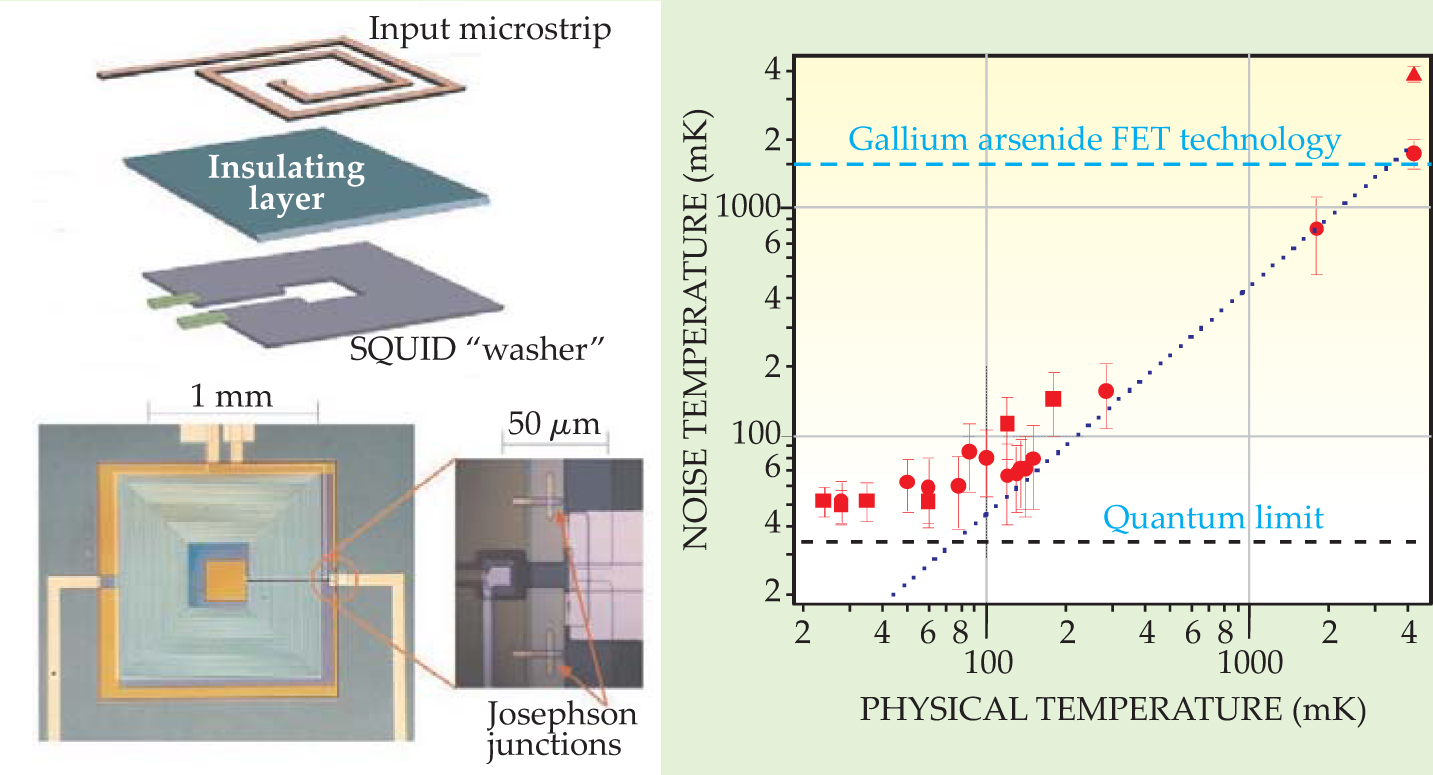
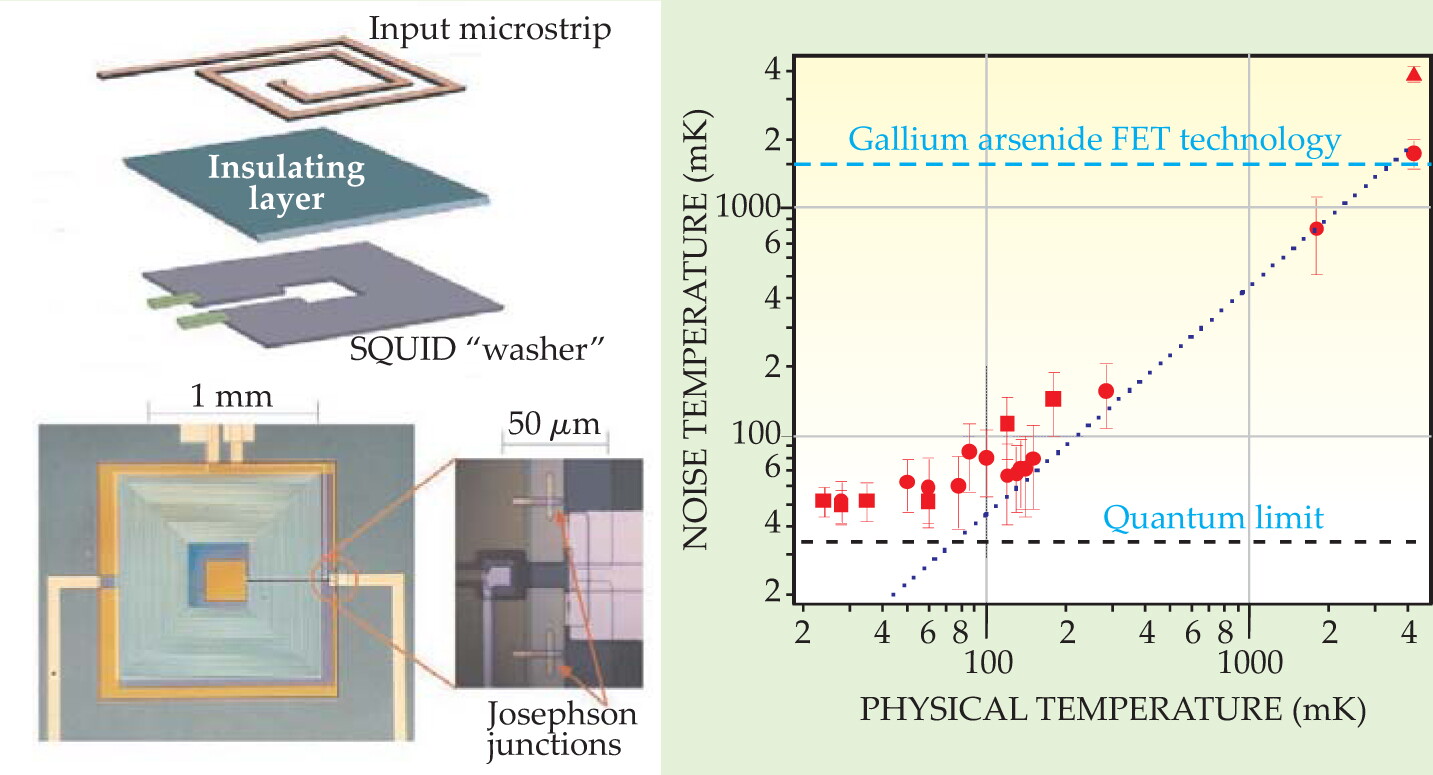
The best HFET amplifiers nevertheless are still far noisier than the quantum limit hv/k, about 50 mK at 1 GHz. An amplifier whose noise temperature approaches the quantum limit would dramatically improve the sensitivity and search rate of the axion experiment. To achieve that goal, our collaborator John Clarke and his coworkers at the University of California, Berkeley, developed a new amplifier based on a microstrip-coupled superconducting quantum interference device in 1996 (see figure 3). 8 Unlike the noise behavior of heterojunction transistor amplifiers at low temperatures, the intrinsic noise of the SQUID is proportional to the physical temperature, the origin being thermal noise in shunt resistors across the SQUID’s Josephson junctions. Cooling reduces the noise until it flattens out within 50% of the quantum limit. Newer SQUID designs with micro-cooling fins that enhance the coupling of electrons to the lattice are pushing these devices closer still to the quantum limit.

Figure 3. This ultra-low-noise amplifier uses a DC superconducting quantum interference device and is configured so that its input coil functions as a microstrip resonator. The input signal is coupled between one end of the coil and the SQUID loop. The result is an RF amplifier that operates at high gain in a narrow bandwidth around the microstrip’s resonance frequency, well into the gigahertz range. The plot at right demonstrates that the intrinsic noise in a sample of three different 700-MHz microstrip-coupled SQUID amplifiers bottoms out at about 50 mK, only 1.5 times the quantum limit. Current gallium arsenide technology, by comparison, has an intrinsic noise temperature 50 times the quantum limit. The dotted line fits the data as the physical temperature decreases, until hot-electron effects take over.
The US Department of Energy Office of High Energy Physics supported a phased upgrade of ADMX with SQUID amplifiers in mid-2004, and initial operation is expected in late 2006. Ultimately, the retrofitted experiment will be capable of detecting DFSZ axions and will scan over frequency space much faster than present detectors can. In addition to their dark-matter application, the early near-quantum-limit devices have already found their way into several other experiments around the world. In particular, they have been combined with single-electron transistors to read qubit states in quantum computation schemes.
Kyoto University’s Seishi Matsuki and collaborators in Japan have pursued an alternative detection scheme that, in principle, can entirely evade the quantum limit during an axion search. In the early 1970s, Daniel Kleppner and others realized that a Rydberg atom—one in which a single valence electron has been promoted to a level with a large principal quantum number n—could serve as a single-quantum microwave detector, effectively a noise-free RF photomultiplier tube. Because such atoms’ energy spectrum is quasi-hydrogenic, available dipole transitions can be found anywhere in the microwave spectrum by an appropriate choice of n, and the transition energy can be tuned using the Stark effect to produce an exact match to a desired frequency. Furthermore, Rydberg atoms possess both very large dipole transition probabilities and suitably long lifetimes, both of which are required for practical microwave axion detectors.
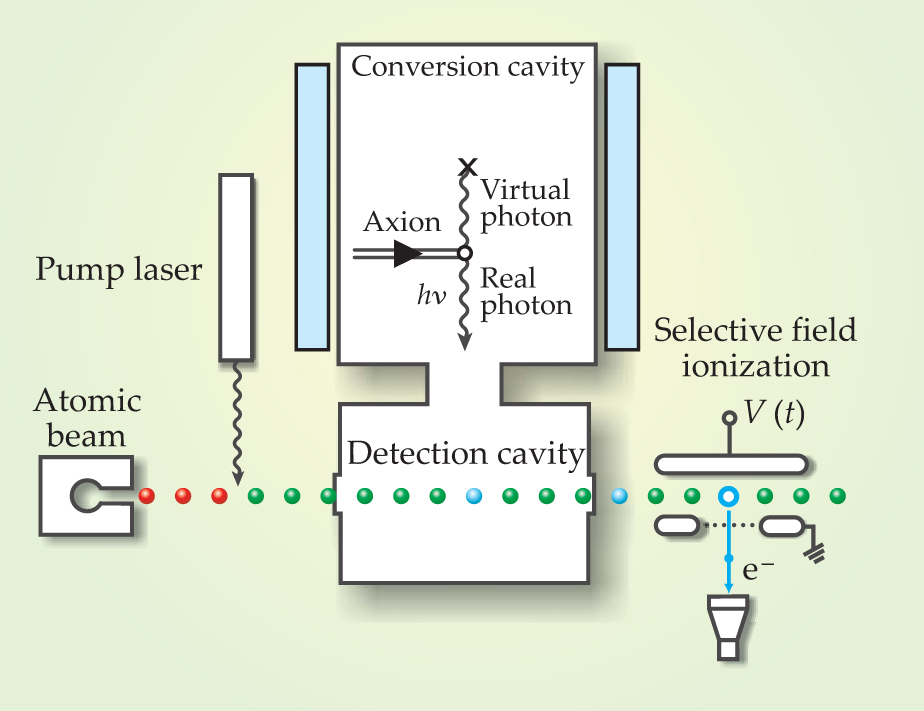
In their experiment schematically pictured in figure 4, Matsuki and company coupled a conversion cavity to a second, detection cavity that was tuned to the same resonant frequency v. Laser excitations create a beam of Rydberg atoms that traverses the detection cavity, where the spacing between energy levels can be adjusted using the Stark effect to equal hv. The result is a coupled atom–cavity system that efficiently absorbs photons. 9

Figure 4. Single-quantum microwave detection. This experimental scheme is used by Seishi Matsuki and colleagues

The Kyoto experiment is designed with the goal of reaching a noise temperature as low as about 10 mK, dominated by the cavity blackbody spectrum if all other contributions can be suitably tamed. Indeed, the group has already measured the cavity emission at 2527 MHz as a function of temperature down to 67 mK, about a factor of two below the standard quantum limit. 10
Rydberg-atom detection, however, is not able to detect structure narrower than the bandpass ΔE/E of the cavity, around 10−5, where E is the photon energy. By contrast, ADMX has implemented a high-resolution channel that is capable of resolving fine structure in the axion signal down to ΔE/E of 10−11 to address certain models of galactic-halo formation that predict such structure.
Searching for solar axions
Researchers realized early on that axions could be produced thermally in stellar burning and escape from the star without subsequent scattering. Even if that happens rarely, it would represent a highly efficient mechanism for energy transport out of the star. Photons produced in the core of a star such as the Sun, by contrast, escape only after thousands of years of scattering inside it. The consequences for stellar evolution would be strikingly apparent if the axionic luminosity were comparable to the photon luminosity in the case of main-sequence stars, or to the neutrino luminosity in the case of type II supernovae such as SN1987a. Setting limits on particle-physics exotica, such as axions, by the concordance between observed and calculated stellar evolution has thus become a powerful tool in establishing limits on the couplings of hypothetical elementary particles. Indeed, the agreement is far more restrictive than accelerator-based experiments. 11
In general, introducing a channel for direct or free-streaming energy loss from a star’s core accelerates the star’s evolution. The core will contract and heat up under the influence of gravity when axions (or whatever) compete with the production of strongly trapped photons, whose radiation pressure acts to counterbalance gravitational pressure. Furthermore, for each stellar system, axions are excluded only over a finite range of couplings. As the axion’s coupling is dialed up in the stellar-evolution simulations, the free-streaming lower limit of the axion’s excluded couplings is reached at a point where deviations from an axion-free model first become noticeable. However, as the coupling is further increased, the axions themselves eventually become strongly trapped; the upper limit corresponds to the regime where their influence on evolution diminishes below the threshold of observation.
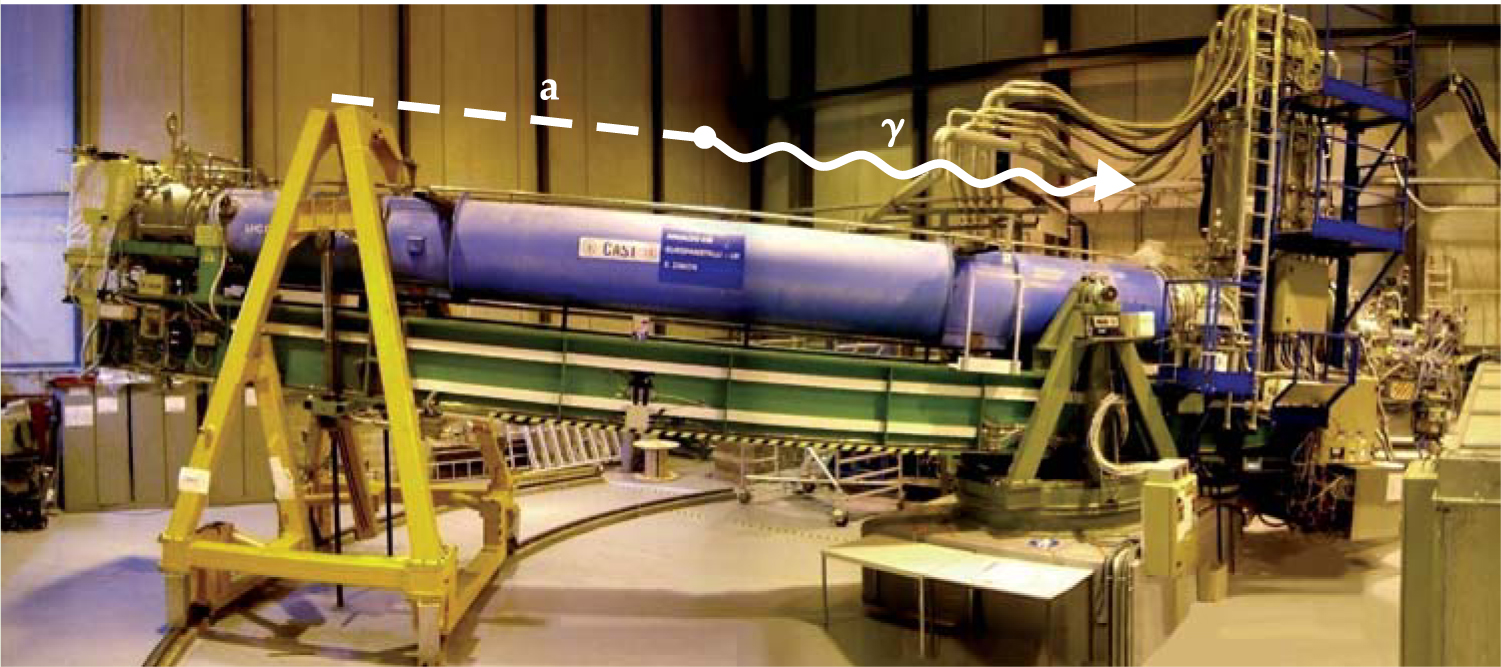
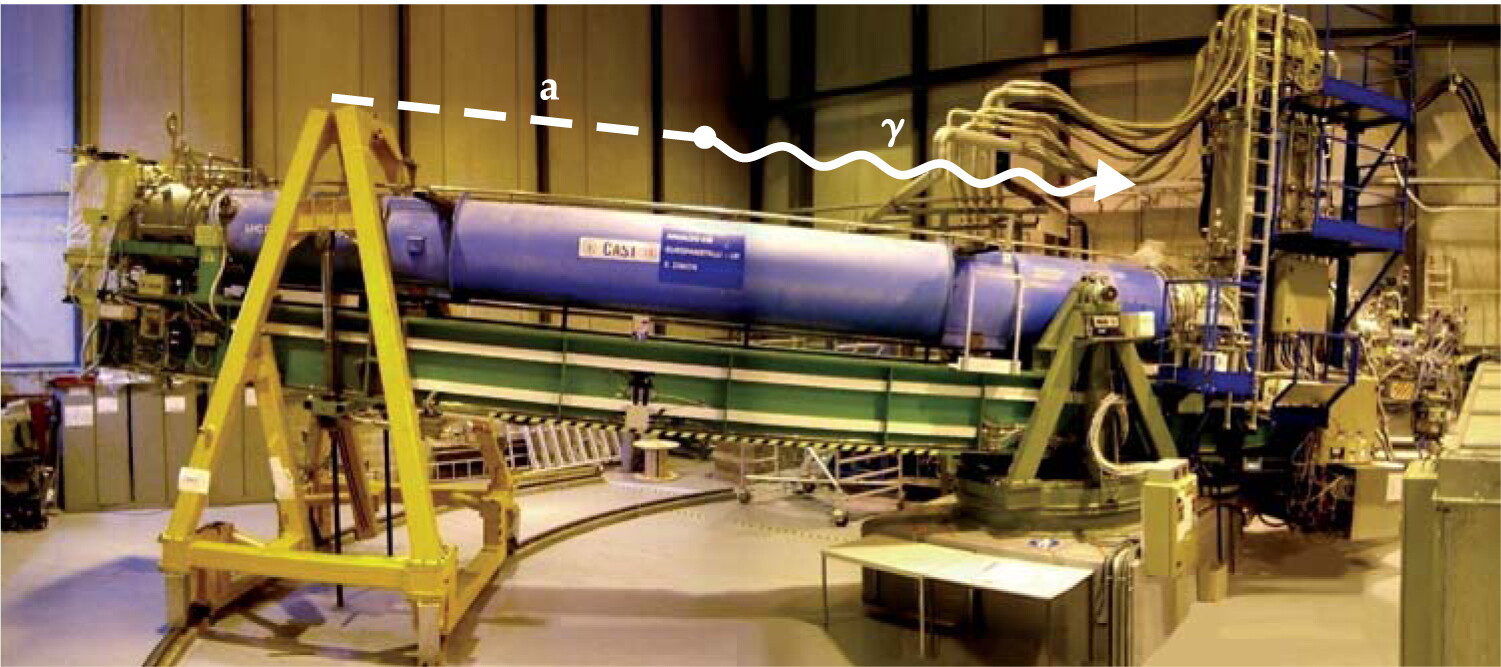
It is remarkable that in the same paper in which Sikivie outlined how dark-matter axions could be detected by their coherent conversion to microwave photons, he also invented a technique for detecting axions streaming from the Sun’s core. 3 He concluded that the direct detection of axions could ultimately improve on limits from inferences based on solar evolution, and would in any case prove much more reliable. In the CERN Axion Solar Telescope (CAST), pictured in figure 5, a long dipole magnet points toward the Sun, with x-ray detectors sitting at the back end. The solar production of axions is dominated by the Primakoff process, whereby a photon interacts with the field of a nucleus with high atomic number to produce an axion. The axion spectrum, and thus the spectrum of detected photons, is predicted to be roughly Maxwellian with a mean energy 〈E a〉 = 4.2 keV. That is higher than the star’s core temperature of 1.3 keV, an effect of plasma screening, which suppresses the production at lower energies.

Figure 2. The coupling of axions to photons g aγγ is proportional to the mass of the axion. Different models predict the coupling strength to fall within a narrow (blue) band. The upper dashed line (KSVZ) signifies one prototypical estimate of the coupling, and the lower line (DFSZ) a much feebler one. Microwave-cavity experiments in the 1980s performed at the University of Rochester, Brookhaven National Laboratory, and Fermilab (RBF)
The integrated solar-axion flux at Earth is given by Φa = 7.44 × 10¹¹ m a 2 cm−2 s−1 for KSVZ axions, where m a is the axion mass in electron volts. In the solar-axion search, the axion–photon conversion rate is given by Φa [g aγγ BL/2]2 A, where B is the strength of the transverse magnetic field, L its length, and A the cross-sectional area of the detector. This rate assumes that the axion is relativistic enough that the axion and photon waves remain in phase down the length of the magnet, a condition fulfilled when axions are sufficiently light. For heavier, less relativistic axions, the axion and photon waves do not remain in phase and the conversion probability is lower.
The CAST experiment utilizes a 50-ton dipole magnet on a movable mount to track the Sun for several hours at dawn and dusk. The x-ray detectors are sensitive enough to register a statistically significant signal from just a handful of conversion events per day. The CAST group has recently published the best upper limit on g aγγ , equaling that derived from red giant stars 12 (see figure 2).
In the ongoing phase II run, CAST is pushing the search for axions further upward in mass into the region of axion models by introducing a gas (currently helium-4, later helium-3) of variable pressure into the magnet bore. The plasma frequency ω p = (4παN e/m e)1/2 ≡ mγ , where α is the fine structure constant, m e the mass of the electron, and N e the electron density, endows the x-ray photon with an effective mass; thus full coherence of the axion and photon states can be restored, and the theoretical maximum conversion probability achieved, for any axion mass, by filling the magnet with a gas of the appropriate density. 13 The mass range to which CAST is sensitive can thereby be extended upward by tuning the gas pressure. Probing the electron-volt range directly by the solar experiment is certainly worthwhile, as the overlap between the upper end of the SN1987a bound and the lower end of the red-giant bound is incomplete at best. In fact, the observed neutrino signals from the 1987 supernova observed in detectors from Kamiokande and a collaboration from the University of California at Irvine, University of Michigan, and Brookhaven still require more refined understanding.
Pure laboratory experiments
Sensitive axion searches based on axion–photon mixing can also be carried out without resorting to either cosmological or astrophysical sources and all their attendant uncertainties. The expected couplings of axions based on quantum chromodynamics (QCD) are so weak, however, that detecting any putative axions made in the laboratory is orders of magnitude beyond today’s experimental sensitivity. Nevertheless, such searches ought to be done, if for no other reason than to check our assumptions about axion models and inferred limits on the axion from cosmology or astrophysics. Nature has the last word, and one should be open to surprise.
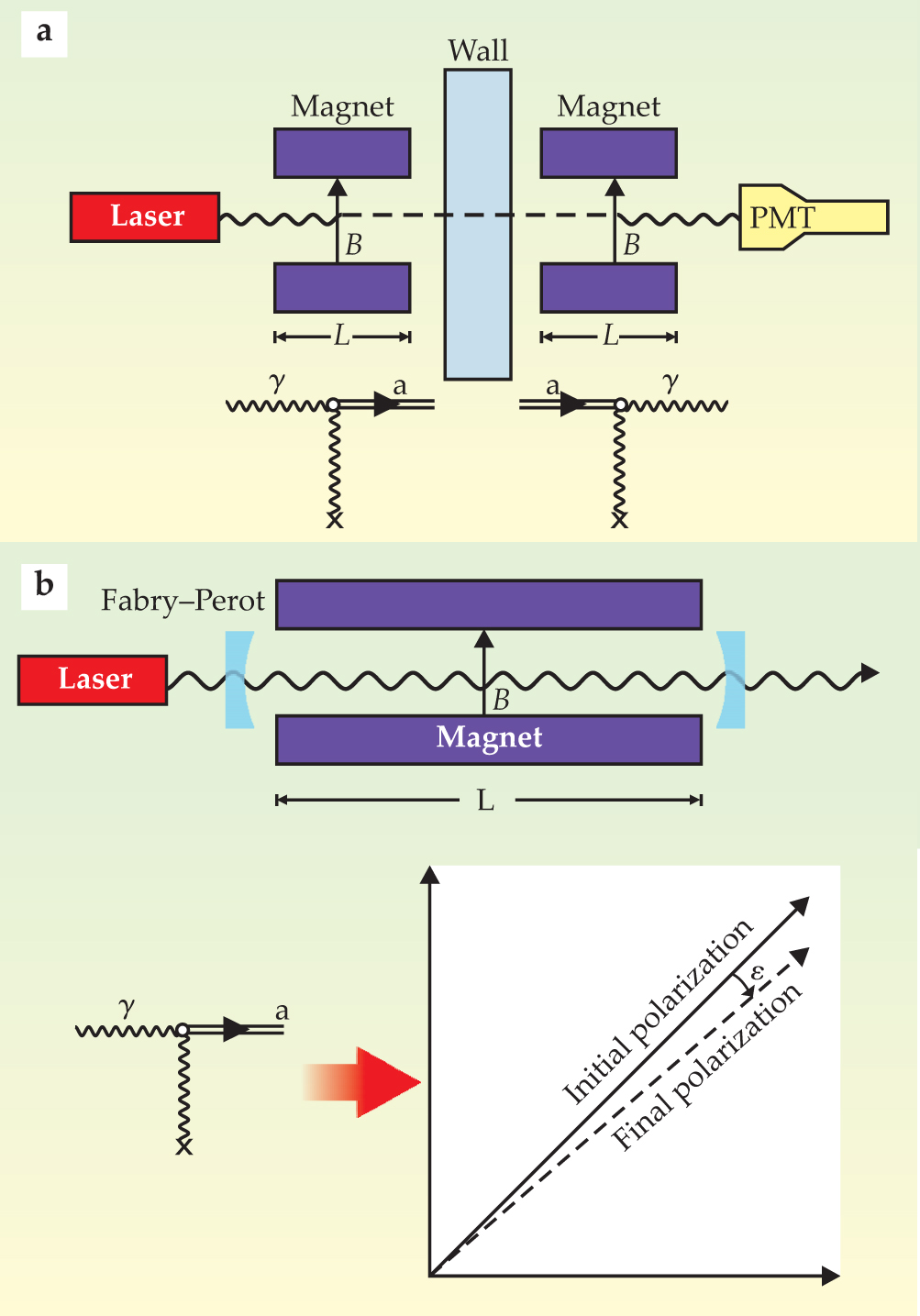
Figure 6 shows two conceptions for experiments based on lasers and dipole magnets. Photon regeneration—more playfully known as “shining light through walls”—relies on a symmetric arrangement of two such magnets. A laser coherently produces axions on one side of an optical barrier, and those axions are then reconverted to real photons on the other. 14 The probability of detecting an output photon per input laser photon is (g aγγ BL/2)4. The g aγγ 4 dependence of the signal severely limits the sensitivity of the search and is a general feature of all laboratory experiments. Using two 3.7-T superconducting dipole magnets at Brookhaven, Giuseppe Ruoso and colleagues set limits on the coupling by photon regeneration: g aγγ < 7.7 × 10⁻⁷ GeV−1 for axion masses less than a millielectron volt. 15

Figure 6. Axion searches using lasers and high-energy accelerator dipole magnets. (a) Photon regeneration is the name given to the process whereby photons from a laser interact with virtual photons in a magnetic field to create axions with the same coherence properties as the laser beam. The newly created axions pass through the wall and, again in the presence of a magnetic field, regenerate photons that can be detected in a photomultiplier tube (PMT). (b) Polarization changes associated with light traversing a strong magnetic field can reveal axion–photon mixing. That mixing and quantum electrodynamic scattering during repeated traversals in a Fabry–Perot cavity contribute to vacuum birefringence—that is, the slight elliptical polarization of linearly polarized light. The production of real axions would produce vacuum dichroism, the net rotation by an angle ε of the plane of polarization that occurs because of the selective depletion of photons in the beam polarized parallel to the magnetic field.
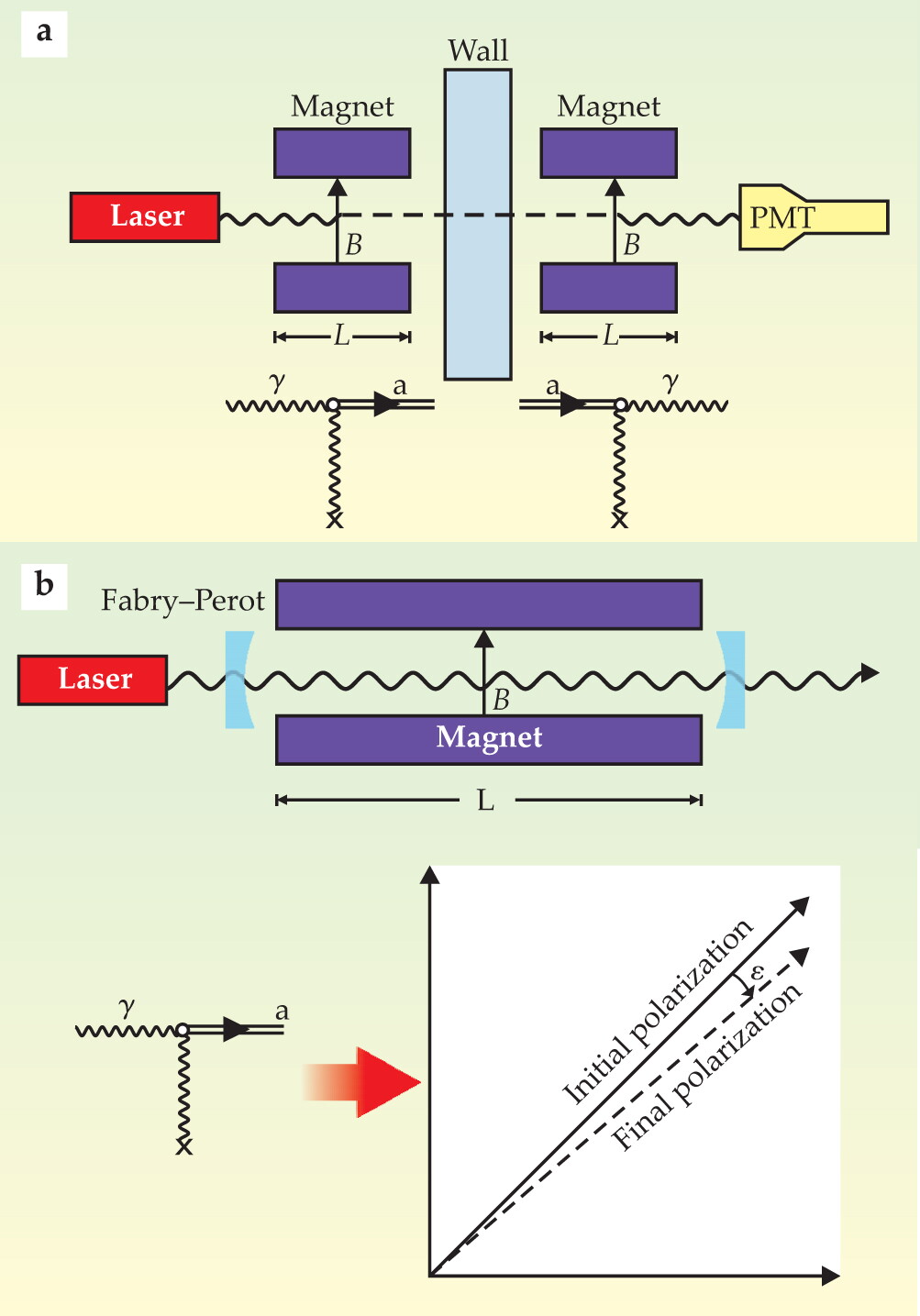
Axion–photon mixing can also, in principle, be observed through subtle changes in the polarization state of light in a magnetic field. In the mid-1980s, Luciano Maiani, Roberto Petronzio, and Emilio Zavattini proposed an elegant measurement of higher-order quantum electrodynamics (QED) in an optical cavity within a strong magnetic field (see figure
Maiani and company pointed out, however, that fluctuations of the photon into a virtual axion would also contribute to the birefringence, the magnitude depending, of course, on the strength of the coupling. Moreover, the production of real axions in the dipole magnet would result in a depletion of the parallel-polarized photons in the beam, but not in the perpendicularly polarized photons. The result would be dichroism, or rotation of the plane of polarization by an angle ε = (g aγγ BL/4)2 per pass, as depicted in figure
Recently, however, the PVLAS collaboration at Legnaro, Italy, reported a positive result with an improved apparatus (40 000 passes of the beam within a 1-meter, 5-tesla magnet) and measured a polarization rotation of about 3.9 × 10⁻¹² radians per pass, as depicted in figure
If an axion be found?
Were a particle interpretation of the PVLAS results borne out, its implications for physics would be imponderable; there could be pseudoscalars, or entire families of pseudoscalars, having nothing to do with either the strong- CP or dark-matter problems. In any case, one can expect the PVLAS results to be clarified in the near future by a new photon-regeneration experiment.
The sensitivity of the resonant-cavity searches is already very nearly good enough to detect axions constituting the dark-matter halo of the Milky Way in the microelectron-volt range, but additional improvements in noise temperature will still be required to speed up the scanning rate in mass and provide definitive answers in 5 to 10 years.
Axionic dark matter, should it be discovered, would provide a rich quantum system to study. Its coherence length, measured in a two-cavity experiment, would be macroscopic—perhaps tens or hundreds of meters. More significantly, any nonthermalized structure of the axion signal could reveal important details of the history of our galactic formation.
The CERN solar-axion experiment is currently reaching into the axion model band in the electron-volt range. Discovery of solar axions would offer an unprecedented image of the Sun’s nuclear-burning core, whose radial distribution and spectrum would provide a direct and powerful test of solar models.
We acknowledge the Laboratory-Directed Research and Development program at LLNL for enabling technology development. We thank Larry Lasher, the Pioneer 10 project manager, for the fascinating history and lore on the Pioneer’s telemetry system.
References
1. R. D. Peccei, H. R. Quinn, Phys. Rev. Lett. 38, 1440 (1977); Phys. Rev. D 16, 1791 (1977) https://doi.org/10.1103/PhysRevLett.38.1440 .
2. S. Weinberg, Phys. Rev. Lett. 40, 223 (1978); https://doi.org/10.1103/PhysRevLett.40.223
F. Wilczek, Phys. Rev. Lett. 40, 279 (1978) https://doi.org/10.1103/PhysRevLett.40.279 .3. P. Sikivie, Phys. Rev. Lett. 51, 1415 (1983); Phys. Rev. D 32, 2988 (1985) https://doi.org/10.1103/PhysRevLett.51.1415 .
4. S. DePanfilis et al. Phys. Rev. Lett. 59, 839 (1987); https://doi.org/10.1103/PhysRevLett.59.839
W. Wuensch et al. Phys. Rev. D 40, 3153 (1989) https://doi.org/10.1103/PhysRevD.40.3153 .5. C. Hagmann et al. Phys. Rev. D 42, 1297 (1990) https://doi.org/10.1103/PhysRevD.42.1297 .
6. R. Bradley et al. Rev. Mod. Phys. 75, 777 (2003) https://doi.org/10.1103/RevModPhys.75.777 .
7. C. Hagmann et al. Phys. Rev. Lett. 80, 2043 (1998); https://doi.org/10.1103/PhysRevLett.80.2043
S. Asztalos et al. Astrophys. J. Lett. 571, 27 (2002); https://doi.org/10.1086/341130
S. Asztalos et al. Phys. Rev. D 64, 092003 (2001) https://doi.org/10.1103/PhysRevD.64.092003 .8. M. Mück et al. Appl. Phys. Lett. 75, 3545 (1999);
M. Mück, J. Clarke, J. Appl. Phys. 88, 6910 (2000).9. Y. Kishimoto et al. Phys. Lett. A 303, 279 (2002); https://doi.org/10.1016/S0375-9601(02)01262-8
M. Tada et al. Phys. Lett. A 303, 285 (2002) https://doi.org/10.1016/S0375-9601(02)01263-X .10. M. Tada et al. Phys. Lett. A 349, 488 (2006) https://doi.org/10.1016/j.physleta.2005.09.066 .
11. G. G. Raffelt, Stars as Laboratories for Fundamental Physics: The Astrophysics of Neutrinos, Axions, and Other Weakly Interacting Particles, U. Chicago Press, Chicago (1996).
12. K. Zioutas et al. Phys. Rev. Lett. 94, 121301 (2005) https://doi.org/10.1103/PhysRevLett.94.121301 .
13. K. van Bibber et al. Phys. Rev. D 39, 2089 (1989) https://doi.org/10.1103/PhysRevD.39.2089 .
14. K. van Bibber et al. Phys. Rev. Lett. 59, 759 (1987); for a similar scheme with strictly massless pseudoscalars, see A. A. Ansel’m, Yad. Fiz. 42, 1480 (1985) https://doi.org/10.1103/PhysRevLett.59.759 .
15. G. Ruoso et al. Z. Phys. C 56, 505 (1992) https://doi.org/10.1007/BF01474722 .
16. Y. Semertzidis et al. Phys. Rev. Lett. 64, 2988 (1990); https://doi.org/10.1103/PhysRevLett.64.2988
R. Cameron et al. Phys. Rev. D 47, 3707 (1993) https://doi.org/10.1103/PhysRevD.47.3707 .17. E. Zavattini et al. Phys. Rev. Lett. 96, 110406 (2006) https://doi.org/10.1103/PhysRevLett.96.110406 .
More about the authors
Karl van Bibber is deputy director of the Laboratory Science and Technology Office at Lawrence Livermore National Laboratory. Leslie Rosenberg is a professor of physics at the University of Washington in Seattle and a senior scientist at LLNL. The authors are the co-spokespersons for the Axion Dark Matter Experiment at LLNL.
Karl van Bibber, 1 Laboratory Science and Technology Office, Lawrence Livermore National Laboratory, US .
Leslie J Rosenberg, 2 University of Washington, Seattle, US .