The two-fluid theory and second sound in liquid helium
DOI: 10.1063/1.3248499
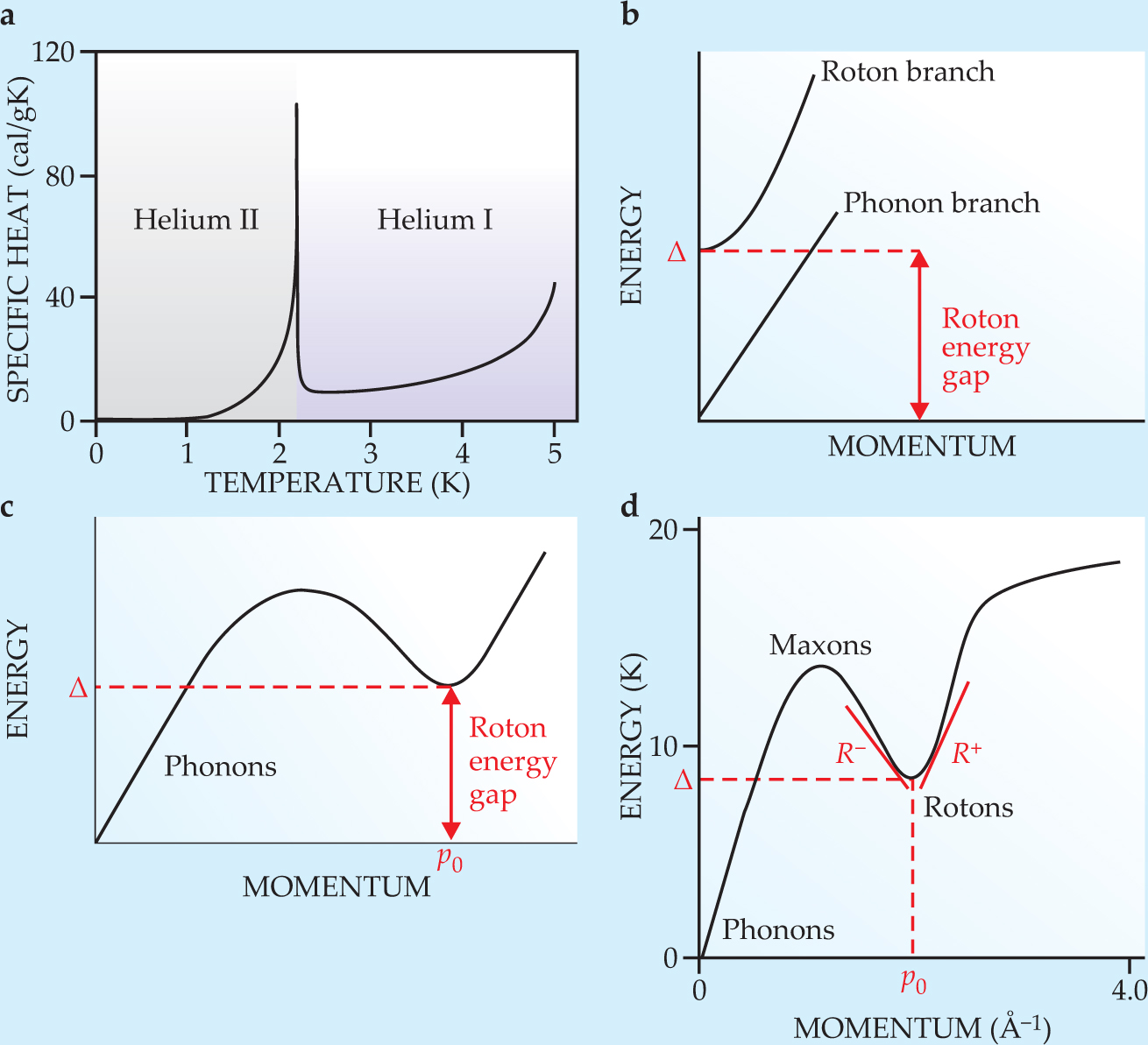
Early research with liquid helium showed that it had remarkable new properties, especially below the so-called lambda transition near 2.2 K, where there is a sharp, narrow peak in the specific heat (see figure 1(a)). The liquid below the transition was named helium II to distinguish it from the liquid above the transition, called helium I. Three properties discovered in the late 1930s were particularly puzzling. First, a test tube lowered partly into a bath of helium II will gradually fill by means of a thin film of liquid helium that flows without friction up the tube’s outer wall. Second, in the thermomechanical effect, if two containers are connected by a very thin tube that can block any viscous fluid, an increase in temperature in one container will be accompanied by a rise in pressure, as seen by a higher liquid level in that container. Third is the viscosity paradox: The oscillations of a torsion pendulum in helium II will gradually decay with an apparent viscosity about one-tenth that of air, but if liquid helium is made to flow through a very fine tube, it will do so with no observable pressure drop—the apparent viscosity is not only small, it is zero!

Figure 1. Properties of liquid helium. (a) The specific heat of liquid helium has an anomalous jump near 2.2 K. The “lambda transition” between the superfluid phase (helium II) at lower temperatures and the normal phase (helium I) at higher temperatures is so named because the anomaly resembles the Greek letter λ. (b) Lev Landau’s 1941 dispersion curve for the excitations in superfluid helium II had two branches: a linear curve for phonons, with a slope corresponding to the velocity of sound, and a quadratic curve with an energy gap Δ for a new class of excitations he called rotons. (c) Landau modified the curve in 1947 so that phonons (low-momentum excitations) and rotons (excitations near the minimum at momentum p0) were parts of a single excitation branch. (d) An experimentally measured dispersion curve obtained by inelastic neutron scattering. The curve’s exact form varies with temperature and pressure.

Laszlo Tisza was captivated by an idea being pushed in those days by Fritz London that the transition to helium II was a manifestation of Bose-Einstein condensation (BEC). In 1925 Albert Einstein had generalized a calculation for photons by Satyendra Nath Bose to massive particles, such as atoms; he found that for an ideal gas of identical, integer-spin particles below a certain temperature, a macroscopic fraction of the particles accumulates, or condenses, in the lowest-energy single- particle state with zero momentum. After one of his discussions with London and inspired by the recently discovered effects, Tisza had the idea that the Bosecondensed fraction of helium II formed a superfluid that could pass through narrow tubes and thin films without dissipation. The uncondensed atoms, in contrast, constituted a normal fluid that was responsible for phenomena such as the damping of pendulums immersed in the fluid. That revolutionary idea demanded a “two-fluid” set of equations of motion and, among other things, predicted not only the existence of ordinary sound—that is, fluctuations in the density of the fluid—but also fluctuations in entropy or temperature, which were given the designation “second sound” by Russian physicist Lev Landau (see
The velocities of first and second sound in helium II
In Laszlo Tisza’s two-fluid model of helium II, the normal and superfluid components each have their own independent density (ρn and ρs) and velocity (v n and v s). The total density of the liquid is the sum of the densities of the two components: ρ = ρn + ρs.
For the two-fluid system, the equations of motion can be linearized (as is appropriate for sound waves) to obtain
Here, P is pressure, S entropy, T temperature, and η viscosity. If the viscous term is omitted, then after some manipulation two wave equations emerge:
These equations produce two velocities of “sound”:
The derivation is valid only if the heat capacities at constant pressure and constant volume (denoted by C) are nearly equal, as they are in liquid helium. The velocity u 1 is the usual expression for the speed of sound. The expression for the second-sound velocity u 2 was first given by Lev Landau. 3
The figure contrasts the waves constituting first sound (top) and second sound (bottom). The proportions of the symbols n and s on any vertical line represent schematically the relative portions of the normal and superfluid components; the total number of symbols on a vertical line represents the total density of the fluid. The waves are traveling horizontally. Here, first sound’s fluctuations in density are driven by changes in pressure, and the two components move in phase with each other. Second sound’s fluctuations in entropy (carried by the normal fluid) are driven here by changes in temperature; the two components are out of phase, and the density remains constant to first order. (Figure adapted from ref. )

A mixture of two fluids
Tisza’s two-fluid hypothesis eventually became the basis for understanding the behavior of helium II. (For a recent history of ideas on superfluidity in helium II, see reference .) The flow of helium II acts as if it were a mixture of two fluids. One, called the superfluid, has no viscosity or entropy and can flow without dissipation through extremely narrow channels. The other, called the normal fluid, does have a finite viscosity η and carries all the entropy S. The liquid is pictured to be all normal fluid at the lambda transition and all super-fluid at absolute zero. The total density ρ is given by the sum of the normal-fluid density ρn and the superfluid density ρs. The proportion of each fluid can be determined, for example, by measuring the fraction of liquid that clings to an oscillating disk by virtue of its viscosity.
The superfluid is viewed as a background fluid that is, in effect, at absolute zero. The normal fluid is the sum of elementary excitations, or quasiparticles, which are excited from the superfluid in increasing numbers as the temperature is increased from absolute zero. There are two different kinds of quasiparticles—phonons and rotons—an idea first put forward by Landau
3
in 1941 and then modified in 1947 (see figures
Today the most fundamental aspect of a superfluid is considered to be the Bose-Einstein condensate. The condensate is described by a quantum mechanical wavefunction that characterizes a macroscopic number of atoms in a single quantum state—a coherent matter wave. The coherence of the wavefunction leads to, among other things, the quantization of circulation: In particular, if a container of superfluid is rotated, quantized vortex lines will appear arrayed parallel to the axis of rotation, an entire subject in itself.
The race for second sound
Although helium II is now well understood, such was not the case in the late 1930s, and Tisza’s prediction of second sound became a test case for the two-fluid model.
First sound is ordinary sound, which consists of fluctuations in total density ρ. Its velocity, u 1, is only weakly dependent on temperature. Second sound has a velocity u 2 that is a strong function of temperature, becoming zero at the lambda point. As shown in
Tisza’s analysis led to the expression 1
where T λ is the lambda temperature. Clearly, u 2 → 0 when T → 0.
Word of Tisza’s model spread even before World War II broke out in 1939. Among the first to hear of it was Jack Allen, one of the discoverers of superfluid flow in helium, then at Cambridge University. Allen wrote to me a number of times during his lifetime. In an undated manuscript entitled “Notes to Help Obit Writers in the RS and RSE” (referring to the Royal Society and the Royal Society of Edinburgh), Allen berated himself (as we all do in missing important discoveries one is in a position to make): “I also stupidly failed to pick up on Tisza’s suggestion to me of ‘ondes de température,’ [temperature waves] and so missed out to [Vasilii] Peshkov on ‘second sound.’” He then added, in a handwritten footnote, something I had drawn to his attention: “Actually, Ernest Ganz (a student) and I nearly got it by finding the speed of a heat pulse in Helium II to be ~104 cm/s.”
Landau moved from Kharkov to Moscow in 1937 to join Pyotr Kapitsa’s Institute for Physical Problems. It was there that Landau put forward his brilliant phononroton theory of helium II. His model and resulting equations were so successful and productive that Tisza’s pioneering work has been largely forgotten. But one should remember that it was Tisza who invented the two-fluid theory and predicted second sound. (Tisza died on 15 April 2009; for more on his life and contributions see PHYSICS TODAY, July 2009, page 65 ). Landau seemed to resist BEC as the basis for superfluidity, and there Tisza was almost certainly correct. Landau apparently never referenced a single work by London. 4
Of course, the low-temperature experimentalists at the Institute for Physical Problems were beavering away trying to generate and detect second sound. In his 1967 book on helium, John Wilks described their efforts: 5
We briefly mention an historical point which shows how difficult it may be to see the obvious for the first time. The wave equation for second sound [see
box 1 ] and the first experiments all came from the Russian workers at the Institute for Physical Problems in Moscow. However, even with the wave propagation equation before them, the first attempts to generate second sound were made using piezoelectric crystals to set up pressure variations. It was only after these had failed … that an analysis by [Evgeny] Lifshitz showed that a much more effective method would be by periodic heating.
We briefly mention an historical point which shows how difficult it may be to see the obvious for the first time. The wave equation for second sound [see
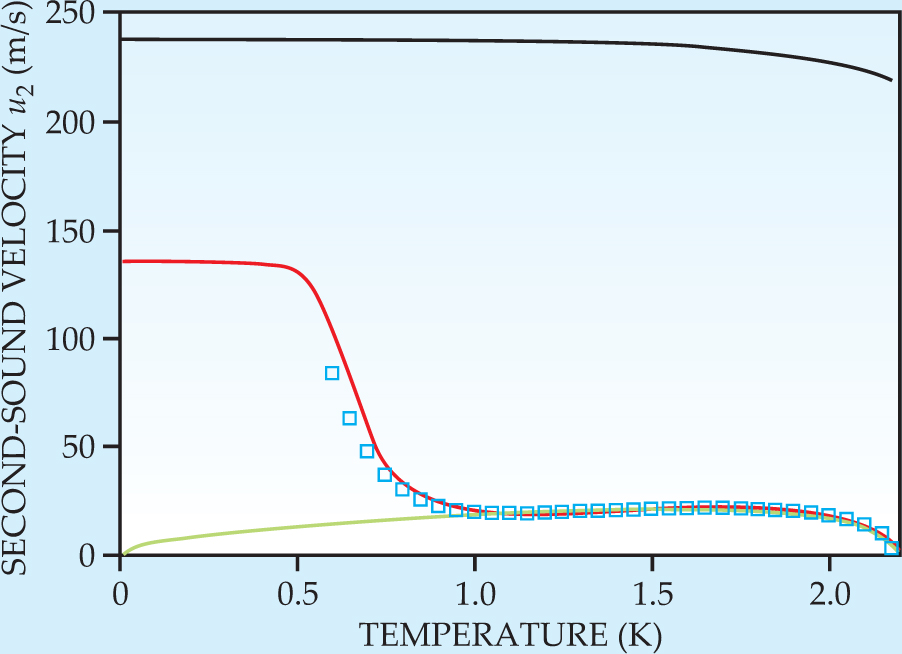
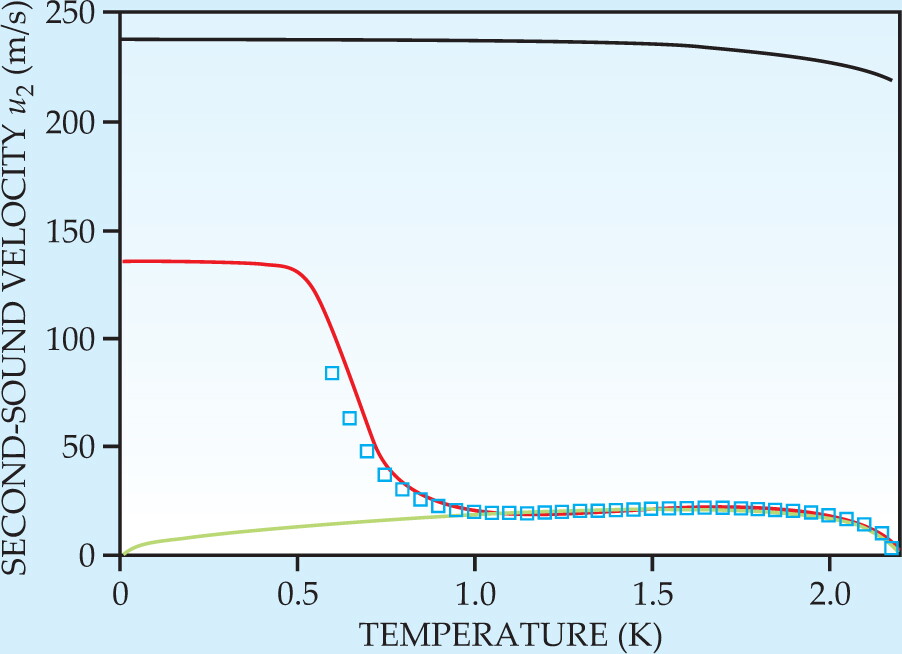
Figure 2 compares Tisza’s calculations for the velocity of second sound with those by Lifshitz, which were based on Landau’s phonon-roton theory. Tisza’s much earlier expression coincides closely with Lifshitz’s above 1.3 K, but continues downward below 1.2 K, reaching zero at absolute zero. Thus, finding the velocity of second sound at low temperatures became the goal to distinguish the Tisza and Landau two-fluid theories. There is much more to Landau’s phonon-roton theory than the velocity of second sound, but the second-sound velocity below 1 K somehow became the prize.

Figure 2. The velocity of second sound as computed by Evgeny Lifshitz (red curve) and by Laszlo Tisza (green curve); for comparison, the upper, black curve shows the velocity of first sound. The blue points are today’s accepted values of second-sound velocity.
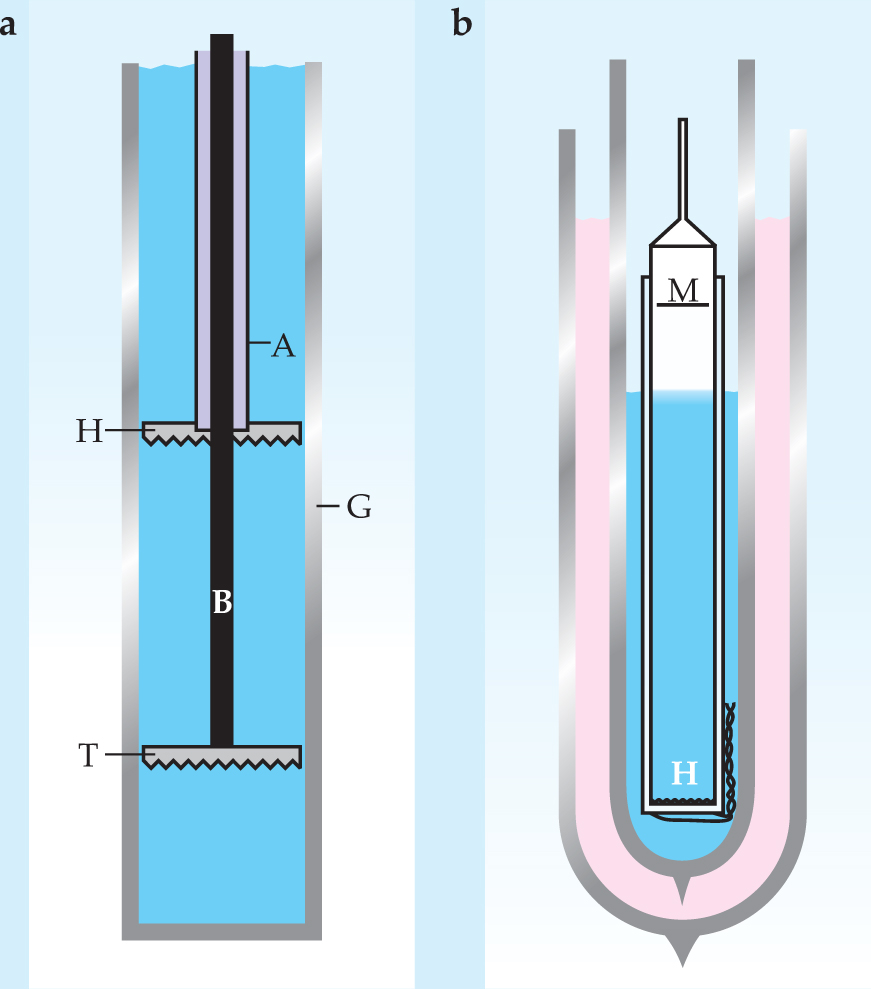
The first successful attempt to generate and detect second sound was in 1944—during the war—by Vasilii Peshkov, 6 who implemented Lifshitz’s suggested approach (see figure 3(a)). After the war, Cecil Lane and his two graduate students William Fairbank and Henry Fairbank at Yale University tried to observe second sound. Because of the disruption of the war, the Yale group was initially unaware of Peshkov’s work.

Figure 3. Detecting second sound. (a) Resonator used by Vasilii Peshkov in 1948 to study standing waves of second sound in helium II. The glass tube G is closed at the bottom and acts as a resonator. The heater H is mounted on a glass disk that can be moved up and down by the tube A. The thermometer T is an open winding of phosphor bronze wire on a frame movable by tube B. An electrical current of frequency f generates small temperature fluctuations of frequency 2f. The thermometer T can be moved up and down to trace out the standing wave patterns of second sound, from which the velocity of second sound can be measured. In 1960 Peshkov used a similar apparatus attached to a helium-3 refrigerator to reach temperatures as low as 0.4 K. (b) Apparatus used at Yale University to detect second sound by Lars Onsager’s method. A thin lucite tube was inserted into liquid helium (blue) in a dewar surrounded by liquid nitrogen (pink). A heater H at the bottom of the tube was excited at 1 kHz, and a microphone M in the vapor above the liquid was tuned to 2 kHz and its signal rectified. As the liquid helium bath evaporated, the free surface fell and resonant peaks appeared from the microphone output, from which the velocity of second sound could be deduced.
((a) Adapted from ref. 6)
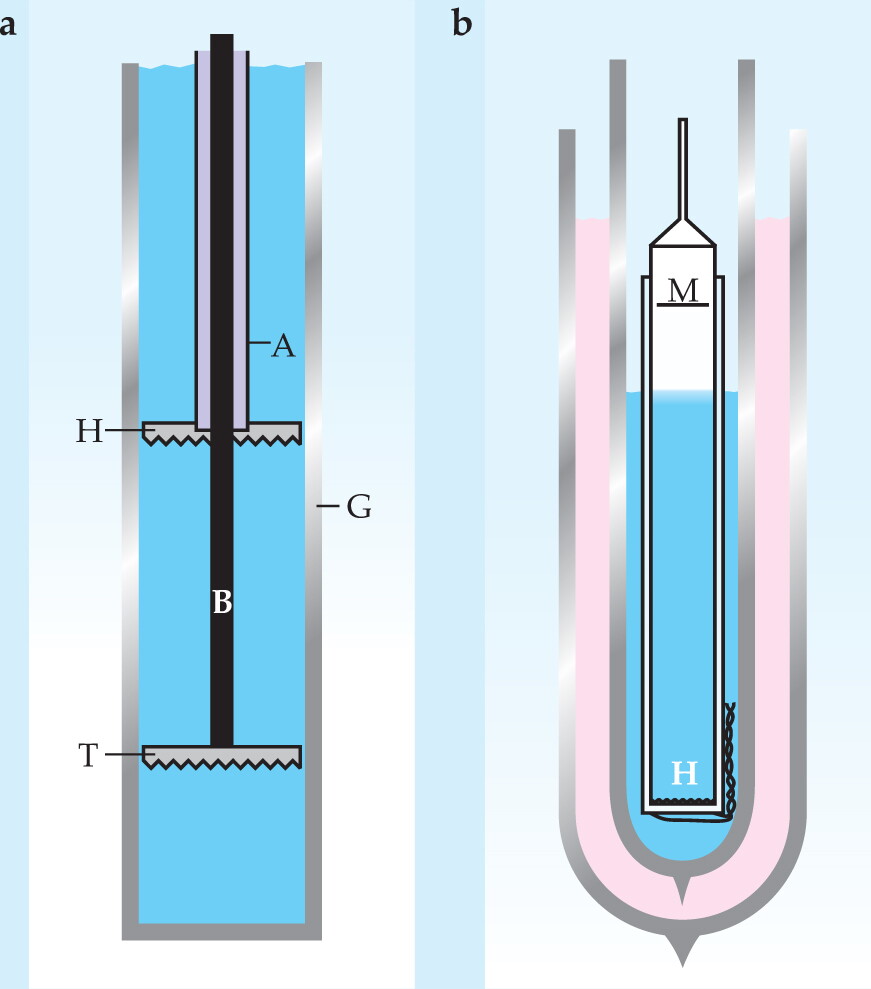
Moscow may have had Landau and Lifshitz thinking about experiments there, but the low-temperature group at Yale had Lars Onsager, based in the chemistry department. Seeking a way to detect second sound, Lane approached Onsager, who suggested that it might be converted to ordinary sound at a liquid-vapor surface by the following mechanism. Second sound consists of temperature fluctuations in the liquid that propagate as a wave. At the liquid-vapor interface, such temperature fluctuations would cause periodic evaporation and condensation, which in turn would give rise to normal sound in the vapor.
Lane and the Fairbank brothers used Onsager’s idea to detect second sound with the arrangement in figure
Landau’s phonon-roton theory
By 1947 Lev Landau had deduced that when plotted as energy E versus momentum ρ, the excitation spectrum in helium II has the form shown in figure
Lacking a detailed theory for the properties of helium II, Laszlo Tisza used the entropy data that Pyotr Kapitsa measured above 1 K, which is dominated by the roton part, and extrapolated it to absolute zero, thus missing the phonon contribution. (Indeed, Tisza argued that the phonons should not be included in the normal fluid.) The resulting discrepancy is enormous, as shown in the figure: The green curve is Tisza’s formula, and the blue points are today’s accepted values. Tisza also had no model for the normal-fluid density and simply guessed it was proportional to the entropy, which is not true. But for accidental reasons the temperature dependence of the roton parts of ρn and S n are similar, which is why Tisza was able to obtain a good fit between his formula for the velocity of second sound and the data above about 1.3 K (see figure 2).

Settling the controversy
Toward the end of their paper, Lane and his students wrote, “Unfortunately we are unable to achieve a temperature below 1.4°K with our set-up but in view of the accuracy of our measurements and the fact of a distinct maximum in our curve, Tisza’s theory seems to be somewhat favored over Landau’s.” 7
That statement resulted in the inevitable outburst by Landau. I do not have written sources for the following, but this is what I recall: Landau apparently wrote a letter to the Physical Review calling the Yale group “physics bandits,” probably in part because he heard about the Yale measurements before the Yale group had gotten Peshkov’s papers. Even in those days the physics rumor mill operated at very high speed.
My guess is that the editors of the Physical Review sent Landau’s manuscript to Lane for review, and in the end ruled against publication. Lane, who had a wry sense of humor, remarked that the Yale low-temperature group would probably be named “enemies of the people of the USSR” and shot by the first wave of troops in the Soviet invasion of New England.
The second problem was that the Yale group quoted the formula for second-sound velocity derived first by Landau, and attributed it to Tisza. The outburst from Landau prompted an erratum by Lane’s group: “We regret our failure to acknowledge Landau’s priority and assure him that this failure was unintentional.” 7
The editors of the Physical Review apparently decided to let Landau and Tisza have it out in two adjacent publications in “Letters to the Editor.” 8 (In those days such letters were not subject to peer review.) In a footnote to his, however, Landau wrote,
I am glad to use this occasion to pay tribute to L. Tisza for introducing, as early as 1938, the conception of the macroscopical description of helium II by dividing its density into two parts and introducing, correspondingly, two velocity fields. This made it possible for him to predict two kinds of sound waves in helium II. [Tisza’s detailed paper (J. de phys. et rad. 1, 165, 350 (1940) was not available in the U.S.S.R. until 1943 owing to war conditions, and I regret having missed seeing his previous short letter (Comptes Rendus 207, 1035, 1186 (1938)).] However, his entire quantitative theory (microscopic as well as thermodynamic-hydrodynamic) is, in my opinion, entirely incorrect.
I am glad to use this occasion to pay tribute to L. Tisza for introducing, as early as 1938, the conception of the macroscopical description of helium II by dividing its density into two parts and introducing, correspondingly, two velocity fields. This made it possible for him to predict two kinds of sound waves in helium II. [Tisza’s detailed paper (J. de phys. et rad. 1, 165, 350 (1940) was not available in the U.S.S.R. until 1943 owing to war conditions, and I regret having missed seeing his previous short letter (Comptes Rendus 207, 1035, 1186 (1938)).] However, his entire quantitative theory (microscopic as well as thermodynamic-hydrodynamic) is, in my opinion, entirely incorrect.
In his reply Tisza wrote,
Landau criticizes our ideas not so much because of their internal inconsistency but because they do not follow his theory of phonons and rotons. We are frankly impressed by the audacity and power of Landau’s approach but we feel that he has introduced into his theory more or less disguised assumptions which cannot claim the same degree of certainty as the principles of quantum mechanics.
Landau criticizes our ideas not so much because of their internal inconsistency but because they do not follow his theory of phonons and rotons. We are frankly impressed by the audacity and power of Landau’s approach but we feel that he has introduced into his theory more or less disguised assumptions which cannot claim the same degree of certainty as the principles of quantum mechanics.
In a publication about the same time, Lifshitz was not much kinder. Anyone interested in the details of the controversy should read Lifshitz’s section “The Tisza Theory of Helium II” starting on page 51 of his book A Supplement to “Helium,“ written with Elepter Andronikashvili. That book, almost unknown in the low-temperature literature, was written as a supplement to the Russian translation of the famous book Helium by Willem Keesom of the University of Leiden. 9
Experiment ultimately settled the controversy. When Peshkov was able to get to about 1.2 K in 1948, he observed the velocity of second sound flattening off; finally in 1960 he was able to get to about 0.5 K, in very good agreement with Lifshitz (see figure 2), and settle the dispute once and for all. 6 Peshkov also found that below 0.5 K, second sound does not exist in any meaningful way, presumably because the density of the normal fluid is so low that thermodynamic equilibrium cannot be established.
In 1959 Kenneth Atkins predicted two more propagating wave modes in helium II, which he called third sound and fourth sound. 10 Fourth sound is much like second sound: It is a pressure wave that travels only in the superfluid, such as in a resonator filled with fine powder that immobilizes the normal fluid. Third sound is a surface wave on a thin film of helium II. Such a film can form on, for example, a vertical microscope slide whose lower edge dips into a bath of helium II. Both of these phenomena have been valuable in exploring the properties of superfluid helium.
Second sound and vortex density
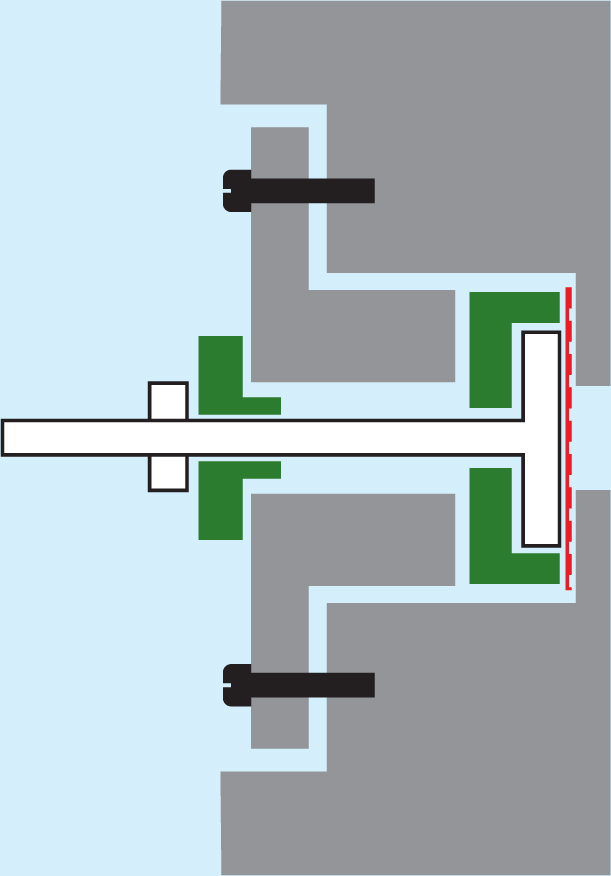
In the second-sound transducer shown in figure 4, a typical resonant response of second sound in quiescent helium II is a Lorentzian curve with amplitude A 0 and full width at half maximum Δ0. Turbulence reduces the amplitude to A. For small attenuation, the length L of quantized vortex per unit volume is given approximately by

Figure 4. Modern superleak transducer for second sound. Nuclepore is a plastic film with micron-size holes created by fission fragments in a reactor. Here a thin film of nuclepore (red) is plated with gold on one side to make a capacitor “loudspeaker.” The frame (gray) is connected to a bias voltage and connected to ground by a large capacitor, the rod and button (white) are insulated electrically (green) and connected to an oscillator, and the whole apparatus is immersed in a bath of helium II. The oscillator causes the nuclepore to vibrate, typically at 20-50 kHz. The normal fluid cannot pass through the film’s holes, but the superfluid can, and the transducer can act as a generator or detector for second sound.

where κ = h/m ≃ 9.97 × 10⁻⁴ cm2s−1 is the quantum of circulation and B is the coefficient of mutual friction at the temperature of interest.
Vorticity is defined in an ideal (inviscid) fluid as the curl of the fluid velocity, or the circulation per unit area. In terms of the above parameters, the vorticity is taken to be ω = κL. A simple example of vorticity is a bucket of helium II rotating steadily at an angular velocity Ω. The vorticity is 2Ω, and per unit area there are L = 2Ω/κ ≃ 2000 quantized vortex lines aligned parallel to the axis of rotation.
In our towed-grid experiments at the University of Oregon, the lower level of sensitivity is dramatic: L = 10 cm−2, corresponding to a vorticity of ω = 10−2s−1. On the higher end we have recorded vorticity to 50 000 s−1 in turbulence produced by a towed grid—a range of five orders of magnitude.
Second sound today
All the above would be a historical footnote, except that second sound has turned out to be an incredibly valuable tool in the study of quantum turbulence (see my article with Joe Vinen, in PHYSICS TODAY, April 2007, page 43 ) and may be a useful probe of ultracold atoms.
Second sound can be generated by any means that separates the motion of normal fluid and superfluid. A second-sound transducer in current use is shown in figure 4. In the mid-1950s Vinen used second sound to study heat currents: A heater at one end of a closed tube generated a “counter-flow” of the two fluids in helium II. Turbulence in the super-fluid component was suspected as causing, in some way, the attenuation in second sound observed in those experiments. The theoretical discovery of quantized vortices—the culprit in the counterflow experiments—by Onsager and Richard Feynman was still unpublished at the time. Henry Hall and Vinen later discovered in 1956 that second sound is also attenuated in a rotating bucket of helium II, and they correctly deduced that the attenuation was due to the presence of an array of quantized vortices (by then published). 11
In the early 1990s my group at the University of Oregon initiated the study of quantum turbulence by towing screens through helium II, which creates intense turbulence without a temperature gradient or rotation. From the measured attenuation of second sound we could deduce the total length of the vortices tangled up in the second-sound resonator (see
What makes second sound such a sensitive probe? The answer goes back to Landau’s phonon-roton theory of helium II. Rotons can scatter off a vortex, and in the process they can undergo so-called species reversal,
12
in which their energy is conserved but their group velocity is reversed as they switch between the R + and R − roton branches shown in figure
In his original prediction of second sound 70 years ago, Tisza used a Bose-condensed gas as the starting point of his two-fluid description. His seminal work got bogged down over the years with the question of how relevant that model was in dealing with helium II, a strongly interacting fluid for which the assumption of weak interactions breaks down. 2 With the discovery of BEC in trapped atomic gases in 1995, one can ask if second sound exists in such superfluid gases.
The key requirement for the validity of two-fluid hydrodynamics in atomic gases is that the collision rate between excitations (that is, quasiparticles) be strong enough to achieve local hydrodynamic equilibrium when the gas is in a state perturbed from equilibrium. That collisional hydrodynamics regime has been difficult to achieve in dilute Bosecondensed gases because the interactions are not strong enough. However, in ultracold Fermi gases, atoms can pair and Bose-condense (see the article by Carlos Śa de Melo in PHYSICS TODAY, October 2008, page 45 ), and by using an atomic Feshbach resonance to increase the interaction strength in such systems, one should be able to access the two-fluid hydrodynamic region.
Inspired by the above picture, theorists have recently calculated the frequencies of first and second sound in a trapped Fermi superfluid gas at finite temperatures.
13
That effort requires knowing all the thermodynamic functions that enter the coefficients of the equations in

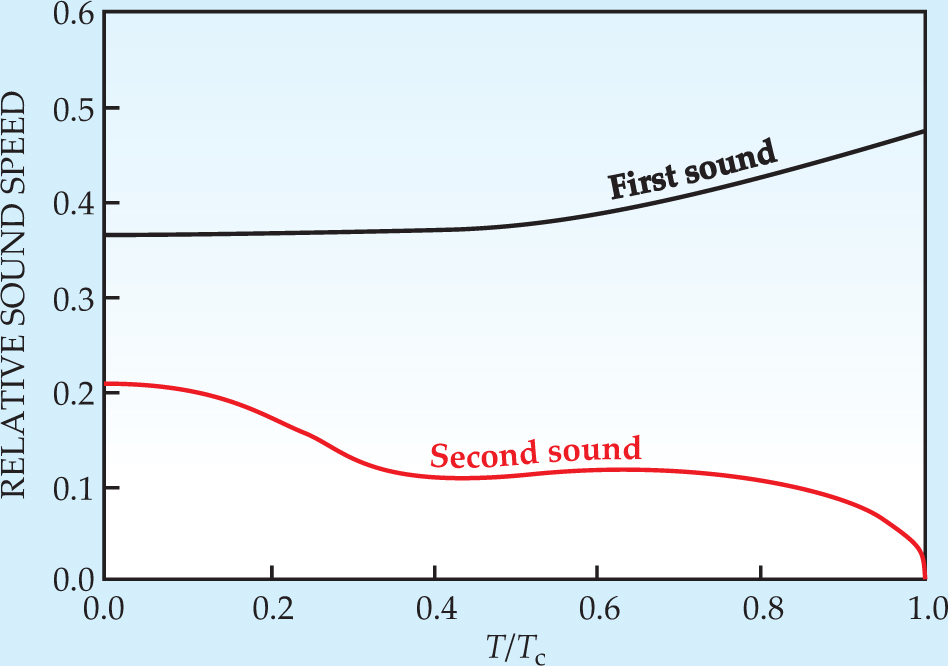
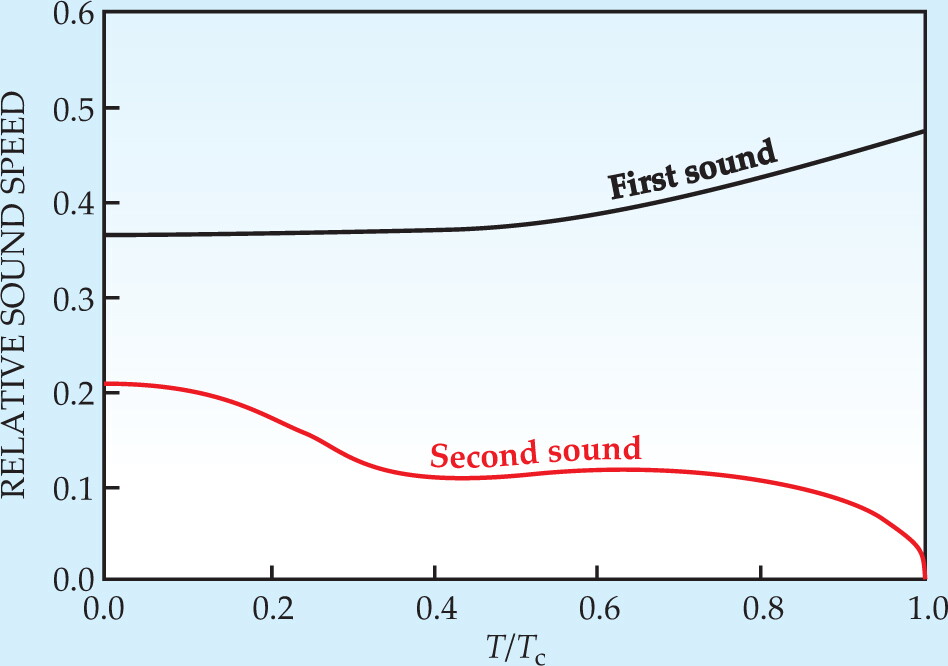
Figure 5. Calculated first- and second-sound velocities in a uniform superfluid gas of ultracold Fermi atoms at unitarity, the point at which the atomic scattering length is infinite. The velocities are given relative to the Fermi velocity, and the temperature T is scaled to the superfluid transition temperature T c.
(Adapted from ref. 13)
Future experiments may be able to detect such temperature waves in Fermi superfluid gases using pulse propagation along the major axis of cigar-shaped trapping potentials. That would be a fitting conclusion to our story about second sound and the pioneering work of Tisza in 1938.
In writing this account, I am indebted to Allan Griffin for informing me of recent research on cold gases and for helpful comments on the manuscript, to Sébastien Balibar for his insightful article in reference 4, and to Joe Vinen for a careful reading of a draft of this paper.
References
1. L. Tisza, C. R. Acad. Sci. 207, 1035 (1938);
207, 1186 (1938).
See also F. London, Phys. Rev. 54, 947 (1938). https://doi.org/10.1103/PhysRev.54.9472. A. Griffin, J. Phys.: Condens. Matt. 21, 164220 (2009). https://doi.org/10.1088/0953-8984/21/16/164220
3. L. D. Landau, J. Phys. (USSR) 5, 71 (1941);
11, 91 (1947).4. S. Balibar, J. Low Temp. Phys. 146, 441 (2007). https://doi.org/10.1007/s10909-006-9276-7
5. J. Wilks, The Properties of Liquid and Solid Helium, Clarendon Press, Oxford, UK (1967), p. 53.
6. V. P. Peshkov, J. Phys. (Moscow) 10, 389 (1946);
J. Expt. Theor. Phys. (USSR) 18, 951 (1948)
;
Sov. Phys. JETP 11, 580 (1960).7. C. T. Lane, H. A. Fairbank, W. M. Fairbank, Phys. Rev. 71, 600 (1947); https://doi.org/10.1103/PhysRev.71.600
72, 1129 (1947).8. L. Landau, Phys. Rev. 75, 884 (1949); https://doi.org/10.1103/PhysRev.75.884
L. Tisza, Phys. Rev. 75, 885 (1949). https://doi.org/10.1103/PhysRev.75.8859. E. M. Lifshitz, E. L. Andronikashvili, A Supplement to “Helium,” Consultants Bureau, New York (1959);
W. H. Keesom, Helium, Elsevier, Amsterdam (1942).10. K. R. Atkins, Phys. Rev. 113, 962 (1959); https://doi.org/10.1103/PhysRev.113.962
K. R. Atkins, Liquid Helium, Cambridge University Press, Cambridge, UK (1959).11. H. E. Hall W. F. Vinen, Proc. R. Soc. London A 238, 204 (1956); https://doi.org/10.1098/rspa.1956.0214
W. F. Vinen, Proc. R. Soc. London A 240, 114 (1957). https://doi.org/10.1098/rspa.1957.007112. D. C. Samuels R. J. Donnelly, Phys. Rev. Lett. 65, 187 (1990). https://doi.org/10.1103/PhysRevLett.65.187
13. E. Taylor, H. Hu, X.-J. Liu, L. P. Pitaevskii, A. Griffin, S. Stringari, http://arxiv.org/abs/0905.0257 .
More about the authors
Russell Donnelly is a professor of physics at the University of Oregon in Eugene.
Russell J. Donnelly, University of Oregon, Eugene, US .