The paradoxical phenomenon of quantum scarring


In a classical chaotic system, tiny changes to its initial conditions produce exponentially large deviations in behavior. Think, for example, of a billiard table with curved ends, similar to the shape of a stadium. A ball that ricochets off one of the curved ends will have a vastly different trajectory than if it bounces off a point just a short distance away. (To learn more about the field of chaos and its development, see the 2013 PT article “Chaos at fifty ,” by Adilson Motter and David Campbell.)
Over time, after the ball bounces off the curved boundaries many times, the trajectories will spread uniformly over the entire stadium and go in every direction. Mathematically, the stadium is said to be ergodic.
Chaotic phenomena can also emerge in quantum systems, but they manifest differently than in a classical system. An example of a quantum chaotic phenomenon is the quantum scar. In 1984, one of us (Heller) made the striking theoretical discovery that some eigenstates of a quantum chaotic system must retain visible traces, called scars, of the unstable classical orbits that form in a classical chaotic system. 1 The scarred eigenstates have an enhanced probability density around the paths of the unstable orbits. Figure 1 shows a theoretical pattern of a quantum wavefunction that has been scarred by multiple classically unstable orbits in a stadium.
Figure 1.

This quantum scar pattern is the result of a particle that is confined to bounce in a 2D stadium. In that quantum chaotic system, the scars form along two types of unstable periodic orbits, which resemble two variants of a bow-tie shape (black lines). The red–blue pattern accentuates the underlying wavelike structure of scars: Red corresponds to wave peaks; blue, to wave troughs.

Because of experimental challenges and technical difficulties, quantum scars remained just a theoretical idea for decades until they were conclusively observed with scanning tunneling microscopy in a quantum dot system in 2024. Now more experiments and observations are underway, and researchers are examining potential applications. Beyond theoretical curiosity, quantum scarring could prove useful in the creation of new kinds of electronic circuits.
The path most traveled
The scar phenomenon is, at first glance, paradoxical because it has no analogous classical expectation. Before the early 1980s, researchers widely assumed that the quantum states of a chaotic system would look random, which reflects the long-term nature of classical chaos.
But in simulations published in a PhD thesis in 1983—one year before the discovery of quantum scars—Steven McDonald noticed anomalous eigenstate structures. They were associated with unstable classical orbits in a quantum chaotic system. He didn’t know what to make of the “mystery” structures and didn’t explain their origin. 2
Before Heller’s 1984 independent discovery and justification of them, quantum scars lacked any theoretical basis. Quantum ergodicity theorems, which were proven in the 1970s and 1980s, make precise the idea that in a quantum system whose classical limit is ergodic, most high-energy eigenstates spread out evenly over the available phase space. 3 4 5 Additional theoretical work by Michael Berry in 1977 led to the random-wave conjecture, which states that high-energy wavefunctions of quantum chaotic systems behave statistically as random superpositions of plane waves. 6
Scarring implies that quantum mechanical systems retain a memory of short, unstable classical orbits, even at infinite times, whereas the corresponding classically dynamic systems, which are governed by those orbits, do not retain such a memory. So what’s going on?
Constructive interference
A key insight is that a quantum wavepacket that’s launched on an unstable periodic orbit will recur at regular intervals that are integer multiples of the orbital period. The recurrences are much more frequent than random overlaps of the wavepacket with its initial state. Over time, scars form as a result of propagating wavepackets constructively interfering with the original one.
The amplitudes of the recurrent wavepackets can be described with an autocorrelation function. To resolve all the eigenstates in the quantum system and to describe how much the wavepacket contributes to eigenstates at different energies, researchers calculate the autocorrelation function’s Fourier transform. The result is the local density of states (LDOS), which describes the amplitude of the system’s eigenstates in the energy domain.
Physically, the time–energy uncertainty principle relates a system’s short-time behavior to the spectrum on large energy scales. Consequently, a smoothed version of the LDOS is computable so long as the short-time autocorrelation function is known. In energy windows in which the smoothed LDOS reaches a peak, the average eigenstate will have an above-average overlap with the wavepacket, and thus the eigenstate will be scarred along the periodic orbit under study. A curious phenomenon occurs for the opposite case: Eigenstates in energy windows in which the smoothed LDOS is at a minimum will be antiscarred. 7 That means that the eigenstates have a probability density that’s below average along the periodic orbit.
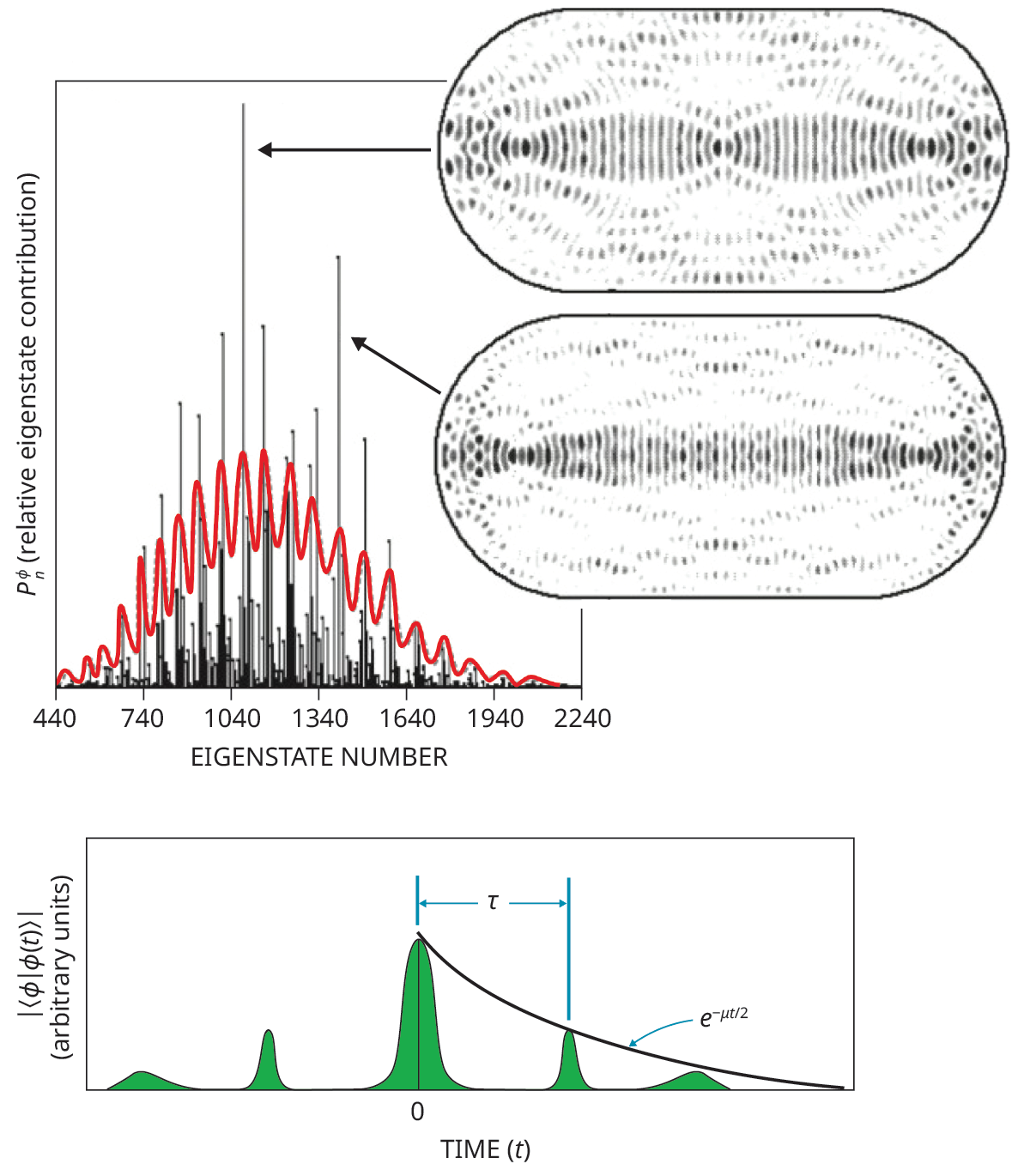
After a long time, the wavepacket spreads out over the entire phase space, although not entirely uniformly, and the autocorrelation behavior becomes much more complicated and is no longer computable from properties of the periodic orbit alone. The long-time behavior adds fine-scale structure to the LDOS, which gives rise to additional LDOS fluctuations. But the wavefunction scarring, caused by the wave interference at particular energy windows, is not erased. Figure 2 plots the LDOS, which shows the overlap of the wavepacket with particular eigenstates, and a sample autocorrelation function of a wavepacket.
Figure 2

How unstable periodic orbits form quantum scars. When a Gaussian wavepacket is launched along an orbit of a stadium (a rectangle with curved ends), it has, in the time domain, an autocorrelation function (shown at the bottom) that’s characterized by a recurrence interval τ. The Fourier transform of the autocorrelation function yields, in the energy domain, the wavepacket’s local density of states (LDOS). The constructive interference of the wavepacket with individual eigenstates of the quantum system produces scar patterns along the unstable periodic orbits, which have a period τ and instability exponent μ. The full LDOS (black dots and lines) shows the wavepacket’s overlap with individual eigenstates: The smoothed LDOS (red curve) is associated with the short-term time evolution of the system. Two scarred eigenstate patterns are shown as examples. (Figures adapted from ref. 17 .)

How is the wavepacket analysis consistent with the quantum ergodicity theorems? Once again, it’s useful to consider the wavepacket picture. A quantum wavepacket with minimal uncertainty has a width that’s given by Planck’s constant, which is fixed, but the size of the available phase space grows with the wavepacket’s mean energy E. As the wavepacket’s energy increases, the wavepacket probes an ever-tighter region of phase space that surrounds the periodic orbit. The fraction of the available phase space that’s covered in the 2D case scales as . The quantum ergodicity theorems don’t apply at the size scale at which scarring happens. Those theorems guarantee wavefunction uniformity on macroscopic, classical scales, but probability-density fluctuations from scarring occur at scales that are classically microscopic but still quantum mechanically significant.
Making predictions
Scar patterns may be visually striking, but the real test of the theory lies with its capability to make quantitative predictions. 8 Even though the random-wave conjecture lacks a formal proof, many theoreticians view it as a promising framework through which to understand quantum chaotic behavior. The random-wave conjecture predicts Gaussian random fluctuations in wavefunction amplitudes instead of perfect uniformity, which is forbidden by the uncertainty principle. (To the human eye, such random fluctuations may appear to look like patterns.) Any theory of quantum scarring, therefore, should predict the statistical distribution of wavefunction amplitudes.
Perhaps the simplest choice is to start with a Gaussian wavepacket with minimal uncertainty and to consider the distribution of overlaps between the wavepacket and the eigenstates in some energy window. All that information is contained in the LDOS, which may be computed from the autocorrelation of the wavepacket in time. With the initial wavepacket aligned optimally along the stable and unstable directions that are perpendicular to the orbit, a simple expression can be obtained for the periodic recurrences, and a lower bound on wavefunction nonuniformity can be placed. 8
Although important information is contained in the full probability distribution , it’s convenient to have a single measure of deviation from ergodicity. The mean intensity over a sufficiently large energy window is fixed by a sum rule. That is, the scarring of some eigenstates by a given orbit is balanced by the antiscarring of others. To measure nonuniformity, therefore, one can calculate the mean intensity amplitude, also called the inverse participation ratio:
An IPR of 1 is indicative of a classical state, in which all eigenstates contribute equally to the system; for random waves, the IPR is 2 or 3. Quantum chaotic systems deviate even further from ergodicity because of the effect of periodic orbit recurrences at short times. In those systems, and if full randomness for new recurrences at large times is assumed, for a wavepacket placed optimally on a periodic orbit. The dimensionless instability exponent μ characterizes the periodic orbit and for a quantum chaotic system is often about 1. 9
Experiments in graphene
In the 1990s, quantum scars were successfully imaged in various classical-wave systems, including microwave cavities in which the squared electric field plays the role of wavefunction intensity, acoustic cavities in which the pressure field may be imaged, and fluid systems that exhibit surface waves. Those types of experiments provided oblique experimental confirmation of scar theory in macroscopic systems and allowed researchers to quantitatively compare the results with semiclassical predictions of scar strength.
The first direct visualization of scars in a quantum system, however, was achieved only in 2024, four decades after scars were first identified theoretically. The researchers imaged electrons in quantum dots using scanning tunneling microscopy with nanometer resolution. 10 Figure 3 shows an example of scarred and antiscarred wavefunctions in a soft-walled, stadium-shaped quantum dot on a graphene sheet. Because the electrons in the graphene system behave like they’re massless and obey the relativistic Dirac equation, the patterns are called relativistic scars. (The 2021 PT article “Relativistic quantum chaos in graphene ,” by Hong-Ya Xu, Liang Huang, and Ying-Cheng Lai, discusses relativistic scars in more detail.)
Figure 3.

These scanning tunneling microscopy images are the first experimental verification of quantum scarring. The patterns are the result of a quantum system’s eigenstates having an increased or decreased probability density around the paths of unstable orbits. The studied system is a soft-walled, stadium-shaped quantum dot on a graphene sheet and is modeled with a relativistic electron wavefunction. The state on the left is scarred by a lemniscate (∞-shaped) orbit, and the one on the right is antiscarred—the probability density around the orbit’s path is decreased. Yellow indicates a high conductivity and is proportional to a high probability density of electrons; blue, to a low conductivity and a low probability density. (Images adapted from ref. 10 .)

Relativistic scars also satisfy an equation analogous to the nonrelativistic, time-independent Schrödinger equation, which is the equation obeyed by conventional scars that were introduced in 1984, so the basic physics of the two scar types is similar. 11 But the relativistic scars do have two novel features: They exhibit chiral behavior, like circularly polarized photons, and the maximally scarred energies, which correspond to the peaks of the smoothed LDOS, occur at equal energy intervals, unlike in systems described by the Schrödinger equation.
Diverse patterns
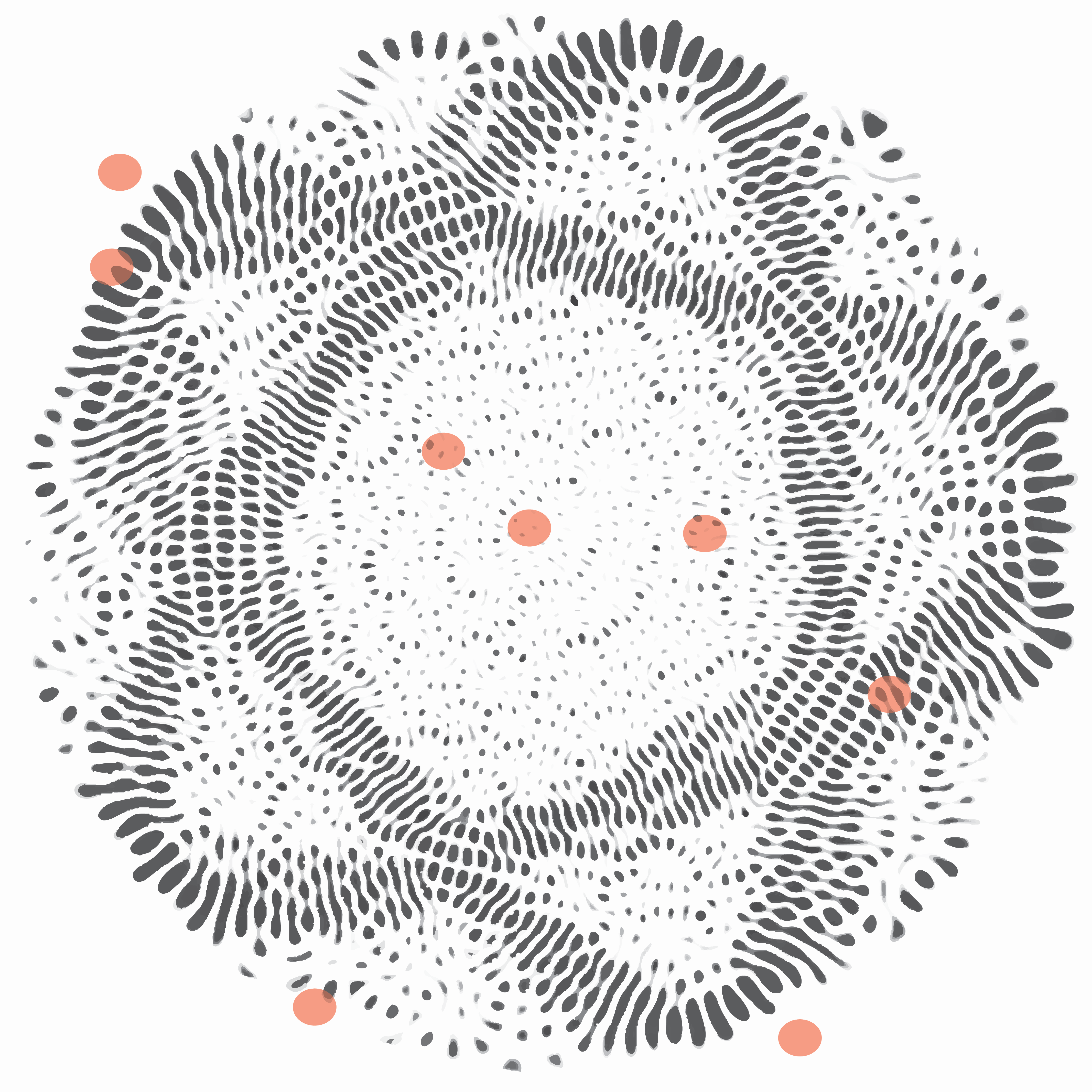
The theoretical scarred state shown in figure 4 visually resembles a traditional quantum scar, but it has a different origin. 12 First, a radially symmetric potential well is perturbed by introducing multiple randomly placed impurities, which in the figure are indicated with red spots. Resonances related to the motion in an unperturbed classical system result in near degeneracies in the unperturbed quantum well. When randomly placed bumps are added, specific linear combinations of the nearly degenerate basis states constructively interfere and form strongly scarred eigenstates.
Figure 4.

This variational scar pattern is formed after a rotationally symmetric potential well is perturbed with randomly placed Gaussian bumps (red spots). The constructive interference of the bumps with an eigenstate of the perturbed system produces scarring along a periodic orbit of the unperturbed system.

Scars formed through that mechanism are called variational because the scarred state is a superposition that either maximizes or minimizes the expectation value of the impurity potential. Examples of both cases are shown in figure 5 . In the time domain, variational scarring is linked to wavepacket recurrences in the perturbed system that are much stronger than the recurrences in the original symmetric well.
Figure 5.

An elliptical oscillator perturbed by even a single Gaussian bump (purple dot) exhibits variational quantum scars. The scarred state is a superposition of the near-degenerate states of the unperturbed system and can either minimize (left) or maximize (right) the expectation value of the bump’s potential. The resulting patterns resemble the periodic orbits (blue curve) of the unperturbed system.

Researchers are working on experimental verifications of variational scarring in semiconductor nanostructures and in graphene-based quantum dots, which were used for the first direct visualization of conventional scarring. If variationally scarred eigenstates exist, they could be useful for certain applications, such as the efficient transport of electrons through a quantum system. Because the scar orientation depends on the position of the local perturbation, scars could possibly allow for electron steering by enhancing or suppressing electron transmission along certain entrance and exit channels.
Furthermore, the shape of the variational scar pattern could be tuned by an external magnetic field or by controlled deformation of the confining potential, which could be done with a nanotip. 13 Looking ahead, the capacity to selectively manipulate variational quantum scars and possibly other types of scars points toward the prospect of “scartronics,” in which conductivity and other properties of a quantum device are engineered through the intentional generation and manipulation of scarred states. 13 14
Recent developments
Of great interest for quantum-information-processing applications are many-body quantum scars—special many-body eigenstates in otherwise thermal systems that display oscillatory behavior and slow thermalization. Their robustness against thermalization has piqued researchers’ curiosity in using them for ultrasensitive measurements. A prototypical example occurs in a Rydberg-blockaded atom chain, in which nearest-neighbor sites are forbidden from simultaneously being in the excited state. 15 The initial configuration of Rydberg atoms exhibits persistent oscillations that are indicative of nonergodic dynamics. Unlike in the case of single-particle quantum scars, the oscillations are not associated with classical periodic orbits. Instead, the orbits in many-body Hilbert space are associated with kinematic constraints and hidden algebraic structures. 16
Many-body scars reveal that even strongly interacting, nonintegrable quantum systems can host hidden, low-entropy trajectories that evade thermalization and sustain unexpectedly long-lived coherent dynamics. Despite significant progress in understanding that form of scarring, many questions remain, including its precise relationship to conventional and variational scars.
What began more than 40 years ago as a surprising imprint of unstable classical orbits on some quantum states has diversified into three main research directions: conventional, variational, and many-body quantum scarring. A central question concerns the underlying ontology of the different types of scars and whether periodic orbits are essential to each type. But all the scar types lead to distinct recurrences in wavepacket dynamics, which reflects their shared ergodicity-breaking nature. With theory and experiment advancing rapidly in tandem, the field is experiencing a renaissance period, which vividly illustrates how a long-standing concept can continue to evolve and surprise.
References
1. E. J. Heller, “Bound-state eigenfunctions of classically chaotic Hamiltonian systems: Scars of periodic orbits ,” Phys. Rev. Lett. 53, 1515 (1984).
2. S. W. McDonald, “Wave dynamics of regular and chaotic rays ,” PhD thesis, U. California, Berkeley (1983).
3. A. I. Shnirel’man, “Ergodic properties of eigenfunctions ,” Uspekhi Mat. Nauk 29, 181 (1974).
4. Y. Colin de Verdiere, “Ergodicité et fonctions propres du laplacien ” (Ergodicity and eigenfunctions of the Laplacian), Commun. Math. Phys. 102, 497 (1985).
5. S. Zelditch, “Uniform distribution of eigenfunctions on compact hyperbolic surfaces ,” Duke Math. J. 55, 919 (1987).
6. M. V. Berry, “Regular and irregular semiclassical wavefunctions ,” J. Phys. A: Math. Gen. 10, 2083 (1977).
7. L. Kaplan, “Scar and antiscar quantum effects in open chaotic systems ,” Phys. Rev. E 59, 5325 (1999).
8. L. Kaplan, “Scars in quantum chaotic wavefunctions ,” Nonlinearity 12, R1 (1999).
9. L. Kaplan, E. J. Heller, “Measuring scars of periodic orbits ,” Phys. Rev. E 59, 6609 (1999).
10. Z. Ge et al., “Direct visualization of relativistic quantum scars in graphene quantum dots ,” Nature 635, 841 (2024).
11. L. Huang et al., “Relativistic quantum chaos ,” Phys. Rep. 753, 1 (2018).
12. P. J. J. Luukko et al., “Strong quantum scarring by local impurities ,” Sci. Rep. 6, 37656 (2016).
13. J. Keski-Rahkonen et al., “Controllable quantum scars in semiconductor quantum dots ,” Phys. Rev. B 96, 094204 (2017).
14. F. Chalangari et al., “Variational scarring in open two-dimensional quantum dots ,” Phys. Rev. B 112, 115137 (2025).
15. H. Bernien et al., “Probing many-body dynamics on a 51-atom quantum simulator ,” Nature 551, 579 (2017).
16. C. J. Turner et al., “Weak ergodicity breaking from quantum many-body scars ,” Nat. Phys. 14, 745 (2018).
17. E. J. Heller, The Semiclassical Way to Dynamics and Spectroscopy , Princeton U. Press (2018).
More about the authors
Lev Kaplan is a physics professor at Tulane University in New Orleans.
Eric Heller is a physics professor at Harvard University in Cambridge, Massachusetts.
Joonas Keski-Rahkonen is a postdoctoral fellow in chemistry and chemical biology at Harvard University in Cambridge, Massachusetts.