The evolution of a dedicated synchrotron light source
DOI: 10.1063/1.2930734
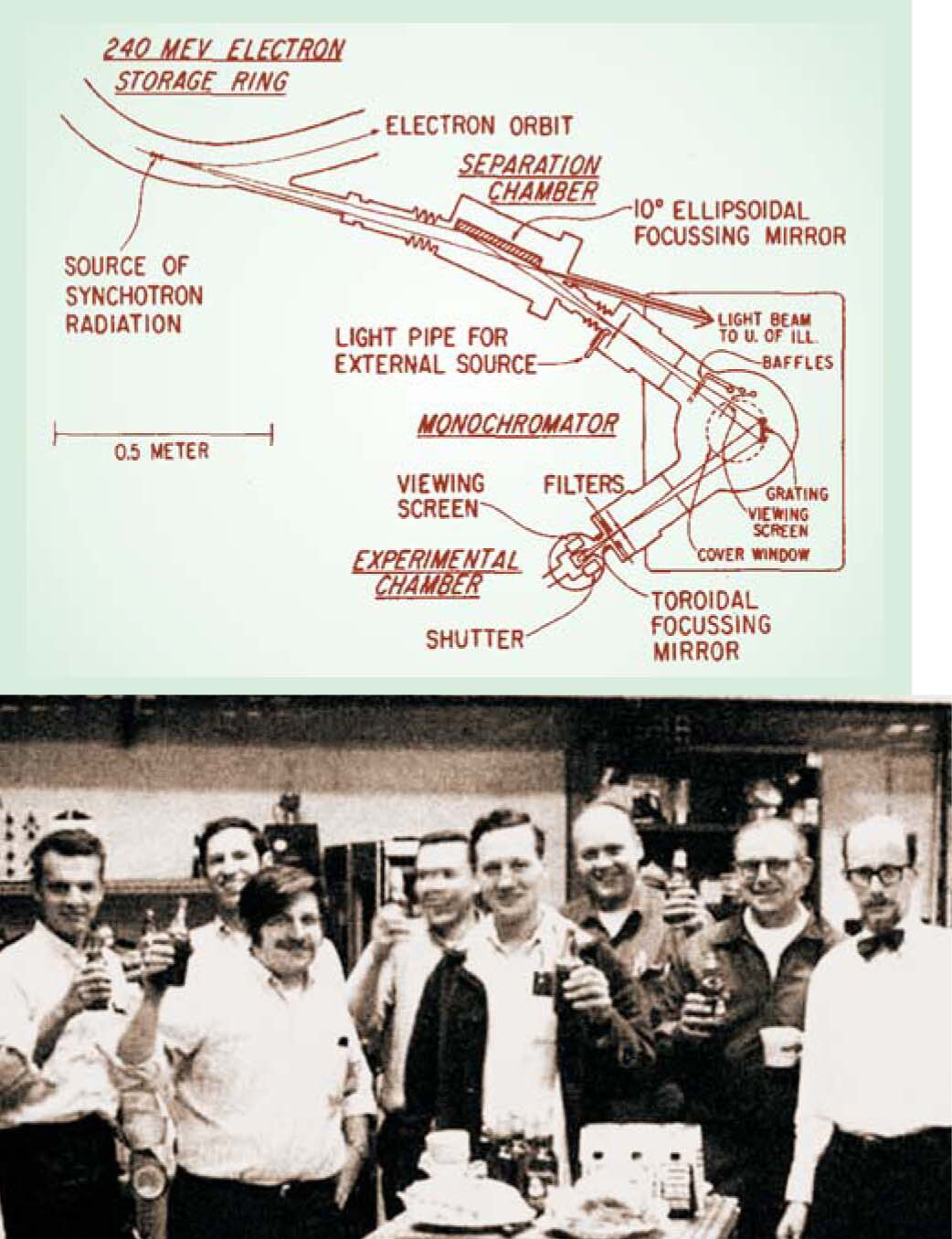
The date was 7 August 1968; the place, an underground bunker inside a hill near Lake Kegonsa in southern Wisconsin. The environment was hardly better than a cavern: dimly lit, noisy, and cluttered with instrumentation—old equipment, recycled war items, and a few new pieces. The 240-MeV electron storage ring known as Tantalus was only 3 meters wide and rather ugly, but it worked. Through a glass window, one could even watch the visible synchrotron light emitted by the circulating electrons. The beam current in the ring was quite small, about 1 mA, and rapidly decreasing. That morning, Ulrich Gerhardt, a German postdoctoral fellow from the group led by University of Chicago faculty member Helmut Fritzsche, prepared to take absorption and reflection spectra of cadmium sulfide in the wavelength range from 1100 to 2700 Å.
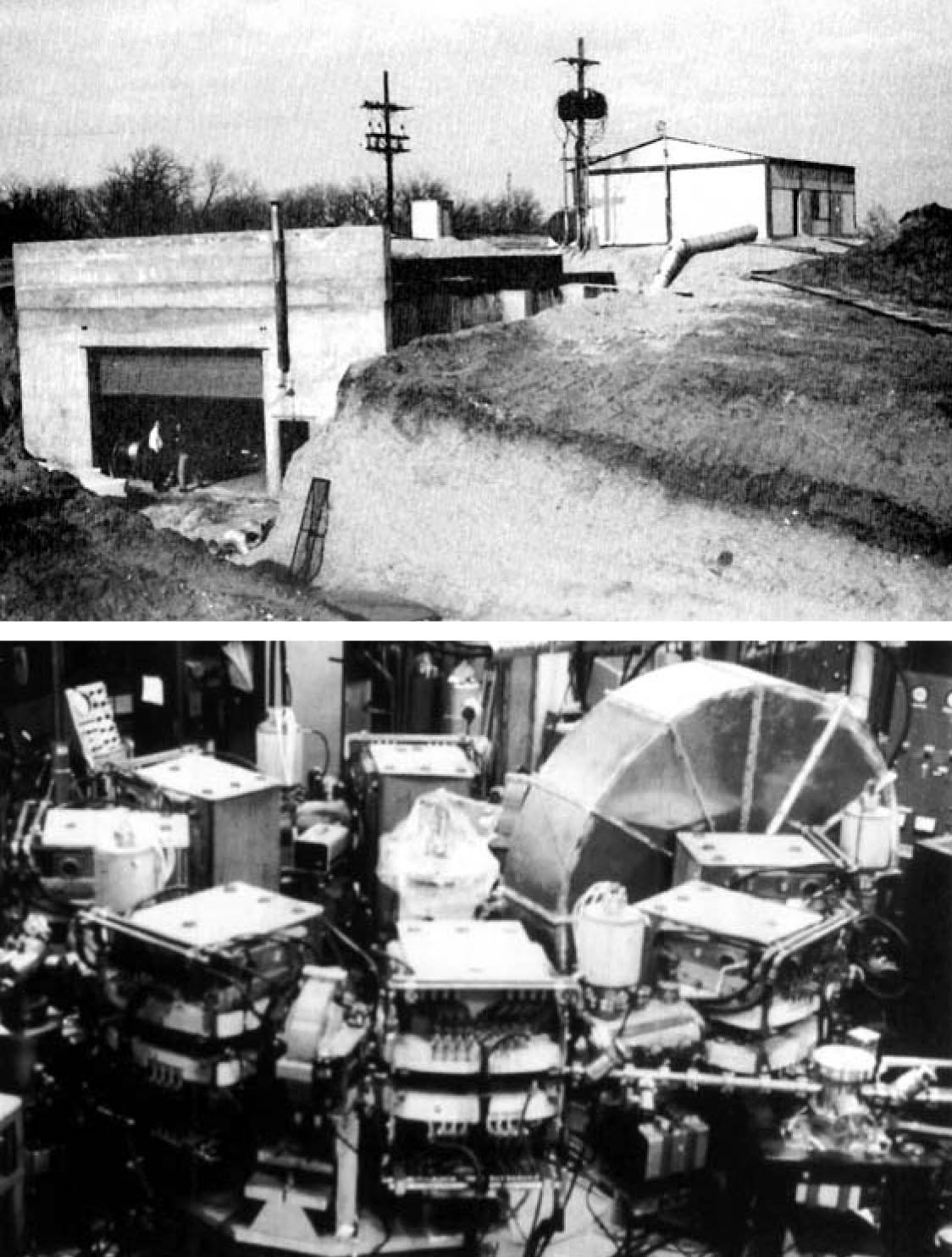
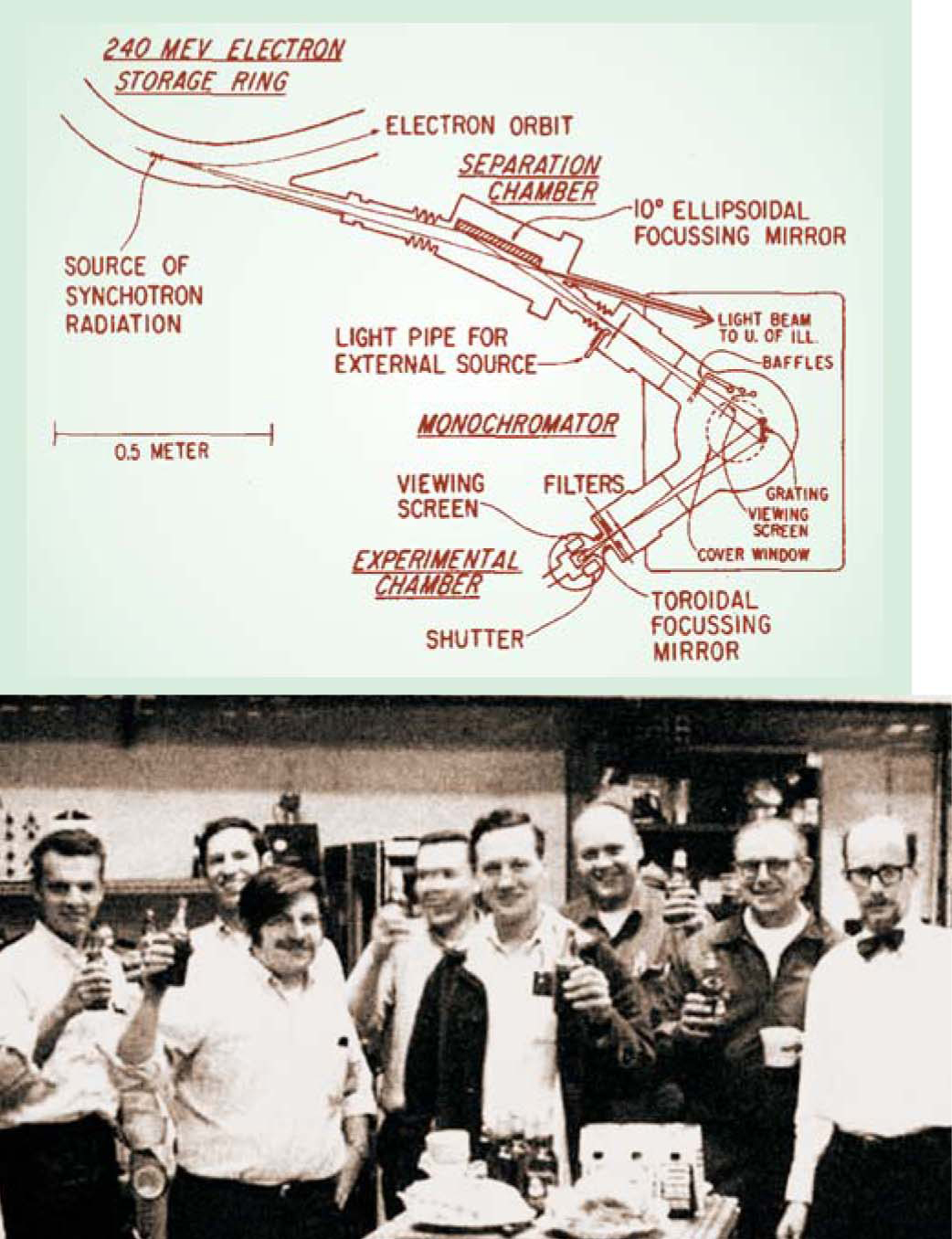
At 10:40am, he obtained the first data set and inaugurated a new era in experimental science. 1,2 The march began toward present synchrotron-radiation research: tens of thousands of users, some seventy facilities in operation or under construction worldwide, total investments of tens of billions of dollars, and a growing impact on new research areas. That first experiment, however, attracted the attention of only a handful of insiders. (Figures 1 and 2 illustrate the setup of the experiment 40 years ago, the subsequent celebration, and Tantalus’s humble origins.)

Figure 2. Tantalus in the early 1970s. Outside, the accelerator vault was shaped from a preexisting structure. Inside, the ring diameter was barely 3 meters and the beam half-life no longer than two hours.


Figure 1. Celebrating the success of the first experiment to use Tantalus, researchers raise their beer bottles.
The path leading to that summer morning began 70 years earlier. French physicist Alfred Liénard conceived of synchrotron emission in 1898, shortly after the discovery of the electron. 3 Only in the 1940s, however, did Isaac Pomeranchuk and Dmitri Iwanenko in Russia 4 and Julian Schwinger in the US 5 develop a full theory.
Also in the 1940s, the General Electric Research Laboratory in Schenectady, New York, built a 70-MeV electron synchrotron with a window to monitor possible electric discharge problems—what George Baldwin later remembered as “a trivial design change and … a conscious disregard for the rules of radiation safety” (see his letter in Physics Today, January 1975, page 9 ). The lucky feature allowed Herbert Pollock, Robert Langmuir, Frank Elder, and Anatole Gurewitsch to peer into the accelerator on 24 April 1947 and see synchrotron light for the first time. 6 The phenomenon was not expected and at first not even recognized.
Synchrotron light is produced from the interaction of energetic electrons with dipole magnets that centripetally accelerate the charges. What makes the emission unique is the relativistic speed of the particles. 7 More specifically, as outlined in the box on page 39, relativity is responsible for the wavelength spectrum—broadband and centered in the UV or x-ray region—and for the extreme angular collimation of the light emission.
Synchrotron sources produce intense, highly polarized, bright beams whose wavelength—ranging from the IR to the x-ray end of the spectrum—can be precisely tuned using a monochromator. Photons in the UV and x-ray range are ideal for investigating atoms and the chemical bonds of solids and molecules. As ingredients of diffraction and scattering techniques, for example, such photons can reveal structural details down to atomic resolution and are used in various spectroscopies to analyze valence- and core-electron states in condensed matter. Simply put, an electron accelerator used as a light source opens up an amazing array of research opportunities over most of the electromagnetic spectrum.
The accelerator builders of the 1950s and 1960s, however, wanted energetic electrons for particle-physics research and regarded synchrotron emission simply as a curious (or even annoying) loss of energy. Few took steps to move synchrotron radiation beyond its status as a mere laboratory curiosity. In 1956 at Cornell University’s 320-MeV synchrotron, Diran Tomboulian and Paul Hartman obtained the first absorption spectra of beryllium and aluminum. 8 And in 1961 Robert Madden and Keith Codling initiated experiments at the SURF facility of the National Bureau of Standards (now NIST). Shortly thereafter, research programs got under way at the German Electron Synchrotron (DESY) in Hamburg and at synchrotrons in Frascati, Italy, and Tokyo; the 6-GeV DESY synchrotron had a particularly important impact by providing emission at wavelengths down to 0.1 Å.
Results at those facilities confirmed the advantages offered by synchrotron light. For example, atomic absorption spectra of noble gases became a leading test of theories of electron–electron correlations in atoms. Likewise, core-level absorption thresholds in solids became a widely discussed and often controversial theoretical issue.
As a research tool, however, synchrotron light was still far from the universal resource that it is today. Early users faced two big problems: Not only were the accelerators themselves quite unsuitable as light sources, they were also expressly optimized for elementary-particle research, not light emission. The dedicated use of Tantalus purely as a light source was a major step in eliminating both handicaps.
Like today’s synchrotron sources, Tantalus was a storage ring. Previous electron accelerators had been synchrotrons, fast-pulsed machines that required continuous injections and accelerations of electron bunches within an RF cavity. Electrons were forced to move along a closed trajectory by bending magnets whose intensity increased synchronously with the electron energy. By contrast, electrons in a storage ring, once accelerated to relativistic energies, could circulate at constant energy and magnetic field for hours or days—thanks largely to the ultra-high-vacuum pressure that can be achieved in the ring.
The continuous injections and accelerations of electrons in a synchrotron severely hampered light users. The process produced dangerous radiation, which made it impossible to work close to the beamline. An operation as simple as aligning the sample, which today takes a few minutes, required several days. Researchers proceeded by trial and error, incrementally moving the sample each time the accelerator vault was accessible and waiting several hours during the injection process before checking the alignment. Only the most motivated scientists endured that routine.
The advent of storage rings in 1961, when a prototype was commissioned by Bruno Toushek and his collaborators in Frascati, promised a radical change. Users could safely work for hours between injections as in a normal laboratory. Under the leadership of Ednor Rowe, Tantalus transformed the promise into reality.
Victory from the jaws of defeat
The conversion of Tantalus from a prototype storage ring to a dedicated synchrotron light source was not a smooth process, but the final outcome of an initial strategic defeat. In 1953, 15 academic institutions had joined forces in particle research to create the Midwestern Universities Research Association. After MURA successfully built a 45-MeV prototype fixed-field alternating gradient (FFAG) synchrotron, its director, Frederick Mills, launched the Tantalus project (see the article by Rowe in Physics Today, May 1981, page 28 ).
Mills’s objective had been to build the next major US high-energy facility in Wisconsin. But the 1963 selection of Batavia, Illinois, as the setting for Fermilab dealt a mortal blow to that objective. Although Tantalus’s construction began in 1965, MURA was already dying from lack of a mission and was dissolved in 1967. The University of Wisconsin–Madison inherited its infrastructure and most of its personnel. Finding money for a prototype like Tantalus seemed hopeless.
Rowe and Frederick Brown, a physicist at the University of Illinois at Urbana-Champaign, saved the project. In 1965 Brown was one of six subcommittee members of a National Research Council (NRC) panel charged with evaluating the possible uses of synchrotron light. At the time, he was unaware that Tantalus was even looking for a mission. Fortunately, panelist Gerald Kruger, a former MURA director, learned about the opportunity and mentioned it to Brown, who then seized the idea and contacted Tantalus management.
Rowe’s reaction was positive and practical. A resourceful, self-made man, Rowe was a member of that ingenious old school of accelerator builders whose philosophy had been captured so well by betatron coinventor Donald Kerst’s aphorism, “If you want to build an electron accelerator, you’ve got to think like an electron.” He was willing to take on big challenges with limited resources and could see research opportunities outside his own field of expertise.
The concept of a dedicated synchrotron source was shaping up: In 1966 Tantalus was prominently cited in the NRC subcommittee report, and a formal proposal was made to modify the facility to accommodate a first beamline. Meanwhile, Brown recruited two other aspiring users: Fritzsche and David Lynch of Iowa State University.
The problem was that Rowe couldn’t find the $750 to connect the first beamline to Tantalus. The Atomic Energy Commission rejected a funding request, but luckily, the US Air Force Office of Scientific Research provided the badly needed initial support. (That was later replaced by funding from NSF.) Money was tight. To cut corners, engineers developed the Tantalus vault by reshaping the existing MURA accelerator building. The result, pictured in figure 2, was very unattractive—in sharp contrast with University of Wisconson’s Frank Lloyd Wright tradition.
Rowe and his team stored the first electron beam in Tantalus in March 1968. Brown, Lynch, and Fritzsche rushed to complete their experimental systems. Shortly after Fritzsche’s team gained a friendly advantage, 2 the other groups started taking data; dedicated synchrotron light was born.
Relativity at work: The emission of synchrotron light
In a synchrotron radiation facility, bunches of electrons circulate around a storage ring, emitting electromagnetic waves each time the electrons are bent by a dipole magnet. When electrons travel at speeds much less than that of light, c, the electromagnetic emission consists of radio waves and occurs over a wide angular range. For simplicity, consider an electron of speed u ≪ c moving along a circular path whose radius R is a few meters. Viewed from the side, the electron looks like a charge oscillating along a linear antenna and emits in a characteristic Larmor radiation pattern with radio frequency u/2πR.

As the electron energy reaches relativistic levels, the emission becomes peaked in the forward direction of the electron’s motion—the torchlight effect sketched in the top panel here—and spreads over a broad frequency band centered in the UV or x-ray range. The middle panel, which illustrates the Lorentz transformation from the electron’s reference frame x, y (black) to the laboratory frame x′, y′ (green), reveals the origin of the forward-peaked light emission. Consider, in the electron’s frame, a photon (purple) emitted at nearly 90° to the electron’s direction of motion with velocity components c x ≈ 0, c y ≈ c. In the laboratory frame, the photon’s velocity is directed at an angle

To understand the origin of the broadband emission, see the bottom panel.
7
As an electron circulates around the ring, its torchlight emission illuminates a point at the detector once per turn during a time interval Δt. The electron positions at the beginning and end of that interval are separated by an arc of length L, roughly equal to

Synchrotron radiation is very intense and is emitted from electron bunches whose transverse area is small. Those factors, combined with strong collimation, produce a beam high in brightness—a parameter determined by the emitted flux divided by the source size and by the angular spread—and in spatial coherence. In actual synchrotron facilities, special light-emitting devices known as wigglers and undulators consist of periodic magnet arrays that wiggle the electrons in the transverse direction, forcing them to emit ever brighter and more coherent beams.
A science factory
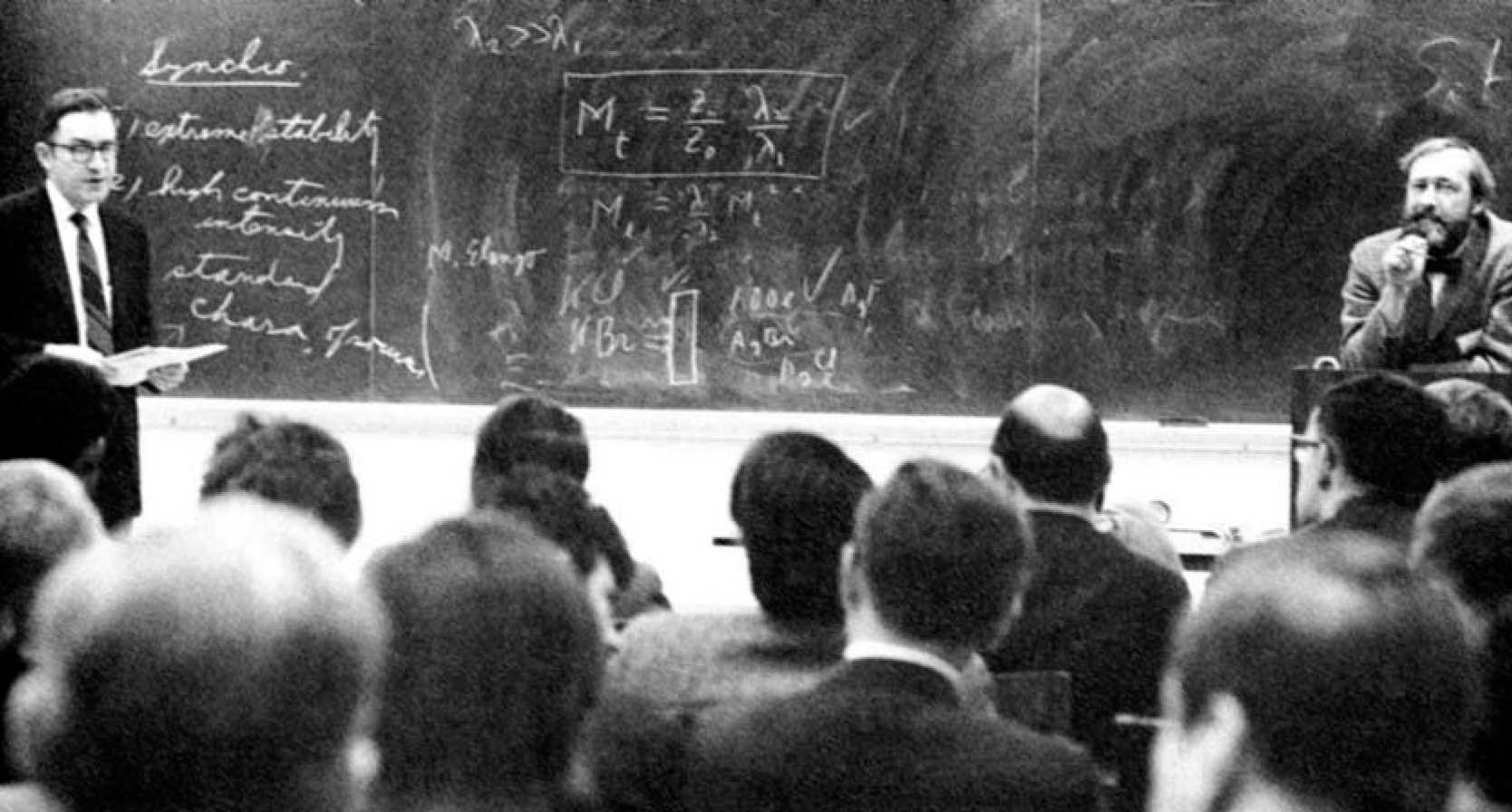
For two decades Tantalus produced hundreds of experiments and was a testing ground for many of the synchrotron techniques used today. Its administrative home, the University of Wisconsin Synchrotron Radiation Center, was located in a bucolic environment more than 13 miles from the Madison campus. The relative isolation facilitated strong bonds among users. The SRC’s annual users meeting became an important event; figure 3 pictures Brown and Rowe at one of the first gatherings, around 1969.

Figure 3. Brown (left) and Ednor Rowe lead an early Synchrotron Radiation Center user meeting, circa 1969.

Today’s dedicated synchrotron facilities can be as large as a city block. But Tantalus was no bigger than a dinner table, and its small building, even after a substantial expansion in 1972, was incredibly crowded with equipment and researchers. Users worked in very close quarters. The close proximity made cross fertilization of ideas unavoidable. The atmosphere was open, friendly, informal, and exciting.
It was not particularly comfortable physically, though. For one thing, the system that heated the control room did not work in an adjoining washroom. So, to avoid frozen pipes, users just left the door wide open. After someone posted a sign alerting users to the policy, an international contest began, with each person translating the message into his own language. A copy of the cosmopolitan sign, shown in figure 4, eventually became part of an NSF funding request as evidence of Tantalus’s growing international impact.

Figure 4. Please leave door open, or the pipes may freeze. The humble purpose of this message, translated into various languages, was to alert users about a problem in the Tantalus washroom. But Ed Rowe submitted it to NSF as evidence of the facility’s growing international stature.

That impact was truly remarkable. After struggling with synchrotrons, users came from many countries to discover in Tantalus an easy-to-use light source. Research during those early years was dominated by optical spectroscopy of atoms, molecules, and solids. The broad band of available wavelengths made that a good choice. The photon energies reached the core-level thresholds in many materials and allowed researchers to investigate a wealth of phenomena, most notably electron-correlation effects. Moreover, Tantalus brought a new dimension to optical experiments. For example, it supported thermomodulation and electromodulation studies of solids, 9 and thereby expanded the scope of modulation spectroscopy, a leading field at that time. By using, say, an oscillating electric or thermal field to perturb a semiconductor, researchers could extract hidden features from the optical spectra. The approach solved important issues about the band structure of gallium arsenide and other materials.
In the mid-1970s the center of gravity at Tantalus gradually shifted toward photoemission experiments, thanks largely to a steady improvement of the emitted intensity, which increased with the beam current circulating in the ring. The initial Tantalus injector was the old FFAG synchrotron; only one electron bunch was injected in the ring, which yielded a current between 1 and 2 mA—three orders of magnitude below what can be achieved today. The advent of multiple bunches in 1973 increased the current to 50 mA. Injection of electrons using a 40-meV accelerator known as a microtron in 1974 pushed current levels still higher—to 150 mA in 1974 and to an amazing 260 mA in 1977.
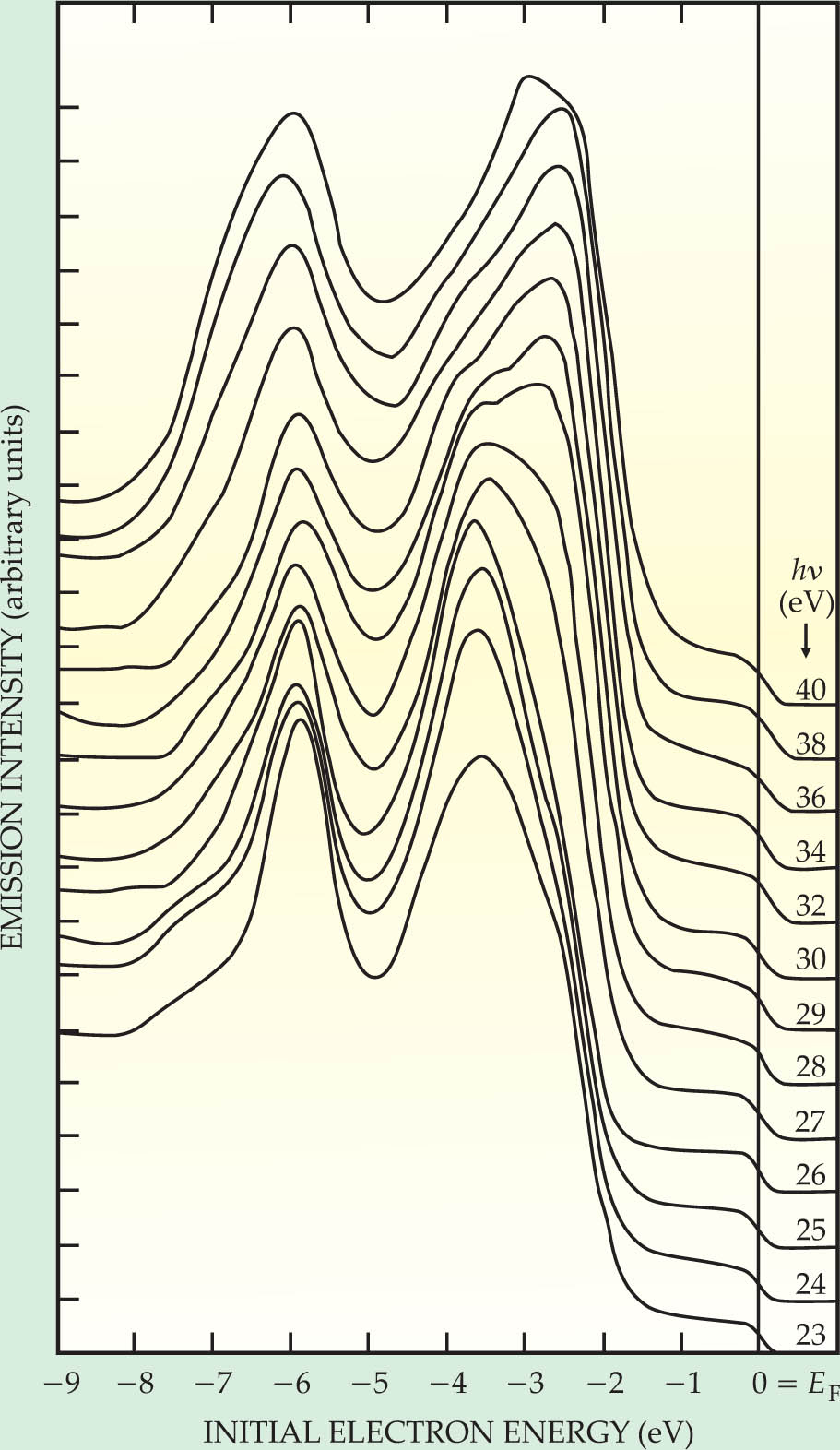
In 1971 Dean Eastman and Warren Grobman of IBM produced the first photoelectron spectra using Tantalus (see figure 5), a result that revealed momentum conserved in photoemission and changes in the lineshape of gold with photon energy. 10 The demonstration was a milestone in the development of photoemission as a research tool. The tunability of synchrotron light allowed researchers to disentangle a material’s ground-state electronic properties—their main objective—from its final-states effects, transition probabilities, and other factors.

Figure 5. First synchrotron photoemission results, obtained from gold by IBM’s Dean Eastman and Warren Grobman. The spectra reveal changes in the probability of exciting electrons to unoccupied states above the Fermi level as the photon energy hv increases.
(Adapted from ref. 10.)

Standard photoemission probes only occupied electronic states, but in 1973–74 Montana State University’s Gerald Lapeyre and colleagues went beyond that standard treatment to explore unoccupied states using what became known as constant initial-state photoemission. 11 To perform CIS photoemission, researchers would simultaneously scan the collected photoelectron energy and the photon energy while keeping their difference, the initial-state energy, constant. This approach to photoemission strictly required a wavelength-tunable synchrotron source. The Montana State team also exploited photon polarization to identify the state symmetry underlying the photoemission spectral features. That was often used to study the geometry of surface adsorbates. 12
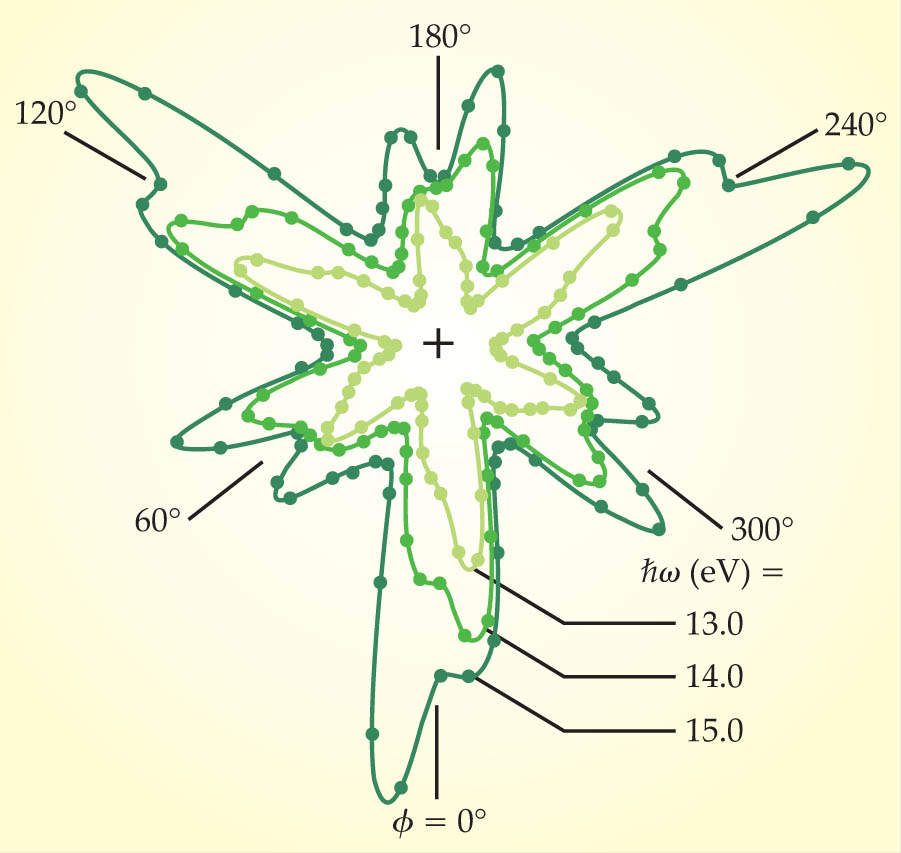
Between 1974 and 1975, Tantalus reached an intensity level sufficient for angle-resolved photoemission. A joint Bell Labs–Montana team led by Neville Smith, Morton Traum, and Lapeyre conducted the earliest experiments. 13 Figure 6 illustrates the impressive first results: The angular intensity patterns revealed the crystal symmetry of a layered compound.

Figure 6. Angle-resolved photoemission conclusively demonstrated. In 1975 Neville Smith, Morton Traum, James Knapp, and Gerald Lapeyre combined into a single experiment the use of synchrotron radiation and the measured angular distribution of emitted electrons from the surface of a layered compound. Recorded as a function of angle at three distinct photon energies ħω, their photoelectron emission spectra revealed the hexagonal crystal symmetry of tantalum sulfide. Previously, the accepted wisdom in the community was that elastic scattering of electrons inside the solid would erase information about the directionality of photoelectrons.
(Adapted from ref. 13.)
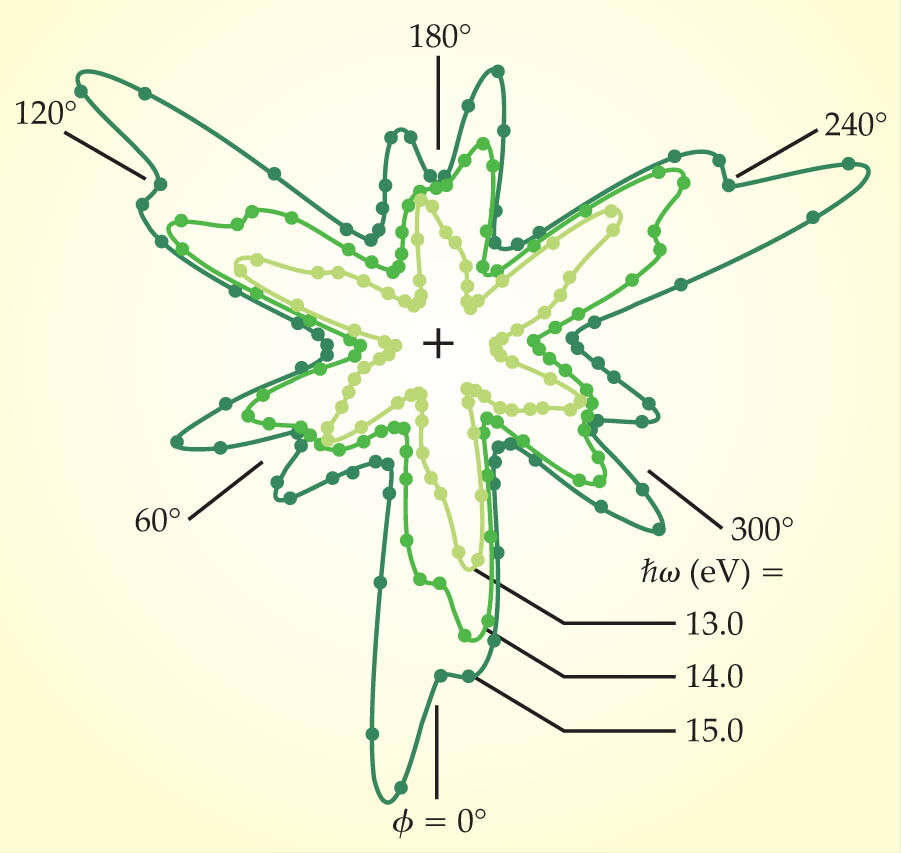
As an experimental technique, angle-resolved photoemission developed rapidly and had an important conceptual impact on condensed-matter physics. It measured both the energy E and wave vector k of the photoelectrons; those quantities could then be derived for ground-state electrons in a solid. In the case of a crystal, the E(k) curves correspond to a band structure. The experimental band-structure maps provided stringent tests of theoretical treatments of elemental and compound crystals. Indeed, the experiments at Tantalus—most notably those of Eastman’s IBM team—yielded definitive band structures for many semiconductors and metals, explained their conduction and optical properties, and solved numerous outstanding problems.
The short photoelectron escape depth makes photoemission ideal for surface and interface studies. A typical experiment probes only the very top atomic layers. And the wavelength tunability of synchrotron light allows one to adjust the surface sensitivity to match the requirements of each experiment. Experiments using photon energies that probe inner-shell electrons can reveal differences between atoms or molecules on the surface and those in the bulk. So-called core-level shifts in the spectra carry precious information on surface chemistry and reveal even subtle changes in the configuration of surrounding atoms.
Extensive interface studies at Tantalus were aimed at exploring semiconductor features, among them heterojunctions, Schottky barriers, and passivating layers. The experimental work of Jack Rowe of Bell Labs, John Weaver of SRC, Leonard Brillson of Xerox Corp, and others contributed to a new theoretical treatment of semiconductor device interfaces. What emerged was a realistic picture of those interfaces, including microchemical and microstructural factors that replaced previous idealized models.
Research in gas-phase spectroscopy was yet another pillar of success at SRC, starting from the early absorption studies of noble gases 14 and silane. 15 Throughout the 1970s and early 1980s, Thomas Carlson and Manfred Krause of Oak Ridge National Laboratory and others produced important results on Tantalus concerning auto-ionization, shape resonances, Cooper minima, and several other phenomena. 16 James Taylor’s team from the University of Wisconsin–Madison inaugurated gas-phase photoemission in 1972. 17 The results of their studies revealed strong photon-energy effects that required, for example, a careful reanalysis of previous benzene data.
The SRC produced more than a flow of experimental results. It was also the source of advanced optical instrumentation such as focusing devices and monochromators. In 1973 Ed Rowe, Mills, and Walter Trzeciak even tested insertion devices, arrays of magnets that produce highly collimated and very intense beams of light by transversely “wiggling” the electrons passing through them.
The cases discussed here are merely a fraction of the hundreds of results produced at Tantalus from 1968 to 1987. One could also mention fluorescence experiments that exploit the time structure of the light emission, photon-stimulated desorption of atoms from surfaces, photoemission resonances, catalysis studies, and spectral calibrations for astronomy. Even that small subset, though, provides a sense of the remarkable scientific impact that Tantalus made over two decades.
End of an era
In 1985 SRC replaced Tantalus with the new storage ring known as Aladdin, another of Ed Rowe’s creations, which provided higher energy and higher intensity. Tantalus survived a short time afterward, used for specialized experiments. In 1987 its 19-year life came to an end. It was dismantled and parts of it are now stored at the Smithsonian Institution.
Its legacy has been profound. Tantalus demonstrated the superiority of storage rings over synchrotrons as light sources and set the stage for the creation of new ones—the 2.5-GeV SPEAR ring at SLAC; the Cornell High Energy Synchrotron Source (CHESS); DORIS at DESY; ACO and DCI in Orsay France; the converted National Bureau of Standards machine SURF II; VEPP-3 in Novosibirsk, Russia; and Adone in Frascati, Italy. Their development strongly influenced protein crystallography x-ray scattering, extended x-ray fine structure, and other key areas. It also extended the scope of synchrotron light beyond traditional physics and chemistry.
To understand how, consider the advantages that accompany a facility dedicated to light emission. Technical choices, including average current, beam characteristics, and operating energy, that would optimize the brightness of the emission are often at odds with choices that would optimize particle-physics experiments. By avoiding the need to compromise with a different set of users, the synchrotron-light community could design its machines with beam characteristics specifically tailored to its own needs.
In the 1980s a second generation of synchrotron light sources emerged. The INS-SOR Tokyo ring was the first example, followed by the Synchrotron Radiation Source in Daresbury UK; the National Synchrotron Light Source in Brookhaven, New York; SuperACO in Orsay; BESSY in Berlin, Germany; MAX-I in Lund, Sweden; the Photon Factory at KEK in Tsukuba, Japan; Aladdin; and others. The success of those machines paved the way in the 1990s and 2000s for third- and fourth-generation light sources that rely heavily on insertion devices, such as wigglers and undulators, and for the present development of UV and x-ray free-electron lasers, such as those at DESY.
Generation after generation, the evolution of those facilities transformed synchrotron light from a specialized and complicated tool to a standard and routine one. In particular, as the light sources became easier to use, biomedical scientists, environmental researchers, archaeologists, or art-restoration specialists, for example, could use the light without tackling complicated instrumentation problems.
As director, Ed Rowe helped foster a culture of user friendliness at Tantalus. His welcoming, enthusiastic presence and his commitment to the users prompted a generation of US and foreign scientists to flock to the facility and learn the techniques. That community includes many past and present leaders of synchrotron research in the US, the UK, Germany, France, Sweden, Switzerland, Italy, Taiwan, Canada, and other countries.
Without dedicated sources, synchrotron light would have remained a niche activity surviving on the edges of elementary particle-physics research. Instead, it has become a leading multidisciplinary research enterprise. The secret was not bureaucratic planning but a reliance on good men and women and a committed effort to support the creativity and minimize the difficulties of visiting scientists. Today’s research leaders would do well to learn from that model.
In heartfelt remembrance of Ed Rowe. I offer thanks also to the early Tantalus staff and users, whose dedication made all this possible, and to Dave Huber, who steered the difficult transition from Tantalus to Aladdin.
References
1. D. W. Lynch, J. Synchrotron Radiat. 4, 334 (1997).https://doi.org/JSYRES
10.1107/S0909049597011758 2. G. W. Rubloff, H. Fritzsche, U. Gerhardt, J. Freeouf, Rev. Sci. Instrum. 42, 1507 (1971).https://doi.org/RSINAK
10.1063/1.1684919 3. A. Lie´nard, L’E´clairage E´lectrique 16, 5 (1898).
4. D. Iwanenko, I. Pomeranchuk, Phys. Rev. 65, 343 (1944).https://doi.org/PHRVAO
10.1103/PhysRev.65.343 5. J. Schwinger, Phys. Rev. 70, 798 (1946).https://doi.org/PHRVAO
6. F. R. Elder, A. M. Gurewitsch, R. V. Langmuir, H. C. Pollock, Phys. Rev. 71, 829 (1947).https://doi.org/PHRVAO
10.1103/PhysRev.71.829.5 7. A. Hofmann, The Physics of Synchrotron Radiation, Cambridge U. Press, New York (2004).https://doi.org/10.1017/CBO9780511534973
8. D. H. Tomboulian, P. Hartman, Phys. Rev. 102, 1423 (1956).https://doi.org/10.1103/PhysRev.102.1423
9. C. G. Olson, M. Piacentini, D. W. Lynch, Phys. Rev. Lett. 33, 644 (1974);https://doi.org/PRLTAO
10.1103/PhysRevLett.33.644
D. E. Aspnes, C. G. Olson, D. W. Lynch, Phys. Rev. B 12, 2527 (1975).https://doi.org/10.1103/PhysRevB.12.252710. D. E. Eastman, W. D. Grobman, Phys. Rev. Lett. 28, 1327 (1972).https://doi.org/PRLTAO
10.1103/PhysRevLett.28.1327 11. G. J. Lapeyre, J. Anderson, P. L. Gobby, J. A. Knapp, Phys. Rev. Lett. 33, 1290 (1974).https://doi.org/PRLTAO
10.1103/PhysRevLett.33.1290 12. R. J. Smith, J. Anderson, G. J. Lapeyre, Phys. Rev. Lett. 37, 1081 (1976);https://doi.org/PRLTAO
10.1103/PhysRevLett.37.1081
M. Schluter, J. E. Rowe, G. Margaritondo, K. M. Ho, M. L. Cohen, Phys. Rev. Lett. 37, 1632 (1976).https://doi.org/PRLTAO10.1103/PhysRevLett.37.1632 13. N. V. Smith, M. M. Traum, J. A. Knapp, J. Anderson, G. J. Lapeyre, Phys. Rev. B 13, 4462 (1976).https://doi.org/PLRBAQ
10.1103/PhysRevB.13.4462 14. L. C. Lee, R. W. Carlson, M. Ogawa, D. L. Judge, Bull. Am. Phys. Soc. 17, 1199 (1972).https://doi.org/BAPSA6
15. W. Hayes, F. C. Brown, A. B. Kunz, Phys. Rev. Lett. 27, 774 (1971).https://doi.org/PRLTAO
10.1103/PhysRevLett.27.774 16. T. A. Carlson, M. O. Krause, F. A. Grimm, P. Keller, J. W. Taylor, J. Chem. Phys. 77, 5340 (1982).https://doi.org/JCPSA6
10.1063/1.443782 17. J. A. Kinsinger, J. W. Taylor, Int. J. Mass Spectrom. Ion Phys. 10, 445 (1973).https://doi.org/10.1016/0020-7381(73)83021-9
More about the authors
Giorgio Margaritondo is vice president for academic affairs at the École Polytechnique Fédérale de Lausanne (EPFL) in Switzerland. From 1975 to 1985, he was a user at Tantalus.
Giorgio Margaritondo, 1 École Polytechnique Fédérale de Lausanne (EPFL) in Switzerland .