The Contentious Role of a National Observatory
DOI: 10.1063/1.1629005
In 1950, President Harry S Truman signed the National Science Foundation into existence. With new resources for scientific research came questions about their equitable distribution and use. One of the topics astronomers fiercely debated in the mid-1950s was the building of federally funded national observatories. By 1957, the situation was resolved and NSF established two new national observatory systems, one for optical astronomy and one for radio astronomy. For many years after the creation of a national center for optical astronomy, however, dissension and disagreement persisted about the proper mission and dominance of the national observatory.
Since the mid-19th century, American astronomers have enjoyed privileged access to the world’s biggest telescopes. From Harvard University’s 15-inch Great Refractor, dedicated in 1847, to the 200-inch telescope on Mount Palomar, inaugurated in 1948, and continuing to this day, the landscape of American astronomy has been shaped by generous philanthropic and university funding that has enabled the construction and operation of the biggest and best telescopes. Such private support distinguishes research in the US from that in other countries, where astronomers have relied almost exclusively on government largesse.
In the 1950s, most US radio astronomers gradually accepted the idea of publicly available and federally funded research facilities. It was otherwise in optical astronomy, where some influential scientists were reticent to accept federal funding in general, and long-established private observatories faced the possibility of new competition. The establishment of a national optical observatory created a unique situation—the coexistence of established and successful private and university-based observatories with a publicly accessible national center that many outside the private system hoped would rapidly expand with the help of generous federal funds.
In 1958, construction of the US national observatory for optical astronomy began on Kitt Peak near Tucson, Arizona. The new national observatory was to offer any astronomer, regardless of institutional affiliation, an opportunity to receive telescope time and compete with scientists from the major private observatories. In building the Kitt Peak National Observatory, the federal government continued the cold war trend of supporting science by investing in large-scale national facilities. The observatory was managed for NSF by the Association of Universities for Research in Astronomy (AURA), a consortium of schools initially dominated by eastern and midwestern members. In 1965, a southern counterpart—the Cerro Tololo Inter-American Observatory (CTIO)—was founded in Chile and managed by AURA with the cooperation of the University of Chile.
The construction of nationally available research facilities on Kitt Peak and at places like SLAC and Fermi-lab sparked debate among scientists and science managers over the proper mission of national observatories. Should they provide cutting-edge large telescopes whose capabilities rival those of the older private observatories? Or should places like Kitt Peak offer only modest-sized telescopes at which astronomers with fewer institutional resources could do their science? More broadly, should the distribution of resources like telescope observing time be based on democratic, meritocratic, or elitist principles?
The implications of such questions have had a profound impact on the organization of US astronomy in the past half-century. Today, the dual system of coexisting private and public observatories persists as astronomers plan the next generation of giant telescopes—behemoths with light-collecting areas 30 m or larger. Consequently, understanding the contentious relationship between the two diverse traditions is important in understanding the history of US astronomy.
Brooklyn boys
For more than a quarter-century after World War II ended, Jesse Greenstein and Leo Goldberg directed prominent astronomy departments and were influential leaders in the international astronomy community. Greenstein, as head of Caltech’s astronomy program, epitomized one style of astronomy—ground-based observing dominated by unparalleled access to large private telescopes in the western US. Goldberg represented another style of research. He worked for years at the University of Michigan and Harvard, which had no large telescopes of their own, and he was committed to the success of large national astronomical facilities, both on the ground and in space. Those two astronomers may be seen as archetypes who advocated two different visions for the national astronomy centers and the future construction of giant new telescopes. Their irreconcilably different visions of how astronomy should be funded, practiced, and managed were a major source of their eventual conflict.
Greenstein and Goldberg grew up in Brooklyn, New York, but inhabited different social worlds. Greenstein, born in 1909, came from a family of cultured and nonobservant Jews who ran profitable furniture making and real estate businesses. When he was a young boy, his grandfather gave him a small brass telescope, and he later did elementary spectroscopy and crystal-radio experiments at the family’s seaside vacation home in New Jersey.
Goldberg’s childhood was less comfortable and his success in life resembled that of a Horatio Alger character. His parents came from Poland to work in New York’s needle trades before their son was born in 1913. Decades later, Goldberg would still recall being an outsider—poor and Jewish—when he related how victory in a state spelling bee brought him to a White House dinner where he was left to wonder which items on his plate were kosher.
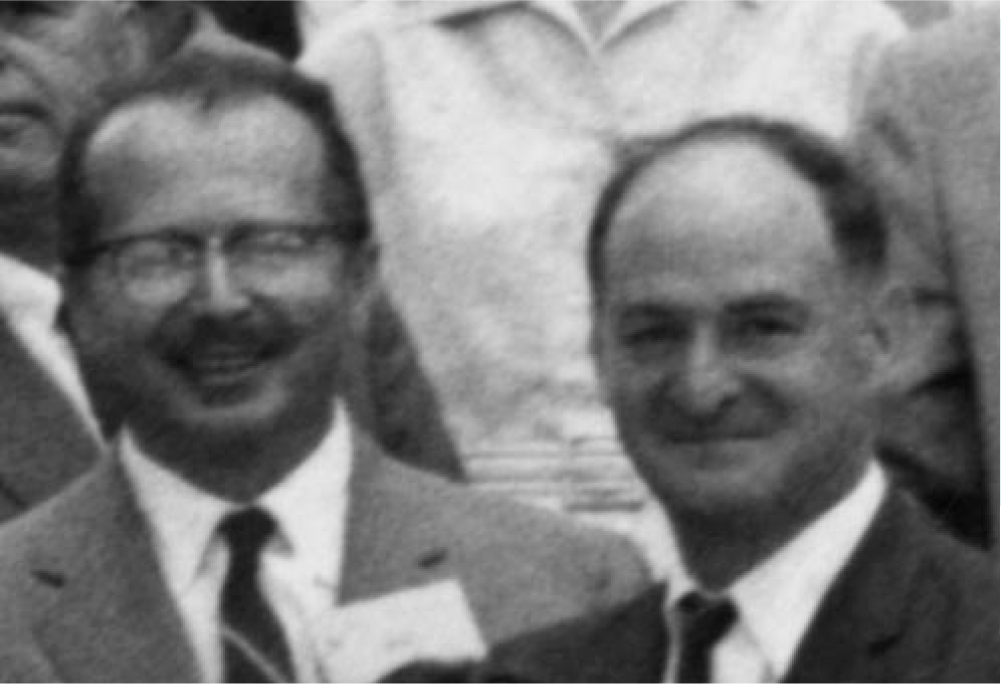
Both men attended Harvard in the 1930s—Goldberg, on a scholarship. There, they established a friendship and chose astronomy as their life’s work. Figure 1 shows the two men together in mid career at a conference. In 1937, Greenstein finished his PhD and took a position at the University of Chicago’s Yerkes Observatory. He kept in contact with his classmate and, in contrast to Goldberg’s stolid correspondence, his self-deprecating letters sometimes ended with joking reminiscences about Harvard life. Greenstein’s humor could have a macabre side, such as when, after an observing run, he confided to Goldberg that he hoped to “be a spectroscopist yet, if Adolph [Hitler] doesn’t get me first.”

Figure 1. Former Harvard University classmates soon to turn rivals Jesse Greenstein (left) and Leo Goldberg at the June 1956 meeting of the American Astronomical Society in Berkeley, California.
(Courtesy of the AIP Emilio Segrè Visual Archives.)

Goldberg continued research in solar physics at Harvard until he landed a more secure post at the McMath—Hulbert Observatory, a small institution affiliated with the University of Michigan. Compared with Yerkes, which had international renown, McMath—Hulbert was a relative backwater. Nonetheless, in July 1941, Goldberg left Harvard to begin his professional career in Michigan, an endeavor soon overshadowed by events on the world stage.
Both men participated in war-related research. After V-J Day, they tried using captured V2 rockets to make astronomical observations from high in the atmosphere. Goldberg became a spirited advocate of the scientific possibilities offered by space-based astronomy and was especially motivated by launches of early Soviet and US satellites. Meanwhile, Greenstein, whose first rocket-borne experiment had been a failure, remained a staunch champion of astronomy done from the ground.
Greenstein had an excellent incentive to stress the importance of traditional ground-based astronomy. In 1948, Caltech asked him to lead their astronomy program. That was an astronomer’s equivalent of being traded to the champion New York Yankees. Greenstein’s talents, which combined both observational experience with big telescopes and theoretical research, made him a logical choice to lead Caltech’s astronomy program. The telescopes on Mounts Wilson and Palomar, paid for by the Rockefeller Foundation and jointly operated by Caltech and the Carnegie Institution of Washington, were the apex of American observational astronomy. The 200-inch Palomar telescope was the world’s most powerful telescope at the time and was available almost exclusively to a small and elite group of scientists. Greenstein, who had ample viewing time, was able to skim the scientific cream in a number of areas, from stellar abundances to extensive studies of white dwarfs. Running Caltech’s program also gave him a powerful position within the international science community.
Differences of opinion
Goldberg, on the other hand, was engaged in the daunting task of making his midwestern astronomy department competitive. In doing so, he relied heavily on the federal funds for science that became increasingly available in the postwar period. In May 1957, Goldberg wrote to a longtime patron of his department about what was new in astronomy and noted that he had been “busy during the last few months in helping to organize the National Observatory in Arizona.” As Goldberg described it, “some day the Arizona observatory will be the most important one in the world, and unlike other observatories, it will be open to all astronomers on the basis of scientific merit only.” He was speaking, of course, about the establishment of Kitt Peak. Goldberg’s activism was an important catalyst for the establishment of the national centers for optical astronomy—Kitt Peak and, later, the CTIO—and for national radio facilities.
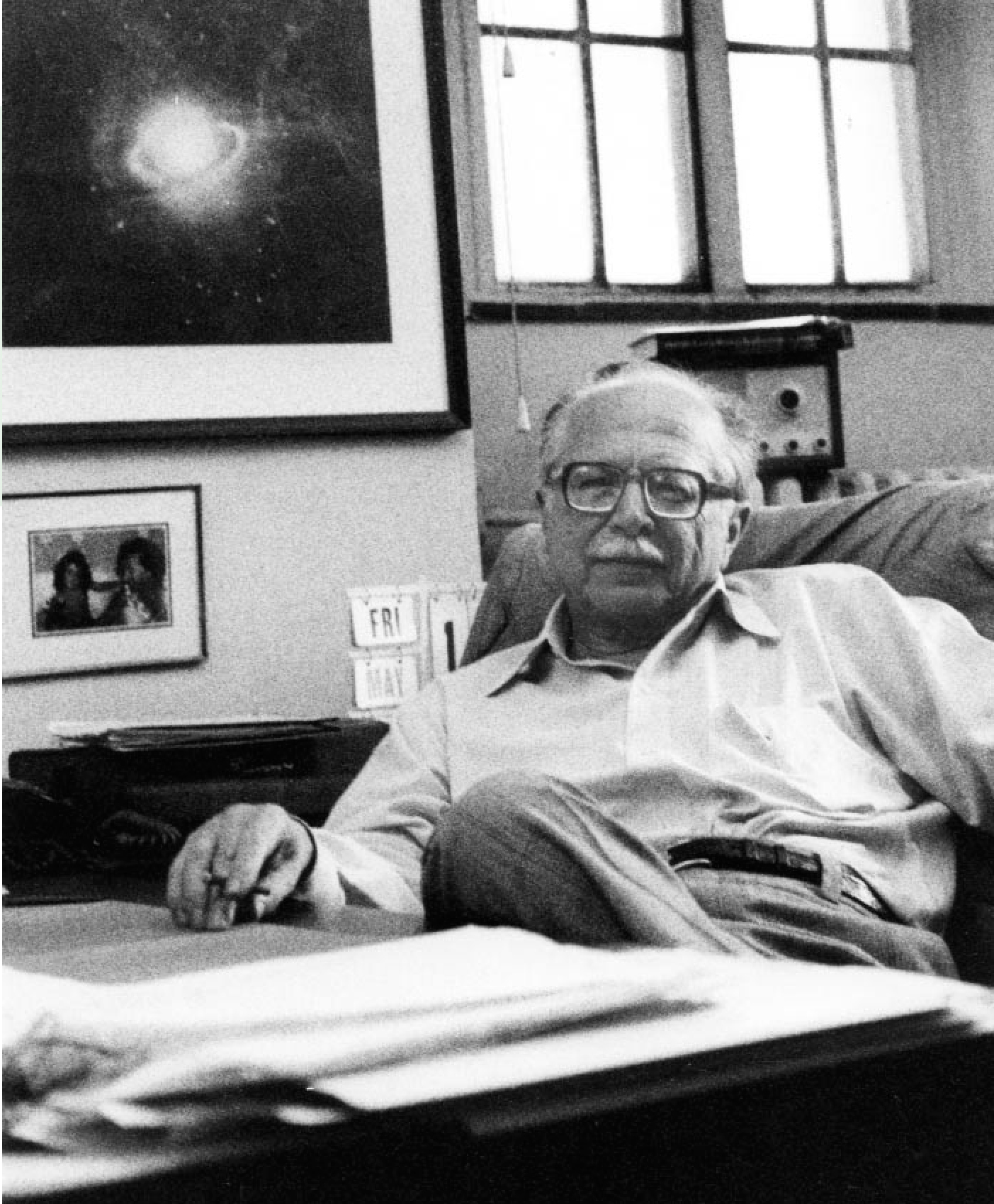
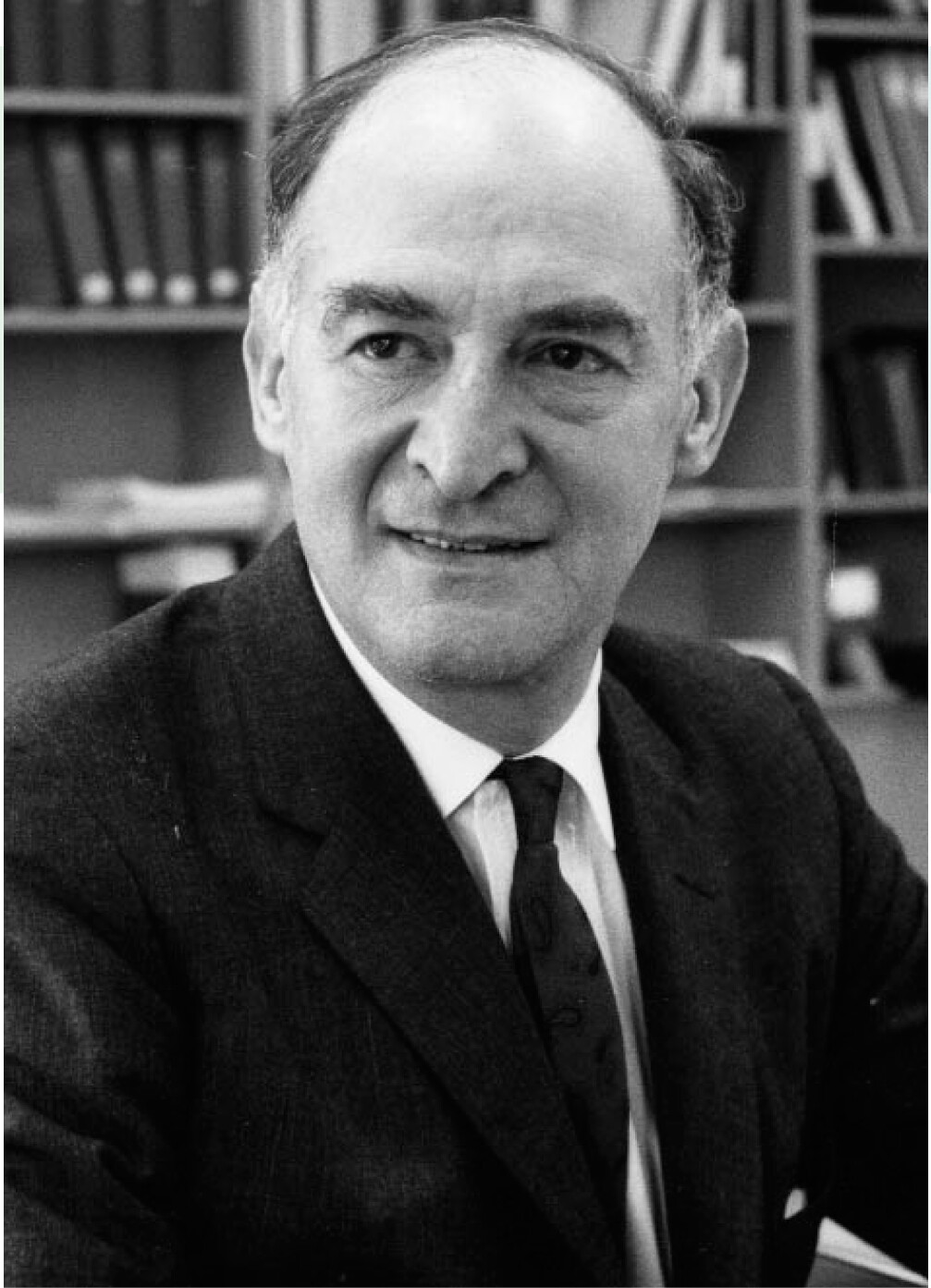
In 1960, soon after the first telescopes at Kitt Peak began taking data, Goldberg returned to Harvard’s astronomy department. Figure 2 is a portrait taken shortly after his return. In 1966, he became department chair and director of the Harvard College Observatory. Those moves enhanced Goldberg’s influence in the science community and enabled him to continue his research in solar physics, especially using satellite-based observations.

Figure 2. Leo Goldberg in his office at Harvard University in 1961.
(Courtesy Harvard University News Office and AIP Emilio Segrè Visual Archives, Physics Today Collection.)
As NSF increased the funding for Kitt Peak, astronomers began to plan bigger national telescopes. In the 1960s, Greenstein became increasingly concerned about the “enormous disproportion” between the low level of federal support for astronomy at private institutions such as Caltech and the generous support given to the national centers. Greenstein expressed “little doubt that a substantial fraction of astronomical research” was still centered around large state and private observatories such as Palomar. If NSF wanted more publicly accessible telescopes, Greenstein thought they could be managed by a single university such as Caltech rather than by the growing AURA consortium. Unless checked, Greenstein warned, national centers would continue to grow at the expense of private facilities. The “need for balance” became, in fact, something of a mantra Greenstein used in his correspondence and formal statements throughout the 1960s.
In March 1963, Goldberg and Greenstein crossed swords over the first decadal survey for astronomy sponsored by the National Academy of Sciences, the so-called Whitford report, which the NAS published in 1964. That survey, like those that followed it, was an influential policy document that set research goals and presented a list of new priorities for funding in the coming decade. Noting that several new ground-based telescopes would cost less than “a single orbiting astronomical observatory,” Green-stein favored a new private telescope at Palomar along with an observing facility at a Southern Hemisphere site. Greenstein tactfully explained that he “meant no invidious comparison,” but he simply wanted to see some degree of parity between “large observatories devoted to ground-based astronomy and the national facilities.” Goldberg agreed that a great observatory such as Palomar could not afford to stand still. But, he said, Kitt Peak was built to meet the growing national needs of scientists who lacked access to the large, private telescopes in the western US.
Access to Kitt Peak’s growing array of modest-sized telescopes was based on a policy that combined elements of democracy and meritocracy. Anyone could apply for observing time, proposals were peer reviewed, and authors of the best ones received observing time. In contrast, access to observatories like Palomar, Mt. Wilson, and Lick, in California, and McDonald in Texas, was largely granted on the basis of staff affiliation, with some nights reserved for a fortunate but small number of visitors.
Greenstein maintained his elitist position. Instead of putting more large telescopes under the control of national centers, the Caltech astronomer maintained that “the only proper method is to see whether Lick or Mount Wilson—Palomar deserve another big telescope and give it to them.” Greenstein favored, as he phrased it in a 1963 letter to physicist Geoffrey Burbidge, “the benevolent dictatorship of the elite. If you don’t think they move fast enough, give the elite more backing.”
Conflict intensifies
Greenstein’s position was shaped in part by his belief that the 1960s had not nurtured the health of his beloved elite science institutions. Although astronomers at observatories such as Palomar and Lick continued to work at the frontier of research, NSF’s annual funding for national optical facilities grew to over $10 million by the decade’s end, far in excess of the agency’s support for astronomy at universities.
Moreover, a mid-1960s initiative by the Carnegie Institution to build a copy of Palomar’s venerable 200-inch telescope collapsed. The telescope, to be located in the Southern Hemisphere, was to be constructed with funding from the Ford Foundation. The foundation’s philanthropic donation of $5 million was instead matched by NSF to build what became the AURA-operated, 4-m telescope at CTIO. Many Carnegie and Caltech staff unfairly held AURA (and even Goldberg) responsible, and Pasadena folklore held that a “last minute plot by the competition” had diverted the Ford Foundation’s money to AURA from the Carnegie Institution.
Private institutions also faced trials in other fields of science. Caltech particle physicists, for example, increasingly did their research at national accelerator labs, and Caltech’s own electron synchrotron closed its doors in 1969. Those changes were, as Greenstein saw it, depressing blows to university-based research.
Greenstein became more vocal about the need to redress astronomy’s priorities. In 1967, he wrote Nicholas Mayall, Kitt Peak’s director, “I do not believe that further telescope construction at Kitt Peak is in the national astronomical best interest.” When Mayall asked for an explanation, Greenstein replied, in a letter to the AURA board, that the “steady drain for continued operation for National facilities is in direct competition with university research applications. … I am not enthusiastic about any major expansion in these centers.” “Science,” as Greenstein later explained, “is not democratic, it is aristocratic.”
Greenstein and Goldberg soon came into direct conflict over their increasingly divergent views of what was best for US astronomy. The stage was set in 1971 when AURA asked Goldberg to become the new director of Kitt Peak—a most appropriate appointment inasmuch as Goldberg’s activism helped found the observatory. Greenstein wrote to his former Harvard classmate that he hoped Goldberg’s appointment would bring Kitt Peak into “direct competition with us dinosaurs in Pasadena.” What was offered, perhaps, as a gesture of friendly rivalry ultimately became a prophetic remark.
Even before AURA had officially formed, Goldberg had big plans for the organization. In 1957, he wrote Lee DuBridge, Caltech’s president, that he looked forward to the day when the national observatory would operate very large telescopes “perhaps 200 inches in diameter or greater.” When Goldberg arrived at Kitt Peak in September 1971, the national observatory was in a crucial period of transition. For 13 years, it had pursued an aggressive program of telescope construction. By 1970, both Kitt Peak and CTIO operated small- to moderate-sized telescopes, and two 4-m telescopes were nearing completion.
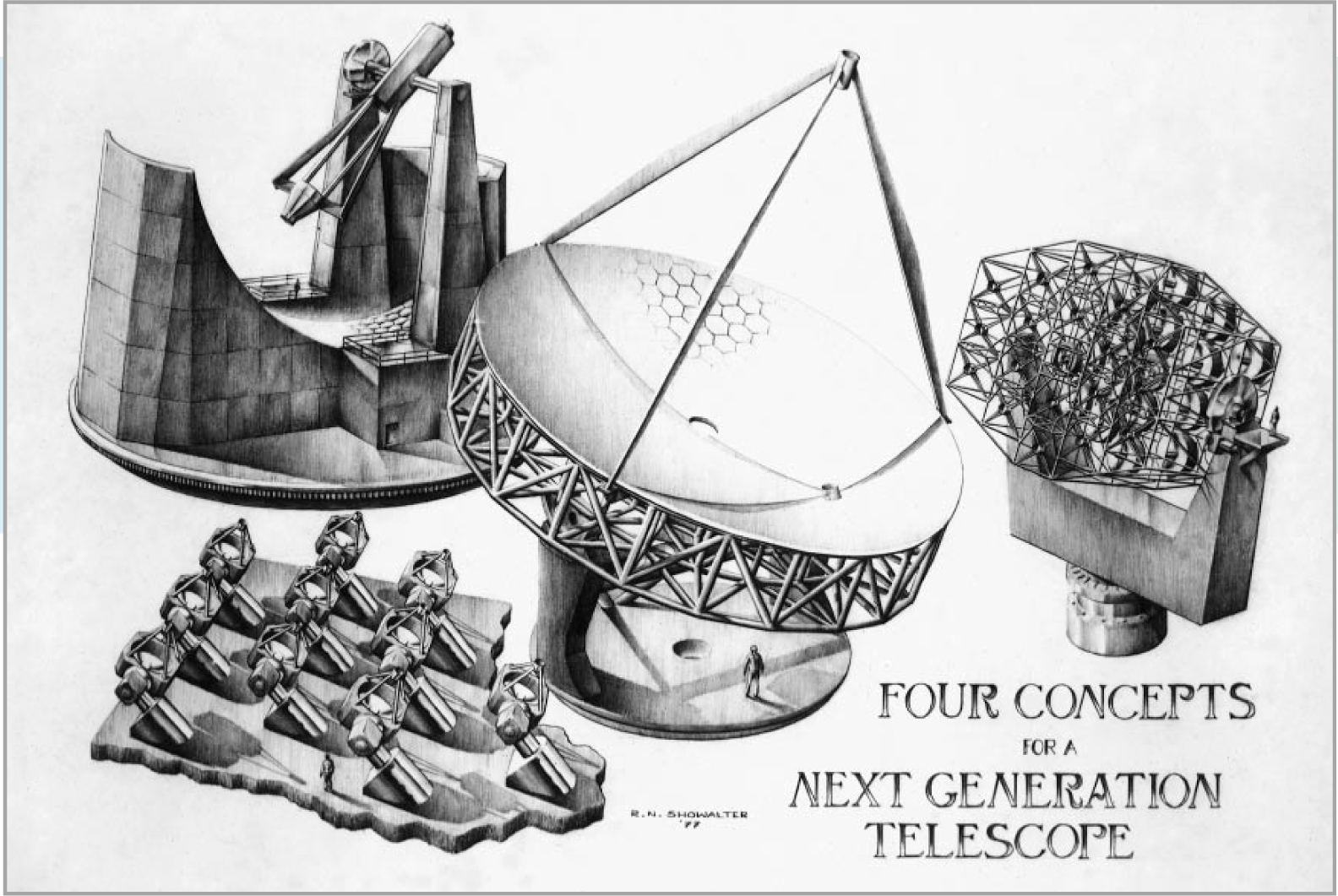
In the summer of 1974, Goldberg acted on his ambition by encouraging plans at Kitt Peak to build a gigantic new ground-based telescope with a 25-m aperture. The Next Generation Telescope project was bold indeed: Its goal was a light-collecting area 25 times greater than Palomar’s 200-inch telescope. (See figure 3 for design proposals.) The project represented an opportunity to expand the national observatory and US astronomy in general. To Goldberg, not pursuing future projects was tantamount to stagnating and was a sure recipe for poor morale and eventual decline. He argued that, as other countries were beginning to build copies of Kitt Peak’s 4-m telescope, a failure to build for the future would eventually make “the US position in optical astronomy … competitive rather than preeminent.”

Figure 3. Four conceptual designs developed for Kitt Peak’s Next Generation Telescope project. The pencil sketch, by Rick Showalter, dates from 1977.
(Courtesy Rick Showalter, the National Optical Astronomy Observatory, the Association of Universities for Research in Astronomy, and NSF.)

Goldberg’s bold ambitions notwithstanding, the US astronomy community did not share a unified vision of the national observatories’ purpose. For astronomy’s have-nots—those from small universities or areas where observing conditions were poor—Kitt Peak’s main obligation was providing essential access to modest-sized telescopes. They were less interested in access to the world’s biggest telescope than in having reliable facilities where they could collect a few nights’ worth of data every year or train students. Astronomers who had access to the best private telescopes saw Kitt Peak and CTIO as competitors for resources and prestige and were suspicious of Goldberg’s vision for bigger national telescopes.
Even Kitt Peak staff members disagreed about the observatory’s mission. Some placed a greater emphasis on serving visiting scientists. Another faction saw the national centers as top-tier research laboratories. As one staff astronomer wrote, “We will never be liked by our well-endowed, but jealous, critics but we should be able to command their respect.” Goldberg himself held the view that Kitt Peak should be a first-class research facility and supported that policy by hiring top-notch astronomers and operating Kitt Peak as a prestigious research institution first and a service facility second.
Delicate questions
In February 1974, the AURA board asked Greenstein to be its new chair. That appointment surprised many people who knew about his demands for conditions more favorable to university-based astronomy. It also meant Goldberg had to answer to Greenstein. The new AURA chair took office only a few years after he had chaired the NAS’s second decadal survey for astronomy. If anything, chairing the NAS committee had further convinced Greenstein of the dire state of university-based research. The major recommendation of the Greenstein committee’s survey was that NSF fund and build the Very Large Array, a national facility for radio astronomy in Socorro, New Mexico, estimated to cost at least $60 million. As Greenstein later recalled, his leadership efforts for the NAS panel had failed as his wishes for a balanced program disappeared “down the maw of big science, the death of university astronomy.”
As the months went by, Greenstein became more convinced that AURA was getting to be too powerful in the astronomy community. For example, he saw Goldberg successfully lobby for AURA to take over management of the Sacramento Peak solar observatory, which the US Air Force was planning to abandon. Even more threatening in Greenstein’s view, Goldberg wanted Kitt Peak to be actively involved in NASA’s nascent plans for what became the Hubble Space Telescope. Such moves contributed to Greenstein’s assessment that AURA might soon control all major research facilities in astronomy and marginalize university-based researchers.
At an AURA board meeting in November 1975, Goldberg was surprised when he was asked about what Greenstein called “a delicate question.” Goldberg would turn 65 in the fall of 1978 and faced a mandatory retirement unless the board voted otherwise. The AURA board decided not to allow Goldberg’s tenure to continue past his 65th birthday. A full two years before rules required it find a new director, AURA, with Greenstein’s approval, initiated a search for Goldberg’s replacement.
Now a lame duck, and perhaps feeling he had little to lose, Goldberg became increasingly vocal about his vision for US astronomy. He argued for the preeminence of national centers and pushed for AURA to be even more active. “AURA,” Goldberg said in a report to the AURA board, “could be the group that speaks for both university interests and national center interests…. The opportunity is there if AURA will take it.”
That was exactly the type of centralized control and management of science that Greenstein opposed. As the US celebrated its bicentennial in the summer of 1976, the two elder statesmen of astronomy clashed over the role and continued expansion of the national observatories. Greenstein began to make his preference for smaller and less powerful national observatories more widely known, arguing that AURA should, as one astronomer noted, “remain small.”
One initiative that Greenstein singled out for attack was Kitt Peak’s 25-m Next Generation Telescope project. Goldberg’s head of engineering at Kitt Peak recalled being told by the Caltech astronomer and AURA chair that there simply wasn’t going to be any 25-m telescope. Greenstein also let Kitt Peak staff know that although their current director might be “an activist,” his replacement would be less inclined in that direction.
Partly in response to Goldberg’s report, AURA attempted to define the mission of the national observatories it managed. When Greenstein vetted a draft of the mission statement among his Caltech colleagues, it generated a firestorm of protest. One astronomer called it “evil” and another said it “scared the hell” out of him. The mission statement’s intent, Greenstein’s colleagues concluded, was to relegate “all major private observatories … to a level of mediocrity such that they will not be competitive with Kitt Peak and Cerro Tololo.”
The final report took such views into account and depicted a national observatory much more modest in scope. Kitt Peak and CTIO were to provide unique and nationally available facilities that were too large, complex, or expensive to be built or operated by “universities with small departments or by smaller private observatories.” But Kitt Peak and CTIO were not to dominate the large private or state-funded observatories when it came to building newer and bigger telescopes. After he stepped down as Kitt Peak’s director in September 1977, Goldberg confessed in his diary, “If I had any inkling of the treatment the Observatory would receive from its sponsor … I would have been out of my mind to take the job.”
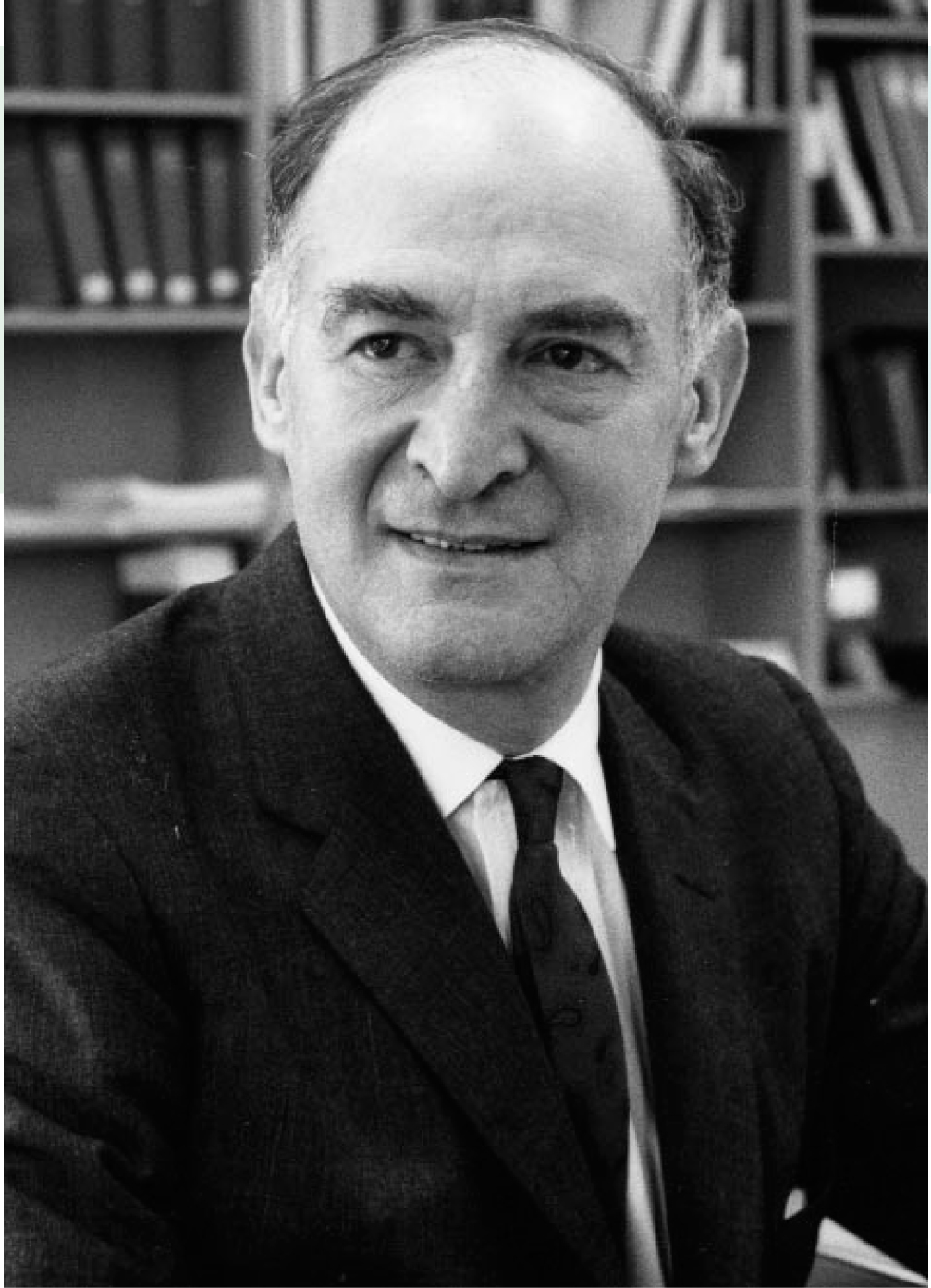
The confrontation between Goldberg and Greenstein was the last major act in a drama of two scientific careers that spanned more than four decades. The events of 1977 effectively ended their relationship. Greenstein (figure 4) formally retired from Caltech in 1979 but, like Goldberg, he remained active in scientific research and offered advice and opinions to the next generation of astronomers planning big telescopes. When Caltech held a symposium in 1984 to honor Greenstein, Goldberg was invited but noticeably absent.

Figure 4. Jesse Greenstein in 1978, shortly before his retirement from Caltech.
(Courtesy AIP Emilio Segrè Visual Archives.)

Lesser ambitions
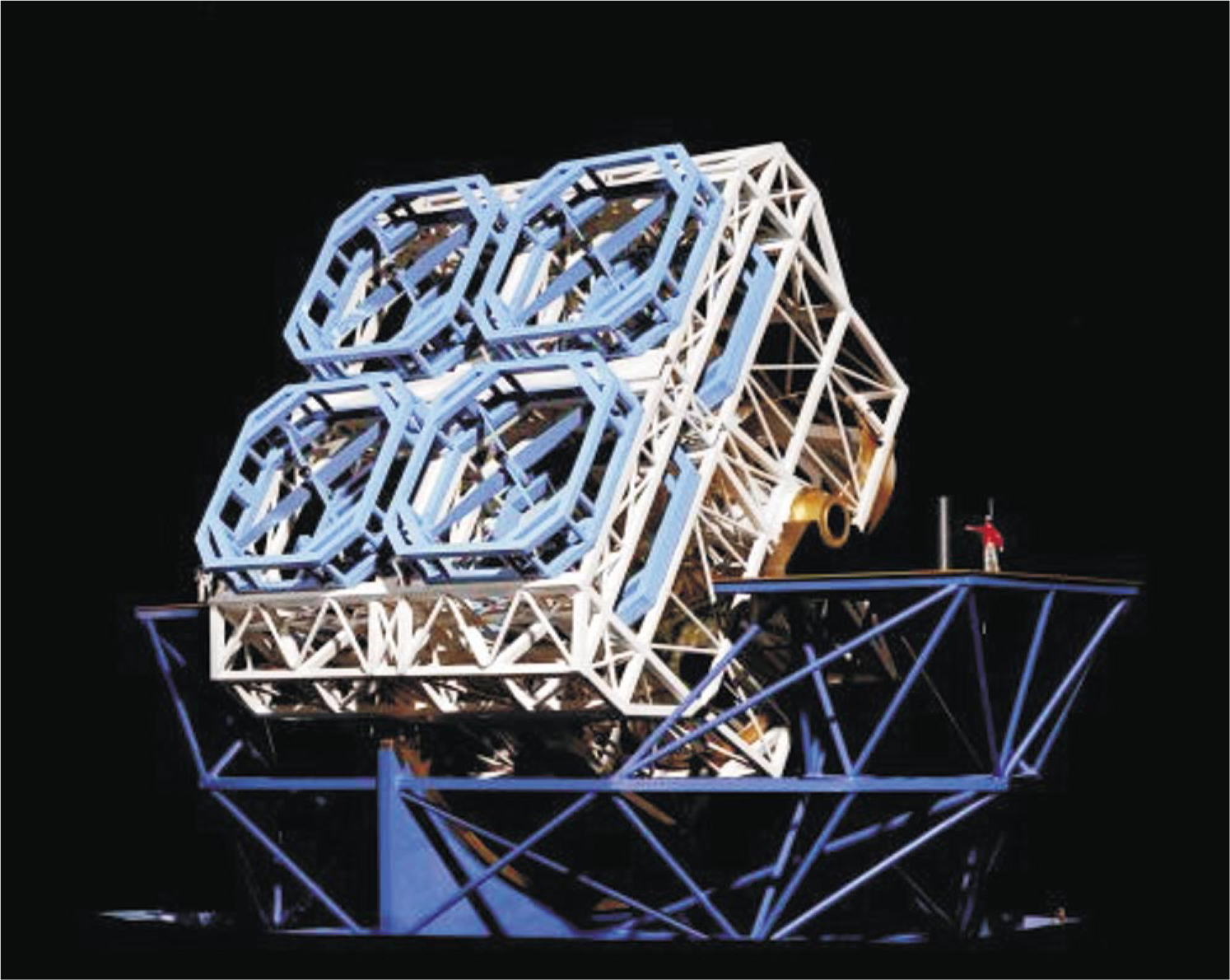
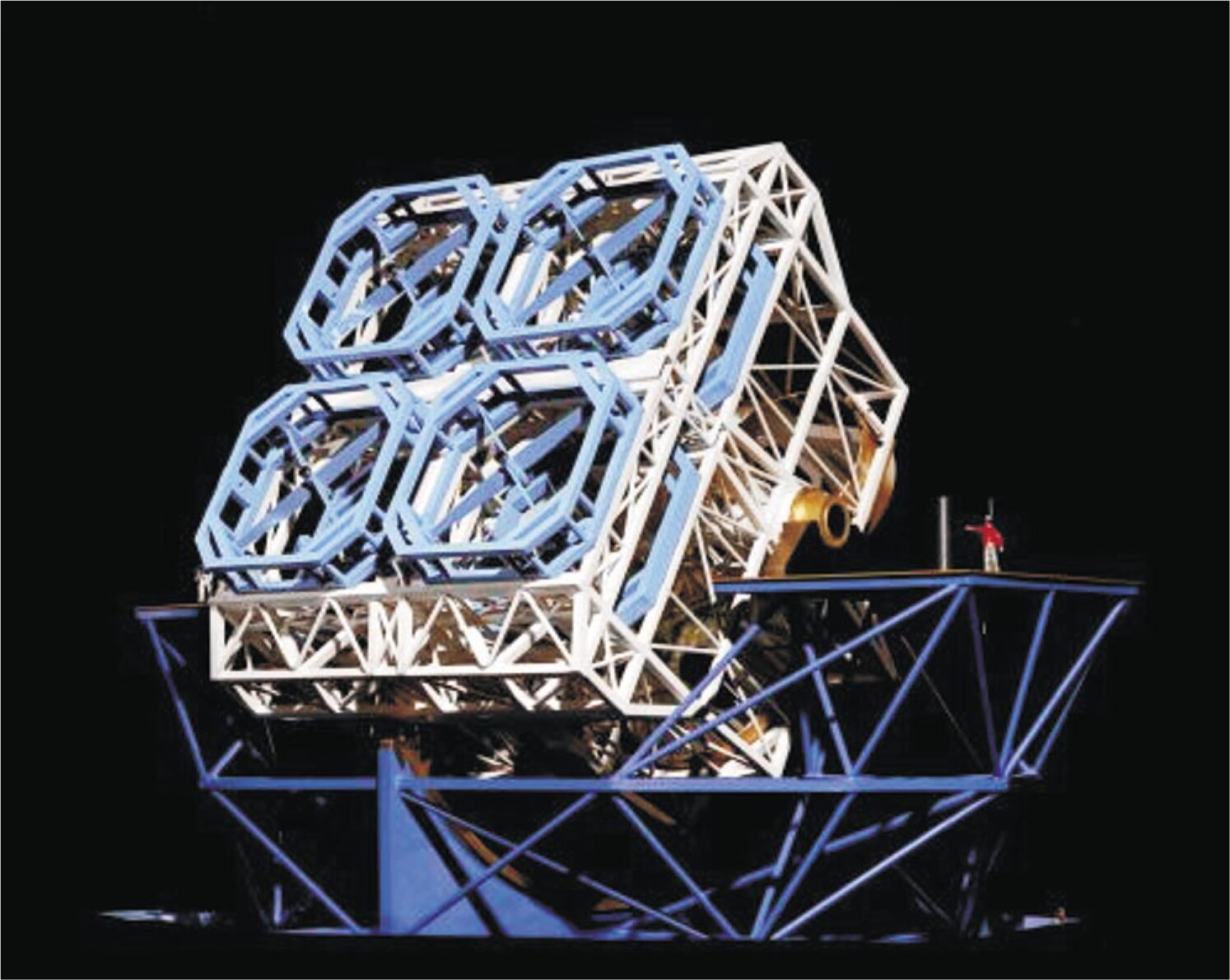
A few years after Goldberg stepped down as Kitt Peak’s director, the Next Generation Telescope was scaled back from having a 25-m aperture to a still-ambitious goal of 15-m. The scaled-back facility, renamed the National New Technology Telescope (NNTT), changed from solely a Kitt Peak effort to a cooperative one among the national observatory, the University of California, and the University of Arizona. The universities developed competing designs and, instead of leading the way, Kitt Peak was relegated primarily to consolidating their expertise into the NNTT design shown in figure 5.

Figure 5. A model for the 15-m National New Technology Telescope, comprised of four 7.5-m-diameter mirrors. The project was never funded.
(Courtesy NOAO, AURA, and NSF.)
Even after receiving a high ranking from the NAS in 1982, the NNTT project struggled to find community support. In July 1982, Goldberg sent a long, confidential letter to a member of the National Science Board. He noted how Kitt Peak’s partners in the collaborative effort all had their own ambitions for large privately run telescopes. “Once these private telescopes are funded,” Goldberg asked, “can you imagine the NSF and Congress putting up $100 million for a National Telescope? … Nonsense! … My feeling is that Kitt Peak ought to leave the field of large ground-based telescopes to the universities that want them.”
Goldberg’s prediction was soon realized. In 1984, the Keck Foundation donated $70 million to Caltech to build the first of two 10-m telescopes on Hawaii’s Mauna Kea. A 76-year-old Greenstein rejoiced in an editorial in Physics Today, February 1985, page 136 that construction of the Keck Telescope signaled that private telescopes and university-based astronomy were alive and vibrant.
In February 1985, Erich Bloch, NSF’s controversial new director, appeared for the first time before the congressional committee that approved the NSF budget. When it came to astronomy, the honeymoon did not last long. The New York Times had recently described the Keck Telescope project and quoted Greenstein as saying that Caltech’s new private telescope would “be able to conduct observations far beyond the reach of the [Hubble] Space Telescope” at a fraction of the cost. The article also described NSF’s plan for the 15-m NNTT that would be even more powerful than the Keck Telescope.
The article incensed Representative Edward P. Boland (D-Mass.), the committee’s powerful chair. He noted, “What Dr. Greenstein is saying, in effect, is that we have spent $1.175 billion to date on a [space] telescope that is not even launched as yet but will be far less capable than the $70 million to be spent on this ground-based telescope [Keck].” When it came to asking for more telescopes, Boland observed that “Astronomers will take whatever they can get and more.” After Boland patronizingly offered copies of the New York Times article to the NSF representatives, no one from the agency dared bring up funding the NNTT. Within two years, AURA had abandoned the project. It was three years after NNTT was scrapped before new plans for a nationally accessible large telescope emerged. In 1990, Congress approved initial funding to build the Gemini 8-m Telescopes. Although it featured two 8-m telescopes that offered full-sky coverage, Gemini was no longer the preeminent national project some astronomers had hoped for. Largely divorced from the national observatory, it had become an international endeavor in which the US was a 50% partner.
The debate continues
The showdown between Greenstein and Goldberg was more than just a philosophical disagreement over science management. At its core was the larger question of who would dominate and control astronomical research: elite universities and a relatively few autonomous observers or big national facilities serving a larger community of scientists. In the 1950s, astronomers like Greenstein and Goldberg grappled with the issue of who should control the expanding reservoir of federal money. Two decades later, they faced a question of similar magnitude that centered around how US astronomy should be organized and whether AURA should assume a leading, perhaps even dominant, role. The positions of the two men toward the mission of the national observatories represented two fundamentally different visions for astronomy’s future.
The early 1970s were, in many ways, a high-water mark for the national observatories at Kitt Peak and CTIO. Their status and potential, however, were soon curtailed by many factors, not least of which were stagnant federal budgets and the fears of some that large national centers were not the best way to operate cutting-edge telescopes. Many astronomers had observed what happened in other fields such as space science and high-energy physics as large federally funded projects dominated the research landscape and university-led efforts became less important. People like Greenstein worked to ensure that optical astronomy kept features they cherished—personal autonomy, self-governance, and science done by individual researchers at privately operated telescopes. Those efforts were rewarded: The tradition of philanthropic and university funding for astronomy remained a powerful force. By 2001, more than 75% of the total light-collecting area available to US astronomers was still privately controlled.
Goldberg and Greenstein’s differing opinions were a microcosm of long-standing differences among US scientists and politicians about the best way for the government to support research. For example, in the 1940s, Vannevar Bush favored an elitist approach, laid out most famously in his report, Science, The Endless Frontier (US Government Printing Office, 1945). Countering Bush’s elitist views were people like Senator Harvey M. Kilgore (D-W. Va.), who wanted to support research for the general welfare, favored government labs, and opposed supporting research at only a few prominent institutions.
In a 1978 interview done shortly before he retired from Caltech, Greenstein noted that the desire of US astronomers for ever more and larger telescopes was “an American disease” that had forced the community to choose between “democratic choice” and “elitist, snobbish concentration of effort.” In many ways, the positions taken by Greenstein and Goldberg echoed earlier statements by Bush and Kilgore.
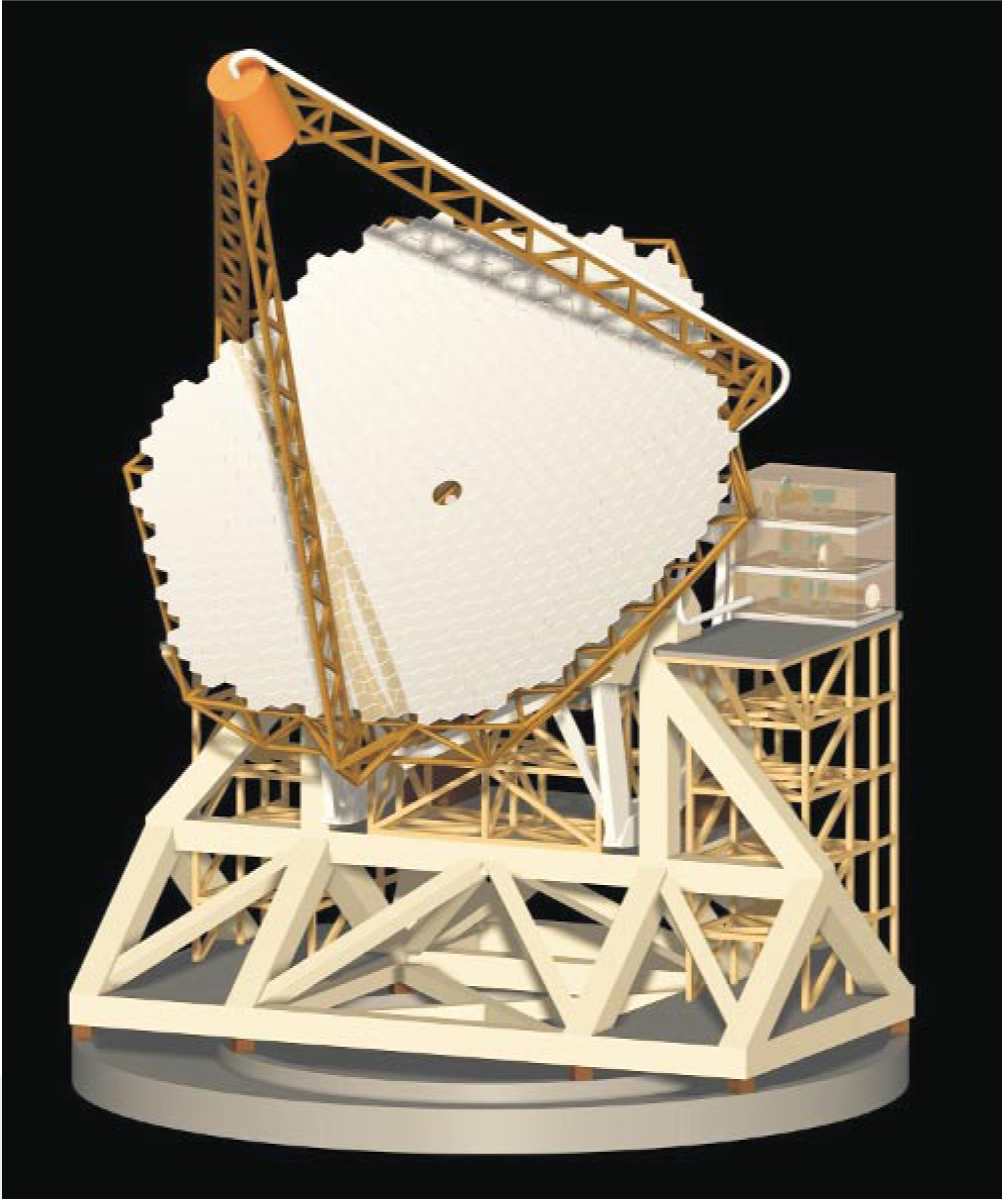
As US astronomy entered the new millennium, concerns about the equitable distribution of the nation’s astronomical resources had not entirely disappeared. But there were encouraging signs of reconciliation. For example, in May 2003, astronomers representing AURA, Caltech, and the University of California issued a letter of intent in which they agreed to cooperate “to achieve complementarities in their respective efforts” to build a 30-m telescope such as the one shown in figure 6. Meanwhile, private observatories like Keck have opened their doors partway to visiting astronomers in exchange for additional NSF support. With price estimates for future giant telescopes approaching $1 billion or more, questions about private versus national control of telescopes and the amount of government involvement in managing science will continue to hold an important role in shaping astronomy’s future.

Figure 6. Giant Segmented Mirror Telescope proposed by the National Optical Astronomy Observatory. NOAO’s 30-m-telescope project complements a similar effort administered by Caltech and the University of California. A new agreement among the three institutions may usher in a period of public and private cooperation.
(Courtesy NOAO, AURA, and NSF.)

A more detailed discussion of the material in this article, along with a history of post-1950 telescope-building in the US, is presented in W. Patrick McCray, Giant Telescopes: Astronomical Ambitions and the Promise of Technology (Harvard U. Press, in press). In preparing that book, the author made extensive use of papers and correspondence from the Caltech Institute Archives and the Harvard University Archives. In addition, he examined published materials and oral histories with Goldberg and Greenstein that are in the collections of the American Institute of Physics’s Niels Bohr Library in College Park, Maryland.
References
1. L. Aller, Biographical Memoirs, vol. 72, National Academy of Sciences, Washington, DC (1994), p. 114.
2. D. H. DeVorkin, Hist. Stud. Phys. Biol. Sci. 31, 55 (2000).
3. D. J. Kevles, Isis 68,5(1977) https://doi.org/10.1086/351711 .
4. D. J. Kevles, The Physicists: The History of a Scientific Community in Modern America, Harvard U. Press, Cambridge, Mass. (1995).
5. W. P. McCray, Soc. Stud. Sci. 30,685(2000) https://doi.org/10.1177/030631200030005002 .
6. W. P. McCray, Technol. Cult. 42,265(2001) https://doi.org/10.1353/tech.2001.0076 .
7. N. Reingold, Hist. Stud. Phys. Biol. Sci. 17,299(1987).
More about the authors
Patrick McCray is an assistant professor in the department of history at the University of California, Santa Barbara.
W. Patrick McCray, Department of History, University of California, Santa Barbara, US .