The 80-year nuclear legacy in the Marshall Islands


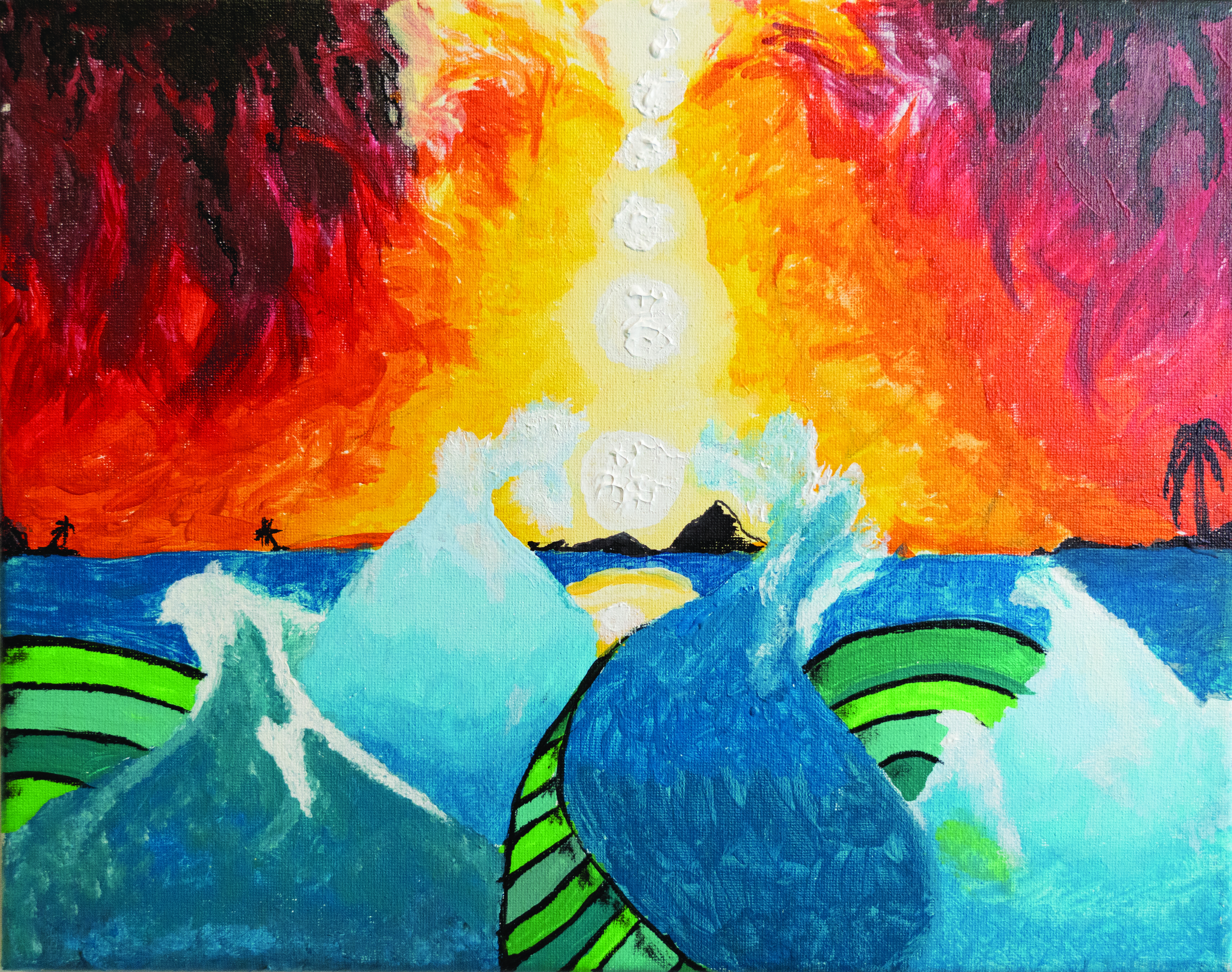
The Descent of a Thousand Suns, a 2022 painting by Marshallese artist Chapel Capelle, commemorates US nuclear detonations in the Marshall Islands by visualizing the descent of several suns into the ocean. The surrounding sky is depicted as if it is on fire.
(Image courtesy of Chapel Capelle and the Marshallese Educational Initiative.)

Between July 1946 and August 1958, the US conducted 67 nuclear detonations in the Marshall Islands, an archipelago in the northwestern Pacific Ocean. 1 2 The US occupied the islands during World War II and later governed them as a part of a United Nations trusteeship called the Trust Territory of the Pacific Islands. 3 4
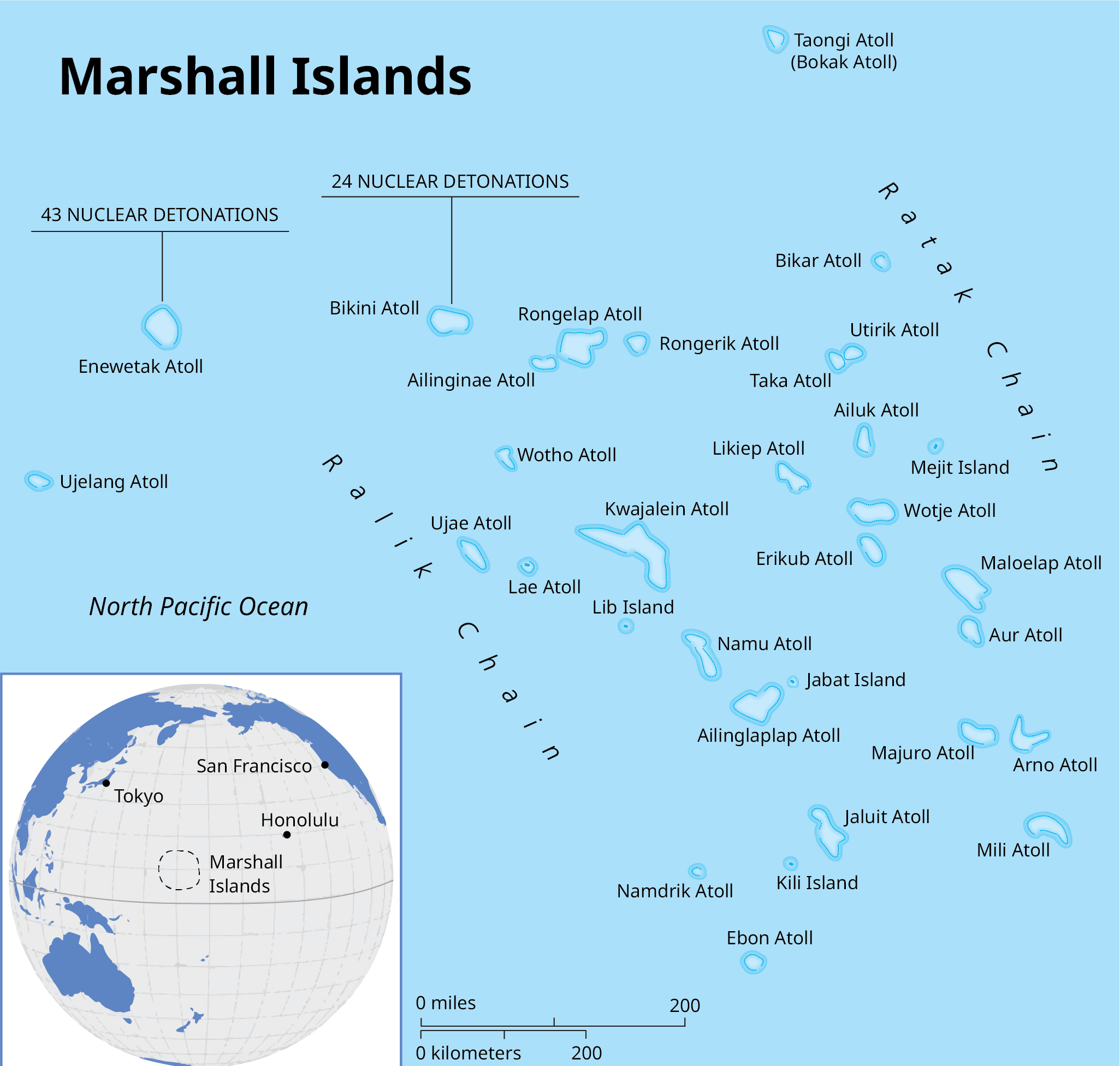
The Marshall Islands became the site of the largest and most devastating aboveground US nuclear explosions, including the first detonation of a hydrogen bomb, called Ivy Mike and detonated on 1 November 1952, and the most powerful US nuclear explosion on record: Castle Bravo, detonated on 1 March 1954. 2 Bikini and Enewetak Atolls, the two atolls used as proving grounds, are the most heavily contaminated, but fallout from the explosions reached others. Parts of the archipelago remain contaminated today, 5 and many Marshallese people continue to experience health effects associated with radiation exposure. 6

Benetick Kabua Maddison, executive director of the Marshallese Educational Initiative, participates in a discussion at the United Nations in New York City on 27 November 2023 as part of the Second Meeting of States Parties to the Treaty on the Prohibition of Nuclear Weapons.
(Photo courtesy of the Marshallese Educational Initiative.)

Although the technical and scientific histories of the explosions are relatively well known, the experiences of Marshall Islanders have received less attention. To mark the 80th anniversary of the beginning of US detonations in the archipelago, I sat down with Marshallese civil society leader Benetick Kabua Maddison to discuss how that history remains an important part of Marshall Islanders’ lived experiences today.
Kabua Maddison is the executive director of the Marshallese Educational Initiative (MEI), a nonprofit organization based in Springdale, Arkansas, that serves the Marshallese community in the US by educating audiences about the archipelago and its people, fostering intercultural dialogue, and helping members of the diaspora navigate life in the US. MEI also works to raise public awareness of the history and consequences of US nuclear operations in the islands. Under Kabua Maddison’s leadership, MEI contributed to the Office of the United Nations High Commissioner for Human Rights’ 2024 report on the nuclear legacy. 7 It is also providing input for the follow-up UN report, which is scheduled for release later this year.
I first met Kabua Maddison in connection with my research on the legal history of US nuclear operations and colonialism in the archipelago. 3 4 8 We were introduced in 2015 at the American Historical Association’s Pacific Coast Branch meeting, where he presented a paper on how Marshallese communities affected by nuclear explosions understand connections to their ancestral atolls.
We got together for another conversation about nuclear history on 29 June 2026, two days before the 80th anniversary of the Able explosion on Bikini Atoll—the first nuclear detonation in the Marshall Islands. Part of Operation Crossroads, the detonation was the first peacetime nuclear detonation and the fourth-ever nuclear explosion, after the Trinity test and the two bombs dropped on Japan. 9
The transcript of our discussion follows. It has been condensed and edited for clarity.
Io̧kwe, Benetick. We’re, of course, meeting to discuss nuclear weapons, but I thought we could start on a happier note. Could you tell Physics Today’s readers a little bit about the Marshall Islands? What are some of the wonderful and special qualities of the archipelago and the Marshallese people?
The Marshall Islands are located in the North Central Pacific between Hawaiʻi and Australia. The archipelago has six islands and over 29 atolls within a territory that’s about 1 million square miles. So, about the size of Kazakhstan. And, right now, the population is 42 000.

A map of the Marshall Islands, identifying all the major islands and atolls. The US nuclear detonations occurred on Enewetak and Bikini Atolls, but fallout from the explosions reached other atolls.
(Map adapted from iStock.com/PeterHermesFurian.)

Unfortunately, the majority of Marshall Islanders, including myself, are living outside the Marshall Islands. But in the islands, the weather is warm all year round. The water is turquoise blue. White, sandy beaches. Friendly people all around. It’s just an amazing paradise that, unfortunately, has this dark history.
You mentioned that you are living in the US. I wonder if you could tell us a little bit about yourself and about the Marshallese community in the US.

A beach on Majuro Atoll, pictured in 2016.

I was born in the Marshall Islands on the atoll of Majuro, which is the capital, and moved here to Springdale, Arkansas, with my parents and my siblings in 2001. We got to Arkansas on 4 March, and it was a culture shock for someone coming in from low-lying atolls to the Ozark Mountains of northwest Arkansas. In fact, when we landed, it was cold. It was snowing outside. And I was nervous because I was wondering to myself, “What is this? What is this white stuff falling from the sky? And why are there so many Caucasians?” So it was a cultural shock for me.
My family has lived here ever since. We came here for employment, for education, for health, and for other reasons that attract Marshallese people to the US. Today, Arkansas is home to the largest population of the Marshallese diaspora. We’re at 25 000 now and growing. I believe we already surpassed the population of Majuro.
Wow! That’s a very large community living in Arkansas. What first brought Islanders to Springdale? Do you have a sense of why folks wanted to come to this mountainous part of northwest Arkansas?
Marshallese people are able to come to the US through the Compact of Free Association, which is this international agreement between the Marshall Islands and the US that stems from the nuclear testing program. * This agreement initially [came into effect] in 1986. Prior to that, we were governed by the US as a United Nations trust territory. Therefore, we had people from our community come to the US for education. We had a lot of Marshallese here in the US attending college and vocational schools during the period of trusteeship.
One of them attended college in Oklahoma. His name was John Moody. After Moody was done with his education in Oklahoma, he moved up to northwest Arkansas, where Springdale is, and he found a job at the Tyson chicken company. He told families and friends back home about the job opportunities and the low cost of living in Arkansas. Marshallese people continue to move here, not just from the islands but also from the West Coast, places like California and Hawaiʻi. 10
So Springdale has become a hub for the Marshallese community in America even for people living elsewhere in the diaspora?
Absolutely. We have people here who tell me, “You know, there’s this person that I used to live with in California, and I just found out recently that they’re here.”
How did you first learn about US nuclear operations in the Marshall Islands? How did that come into your life in Springdale and into your work?

Independence Day celebrations on Majuro Atoll on 4 July 1944, shortly after the US occupied it during World War II.
(Image from box 2, folder 50, Photographs of the Civil Affairs Activities in the Trust Territory of the Pacific Islands, record group 38, National Archives at College Park, MD.)

Growing up, I always heard about the US nuclear testing program in the Marshall Islands, but it wasn’t something that I really delved into. I became much more aware of the nuclear legacy when I joined the Marshallese Educational Initiative. I was still in high school. On Nuclear Victims Remembrance Day in 2014, I was invited to the Clinton Presidential Library in Little Rock, Arkansas, to attend [an event commemorating] the 60th anniversary of the Castle Bravo disaster. † I was asked to speak on the importance of youth engagement and the impact of climate change, connecting that to the nuclear legacy.
From then on, I’ve been involved in raising awareness about the ongoing impact of the tests, as well as participating in international conferences—not just to raise awareness but also to demand that the world abolish these weapons of mass destruction.
I noticed just now, and I’ve heard on other occasions, that you often speak about these nuclear bomb detonations as a legacy rather than as a history. What does the term legacy convey that the term history doesn’t capture?
I think when people hear the word history, they often think about what happened in the past. And so for us Islanders, we use the word legacy because these are issues that we’re still dealing with to this day—issues that we are literally dealing with in our own homes, in our own bodies. Many of us continue to take care of loved ones who have cancer, who have diabetes, heart disease, and other chronic illnesses that are tied back to what happened in the Marshall Islands. 6 And it’s not something that we can ignore, or forget about, because it’s here. It’s the reality for all of us.
And so that’s why we call this the nuclear legacy instead of nuclear history. Because these issues are intergenerational. Our islands are still contaminated, and they will be for tens of thousands of years, impacting thousands of generations down the road. 11 12 13
Could you speak to some of the other ways that Marshallese communities living in the US are still affected?
The most obvious one is migration. Before the Compact of Free Association, there was the UN Trust Territory of the Pacific Islands, which was this [1947] agreement between the US and the UN. 3 Under that agreement, the US was supposed to take care of us. It was supposed to take care of the development of our islands, of our well-being. But that was not the case. Instead of investing in the Marshall Islands, the US was investing in nuclear weapons. We move here to the US seeking opportunities that should have existed over there [in the Marshall Islands] in the first place. When we think about the destruction of lands, you cannot do any economic development on those lands because they’re poisoned. ‡ And so people have to come here for jobs. 10

Members of the Marshallese community in Springdale, Arkansas, and staff from the Marshallese Educational Initiative pose with a delegation from the Office of the United Nations High Commissioner for Human Rights during a meeting in Springdale on 21 May 2025.
(Photo by April L. Brown, courtesy of the Marshallese Educational Initiative.)

We’re also dealing with a health-care system back home that is not sufficient. Yes, it is universal health care where people do not have to worry about health insurance or high medical bills. But we don’t have oncologists. Sometimes the dialysis machine breaks down. And so people have no choice but to come to the US for these opportunities or to seek help. 14 15
There’s also cultural loss. A lot of the children who are born in the US or who come here at a very young age, like myself, lose their language. They lose their ancestral ways. Many do not know the ancient chants. Many do not know how to make traditional medicines or how to navigate or how to build traditional homes. And so these are some of the larger consequences of the testing. 12 13
What are some of the things that the Marshallese Educational Initiative is doing to address some of these issues?
We don’t just talk about the nuclear legacy. We also provide programs and services to uplift Marshallese community members. For our youth, we provide programs that connect them to our elders, where they can learn the language, the culture, the history. And, in fact, just from our experience with that, a lot of young Marshallese are interested in knowing more about who they are and where they come from.
What’s also interesting is that when you ask a Marshallese child born here in the US, “Where are you from?,” they automatically say, “I’m from the Marshall Islands.” They don’t say “I’m from the US,” despite the fact that they were born here. That shows that we are still connected to our islands in some ways, and we’re trying our best to maintain our identity despite everything that we’ve been through and are still going through. This is where MEI steps in to ensure that opportunities [to learn] our history, our culture, and the language are provided to our community, so that they can continue to embrace who they are.
It’s a really big year with the 80th anniversary of the beginning of US nuclear detonations in the Marshall Islands. What is MEI doing to commemorate the anniversary at home in Springdale and far beyond?
We’re hosting the Solidarity concert, featuring MARK Harmony, which is a Marshallese local boy band here in Arkansas. [The concert was held on 30 June.] We’ve been collaborating with the band since last year on creating a 10-song album. [The album was released on 10 September.] And the songs are really moving, powerful, and all connected to the nuclear legacy. So that’s one of the ways we’re trying to remember the past but also educate others that these issues are not history; these issues are ongoing. We also plan to take the band on a nuclear-free-world tour, launching in Geneva later this year when the Office of the UN High Commissioner for Human Rights introduces its [upcoming] report on the Marshall Islands nuclear legacy to the UN Human Rights Council. [The tour will start on 25 September.]

The Marshallese band MARK Harmony (from left, Kairo Langrus, Raygon Jacklick, Arsi Lokot, and Matthew John) performs at the 2023 Nuclear-Free Future Awards in New York City.
(Photo by April L. Brown, courtesy of the Marshallese Educational Initiative.)

Why is song such a powerful way of speaking to the nuclear legacy?
Yeah, so, these are lived experiences. It’s hard to talk about these things. And so we find other mediums to try to get the message out, whether that’s poems, movies, or songs, and so forth. We decided, well, let’s use songs, but also artwork and storytelling for this Solidarity concert. It’s a blend of everything that we try to use to convey how we feel about these issues and how they impact us.
And songs are traditionally a very important part of Marshallese culture, right?
They are! I mean, when you’re in the islands, you’ll see people with their ukulele ready to sing. We sing at home, in churches, at community gatherings. It’s a really important part of who we are. 16
If you could leave Physics Today readers with something that you wish scientists, historians, and the general public would keep in mind, what might that be?
That’s a very good question. It’s really important to note that we are still trying to seek justice. But I think the most important thing that needs to happen is that we need these documents about nuclear explosions and contamination that the US continues to withhold from us. In its [2024] report, 7 the UN Office of the High Commissioner for Human Rights noted that there are 80 million documents that the United States continues to withhold from the Marshallese people. § The first step that needs to happen is the release of all these documents in order for us to determine what is owed.
Footnotes
* The Compact of Free Association transitioned the Marshall Islands from a US-governed status of trusteeship to a self-governing status called free association. Under the agreement, the US required the Marshall Islands to accept a global settlement of all nuclear claims. The US furnished a $150 million settlement trust fund but stripped its federal courts of jurisdiction over pending and future nuclear claims. The fund did not come close to covering the damages subsequently adjudicated by the international tribunal established to handle the claims: Almost $1 billion worth of those awards remain unfunded. Federal courts have dismissed litigation over the settlement, and the US government has declined to reopen negotiations.
† Nuclear Victims Remembrance Day is held annually on 1 March, the anniversary of the Castle Bravo detonation, which exposed hundreds of Marshall Islanders to radioactive fallout. It is a national holiday in the Republic of the Marshall Islands.
‡ The kinds and levels of radiological contamination vary across the archipelago’s atolls and islands. Bikini, Enewetak, and Rongelap Atolls have the highest levels of contamination. 5 A remediated portion of Enewetak is home to a Marshallese community, but Bikini and Rongelap do not currently have full-time residents.
§ The US government states that it has declassified more than 10 million pages of documents relating to nuclear detonations in the Marshall Islands. But the 2024 UN report notes that the US acknowledges that 40 million–80 million potentially relevant pages remain unprocessed and therefore undisclosed. The latter figure is drawn from a comprehensive 2022 study by a US governmental advisory committee that examined the feasibility of declassifying all as-yet unprocessed records relating to nuclear operations and cleanup in the archipelago. 17
References
1. M. Smith-Norris, Domination and Resistance: The United States and the Marshall Islands During the Cold War, U. Hawaiʻi Press (2016).
2. B. C. Hacker, Elements of Controversy: The Atomic Energy Commission and Radiation Safety in Nuclear Weapons Testing, 1947–1974, U. California Press (1994).
3. M. X. Mitchell, “The Nuclear Charter: International law, military technology, and the making of strategic trusteeship, 1942–1947 ,” in Living in a Nuclear World: From Fukushima to Hiroshima, B. Bensaude-Vincent, S. Boudia, K. Sato, eds., Routledge (2022), p. 85.
4. M. X. Mitchell, Unsettling Sovereignty: International Law, Nuclear Weapons, and US Extraterritorial Power in Postwar Oceania, U. Chicago Press (2026).
5. M. K. I. L. Abella et al., “Background gamma radiation and soil activity measurements in the northern Marshall Islands ,” Proc. Natl. Acad. Sci. USA 116, 15425 (2019); C. E. W. Topping et al., “In situ measurement of cesium-137 contamination in fruits from the northern Marshall Islands ,” Proc. Natl. Acad. Sci. USA 116, 15414 (2019); J. A. Corcho-Alvarado et al., “Assessment of residual radionuclide levels at the Bokak and Bikar Atolls in the northern Marshall Islands ,” Sci. Total Environ. 801, 149541 (2021).
6. S. L. Simon et al., “Radiation doses and cancer risks in the Marshall Islands associated with exposure to radioactive fallout from Bikini and Enewetak nuclear weapons tests: Summary ,” Health Phys. 99, 105 (2010); R. Patel, “Aftermath of nuclear testing in the Pacific Islands ,” JCO Glob. Oncol. 10, e2400455 (2024).
7. Office of the United Nations High Commissioner for Human Rights, Addressing the Challenges and Barriers to the Full Realization and Enjoyment of the Human Rights of the People of the Marshall Islands, Stemming from the State’s Nuclear Legacy , A/HRC/57/77 (24 September 2024).
8. M. X. Mitchell, “Offshoring American environmental law: Land, culture, and Marshall Islanders’ struggles for self-determination during the 1970s ,” Environ. Hist. 22, 209 (2017).
9. J. M. Weisgall, Operation Crossroads: The Atomic Tests at Bikini Atoll, Naval Institute Press (1994).
10. E. Mitchell-Eaton, New Destinations of Empire: Mobilities, Racial Geographies, and Citizenship in the Transpacific United States, U. Georgia Press (2024).
11. E. W. Hughes et al., “Radiation maps of ocean sediment from the Castle Bravo crater ,” Proc. Natl. Acad. Sci. 116, 15420 (2019).
12. H. M. Barker, Bravo for the Marshallese: Regaining Control in a Post-Nuclear, Post-Colonial World, 2nd ed., Wadsworth (2013).
13. B. R. Johnston, H. M. Barker, Consequential Damages of Nuclear War: The Rongelap Report, Left Coast Press (2008).
14. P. A. McElfish, E. Hallgren, S. Yamada, “Effect of US health policies on health care access for Marshallese migrants ,” Am. J. Public Health 105, 637 (2015).
15. P. A. McElfish et al., “ ‘Just doing the best we can’: Health care providers’ perceptions of barriers to providing care to Marshallese patients in Arkansas ,” Ethn. Health 25, 1004 (2020).
16. J. A. Schwartz, Radiation Sounds: Marshallese Music and Nuclear Silences, Duke U. Press (2021).
17. Public Interest Declassification Board, Declassification of Records Relating to Nuclear Weapons Testing and Cleanup Activities in the Marshall Islands: Feasibility Study (August 2022).
More about the authors
M. X. Mitchell is an assistant professor in the federated department of history at the New Jersey Institute of Technology and Rutgers University–Newark in New Jersey. Her 2026 book Unsettling Sovereignty: International Law, Nuclear Weapons, and US Extraterritorial Power in Postwar Oceania explores the legal history of US nuclear colonialism in the Marshall Islands.