The last crisis of US physics


President Richard Nixon meets with George Shultz, director of the Office of Management and Budget, and economist Milton Friedman (from left) in the Oval Office on 6 August 1971.
(Photos by Byron Schumaker, photo no. WHPO-6503, White House Photo Office, Richard Nixon Presidential Library and Museum.)

For nearly 25 years after the end of World War II, physicists in the US enjoyed a period of unprecedented growth and societal prominence. Widely credited with ending the most destructive conflict in modern history, physicists moved to the center of public attention as no group of US scientists had ever before. They benefited from a seemingly limitless stream of government funding and a popular consensus that global leadership in physics was essential to US national security in the new nuclear age. 1
But at the turn of the 1970s, US physicists found themselves newly confronted with powerful challenges both to their moral stature and to the sources of government funding that had underwritten their field’s postwar golden age. As discontent with the Vietnam War boiled over on university campuses, physicists clashed with a powerful antiwar movement and a politicized student body that sharply criticized postwar entanglements between science and the military. 2 In Washington, DC, officials in the Nixon administration made extraordinary cuts to federal science funding that imperiled both long-running research programs and the careers of an entire generation of young scientists. The postwar boom ended fast and hard. (For a snapshot of the physics community’s response to the crash, see PT ’s June 1971 article by H. William Koch, the then-director of the American Institute of Physics, publisher of Physics Today.) By 1973, the crisis was undeniable. As theorist Sidney Drell put it, “the field is in deep trouble.” 3

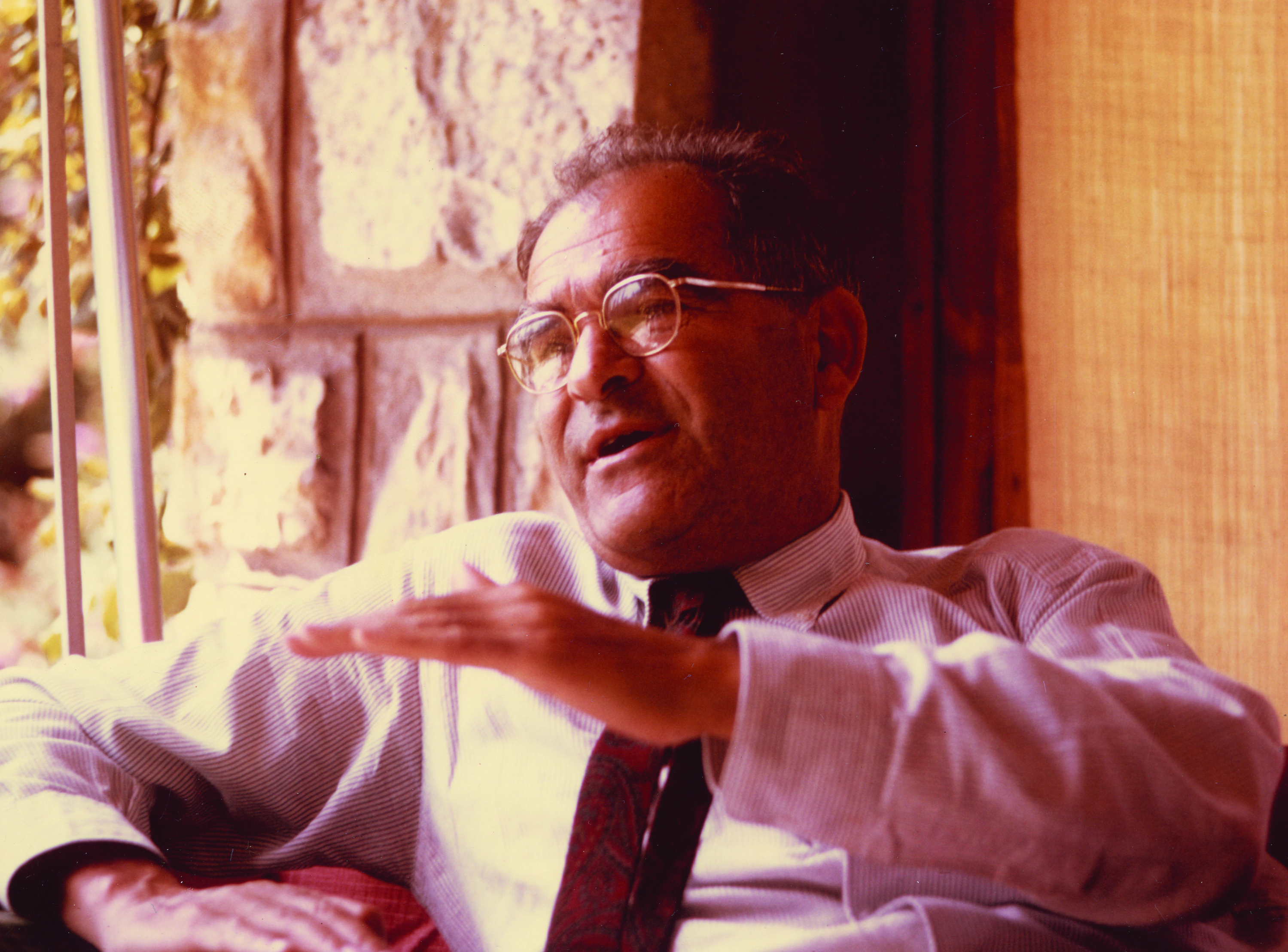
Particle physicist Victor Weisskopf in conversation.
(Undated photo from the AIP Emilio Segrè Visual Archives, Physics Today Collection.)

In the wake of devastating funding cuts to basic science, US physics entered a crash that would last for 15 years—one that was worse even than that endured during the years of the Great Depression. The fallout led young scientists to leave the field in droves and veteran science advisers to resign from government roles in protest. Victor Weisskopf, the renowned MIT particle physicist and director general of CERN from 1961 to 1965, announced his exit as chair of a major Atomic Energy Commission panel by paraphrasing Winston Churchill, vowing that he would not “preside over the demise of an empire” by continuing to serve the federal government. 4 Surveying the wreckage in 1981, the year before he was awarded the Nobel Prize in Physics, theorist Kenneth Wilson bemoaned “the liquidation of the American basic research establishment” over the preceding decade. 5
Austerity politics
At the time, many physicists attributed their stark reversal in fortune to a breakdown in the relationship between the scientific community and the public, a breakdown rooted in antiwar demonstrations, clashes with student protesters, and other confrontations. In hindsight, however, a different set of causes emerges, grounded not in campus politics or failures of public understanding but in the political landscape of the Nixon administration. In the early 1970s, a new crop of policymakers moved aggressively to renegotiate the postwar relationship between scientists and the government. Singling out dissident scientists as political enemies, administration officials skillfully painted scientists as out-of-touch, entitled elites and targeted big physics specifically for austerity. Those shifts led to disastrous consequences for basic research.
Attitudes toward science that would have been political anathema a decade before quickly hardened into a new common sense in Washington. “I am amazed when scientists say that we must embark upon a major technical project on faith—faith that through serendipity . . . it will turn out to be worthwhile after all,” remarked Murray Weidenbaum, a top Nixon Treasury official, in 1970. When a scientist asks for funding from taxpayers, he said, “He should have to answer questions such as these: Are the expected benefits worth the cost? How well can he measure the benefits? . . . Are the returns from this use of public funds likely to be greater than from alternative uses?” 6 That hard push into the language of economics, which often masked more nakedly political aims, powerfully reshaped the terrain on which scientists and policymakers would debate the value of government spending on basic research.
At the epicenter of the Nixon administration’s onslaught on science budgets was the Office of Management and Budget (OMB), a government agency established by executive order in spring 1970 as a redesignation of the Bureau of the Budget and formally tasked with oversight of the federal budget-making process. Despite its ostensibly technical purview, the OMB was an extremely powerful agency that famously doubled as a training ground for policy advisers and cabinet officials.
Directed by George Shultz, a friend and acolyte of economist Milton Friedman, the office was staffed by a veritable who’s who of up-and-coming Republican officials and right-wing economists, many of whom would rise to prominent roles in the Reagan administration a decade later. Its leaders included Caspar Weinberger (nicknamed “Cap the Knife” for his cost-cutting acumen), the future secretary of defense; Arthur Laffer, the mastermind of Reaganomics; William Niskanen, the future chairman of the libertarian Cato Institute; and James Schlesinger, a former RAND Corp economist who would replace nuclear chemist Glenn Seaborg as chairman of the Atomic Energy Commission in 1971, much to the dismay of US physicists.

Office of Management and Budget (OMB) personnel visit Oak Ridge National Laboratory in 1970. Starting from back left are lab director and nuclear physicist Alvin Weinberg (with glasses), OMB deputy director Caspar Weinberger, nuclear chemist Glenn Seaborg, and OMB assistant director Donald Rice.
(Photo from the Oak Ridge Office of Environmental Management, US Department of Energy/Flickr.)

Nixon’s OMB, holder of the federal purse strings, acted with few formal checks on its authority. It was notorious for using its role as auditor-in-chief to settle political scores and shape government policy through dubiously constitutional means. It drew the ire of many legislators by impounding congressionally appropriated funds, ignoring the recommendations of agency directors and advisory panels, and shutting Congress out of its private deliberations.
Critics charged that its staff of career politicos and PhD economists—“a miniscule group of elitists,” as one congressman described them—functioned as “the invisible Government of the United States,” according to another congressman, and threatened the very ideals of representative democracy. “The people who comprise the Office of Management and Budget are slide-rule experts and people who know the price of everything but the value of nothing,” a third congressman complained. “They sit there with this enormous power, wielding an ax or scalpel over the prostrated body politic, which is lying there being operated upon—sometimes not even knowing the identity of its surgeon.” 7
US science was not spared such treatment. In 1972, for example, the OMB unilaterally confiscated $32 million of congressionally appropriated funds for NSF educational programs. The action led Lloyd Humphreys, a top NSF official, to resign in protest, and Harold Davis, editor-in-chief of Physics Today, to declare in a January 1972 editorial that “the influence of the scientist in Washington affairs [has] decreased to an all-time record low.” Scientists observed that calls for belt-tightening often doubled as political retaliation for dissenting speech. Fiscal austerity, whatever its stated rationale, served as an important way for the Nixon administration to bring scientists to heel.
For high-ranking physicists who served as federal science advisers, the rough and adversarial style of OMB officials often came as a shock—a stark and sudden reversal from the postwar status quo. Wolfgang Panofsky, director of SLAC, was no stranger to policy circles. But he was nonetheless alarmed by a 1971 meeting with Niskanen and other “hard-nosed economists” in the OMB who announced their intention to let “the ‘political customer’ determine the level of financing” of basic research. 8

Wolfgang Panofsky, SLAC director from 1961 to 1984.
(Undated photo from the AIP Emilio Segrè Visual Archives, Physics Today Collection.)

Indeed, in just a few short years, Niskanen, Weinberger, and Schlesinger aggressively reshaped federal physics spending according to putatively economic notions of efficiency, cost, and benefit. Against the resistance of scientists, the officials repeatedly invoked dubious and often arbitrary measures of utility and productivity to justify drastic cuts to research budgets, with little concern for the long-term consequences.
The ideological impulses behind those actions are not difficult to identify. Agency staffers themselves joked that the high church of the OMB under Shultz was the University of Chicago’s department of economics—at the time widely recognized as a font of conservative and neoliberal intellectuals. Niskanen, a PhD graduate of the department, would publish a major study of the economics of government bureaus just months after his confrontational meeting with Panofsky in Washington.
In Niskanen’s book, which was widely influential in right-wing circles, scientific research managers appeared alongside welfare recipients and public-sector employees as “budget-maximizing” bureaucrats: government dependents who leveraged their privileged relationship to the state to extract an unearned “rent” from a victimized minority of US taxpayers. 9 While OMB officials certainly did not agree on all issues or adhere to a single political ideology, they found common ground in their opposition to federal spending on basic research. For avowed opponents of big government, Big Science was an obvious target.
Decimating a field
While many branches of physics suffered similar fates, the effects of the Nixon administration’s funding cuts were perhaps most dramatic in particle physics, which for many years had been the most lavishly funded and publicly prestigious field in US science. Between 1968 and 1975, more than a quarter of all personnel working at high-energy physics laboratories in the US lost their jobs, and the number of graduate students working at those facilities fell by more than half.
Funding for new equipment, laboratory improvement projects, and new experiments was slashed nearly to zero, while strikes, firings, furloughs, and forced shutdowns translated directly into losses of beam time and slowed experimental programs. By 1971, utilization at most US accelerator facilities had already dipped below 65%, and it fell below 50% by the middle of the decade. In an ironic twist, the very austerity measures justified in the name of efficiency dramatically reduced the productivity of US research laboratories by every measure.
In the span of less than five years, more than half of all high-energy-physics laboratories in the US were shut down or scheduled for closure: the Caltech synchrotron, the Princeton–Pennsylvania Accelerator Laboratory, the Cambridge Electron Accelerator, Lawrence Berkeley National Laboratory’s Bevatron, and Argonne National Laboratory’s Zero Gradient Synchrotron. Directors of those laboratories, like Argonne’s Robert Sachs, decried how smaller facilities were “picked off one-by-one” 10 as leading science advisers funneled diminishing funds into the three largest domestic facilities: SLAC, Brookhaven National Laboratory, and the National Accelerator Laboratory (now known as Fermilab).
Other subfields suffered similar fates. The Los Alamos Meson Physics Facility, for example, saw its budget slashed by two-thirds, about $10 million, in 1969 alone. Researchers in solid-state physics—by the 1970s, the largest specialization in the US physics profession—struggled to scrape together funds both for extant laboratory programs and exploratory research. 11 (For more on the evolution of solid-state physics, see the January 2019 PT article “When condensed-matter physics became king ,” by Joseph D. Martin.) Across the field of physics, particularly within more marginal and smaller-budget subfields, numerous projects were abruptly and unceremoniously canceled altogether.

The employment crisis in physics was a major topic in Physics Today during the early 1970s. The May 1971 issue’s State and Society department featured no less than three articles on the crisis, one of which contained several charts illustrating the severity of the problem.

After years of steady growth in academic employment opportunities for young PhD graduates, the physics profession entered an unprecedented tailspin of hiring freezes and job cutbacks. In 1968, US physics departments hired between 1100 and 1200 new faculty members; by 1973, that figure had fallen by half, even while newly minted PhDs continued to pour out of full pipelines at a rate that continued to rise into the early 1970s. In 1967, the American Institute of Physics Placement Service registered more employers than new PhDs seeking jobs; in 1971, more than 1000 applicants competed for just 53 entry-level positions.
Of the physicists who completed doctorates in the US, many (14% in 1971) left the country to seek employment abroad, while thousands of young researchers chose instead to leave the profession for other fields. 12 Indeed, 35% of individuals who received physics PhDs from US universities in 1967 and 1968 left the field entirely; many migrated into industry jobs in engineering fields, operations research, and the biosciences.
Experienced PhDs—physicists who received their degrees shortly before the crash—fared the worst; many scientists employed as postdoctoral researchers or as staff scientists in national or industrial labs saw positions once assumed secure to be abruptly terminated (reported on in the May 1971 PT news article “Job shortage hits older physicists hardest ”). Physicists denied tenure in their departments struggled considerably to find new employment in traditional physics jobs, with only 1 in 10 (according to one 1974 estimate) remaining in academia. 13
Perceptions of the difficulties facing those on the academic research track led many PhD recipients to forgo the pursuit of university employment altogether and to take jobs in applied research fields directly out of graduate school. For many years, talk of the manpower crisis, as it came to be known, filled the pages of science magazines, departmental memos, and advisory committee reports, with lasting consequences for the morale and outlook of physicists at all stages of their careers.
The aftermath
The long-term consequences of the crisis were profound and far-reaching. In a 1973 speech at SLAC, Andrew Sessler, director of Lawrence Berkeley National Laboratory, offered one prediction from inside the eye of the storm. “I think I can say with no exaggeration,” he projected, “that when the course of physics in the twentieth century is plotted by some historian of the future, it will show that the center was in Europe up until the early ’30s, that it switched at that time to America, and that then it switched back to Europe in approximately 1970.” 14
Sessler’s speech proved prophetic—at least for his branch of physics. European support for high-energy physics surpassed US funding levels in 1971 and continued to climb steadily well into the 1980s, bankrolling ambitious accelerator upgrades and experimental projects at CERN and the German Electron Synchrotron (DESY) while US laboratories continued to struggle with budgetary shortfalls and year-to-year uncertainty. European collaborations soon overtook their US counterparts in rates of publication and claimed many of the major experimental results of the period, which led many US physicists to look to beamlines overseas for the field’s cutting edge.
The late-breaking cancellations of two major US accelerator projects—the ISABELLE collider at Brookhaven in 1983 and the Superconducting Super Collider in Texas in 1993—solidified a shift that had, in many respects, already come to pass. By the early 1980s, the center of experimental particle physics had moved decisively across the Atlantic. While the US remained the geographic center of many other fields of physics, researchers across specialties were forced to adapt quickly to a new and scarcer reality.
The funding cuts of the 1970s also had more subtle effects on the US physics profession. MIT physicist Lee Grodzins in 1986 undertook a study of what he called “the graying of the physics faculties”: a steady rise in the average age of physicists employed at research universities across the US and a marked shift in the composition of physics departments from junior to more senior ranks. In the 15 years since 1970, Grodzins found, the average age of university physicists had climbed from below 40 to over 50, and the percentage of junior faculty had dropped from more than 35% to less than 13%.

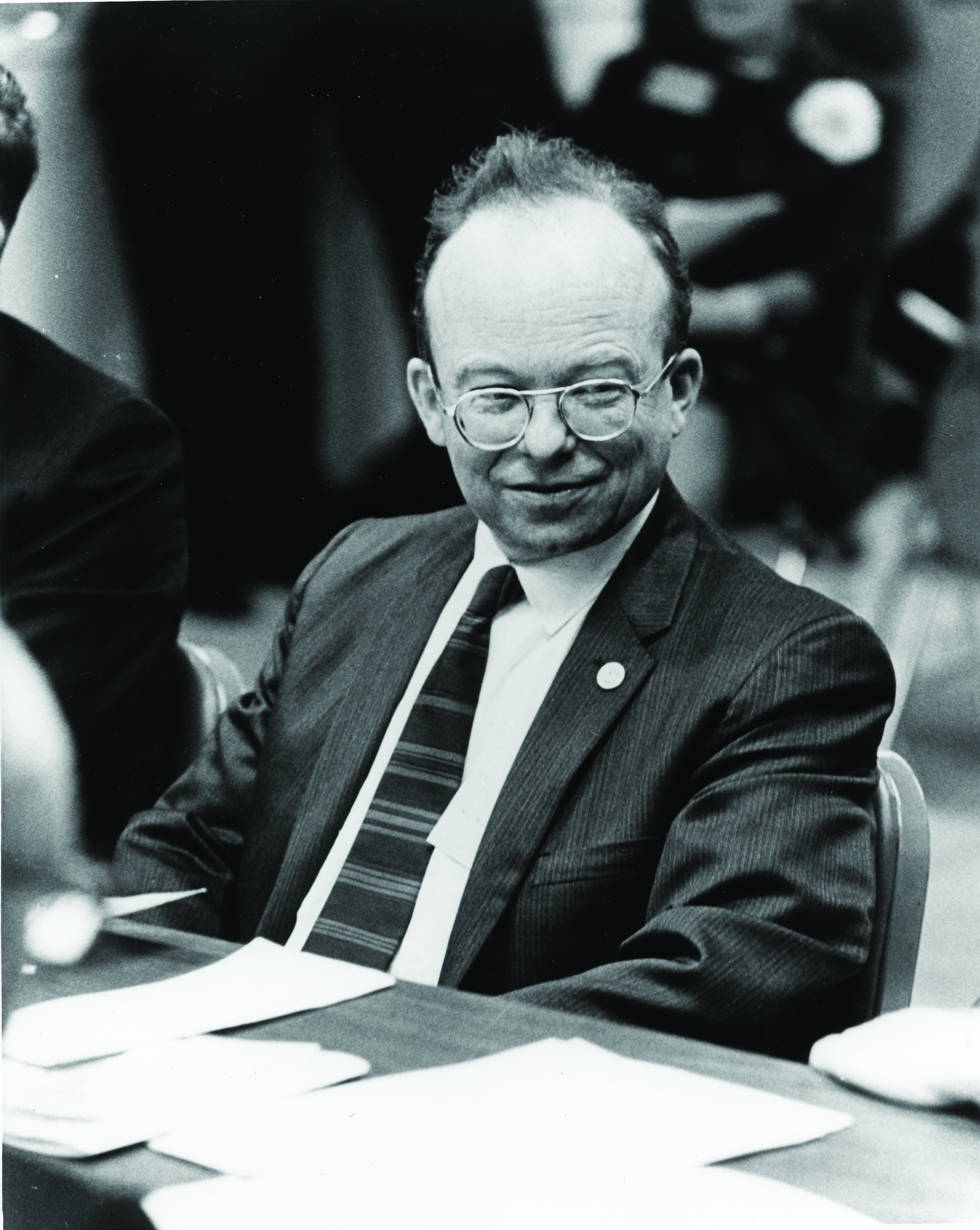
MIT physicist Lee Grodzins, pictured here in 2013, compiled several reports in the 1970s and 1980s on the employment crisis in physics.
(Photo courtesy of Justin Knight/CC BY-NC-ND 3.0 .)

As Grodzins emphasized, those figures were not a natural result of funding cuts to physics in general but rather a consequence of how many departments had chosen to respond to the shortfalls—namely, by eliminating positions at the lower rungs of the academic hierarchy and consolidating resources at the higher ranks. 15 As elsewhere in the US economy, the drought in permanent positions for young scientists was accompanied by a general rise (as a percentage of total opportunities) in contingent forms of employment, which typically took the form of postdoctoral appointments and short-term visiting positions.
The prolonged drought in positions for young scientists had particularly pernicious effects on the gender and racial demographics of US physics in the decades to come. As historians and physicists have noted, the postwar decades were a low-water mark in the entry of women and people of color, particularly African Americans, into the physics profession—a trend that had only just begun to reverse in the lead-up to the Nixon-era funding cuts. 16 Although women and people of color were marginally more successful than their peers in securing academic positions during the crash, they, too, struggled considerably to find secure positions either in universities or in industry. The crisis of the 1970s effectively froze the demographics of the US physics profession as they were in the mid 1960s.
But those disruptions also created openings for new ways of doing and organizing physics, many of which broke sharply with the conventions of the 1950s and 1960s. Neutrino and cosmic-ray physicists, long used to playing second fiddle to colleagues working at accelerator facilities, pioneered new approaches to high-energy experiments outside the walls of the laboratory by moving underground into subalpine tunnels and commercial mine shafts in far-flung locales around the globe. In transatlantic networks traversing the US, UK, and Soviet Union, general relativity enjoyed a renaissance and resurfaced as a major field of research after decades of quiescence. 17 In many cases, physicists responded to shortfalls in federal science funding by experimenting with new financial and institutional partnerships with corporations, philanthropies, and individual donors—with varied and contradictory results.
Navigating uncertain career prospects and the skepticism of more established researchers, young physicists with ties to the US counterculture returned to fundamental, philosophical questions about the interpretation of quantum mechanics that had long been pushed aside in the packed classrooms of the postwar years. In doing so, they laid the foundations of what is now a major field of research—quantum information science—through informal discussion groups and unconventional collaborations with figures on the West Coast fringe. (For more on that history, see David Kaiser’s June 2025 PT article, “Hippies, Bell tests, and a career studying quantum entanglement .”)
Chafing against what they saw as the excessively restrictive structures of the postwar university, physicists experimented with new organizational models and labored to build a new world of flexible institutions devoted to hybrid forms of theoretical and computational research. Perhaps counterintuitively, the ruthless pragmatics of austerity politics and the Nixon administration’s strategic economism created new opportunities for what some described as the rehumanization of US physics after two decades of Cold War conformity. 18
A striking parallel
Physicists today are faced with many of the same dilemmas as their predecessors a half century ago. Once again, physicists face extraordinary cuts to federal research lines in the name of efficiency, many of which have been enacted by unelected officials in the OMB and the Trump administration’s so-called Department of Government Efficiency. And once again, physicists face sharply ideological attacks on the integrity of research scientists and their value to society as well as extraordinary efforts by public officials to discipline dissenting scientists and remold US science into an image more favorable to those in power. More than ever before, elite critics of the administrative state hold the levers of state power—and the purse strings of US science.
No doubt, a better understanding of the last crisis of US physics—and of the long-term historical sources of the present conjuncture—might help inform better decision-making today as individuals, departments, and administrators navigate challenging and unpredictable circumstances. If the past is any guide, physicists would do well to consider the long-term effects of different approaches to crisis mitigation. What may seem like short-term fixes today could end up affecting careers, departments, and the profession 5, 10, or 20 years into the future. Physicists might also consider what opportunities, however slim, the present crisis offers to break out of old and deep-rooted ways of doing science and to recover lost or neglected possibilities: unfashionable areas of research, unorthodox ways of organizing physics, or unconventional ways of being a physicist.
Above all, history shows the importance of framing the present crisis as a political issue rather than strictly as a failure of public understanding or erosion of trust in science, although outreach initiatives and educational programs guided by those goals remain vital. As in the 1970s, the political opponents of physics today are eager to reshape the common sense by which the public assesses the purpose of science and the value of scientists. To mount a response to the present onslaught on US science, physicists will need to refuse their antagonists’ terms of debate and think strategically—and expansively—about how to forge new alliances between scientists and others committed to a just and intellectually creative future.
References
1. D. J. Kevles, The Physicists: The History of a Scientific Community in Modern America, Harvard U. Press (1995), chap. 23; D. Kaiser, “Cold War requisitions, scientific manpower, and the production of American physicists after World War II ,” Hist. Stud. Phys. Biol. Sci. 33, 131 (2002).
2. D. J. Kevles, in ref. 1, chaps. 24–25; D. Kaiser, How the Hippies Saved Physics: Science, Counterculture, and the Quantum Revival, W. W. Norton (2011), chap. 1; S. Bridger, Scientists at War: The Ethics of Cold War Weapons Research, Harvard U. Press (2015).
3. S. Drell, memorandum (1 May 1973), “The support of high energy physics in the USA,” box 08-002, folder 5, Victor Frederick Weisskopf Papers, MC-0572, Department of Distinctive Collections, MIT Libraries.
4. V. F. Weisskopf (17 December 1973), “Speech at SLAC, HEPAP resignation,” box 11-016, folder 48, Weisskopf papers, in ref. 3.
5. K. G. Wilson, memorandum (15 July 1981), “A push for major improvements in both large-scale computing capability and simulation techniques for physical processes,” box 6, folder 3, Kenneth G. Wilson Papers, 14-22-4086, Division of Rare and Manuscript Collections, Cornell U. Library, p. 14.
6. P. M. Boffey, “R&D funding: Top Treasury aide decries blind faith approach ,” Science 170, 512 (1970), pp. 512, 515.
7. L. Berman, The Office of Management and Budget and the Presidency, 1921–1979, Princeton U. Press (1979), pp. 123.
8. W. Panofsky, memorandum (24 February 1971), “Discussions in Washington concerning high energy physics financing,” box 08-001, folder 4, Weisskopf papers, in ref. 3.
9. W. A. Niskanen Jr, Bureaucracy and Representative Government, Routledge (1971).
10. R. Sachs, quoted in “Minutes: High Energy Physics Advisory Panel, December 17–18, 1973,” box 08-004, folder 5, Weisskopf papers, in ref. 3.
11. J. D. Martin, Solid State Insurrection: How the Science of Substance Made American Physics Matter, U. Pittsburgh Press (2018), chap. 5.
12. L. Grodzins, report (1974) “Where have all the physicists gone?,” box 5, folder 7, Lee Grodzins Personal Archives, MC-0767, Department of Distinctive Collections, MIT Libraries; D. Kaiser, in ref. 2, p. 28; L. Grodzins, The Manpower Crisis in Physics: Special Report of the Economic Concerns Committee, American Physical Society (1971).
13. L. Grodzins, “Where have all the physicists gone?,” in ref. 12.
14. A. Sessler, speech at SLAC (17 December 1973), box 08-004, folder 3, Weisskopf papers, in ref. 3.
15. L. Grodzins, draft report (1986), “The graying of physics faculties,” box 12, folder 12, Grodzins archives, in ref. 12.
16. See, for example, E. F. Keller, “The anomaly of a woman in physics,” in Working It Out: 23 Women Writers, Artists, Scientists, and Scholars Talk About Their Lives and Work, S. Ruddick, P. Daniels, eds., Pantheon Books (1977), p. 77.
17. S. Weinberg, “The decay of the proton ,” Scientific American, June 1981, p. 64; A. Blum, R. Lalli, J. Renn, “The reinvention of general relativity: A historiographical framework for assessing one hundred years of curved space-time ,” Isis 106, 598 (2015).
18. Aspen Center for Physics, “Role of the physics division in the program of the Aspen Institute,” (1968).
More about the authors
Julia Menzel is the Kenneth O. May Postdoctoral Fellow at the Institute for the History and Philosophy of Science and Technology at the University of Toronto.