Santa Barbara, physics, and the long 1970s
DOI: 10.1063/PT.3.2115
The late 1960s through the early 1980s—the long 1970s—were tough years for US physicists. Following explosive growth after the 1957 launch of Sputnik, federal R&D funding across all disciplines declined for a decade after 1966 and, as adjusted for inflation, did not return to its previous peak until 1983. And it was the physical sciences and engineering that bore most of the impact.
The overproduction of physics PhDs after World War II combined with severe cutbacks in the aerospace industry in the late 1960s and early 1970s to create what physicist and historian David Kaiser has called “the worst job shortage [for physicists] the nation has ever seen—far more protracted than any employment-placement difficulties during the Depression years.” 1 Culturally, many in the US, especially baby boomers, had become disenchanted with physics, due to the discipline’s close association with both the Cold War nuclear complex and the hot war in Southeast Asia. And since physics jobs were scarce and increasingly undesirable, fewer and fewer young people sought PhDs in physics; as a result, some universities’ graduate programs neared collapse.
For many US physicists, then, the long 1970s were a lost decade, best forgotten quickly. Yet looking back to those years can offer many lessons, in part because we may now be experiencing a similar period of sharp budgetary and cultural pressures on scientists. Moreover, the unconventional ways in which some physicists responded to crisis conditions back then have become ubiquitous features of the US scientific enterprise today. In a sense, we are still living in the long 1970s, even if some of the wilder aspects of that era seem increasingly alien and remote.
Few regions illustrate the strangeness, creativity, and lasting influence of the crisis years more than Southern California. Home to a vast aerospace industrial district, Southern California reeled from the impact of cuts to the NASA and Department of Defense R&D budgets. Though less restive than their Bay Area peers to the north, Southern California undergraduates protested and rioted enough to force major changes in local university life, including in the conduct of academic science. The 1969 Santa Barbara oil spill seared environmental issues into local citizens’ consciousness, while the constant drumbeat of smog alerts raised pressure on scientists to find a technological fix for pollution. To top it all, the long tradition of Southern California countercultural spirituality blossomed in the late 1960s and unavoidably spilled over into scientific labs and classrooms.
Many physicists navigated the 1970s with few changes to their personal or professional lives, and they did good work along the way. What follows is in no way meant as a slight to those who labored to preserve the best features of postwar physics in a period of chaos and sometimes unsalutary change. Some of the “reforms” of the 1970s were anti-intellectual fads; others were well meaning but rolled out too hastily, with little wisdom or foresight. In such an environment, scientists had every reason to be skeptical of untried experiments in the conduct and organization of research.
For some individuals, though, the turbulence of the times demanded experiments in how to do physics and how to be a physicist. I have identified one particularly fascinating cluster of Santa Barbara physicists whose experience of the long 1970s was marked repeatedly by radical departures, unconventional approaches, and a willingness to risk failure and learn from mistakes. In telling their story, I will focus on three individuals—Philip Wyatt, David Phillips, and Virgil Elings—but readers should keep in mind that their pedagogical, entrepreneurial, and scientific experiments were fostered by a broad network of students, colleagues, employees, funders, spouses, children, philanthropists, and other fellow travelers. Indeed, that is partly the point: The chaos of the 1970s encouraged some physicists to listen to and work with a broader and more unusual (occasionally even dysfunctional) spectrum of collaborators than they had in the flush 1960s.
Science Spectrum
In the late 1960s, Santa Barbara was still an out-of-the-way place to do physics. The physics department at the University of California, Santa Barbara (UCSB), was only founded in 1960, when the broader physical science department split up; a decade later it was just beginning its rise to national prominence. The city’s industrial-physics community was tied to the Southern California aerospace district, particularly through Hughes Aircraft’s Santa Barbara Research Center, but not as closely as physicists in Los Angeles, Pasadena, or perhaps even San Diego. Since the 1950s many Santa Barbara physicists had been employed by defense think tanks located there explicitly—as a brochure for one such outpost put it—“to provide isolation from the day-to-day interchange with engineering and manufacturing functions . . . and to encourage independent and objective studies by the technical staff.”
Among those think tanks was Defense Research Corp, where Philip Wyatt, a young theoretical physicist, spent the mid 1960s exploring ways to differentiate incoming nuclear warheads from decoys. Wyatt’s attention wandered, however, and by 1967 he had come up with a scheme for laser-based pathogen detection and had persuaded the US Army to fund it. Friction with management led Wyatt to leave Defense Research for another think tank and then to found his own company, Science Spectrum, in 1968 with the aim of commercializing his inverse-scattering particle-characterization technology.
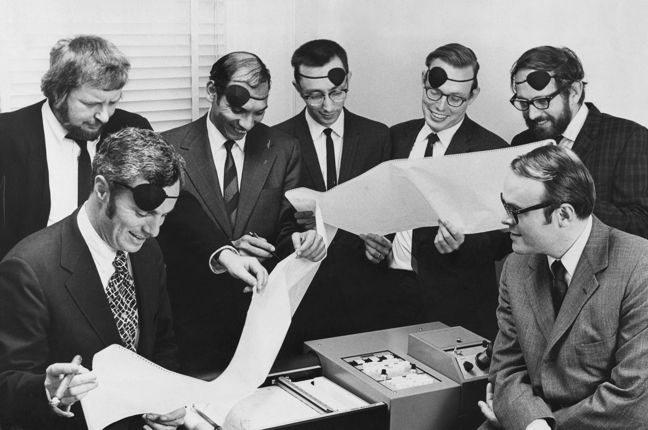
While at Defense Research, Wyatt was in training as one of the final 15 candidates in NASA’s first scientist-astronaut program. Wyatt’s stint as a trainee astronaut was in keeping with his maverick nature—perhaps also apparent in figure 1—which served him well in securing funding in the then-novel form of venture capital investment. It would be interesting to ponder what would have happed if Science Spectrum had been founded in the Bay Area, where the combination of maverick physicist-entrepreneur Donald Glaser, life-sciences instrumentation, and venture capital yielded Cetus Corp and the first steps toward the biotech industry.

Figure 1. Science Spectrum employees gather around their first multi-angle light-scattering instrument in 1970. Philip Wyatt is in the front row to the left. David Phillips is in the back row, second from the right. The eye patches, included at no extra cost, were used to enhance the contrast when viewing through the instrument’s monocular. (© Wyatt Technology Corp.)

Science Spectrum was no Cetus, but it did enjoy some success, including an Industrial Research IR 100 Award (precursor to today’s R&D 100 Awards given by R&D magazine) in 1972. That achievement was facilitated in part by Wyatt’s and his employees’ willingness to depart from Cold War military–industrial applications and creatively hustle for civilian partners. Though Wyatt conceived of Science Spectrum’s particle-characterizing photometers in a context of missile tracking and biowarfare, by 1970 he was telling local citizens that his company was in an excellent position to fight pollution because its technology could be used to study smog. 2 Medical applications beckoned as well; by 1972 Science Spectrum was in clinical trials with the National Institutes of Health to field-test its prototype photometer as a means for assaying the relative efficiency of various antibiotics against bacterial specimens. 3 The firm later collaborated with researchers at the Southern Research Institute in Alabama to apply its photometers to the detection of chemotherapy compounds in cancer patients’ blood. Science Spectrum also received a grant from the Food and Drug Administration to develop a technique for detecting veterinary drug residues in food-producing animals in collaboration with researchers at both the FDA and the Department of Agriculture. 4
Wyatt and colleagues were adapting a military–industrial technology and research infrastructure for civilian ends. They certainly weren’t the first physicists to make that move, but they were pioneers in answering early-1970s calls from the US Congress and the public to make physics more relevant to civil society. In today’s post–Cold War world, it is common sense for physicists to look to move dual-use technologies into the civilian marketplace. But it may nonetheless be worthwhile to look for lessons from the early 1970s, when that was not common sense—after all, military–industrial technologies are probably still awaiting widespread civilian deployment in markets such as solar-energy generation.
To make the transition, however, Wyatt needed help—specifically, a biologist to develop applications and represent customers’ viewpoints, and an experimental physicist to build user-friendly devices. For the former, he hired a PhD microbiologist; for the latter, he prevailed upon David Phillips, an assistant professor at UCSB, to consult for Science Spectrum and eventually to join the company. Phillips seems to have been critical to bringing Science Spectrum’s products to market. 5 Wyatt Technology Corp, Science Spectrum’s successor company, put it this way in publicizing its founder’s winning the 2009 American Physical Society Prize for Industrial Applications of Physics: Science Spectrum’s core technology emerged when “together with his colleagues, most importantly Dr. David T. Phillips, [Wyatt] modified a traditional light scattering photometer to incorporate a laser light source.”
Dad’s in the garage
Phillips must have been a reasonably competent experimentalist. So why did he allow Wyatt to distract him from the publish-or-perish demands of academia and ultimately cripple his chances of obtaining tenure? Remember that at the time the term Silicon Valley hadn’t been coined, biotech hadn’t been invented, and today’s mythologies of heroic high-tech startups were neither prevalent nor potent. The answer, perhaps, can be found in a song memorializing Phillips by his son Glen, frontman for the band Toad the Wet Sprocket:
Dad’s in the garage
Place of legend and fable . . .
We had 43 boxes of textbooks on physics
20-odd more on parapsychology
Well there’s DTP’s papers, DTP’s projects
Just one lonely box simply marked DTP.
6
Dad’s in the garage
Place of legend and fable . . .
We had 43 boxes of textbooks on physics
20-odd more on parapsychology
Well there’s DTP’s papers, DTP’s projects
Just one lonely box simply marked DTP. 6
That is, Wyatt’s job offer came just when Phillips was turning much of his attention toward projects that would be difficult to carry out while still on the tenure track and that in any case would likely have endangered his chances of getting tenure. In particular, he had become a serious student of the varieties of mystical experience and unexplained phenomena and a member of the growing corps of parapsychology researchers. Indeed, for several years before 1974, he was the research director of the Southern California Society for Psychical Research, and he frequently corresponded with or appeared on public panels with prominent parapsychologists such as Charles Tart and Hal Puthoff and members of Berkeley’s Fundamental Fysiks Group.
David Kaiser’s recent book on the Fundamental Fysiks crew argues that the budgetary and cultural upheavals of the early 1970s opened a space for the imaginative exploration of topics that had been foreclosed during the prosperous years of the early Cold War. 7 Some members of the Berkeley group may have been interested in ESP, astral projection, communication with the dead, and UFOs. Kaiser shows, however, that those interests inspired them to plumb mysteries of quantum mechanics—for example, Bell’s theorem—that most physicists at the time ignored but that, thanks in some measure to those “hippies,” have become mainstream topics today. What Kaiser underplays, but Phillips’s career highlights, is that the same conditions that encouraged some physicists to explore parapsychology also opened the doors for other unconventional endeavors: gathering venture capital and founding a high-tech startup, say, or adapting military–industrial research to environmental remediation, or devising new ways of teaching physics to a broader cross section of US society.
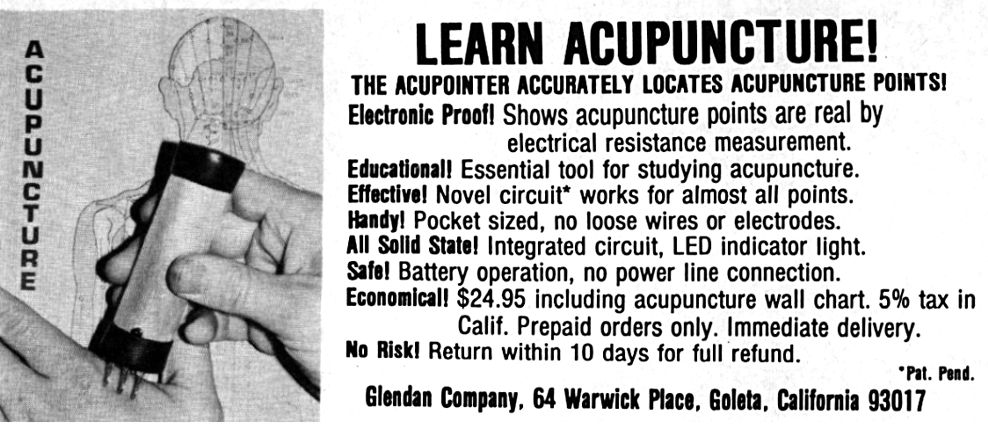
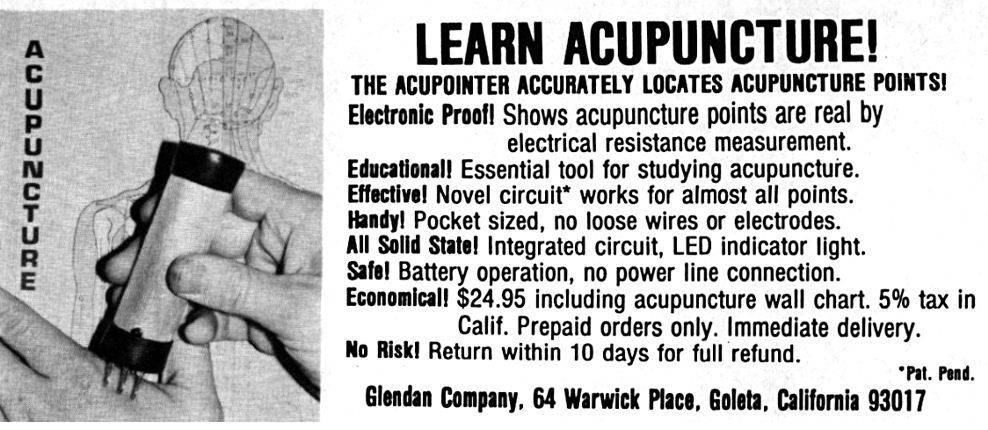
Phillips was doing all of those things. At the same time he was developing biomedical and environmental applications for Science Spectrum, he was building devices in his garage to measure various parapsychological phenomena. In some cases, he shared those contraptions freely with other local enthusiasts. However, he also formed his own startup, Glendan Co, named after his sons, to market his garage projects more widely. Figure 2, for instance, shows an ad for the Acupointer, a transistorized pen for locating areas of low skin resistivity that supposedly would be effective acupuncture points. And like many entrepreneurs, Phillips sought funding from wealthy investors; in one case he even drew up a legal contract with a local businessman to share future profits from sales of an ESP-testing machine in return for funding to develop the product.

Figure 2. The Acupointer was David Phillips’s device for locating acupuncture points. A similar Tobiscope was marketed by Virgil Elings. This advertisement comes from the October/November 1973 issue of Today’s Chiropractic, page 32. (Courtesy of Linda Phillips.)
Masters of instrumentation
Phillips also resembled today’s academic entrepreneurs in attempting to leverage his ties to a major research university. Although he had left UCSB’s tenure track, Phillips still maintained two campus connections. In the extradepartmental tutorial program, he cotaught with Robert Morris, a prominent parapsychologist. In the physics department, he was the junior partner to Virgil Elings, an assistant professor, in running an experimental new degree program to offer a master’s in scientific instrumentation.
The MSI program was one of several departmental adaptations to the difficult conditions of the early 1970s. Department brochures from the era complained of serious misconceptions about science as elite, colorless, and disconnected from the needs of civil society—perceptions that might explain the precipitous drop in the number of physics majors as a proportion of UCSB’s total enrollment. (Between 1959 and 1976 the decline was almost 73%.) Individual members of the department attempted to rehabilitate their discipline’s reputation in a variety of ways. For instance, lecturer Melvyn Manalis began offering a course on environmental physics that intended to show the relevance of physics to environmental topics. In a similar spirit, Anthony Korda, a technician and friend of Phillips who shared an interest in parapsychology, established a physics learning center to make experimental equipment available to the local community.
At the same time, the department, like others across the US, faced cuts in funding and a falloff in the number of PhD students. Campus administrators noted a 22% decline in the size of basic research grants to UCSB faculty in fiscal year 1972 alone, and PhD enrollment in the physics department decreased by a comparable amount between 1969 and 1971. The MSI program ameliorated both those losses by filling the department’s graduate program with paying customers who were willing to build experimental equipment for faculty for free as part of their education.
Elings’s outreach to prospective students marks the program as a product of both baby boomer scientists’ job insecurity and their desire to bring scientific knowledge to bear on the concerns of civil society. Ads told potential applicants that “the UCSB Master’s Program in Scientific Instrumentation is looking for Creative, Hardworking Bachelor’s Degree Scientists who want to Solve Real Problems . . . on campus and in nearby hospitals and industrial laboratories.” Elings also sold the program with a buzzword ubiquitous in the early 1970s and today: interdisciplinary. The US public and its politicians of the time associated single-discipline research with ivory tower isolation; they saw the pressing issues of the day—pollution, energy, health, urban problems, and so forth—as fixable only through the combined efforts of engineers, natural and social scientists, and scholars in the humanities. Sound familiar? In response, physicists scrambled to forge interdisciplinary connections with much greater urgency than they had a decade before. Elings was no different. Virtually every grant proposal, advertisement, and newspaper article profiling the MSI program in the early 1970s highlighted the interdisciplinary aspects of its curriculum.
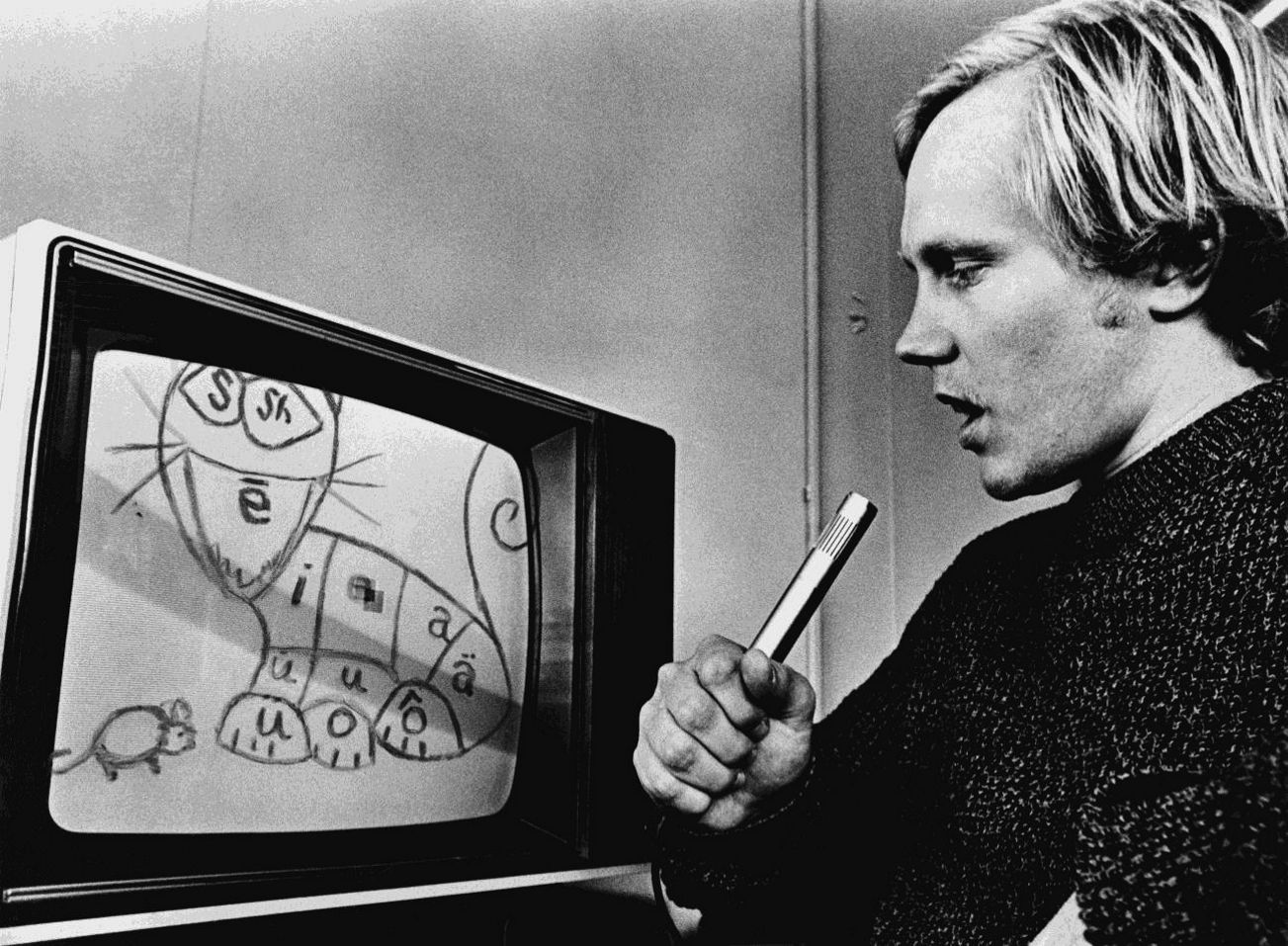
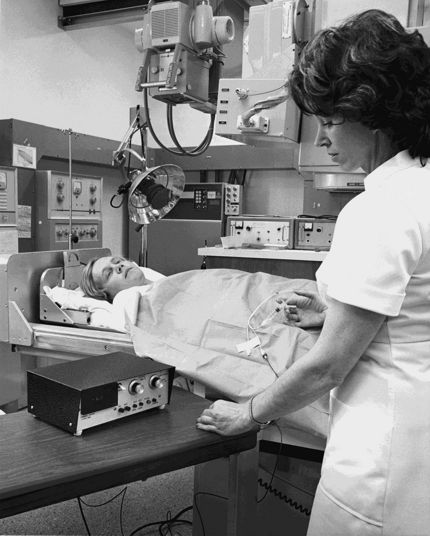
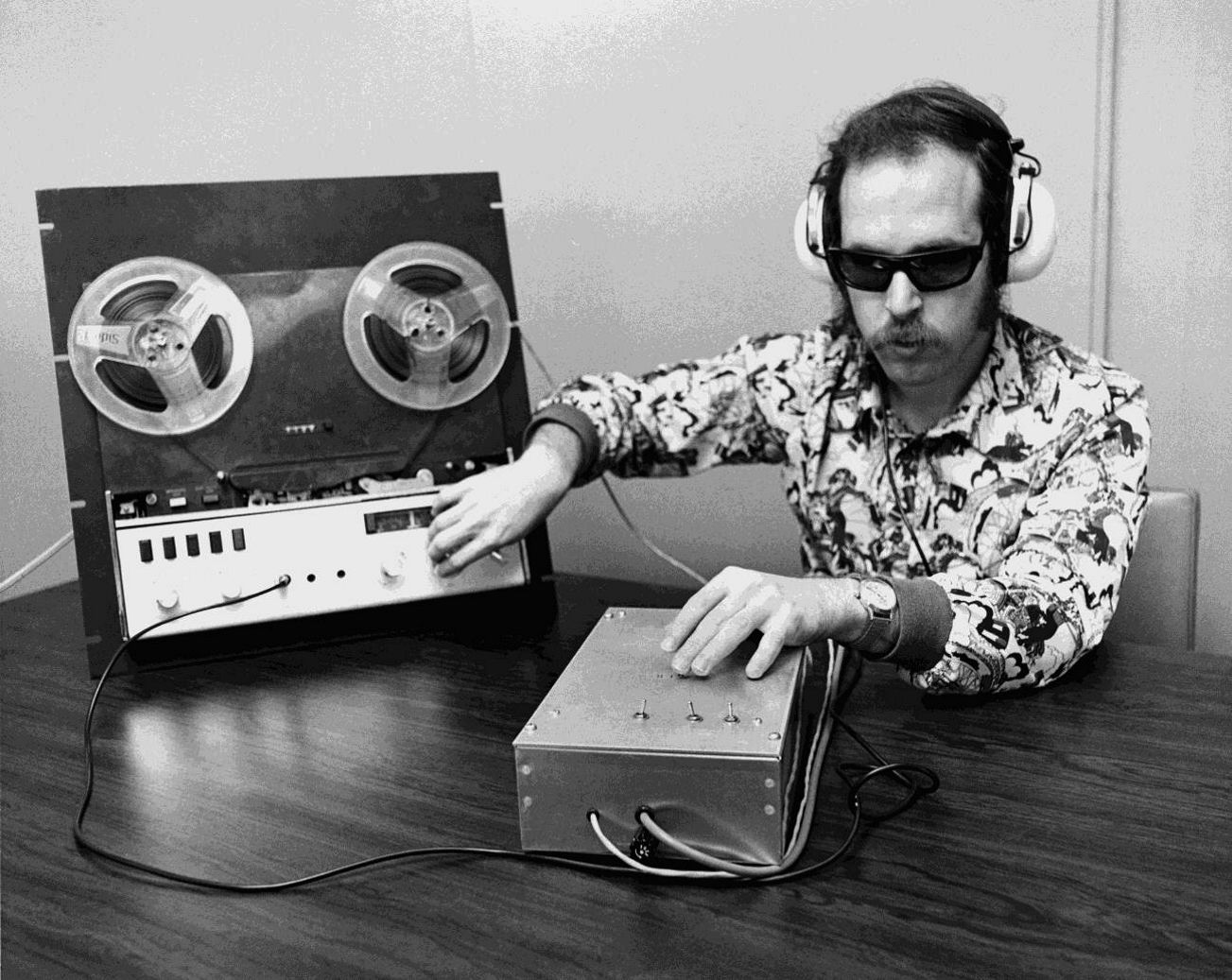
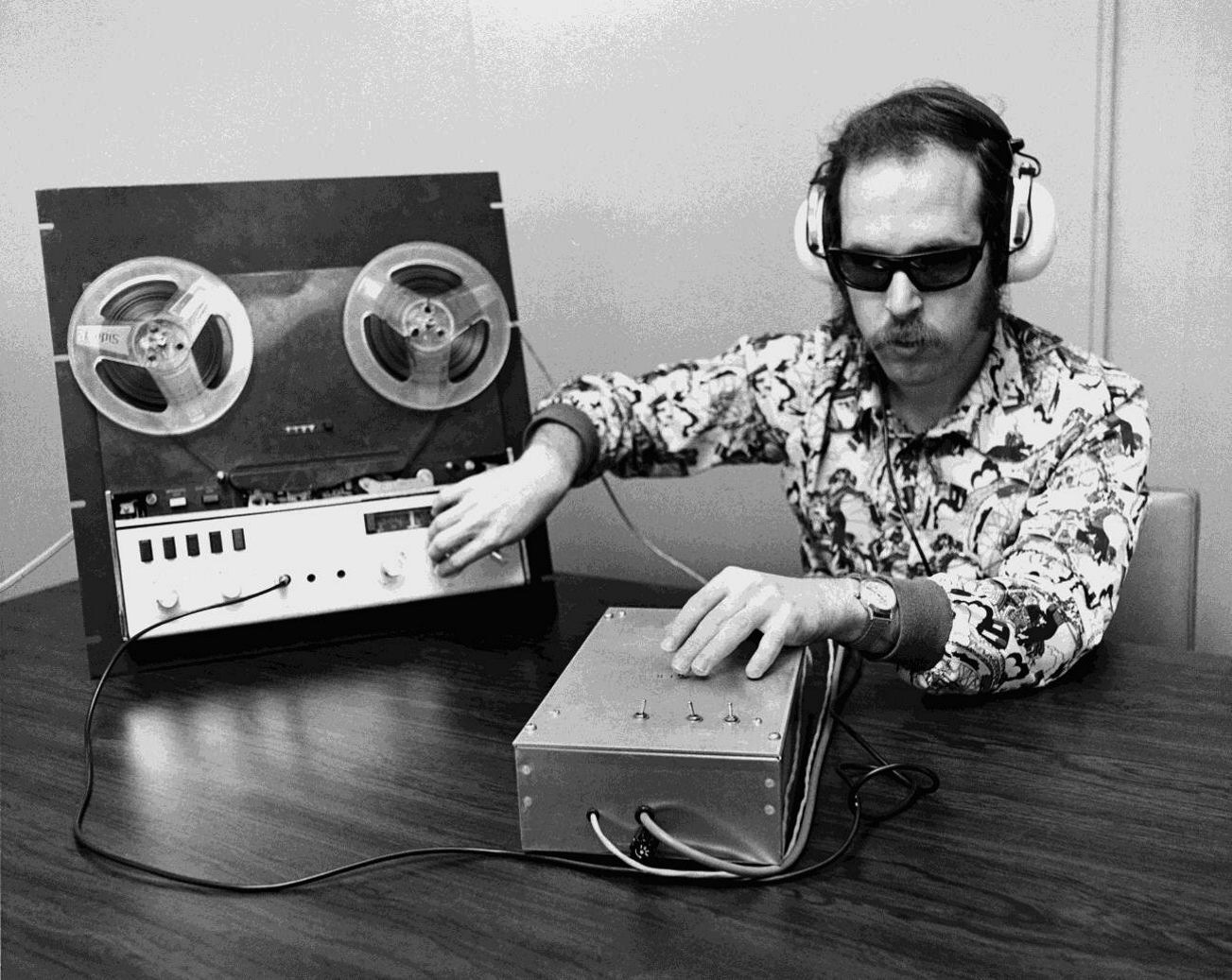
Final projects from the program’s early years indicate that students were, indeed, eager to do applied, civilian, interdisciplinary work that, as student Michael Buchin put it, “will help people” and will pay off “tangibly as well as esoterically” by helping students gain employment and providing a sense of altruistic accomplishment. Projects included an image stabilizer that helped sharpen radiographs obtained for cancer detection; a digital heart-rate monitor; a tactile sound mixer built for a blind audiophile undergraduate (figure 3); ocean monitoring instrumentation packages; a portable instrument to measure lead in gasoline; and a thermodilution cardiac computer that used thermal measurements to determine the quantity of blood flowing from the heart (figure 4). Phillips worked with a student to build a random-number generator for testing extrasensory ability. Following a suggestion from computer scientist Glen Culler, he also worked with a student who built a device to help foreign language students or deaf children pronounce vowels correctly. (Figure 5 shows a second-generation version.) Glendan Co later sold versions of both inventions.

Figure 5. A TV-assisted pronunciation aid, SPOT (speech–optical translator) is demonstrated in 1973 by Michael Buchin, master’s of scientific instrumentation student at the University of California, Santa Barbara. When the user—for example, a foreign language student trying to enunciate a particular vowel sound—spoke into the microphone, a cursor would indicate the sound actually pronounced. (Courtesy of the Department of Special Collections, Davidson Library, UCSB.)
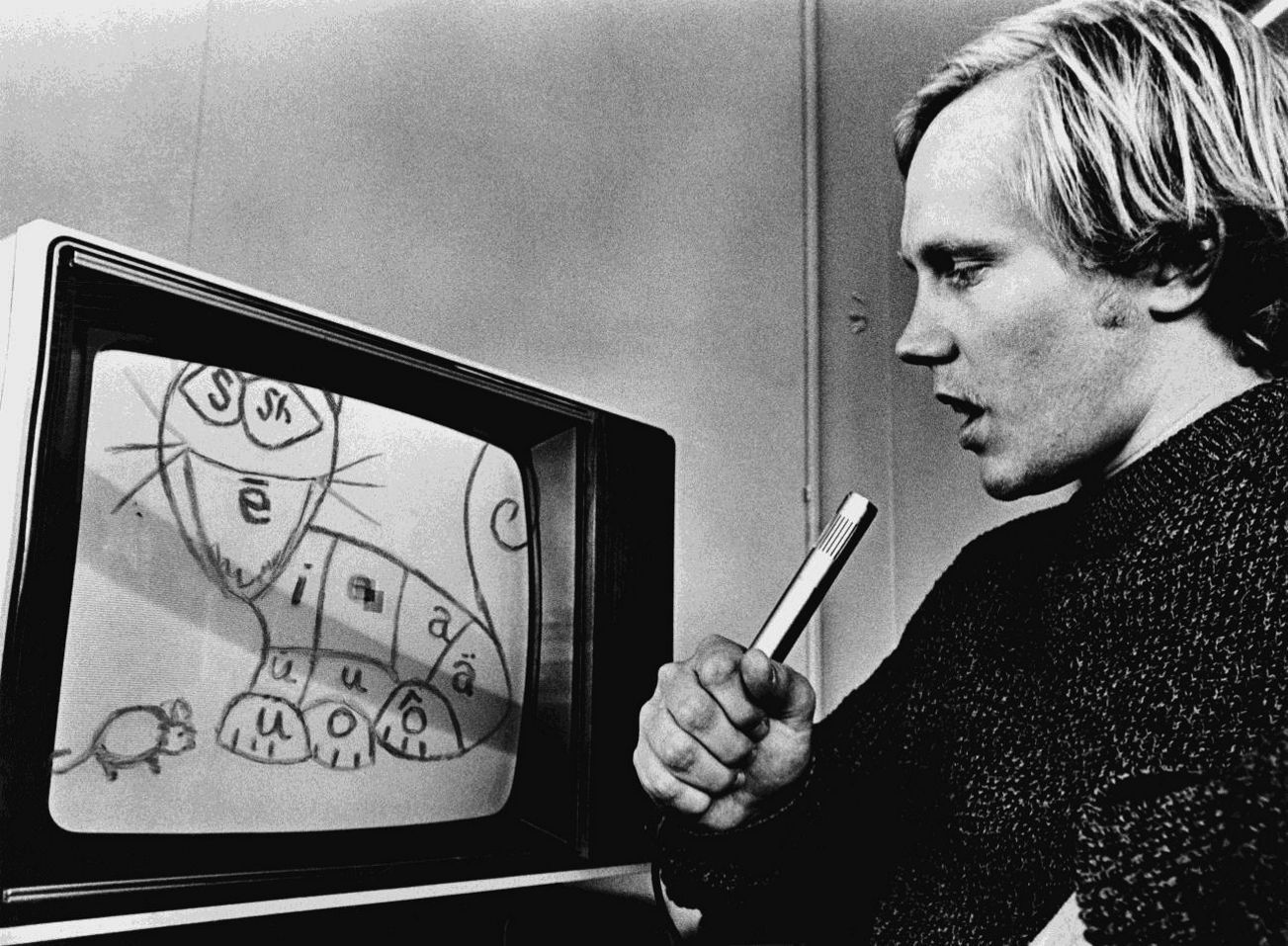

Figure 4. While demonstrating the thermodilution cardiac computer he designed to measure blood flow from the heart, master’s of scientific instrumentation student Michael Buchin is injected with saline solution in a Santa Barbara hospital. (Photograph from 1974; courtesy of the Department of Special Collections, Davidson Library, UCSB.)


Figure 3. This tactile audio system was designed for blind audiophiles by students in the University of California, Santa Barbara, master’s of scientific instrumentation program. Instead of having a visual meter for sound levels, it had metal pins representing Braille numbers. Here UCSB undergraduate Joe Renzi uses the device. (Photograph from 1975; courtesy of the Department of Special Collections, Davidson Library, UCSB.)
Lessons learned
As UCSB’s press office proudly noted in 1972, the MSI program succeeded in giving students both a personal sense of accomplishment and employment in instrumentation. In return, Elings and Phillips soon found that they, too, were learning from their participation in the program and that they could derive their own tangible and esoteric benefits from students’ projects. The early 1970s were a period of widespread pedagogical experimentation in which the usual power differentials between students and teachers narrowed or were upended—as evidenced, for instance, by the proliferation of student-taught courses at US universities. Elings and Phillips soon found that they needed to adapt their methods to the new climate. As they wrote in an article for the American Journal of Physics, “The too familiar pattern of factual presentations of material chosen by the instructor was more tolerated than appreciated. . . . One year’s experience indicates that experimental science students learn more from doing their ‘own problem’ than from passive reading and exercises.” 8
As a result, Elings became a lifelong advocate of learning by doing and an increasingly harsh critic of conventional pedagogy. As he described it later (see the letter by David Nicoli, Paul Barrett, and Elings, Physics Today, September 1978, page 9 ), the MSI program was so unconventional in insisting that students learn things for themselves that for some students it was “a rude awakening from the spoon-feeding of most undergraduate experiences.” Again, there may be lessons here for our own era. Today’s vogue for do-it-yourself technology, hackerspaces (community-operated workplaces), and design projects in undergraduate engineering education all indicate a demand for the kind of pedagogical environment fostered by Elings, Phillips, David Nicoli (who replaced Phillips as junior partner in the master’s program), and other MSI students and instructors.
The MSI program also helped reorient Elings’s on-campus research program and heightened the interest of its instructors in off-campus entrepreneurship. Like Phillips, Elings had founded a garage company, Santa Barbara Technology, around 1970. In fact, the two firms seem to have cross marketed, since SBT sold something called a Tobiscope that closely resembled Glendan’s Acupointer, and both companies sold versions of the TV-assisted pronunciation aid whose use is shown in figure 5. Somewhat controversially, Elings and Phillips also obtained a patent on a thermodilution cardiac computer related to Buchin’s final project (seen in figure 4); SBT sold a version of that product at least through the early 1980s. As the 1970s wore on, Elings became a serial entrepreneur, founding one biomedical instrumentation company, then plowing the profits into founding another and another; it all culminated in 1987, when he cofounded Digital Instruments, the enormously successful probe microscope manufacturer now part of Bruker Nano Surfaces. 9
In conjunction with founding startups, Elings shifted his research away from high-energy physics and toward the development of biomedical instrumentation. In at least a few cases, a pattern can be discerned: An MSI student would invent or refine some apparatus, then graduate; Elings would further develop the device in collaboration with life-sciences researchers or clinicians, some of them former MSI students or extramural mentors for MSI student projects; Elings and his collaborators would publish a few peer-reviewed articles describing their technique; and Elings would market the technique through a startup. Remember, this was all happening before the biotech industry took off and in a physics department rather than in a molecular-biology group; Elings’s story somewhat complicates the usual narrative that the academic entrepreneurship boom since the 1980s was a product of the life sciences and of government actions such as the Bayh–Dole Act.
Certainly, Elings’s entrepreneurship was unusual in his department at the time, and his commercialization process was sometimes messy with respect to intellectual property, at least by today’s norms. But nowadays startups like Elings’s are increasingly common in the physics department at UCSB and many other US research universities (see the article by Orv Butler and Joe Anderson, Physics Today, December 2012, page 39 ). If we want to understand the origins of that trend, we need to look back to both the budgetary and cultural crises of the early 1970s and the tangible and esoteric pressures on academic physicists to translate their research for civil society.
On to the 1980s
In a sense, science continues to live in the world created in the early 1970s. Still, the trying conditions of those years didn’t last forever. What happened when budgets and student enrollments bounced back and popular distrust of science and protest against it abated? Here, again, Santa Barbara can serve as an illustrative if not necessarily generalizable microcosm of the time.
For Wyatt, the early 1980s brought one step back and two somewhat humorous steps forward. In late 1980 or early 1981, Science Spectrum sputtered to an end, and Wyatt invited his staff to bid it farewell with a small party. This being Santa Barbara in the early 1980s, their late afternoon celebration turned into an open-door wine tasting, and then into a laboratory experiment when someone decided to test the wines with the company’s light-scattering instruments. As a last hurrah, Wyatt sent a paper to Science comparing the ratings of the “nonprofessional consumer panel” consisting of a physicist, mathematician, electrical engineer, office manager, x-ray technician, coin dealer, electromechanical assembler, and attorney with the output of the light-scattering measurements. 10
Then, to hear Wyatt tell it, something of a miracle happened. His letter to Science was picked up in various outlets, and in 1982 Wyatt was able to reincorporate, this time under the name Wyatt Technology. Soon he received overtures from soft drink companies asking him to perform light-scattering analyses on their products. Those resulted in further articles and publicity and snowballed into interest from the military and other customers. Before long, Phillips was consulting for Wyatt Technology; eventually he joined as an employee and developed the company’s DAWN line of light-scattering detectors and an aerosol-particle analyzer that formed the basis for a spin-off company, Wyatt-Lorenz. Today Wyatt Technology remains in operation as one of the oldest in a small cluster of nanoscience instrumentation companies located north of the Santa Barbara airport.
Interestingly, Phillips’s notebooks from the time show that he was still dabbling in parapsychology, but with a 1980s twist. There, right next to computer code for Wyatt instruments and notes on meetings between Wyatt engineers and representatives from the US Army, are data Phillips collected from possible ESP adepts whom he tasked with predicting the value of the next day’s Dow Jones index and the price of silver!
At UCSB, meanwhile, the conditions that gave rise to the MSI program evaporated along with departmental support for the program. There had always been some faculty members who worried that a terminal master’s degree diluted the value of the department’s PhD. Undergraduate enrollment in the physics department was roughly four times greater in 1986 than in the trough year of 1975, and graduate enrollment more than doubled from its 1971 nadir. Nationally, constant-dollar R&D funding for US universities, from both public and private sources, started a rapid climb in 1985 after nearly 20 years of stagnation. In such a changed environment, the department gained less from the MSI program than it had in the early 1970s. In 1986 the program was abruptly canceled.
By then Elings was already preparing to cofound Digital Instruments. At around the same time, a trickle of other UCSB physics faculty began to join him in starting companies. Nicoli cofounded Nicomp with Elings in 1978 to sell particle-sizing systems. Of more lasting influence on the department was Nobel laureate J. Robert Schrieffer’s cofounding of Superconductor Technologies in 1987. What had been unusual in the 1970s slowly became common over the course of the 1980s.
Along the way, academic entrepreneurship’s Wild West ways were, for better or worse, gradually tamed. In Elings’s case, the turning point came when, as Elings tells it, someone at UCSB accused Digital Instruments of improperly profiting from its commercialization of scanning tunneling microscopes based, in part, on those built by Elings’s departmental colleague Paul Hansma. The complaint never went anywhere. But it signaled that in the 1980s, Elings’s commercialization of ideas related to a colleague’s work—even with that colleague’s permission—was going to stir opposition that his 1970s commercialization of ideas flowing from his master’s students’ work had not. So he quit his job to concentrate on running Digital Instruments full- time, though he remained connected to UCSB through ongoing technology transfer to and from the Hansma lab and later through his and his ex-wife’s multimillion-dollar gifts to the university to support nanoscience research.
Coda
The long 1970s were no nirvana for US physicists. Times were tough, and although some of the responses to the decade’s crises should be hailed, others were ill-conceived. I’ve tried to bring to light the spirit of the times through a case study of a small, interconnected network of physicists in Santa Barbara who, in many ways, were and are wholly unrepresentative of their profession. Nonetheless, conditions in Santa Barbara were similar to those faced by physicists across the US; and although local and individual responses everywhere were no doubt idiosyncratic, there were probably significant commonalities. Certainly, those strands of crisis response that endured into the 1980s became more homogenized, as best practices spread from institution to institution and norms were established for once-unorthodox activities such as academic physicists’ patenting their work and founding startups.
Five features of Southern California physics in the long 1970s have had particular relevance to today or are especially illuminating of the strangeness of the time: interdisciplinarity, civilianization, entrepreneurship, pedagogical experimentation, and parapsychology. The last will no doubt strike many readers as the most alien characteristic of those groovy days, and some will likely dismiss the achievements of Phillips and his fellow travelers because of their investigations into things like psychokinesis and communication with the dead. Yet I would encourage readers to place parapsychology in the context of a world—and a physics discipline—that was newly curious about a whole range of unexplored possibilities. I myself don’t share Phillips’s interest in parapsychology, but I find something compelling about his willingness to seek new holistic and humanistic applications for a skill set forged in the military̵–industrial complex. Plenty of brilliant physics has been inspired by much stranger ideas than those of Phillips and the Fundamental Fysiks crew.
The pedagogical experiments of the 1970s, too, may seem strange to 21st-century eyes. Certainly, it’s hard to imagine a master’s of scientific instrumentation program taking root today in a leading physics department like UCSB’s. Yet calls for university faculty to be more pedagogically innovative are increasingly common, stimulated in part by the spread of new media technologies but also by economic and cultural pressures that resemble those of the early 1970s. As universities try to figure out how to keep undergraduates’ attention while training them for an ever-changing and increasingly high-tech workforce, the MSI program and other pedagogical experiments of the 1970s may provide useful models.
By contrast, the interdisciplinarity, entrepreneurship, and civilian focus of the long 1970s should sound familiar to most readers. US physics is irreversibly less dependent on national-security aims than in the early Cold War, collaborations between physics and a wide range of disciplines are now commonplace, and interchanges of ideas and personnel between universities and high-tech startups routinely occur. Those are all, in many ways, salutary changes, and each, I have tried to show, was born from noble intentions in the context of the time. Yet each of those changes comes with dangers: Civilianization shouldn’t proceed at the expense of national security; market incentives and intellectual-property regimes can distort the search for fundamental knowledge; and the current vogue for interdisciplinarity sometimes has the ring of magical thinking. In each of those areas, looking at the hastily assembled responses to the crises of the 1970s may help us think more carefully about what to preserve and what to amend.
I gratefully acknowledge support from NSF.
References
1. D. Kaiser, Hist. Stud. Phys. Biol. Sci. 33, 131 (2002). https://doi.org/10.1525/hsps.2002.33.1.131
2. C. Holcombe, Santa Barbara News-Press, 26 May 1970, p. A–16;
C. Holcombe, Santa Barbara News-Press 15 January 1971, p. B–3.3. Santa Barbara News-Press, 14 July 1972, p. A–15.
4. P. J. Wyatt, D. T. Phillips, E. H. Allen, J. Agric. Food Chem. 24, 984 (1976). https://doi.org/10.1021/jf60207a002
5. D. T. Phillips, Bioscience 21, 865 (1971). https://doi.org/10.2307/1295813
6. 6. G. Phillips, ”Glen Phillips Garage Lyrics,” http://www.lyricsfreak.com/g/glen+phillips/garage_20854191.html .
7. D. Kaiser, How the Hippies Saved Physics: Science, Counterculture, and the Quantum Revival, W. W. Norton, New York (2011).
8. V. Elings, D. Phillips, Am. J. Phys. 41, 570 (1973). https://doi.org/10.1119/1.1987290
9. C. C. M. Mody, Instrumental Community: Probe Microscopy and the Path to Nanotechnology, MIT Press, Cambridge, MA (2011).
10. P. J. Wyatt, Science 212, 1212 (1981). https://doi.org/10.1126/science.212.4500.1212
More about the authors
Cyrus Mody is an assistant professor of history at Rice University in Houston, Texas.