Rutherford’s geophysicists
DOI: 10.1063/1.3463627
Ernest Rutherford’s fame rests on his studies of radiation, radioactive decay, and the structure of the atom. From his first work with Frederick Soddy at McGill University at the turn of the 20th century, Rutherford excelled at the experimental isolation of different “rays” and the identification and characterization of radioactive elements. So how is it that two of his students, Patrick Maynard Stuart Blackett and Edward “Teddy” Crisp Bullard—both of whom proved quite adept in Rutherford’s lab at Cambridge University studying nuclear phenomena—made prominent contributions to geophysics? To address the question, one needs to first consider Rutherford and the Cavendish Laboratory in the context of the Earth science that lay in the background of much research done there.
Rutherford and others believed that the heat given off by radioactive elements derailed the arguments that Lord Kelvin had used to support a youthful Earth and to critique Charles Darwin’s theory of evolution by natural selection. 1 Rutherford could not, of course, foresee the geophysical discoveries that generations of researchers later made regarding isotopic dating, the geodynamo, and plate tectonics. But he knew that basic physical research could make possible dramatic discoveries about Earth.
Yet Rutherford was no geophysicist. In his time, few scientists even used the word. Göttingen University’s Emil Wiechert was the only “professor of geophysics” (a position created in 1898) in the world. Seismology, terrestrial magnetism, meteorology, and geodesy—including measurements of Earth’s gravitational field, crustal motion, and tides—provided foci of research, but any idea of geophysics as a unifying discipline was taking shape only in a sporadic, halting, and complicated way, 2 a story for another time.
Geophysics was quietly taking shape at the Cavendish Lab. A surprising number of Cavendish students, staff, and visitors in the late 19th and early 20th centuries later became known for their geophysical work. Arthur Schuster made a name in geomagnetism (and as a model Maxwellian), George Darwin (son of Charles Darwin) in geodynamics, Lars Vegard in auroral studies, and Harold Jeffreys in seismology. Others became famous, but their geophysics is not well known. For example, Charles Thomson Rees Wilson, known principally for his cloud chamber work and 1927 Nobel Prize in Physics, researched atmospheric electricity and lightning discharge throughout his career. 3 , 4
Against that backdrop, Patrick Blackett (1897–1974) and Teddy Bullard (1907–80) went to the Cavendish Lab as research students. Neither intended to be a geophysicist. Blackett, who arrived in 1920, began with a modified Wilson cloud chamber, α particles, and questions. He moved on to the coincidence-controlled cloud chamber and began his work on cosmic rays. Together with Giuseppe “Beppo” Occhialini, he confirmed the existence of the positron in 1933, not long after Carl Anderson discovered it. For his work, Blackett received the 1948 Nobel Prize in Physics. Quietly, in the background, he considered how that cosmic-ray work related to Earth and the cosmos. His transition to geophysics was gradual.
Bullard, on the other hand, arrived in 1926 and experienced a sudden conversion. As he said in a 1969 interview,
I started in Rutherford’s lab as a physicist. I did my PhD on the scattering of slow electrons and broke off from that in the middle to go into geophysics.
5
I started in Rutherford’s lab as a physicist. I did my PhD on the scattering of slow electrons and broke off from that in the middle to go into geophysics. 5
Both Blackett and Bullard ultimately linked up with geologists, oceanographers, and computer modelers in producing the great mid-20th-century revolution in the geosciences. Specifically, Blackett moved through geomagnetic theory to paleomagnetism to plate tectonics. Meanwhile, Bullard developed experimental techniques for studying crustal structure, marine geology, heat flow from Earth’s interior, the origin of Earth’s magnetic field, and plate tectonics. How did Blackett and Bullard gravitate to research areas so different from their starting points?
We begin with Bullard, whose migration occurred first.
From atom to Earth
Teddy Bullard was born into a prominent brewing family in Norwich, UK. Like many English children, he attended boarding school, where his experiences were intensely uneven. The most positive influence there was his physics teacher, Arthur W. Barton, who had himself completed a PhD at the Cavendish Lab under Rutherford. Barton worked hard on Bullard, preparing him for life at Cambridge. 6
Bullard followed the path of all new research students at the Cavendish. With undergraduate studies done, he spent the long vacation of summer 1929 in the laboratory’s “attic,” learning experimental technique from a pile of discarded or temporarily unused apparatus. Rutherford assigned him to work under Blackett, who suggested that he study electron scattering by gases, a project that required vacuums and lots of glass tubing. Others had previously explored aspects of the wavelike behavior of electrons diffracted by crystals, but Bullard and his colleague Harrie Massey were among the first to note the similarity of single-atom scattering to the diffraction of light by small spheres. The challenge of the experimental setup tested Bullard and Massey for months.

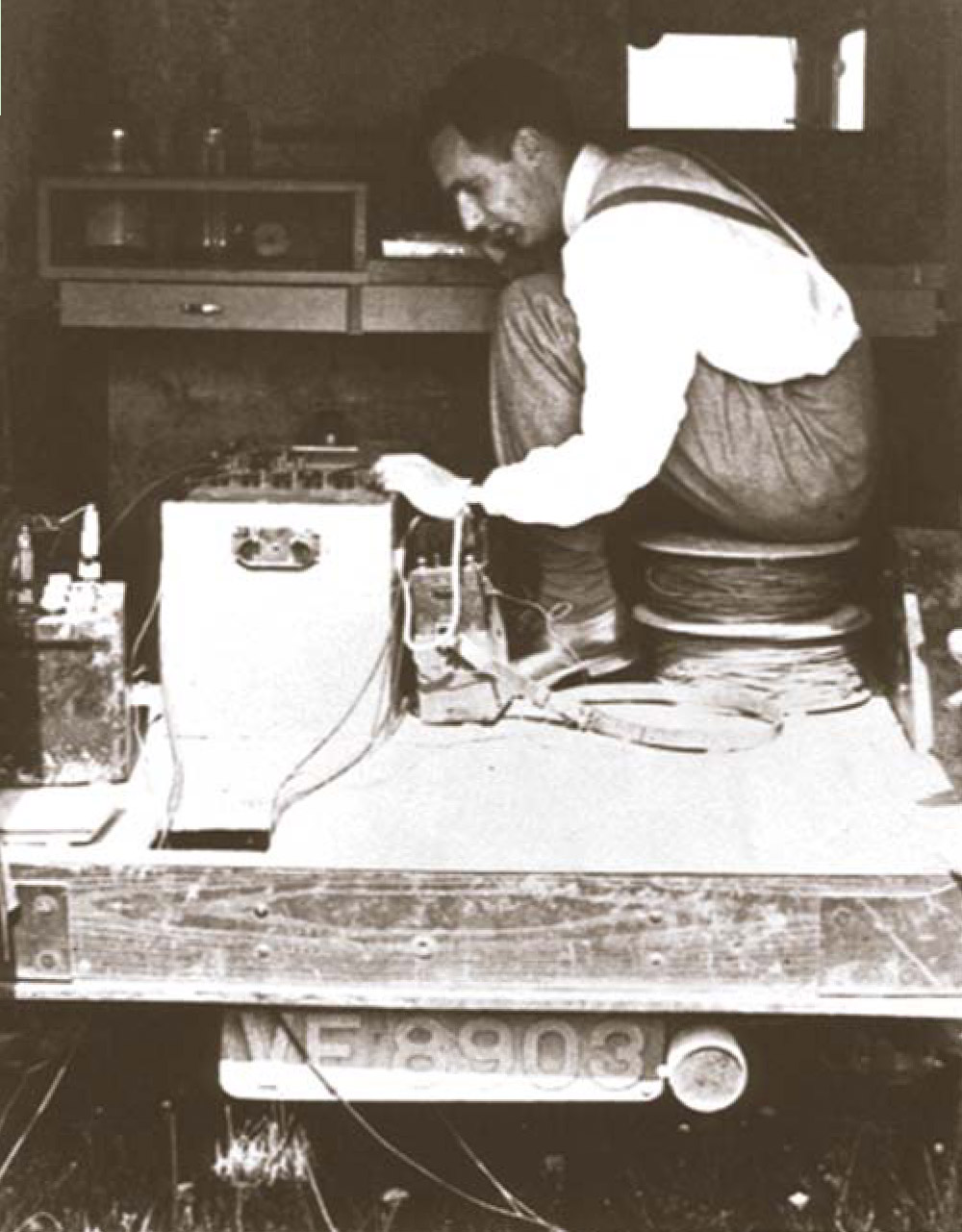
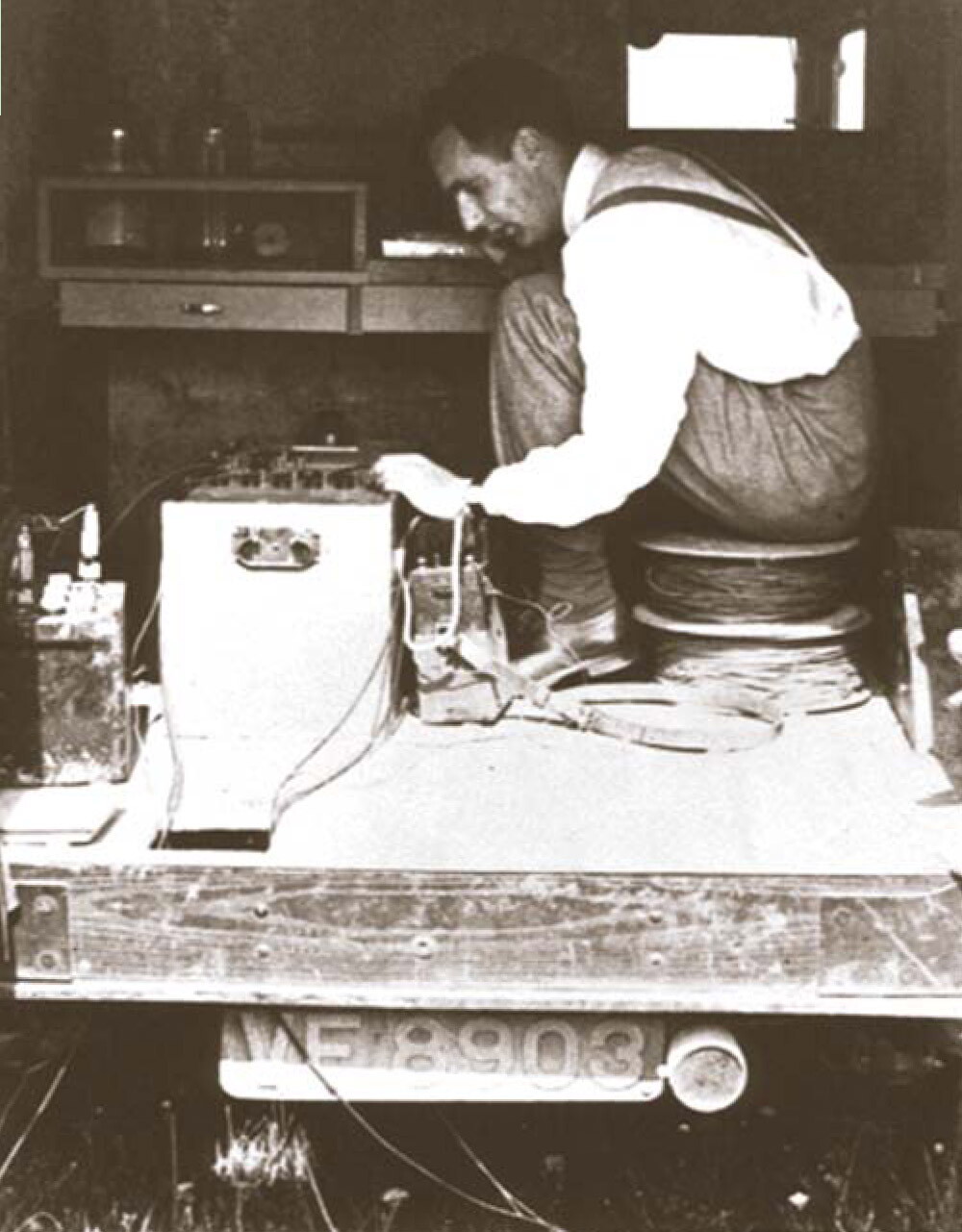
Edward Bullard sits atop spools of wire in the back of a truck used during explosive seismological investigations of geological strata around Cambridgeshire, UK. In the late 1930s Bullard was keenly interested in investigating and publishing geophysical techniques that the oil companies used but treated as proprietary knowledge.
(Courtesy of the University of California, San Diego.)
During that time, just prior to James Chadwick’s discovery of the neutron, Bullard shared a lab with five other students. Rutherford was just down the hall, and Bullard remembered the Cavendish fondly as a hive of activity. Ironically, Bullard saw little of Blackett, who was away in Germany.
In 1931, as Bullard pursued electron diffraction, the university established a department of geodesy and geophysics. The decision to do so was complex, and a full manuscript record on the issue exists: Bullard gathered and saved the papers, and they are now in his collection in the archives of Churchill College of Cambridge. Gerald Lenox-Conyngham had occupied an unpaid readership at the university since 1922 and single-handedly operated a school of geodesy that trained field geodesists for government service. The school had been established in the wake of the Treaty of Versailles: The previously dominant role of Potsdam, Germany, in international geodesy could not be resumed. Cambridge stepped up.
Jeffreys, already at Cambridge as a fellow of Trinity College, became a reader in geophysics, which left Lenox-Conyngham with two more positions to fill. For the position of demonstrator, he needed an experimentalist, and he asked Rutherford for a recommendation. The first choice was Norman Feather, but Feather turned the position down and suggested to Bullard that he talk to Rutherford about it. Bullard later stated that Rutherford told him he should take any job he could get. The depression was on and Bullard was junior to others on the market. He accepted and started a change of career that was momentous for him and important for geophysics.
Bullard quickly found opportunities in his new environment—first with gravimetry and later with explosion seismology and geomagnetism. In 1931 he plunged into gravimetry “because there were some pendulums.” 5 The offhand comment belies how seriously Bullard took the research project. Lenox-Conyngham had sophisticated double-pendulum gravimeters that were based on the gravimeter perfected by Dutch geophysicist Felix Vening Meinesz in the early 1920s.
Bullard’s research with pendulums was much more than opportunistic. He treated the project as he had his experimental work on electron scattering. He conducted a detailed study of the instruments and all sources of errors, including electrical currents induced in the pendulums swinging in Earth’s magnetic field. Not content with simply measuring the swings of the pendulums and moving from place to place, Bullard used radio signals to coordinate measures made at a fixed observatory and in the field. He also developed a signal amplifier with vacuum tubes and a data-recording device. Those represented significant innovations in gravimetry.
Bullard approached gravimetry with an eye for experimentation. What could precision gravimetry reveal about hidden geological features? He made trial measurements around Cambridgeshire to perfect the method and the instruments so that he could apply them in more difficult and important field situations.

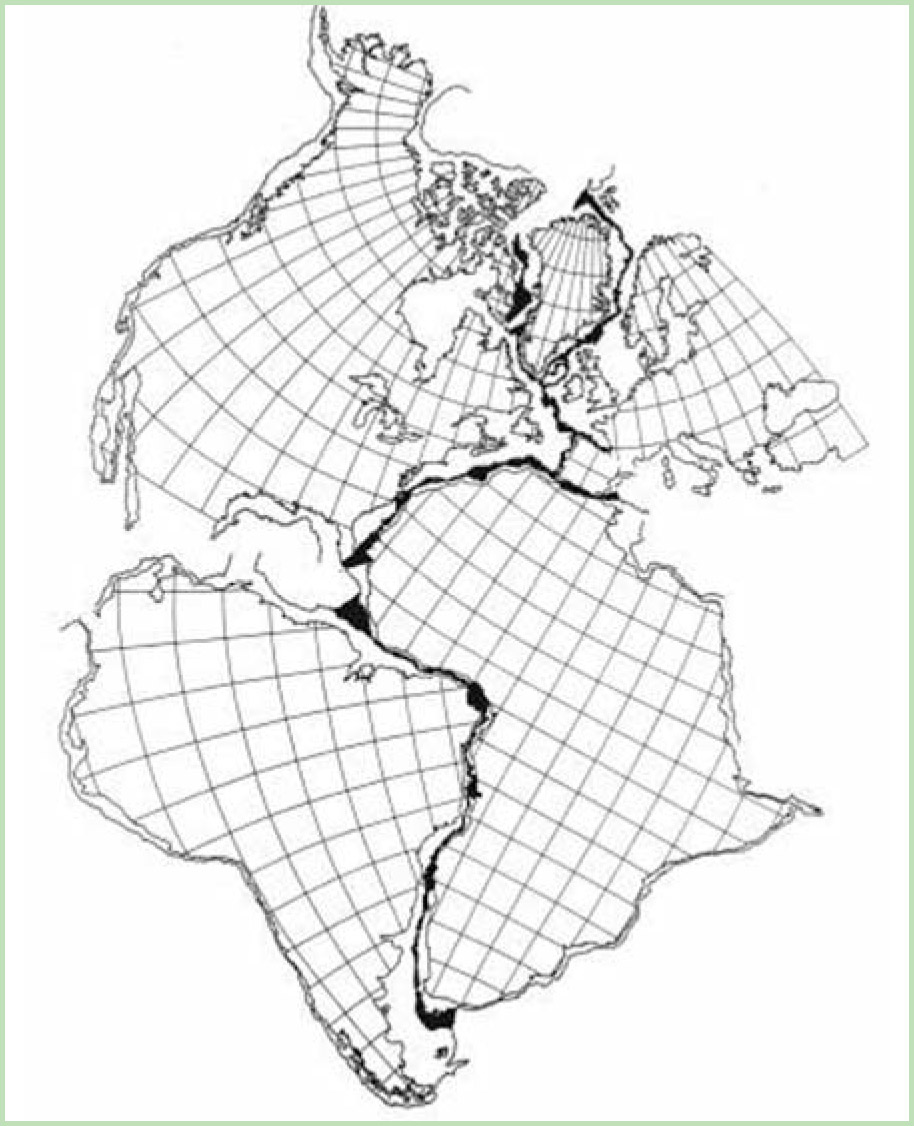
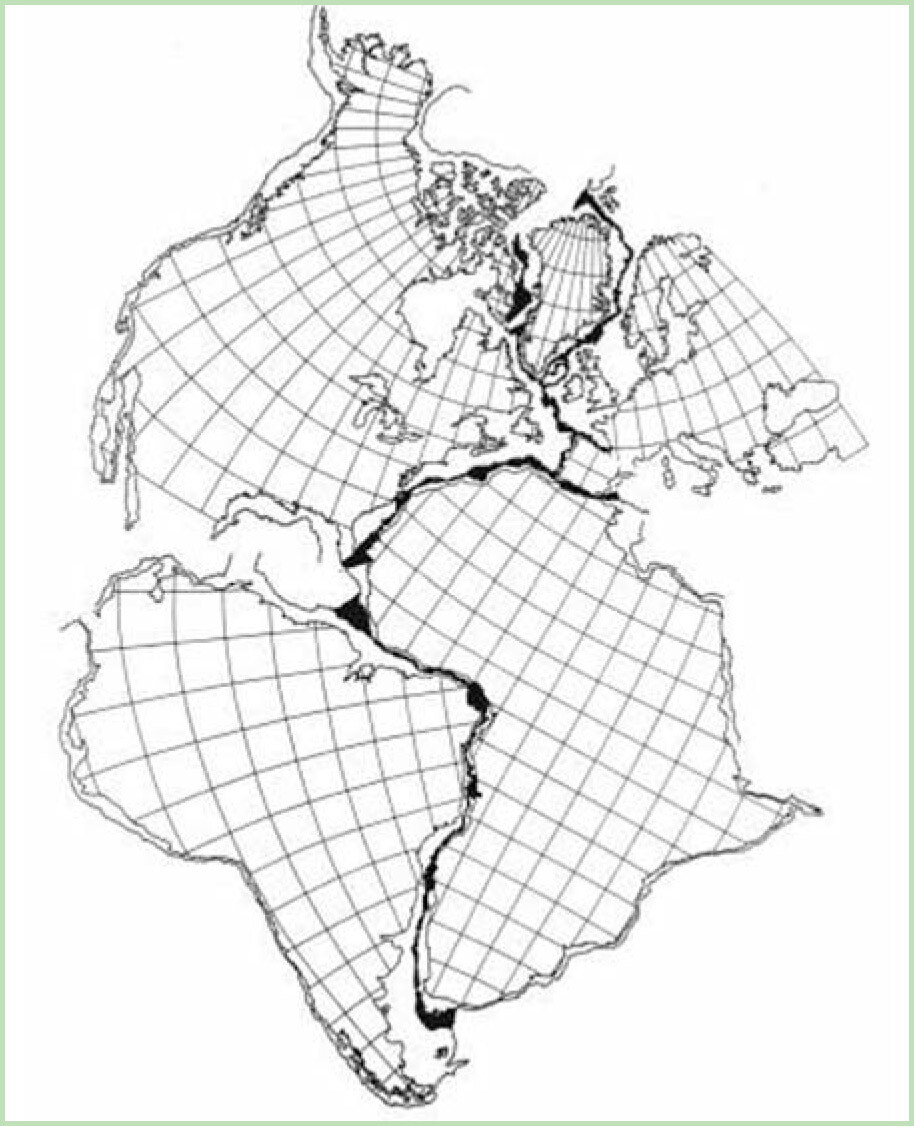
The “Bullard fit,” a 1965 computer-generated map based on extensive field data at the continental margins between the Americas and Africa and Europe, was one of the last arguments needed to convince most geologists of the validity of plate tectonics.
(Adapted from
As he later explained, the initial idea was based on geophysical prospecting—using physics to find oil or other resources. Such techniques were in fairly wide use in the 1920s and 1930s and included refraction and reflection seismology, gravimetry, and electrical and magnetic methods. Bullard gave his attention to each of those techniques in turn.
Bullard realized, however, that his interest was not in resources but in “major problems of earth structure and history.” 5 He developed a plan to conduct a geophysical survey of the Great Rift Valley in east Africa to see which techniques shed light on the nature and origin of the rift. In 1933 Bullard traveled to Africa on a steamer with a gravimeter, chronometer, radio receiver, and magnetometers borrowed from the UK’s Ordnance Survey and the Carnegie Institution of Washington. The results of his first geophysical expedition proved of lasting value, but more importantly, the experience convinced him of the value of further developing geophysical methods for learning about Earth. Prophetically, Bullard wrote about both the Gondwanaland supercontinent and Alfred Wegener, the proponent of continental drift, in his 1936 article on the rift expedition in the Royal Society’s Philosophical Transactions. 7
Seismic shifts
Bullard’s first efforts at explosion seismology occurred before the African expedition, but he tackled the technique systematically in 1935. Explosions set off at the surface send waves deep underground, where their paths are both refracted and reflected, much as in optics. In that work Bullard saw a geophysical field technique that was as controllable as laboratory experiments. But he noted in another article in Philosophical Transactions,
The investigation of geological problems by the study of the elastic waves from explosions has been widely practised of recent years. Unfortunately, most of the work has been carried out by commercial firms who do not publish detailed accounts of their methods or results. Anyone wishing to use the method has therefore to start practically from the beginning and solve problems many of which have already been solved several times before. To help to remedy this state of affairs the Department of Geodesy and Geophysics of Cambridge University undertook a study of the seismic method.
8
The investigation of geological problems by the study of the elastic waves from explosions has been widely practised of recent years. Unfortunately, most of the work has been carried out by commercial firms who do not publish detailed accounts of their methods or results. Anyone wishing to use the method has therefore to start practically from the beginning and solve problems many of which have already been solved several times before. To help to remedy this state of affairs the Department of Geodesy and Geophysics of Cambridge University undertook a study of the seismic method. 8
Bullard wanted to develop that method for open scientific use. On advice of a geologist, Bullard and his students first perfected their explosion-seismology techniques to explore the Paleozoic floor around Cambridge in 1935. They settled on using a string of miniaturized seismographs 200 feet apart, but wiring for the electrical connections became an unforeseen problem:
The chewing of this wire by cows was a source of much annoyance, and at some stations more time was spent in chasing cattle and repairing wire than in any other part of the work.
8
The chewing of this wire by cows was a source of much annoyance, and at some stations more time was spent in chasing cattle and repairing wire than in any other part of the work. 8
Bullard switched to radio communication.
He originally intended to reflect waves off the Paleozoic floor but found that the reflected signal was too diffuse. Instead, his team used waves refracted through successive strata and recorded along the array of seismographs. Bullard much appreciated Lenox-Conyngham’s support of their use of explosions, produced by as much as 15 pounds of gelignite, the same explosive used by the Irish Republican Army in the 1930s. And one morning Bullard read in the paper that an “IRA atrocity” had been committed and the police were seeking the bombers. The explosion had been his team’s mishap and was far larger than he had wanted. Lenox-Conyngham quipped, “I don’t think I should tell them [the police], it will be interesting to see if they can catch you.” 9 The seismology project attracted the attention of mineral companies, but more importantly, it prepared Bullard’s research group for a new direction: marine geophysics.

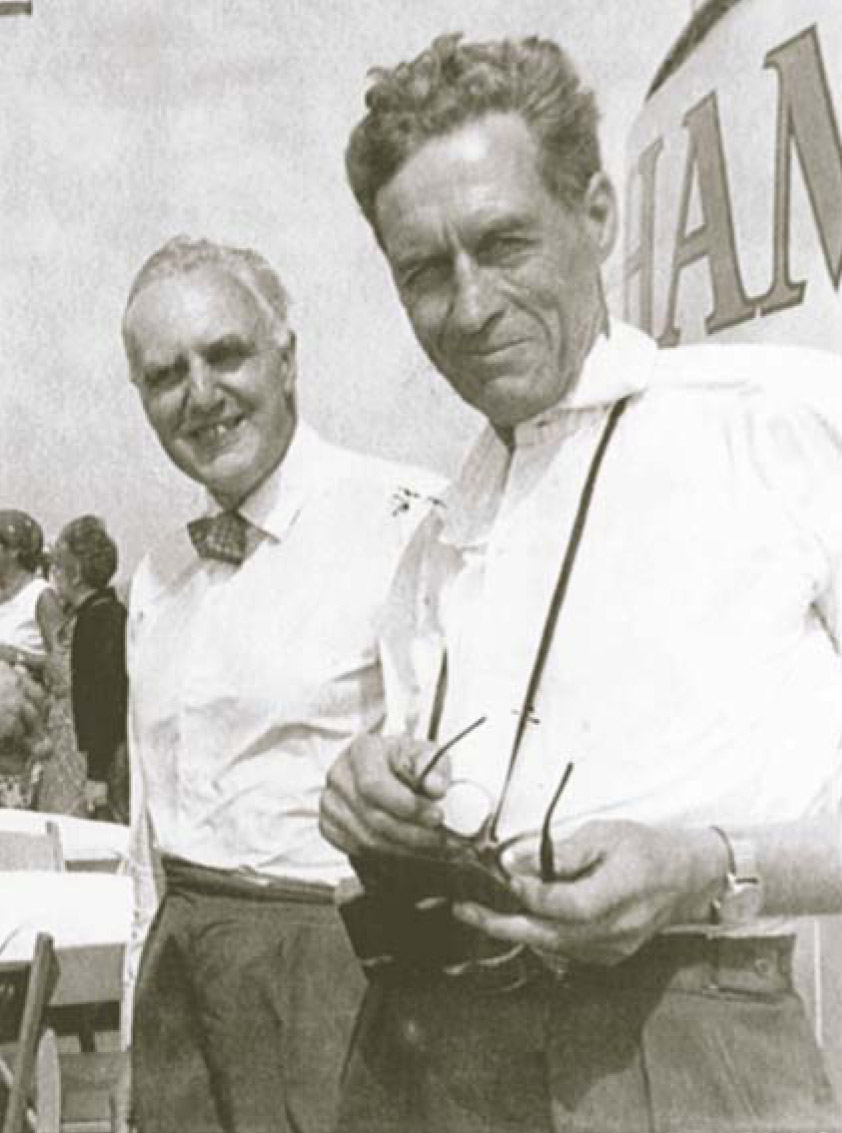
Patrick Blackett (right) and Robert Street around 1950, when both were beginning work on paleomagnetism. Like Blackett, Street trained at the Cavendish Laboratory and was involved in nuclear physics before migrating to Earth science.
(Courtesy of Robert Street and the Australian Academy of Science.)
Bullard met the marine geologist Richard Field at the 1936 meeting of the International Union of Geodesy and Geophysics. Field bowled Bullard over, arguing strenuously for marine geology “with the burning zeal of an old testament prophet.” 5 In 1937 Field introduced Bullard to Harry Hess and geophysicist Maurice Ewing. Ewing was especially important, since he too was developing explosion-seismology techniques for use at sea. Those associations, cemented by joint ocean cruises and at international union meetings, defined a continuing theme in Bullard’s marine geophysical research into the 1970s.
Bullard and his team began work at sea in the late 1930s. They used a Vening Meinesz gravimeter aboard a submarine to measure gravity over the continental shelf west of England. They also extended their refraction-seismology techniques to the hard rocks underlying the continental shelf west of the English Channel. Ewing pursued similar studies off the North American coast at the same time. Ewing, Bullard, and the Cambridge department of geodesy and geophysics during that period contributed to the first understanding of geological structure of the ocean floor. Those pre–World War II researches prepared the way for a revolution in marine geophysics, ultimately producing evidence of sea-floor spreading and plate tectonics.
At this point, we turn to the career of Patrick Blackett, because during the war the careers of Blackett and Bullard began to converge again after a decade apart. Their close wartime collaboration provided them an opportunity to think ahead to postwar research.
From cosmic rays to geophysics
Before Blackett left the Cavendish in 1933 for Birkbeck College in London, he, Chadwick, and Occhialini explored many sources of α and β radiation and the nuclear interactions produced. His vision, however, was shifting progressively away from the atom and toward cosmic rays. Atoms and cosmic rays are connected, of course, but Blackett’s study of cosmic rays in the context of Earth raised new kinds of questions. The origin of cosmic rays intrigued him: Was there an extraterrestrial source? Was it thunderstorms? Or was it cosmogonical?
After his characteristically thorough reading of the literature, Blackett dove into the investigation. He raised thousands of pounds and collaborated with industry to produce massive equipment. He explored the energy spectrum of cosmic rays and investigated the processes of cosmic-ray showers, a phenomenon he discovered and named. He found cosmic rays to be composed of roughly equal numbers of positrons and electrons, with about 15% of the material “of protonic mass.”

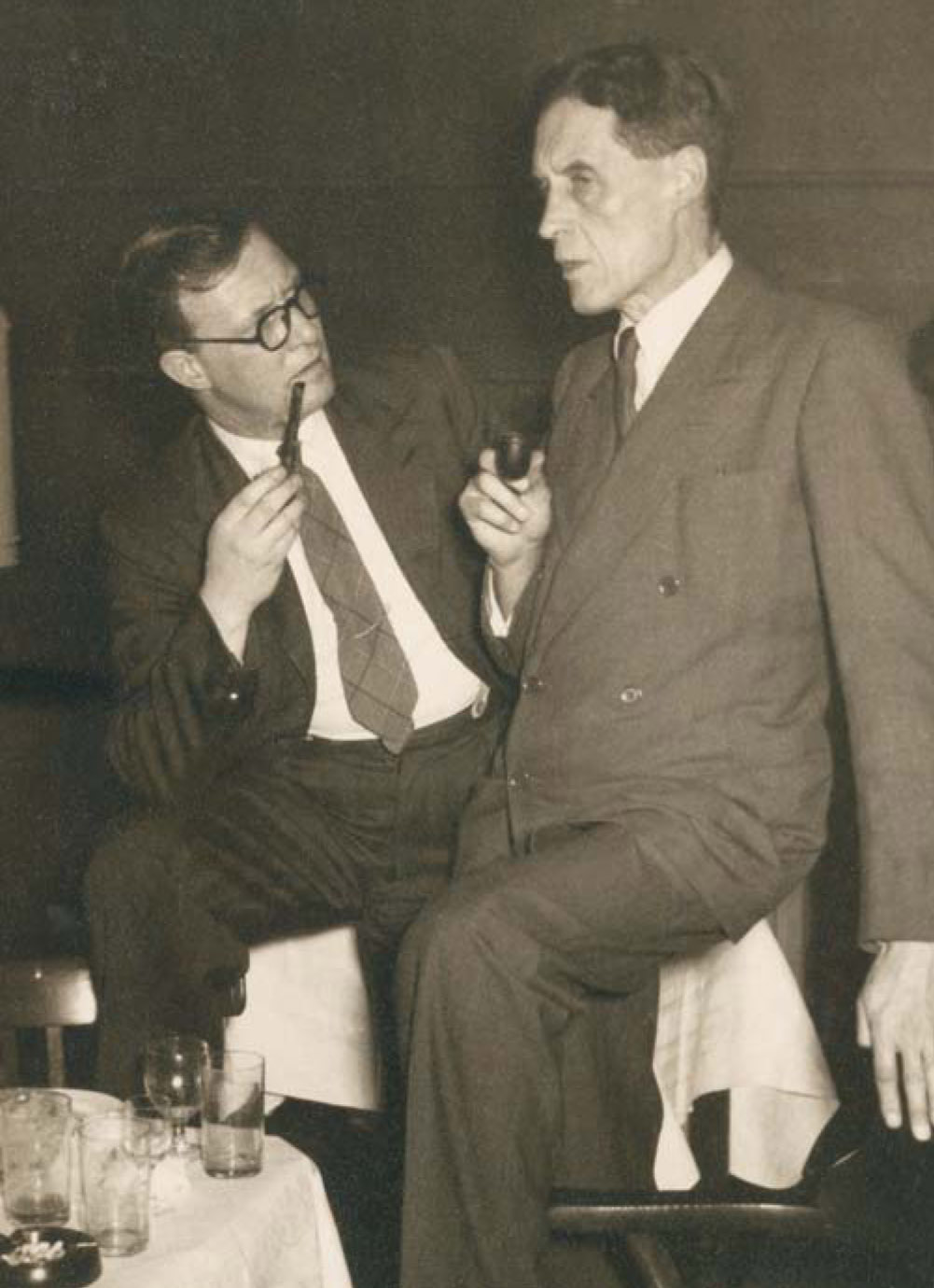
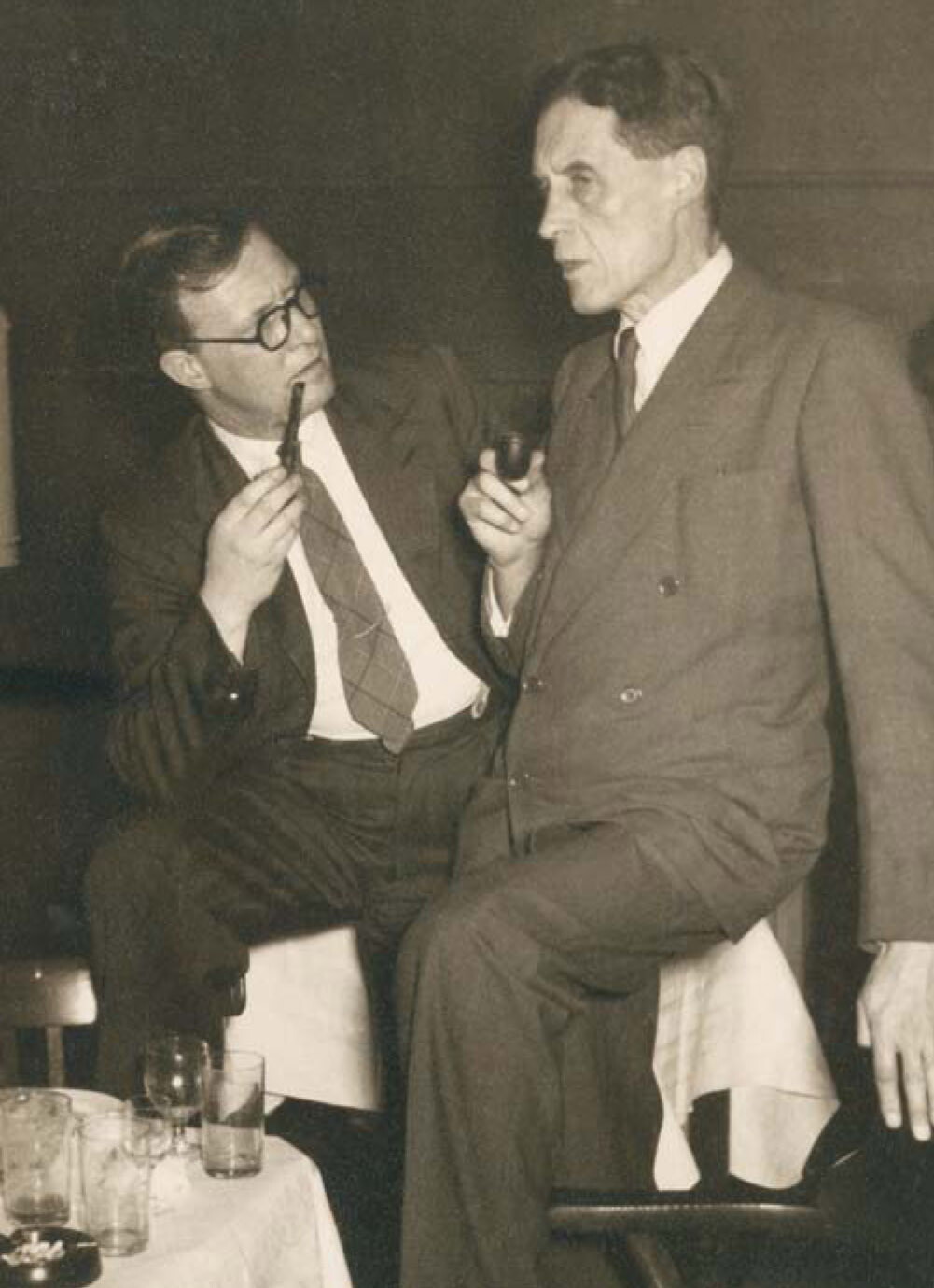
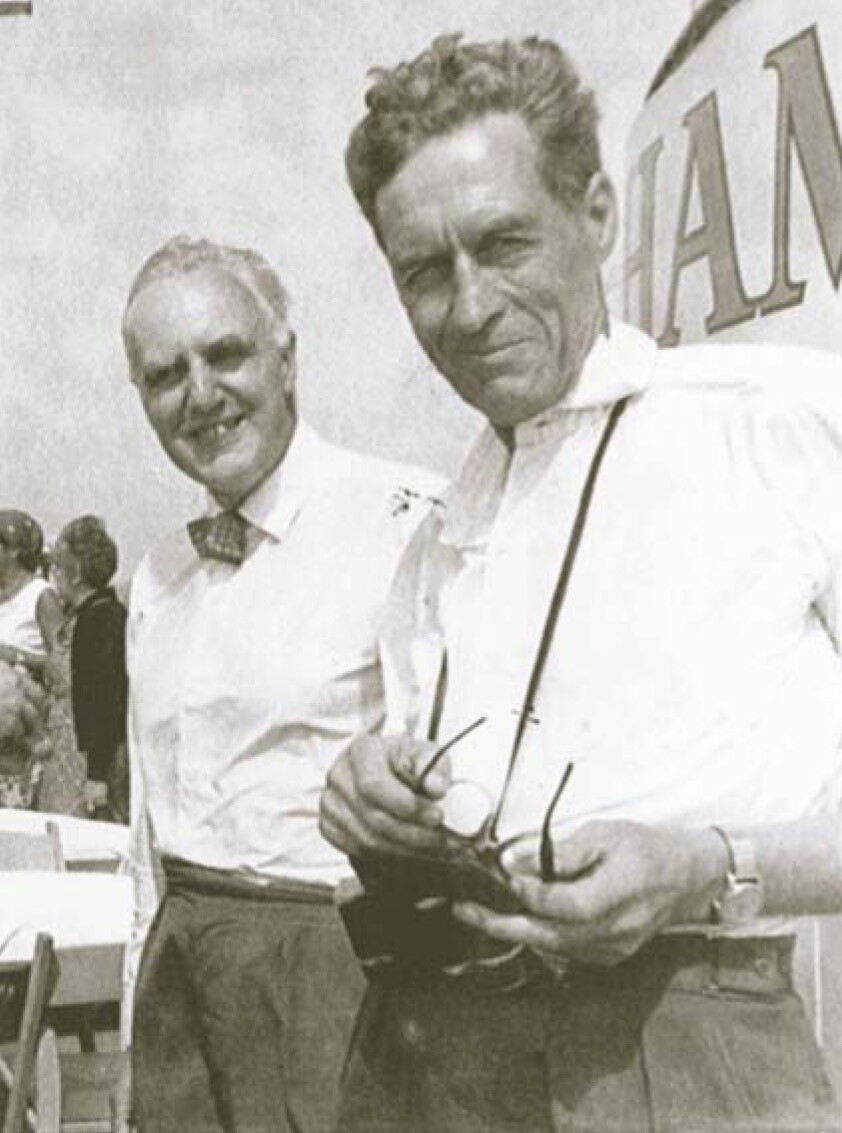
Edward Bullard (left) and Patrick Blackett aboard a ship in the 1960s. The two were linked as early as 1930, when Blackett directed Bullard’s doctoral research at the Cavendish Laboratory. During World War II, they worked together in operational research for the British military. Similar interests in geophysics—especially geomagnetism, paleomagnetism, and plate tectonics—brought them together again in the 1950s and 1960s.
(Bullard Papers, D.472, Churchill Archives Centre, Cambridge, UK.)
Blackett conducted his search for the rays’ significance with consummate experimental skill and a deep awareness of their geophysical relevance. Indeed, it was in his investigation of cosmic rays that Blackett developed his interest in geophysics. He devoted the largest part of his 1936 Halley lecture at Oxford University to what he said “may be called the geophysical problem” of cosmic rays: How does the intensity of the rays depend on the place and time of observation—elevation, latitude, longitude, and direction of travel? 10
Blackett knew the work of recent investigators—Arthur Compton, Erich Regener, and Anderson, among others. But he also surveyed much older publications, back to Edmond Halley’s ocean magnetic charts produced around 1700. Blackett’s public assessment that “even after the 200 years that have elapsed since Halley’s expeditions, no satisfactory theory has been found for the phenomenon of terrestrial magnetism” 10 was behind many of his investigations in the subsequent decades.
He traced geophysical investigations of cosmic rays to 1912 and Victor Hess’s balloon-borne observations. Regener’s 1930s balloon research showed that cosmic-ray intensity increased rapidly from Earth’s surface upward, with a maximum increase at 50° north latitude. At the equator, the intensity increased only 10-fold at balloon altitudes, which prompted Blackett to comment: “More data in this region are urgently needed. Here is an admirable chance for an interesting holiday at the expense of some enterprising scientific body.” 10 He also summarized cosmic-ray intensity studies in mines and underwater, where a few hundred meters below sea level the intensity is one twenty-thousandth its level in the stratosphere.
Cosmic rays, he said, are a form of radiation that travels down toward Earth’s surface, either from the upper atmosphere or from beyond Earth altogether. Others had established from ocean voyages in the 1920s and 1930s that cosmic-ray intensity increases from the equator toward the poles. That made sense, Blackett argued, if the rays were charged particles that originated far from Earth and were deflected inward by Earth’s magnetic field. He said those particles follow Carl Størmer’s calculations and spiral in along the field lines.
Regener had indicated that the cosmic-ray intensity rose steadily up to a certain elevation but then decreased at yet higher elevations, results that Blackett attributed to the production of cosmic-ray showers. In fact, as Blackett soon understood from the cascade theory of Homi Jehangir Bhabha and Walter Heitler, the key to understanding some of the stickiest parts of cosmic-ray phenomena lay in the quantum theory of radiation.
In 1937 Blackett accepted a physics professorship at the University of Manchester, previously directed by Arthur Schuster, Rutherford, and William Bragg, and he rapidly transformed the department into a major locus of cosmic-ray research. The long list of visiting researchers included Occhialini, Heitler, and Bhabha. Blackett brought a research group with him from Birkbeck College, along with his massive cloud chamber and electromagnet. Many of the remaining puzzles about penetrating radiation and absorption processes fell into place in those first few years in Manchester—again, a story for another time.
That move brings Blackett to the verge of World War II and to the point at which his path again intersects Bullard’s. They had, of course, known each other since Bullard went to the Cavendish in 1929. But as Bullard later reminisced, they saw little of each other early in the war. Bullard worked with the British navy on degaussing ships and sweeping mines that could be triggered acoustically and magnetically, work that grew naturally from his prewar marine geophysics. Blackett worked with the Royal Air Force, directing the analysis of the use of radar for antiaircraft batteries protecting England, among other tasks. When he became director of operational research for the Admiralty in 1942, he and Bullard worked closely. From 1943 onward the pair began thinking about postwar science.
Understanding geomagnetism
Even two years before the end of the war, Bullard, Blackett, and other scientists in the UK considered what sort of geophysics should be encouraged after the war. Questions ranged from the distribution of professorships among universities and the relationships between different branches of geophysics to potential uses of new technologies such as radar and a new generation of magnetometers.
While other scientists excitedly planned how new technologies could be used to map Earth’s magnetic field much faster than had been possible before the war, Blackett turned his attention to a fundamental theory of how that magnetism is produced. He had noted that the magnetic fields attributed to the Sun and Earth seemed proportional to their angular momentum. Could it be that every large, rotating gravitational mass generates a magnetic field according to a simple, elegant relation, he wondered. Blackett first presented a sketch of his theory in a seminar in November 1946. Two instances do not prove a theory, however, and he asked astrophysicist Subrahmanyan Chandrasekhar at Yerkes Observatory,
Did you succeed in finding any promising stars with high angular momenta? I have not made much progress with the thinking about this magnetic field question owing to other preoccupations, but I am taking it very seriously and considering whether any terrestrial experiment is likely to be possible. All astronomical evidence if it exists or can be obtained would be of the greatest importance.
11
Did you succeed in finding any promising stars with high angular momenta? I have not made much progress with the thinking about this magnetic field question owing to other preoccupations, but I am taking it very seriously and considering whether any terrestrial experiment is likely to be possible. All astronomical evidence if it exists or can be obtained would be of the greatest importance. 11
In January 1947 Blackett learned of Horace Babcock’s discovery of the considerable magnetic strength of the star 78 Virginis, whose rotation and magnetic field seemed to follow the same relation. Four months later Blackett staked his claim at a Royal Society lecture and gained widespread fame for the discovery of a connection between magnetism and gravity.
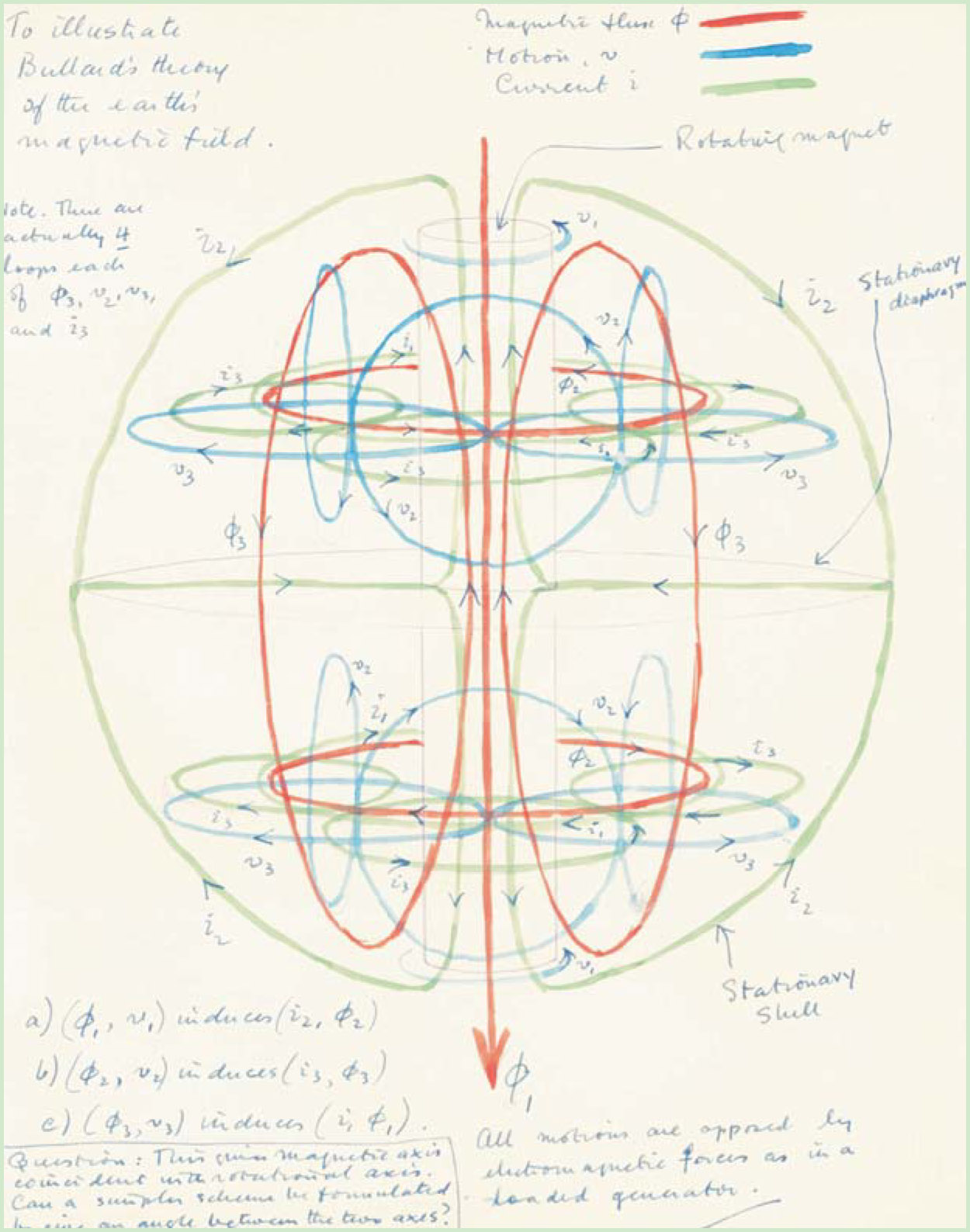
Bullard, on the other hand, brought out a gritty, complex model in March 1948. Seismology, he argued, had shown that Earth’s core is liquid and likely a molten mixture of nickel and iron, as indicated by its density. Could electrical currents flowing through those materials at the edge of the core produce a magnetic field, whose signal we measure on Earth’s surface? Such geodynamos are computational models. And so complex were Bullard’s dynamo models that they required the fastest computers.
According to historian of science Mary Jo Nye, 12 Blackett’s theory was tested thoroughly using a rotating half-ton aluminum disk, a static gold 15-kg cylinder, and a sensitive magnetometer. Unfortunately, data on newly observed stars did not fit Blackett’s simple relation. Worse, observations of the Sun indicated that earlier estimates of its magnetic field had been much too high. New calculations indicated a much smaller magnetic field.

Edward Bullard developed his geodynamo theory of the origin of Earth’s magnetic field in the late 1940s and early 1950s. The theory posits that the main field is produced by electrical currents at the core–mantle boundary. This sketch—found among Bullard’s papers but likely drawn by a student or assistant—shows the magnetic flux in red and electrical currents in green. Bullard’s early models were imperfect, but they began a line of research that is very lively today.
(Bullard Papers, A.239, Churchill Archives Centre, Cambridge, UK.)
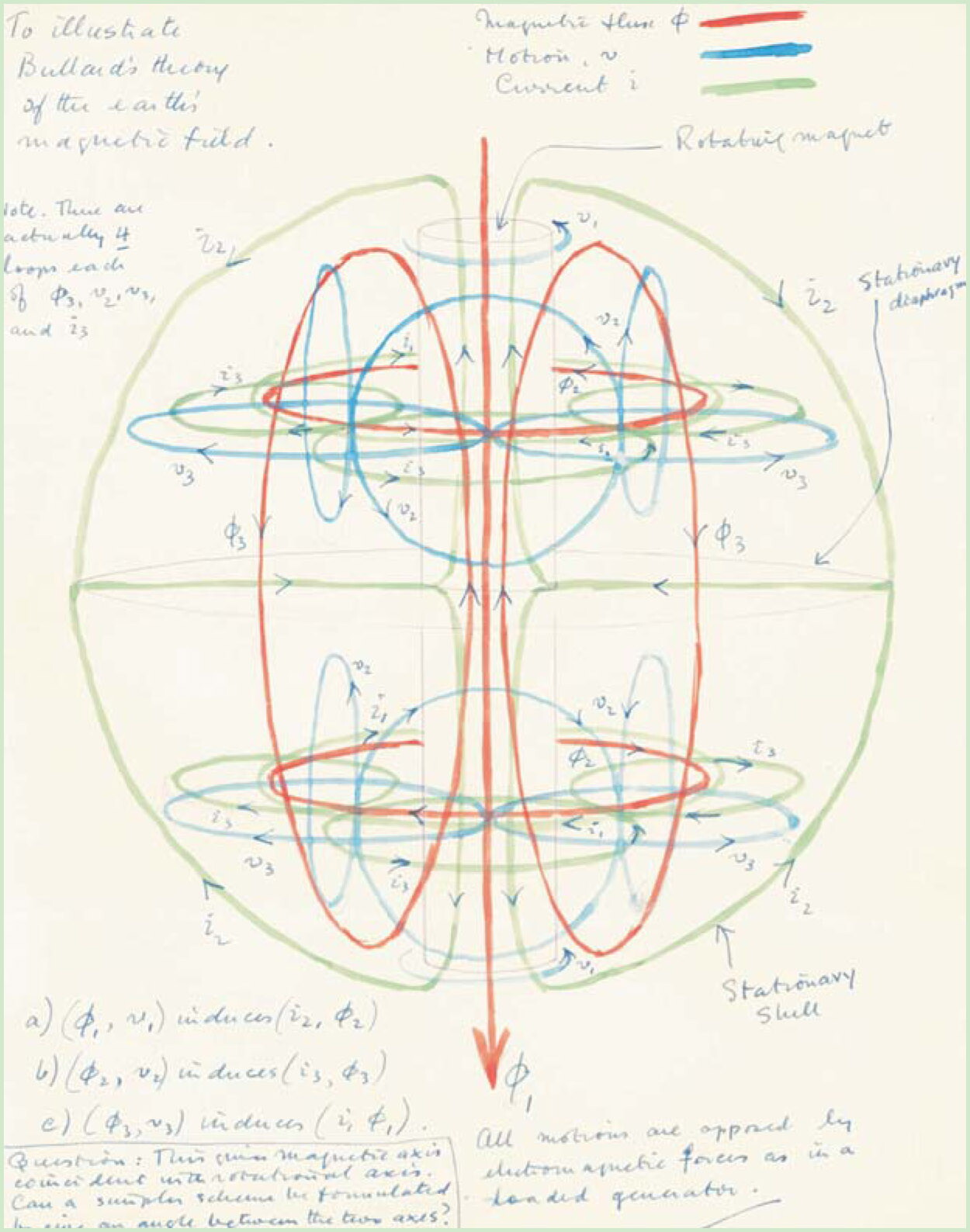
Bullard suggested a field experimentalist’s test. On the one hand, implicit in Blackett’s fundamental theory was the idea that Earth’s magnetic field should decrease with depth below the surface—deep in Earth’s mines, say. On the other hand, a theory that places the production of the magnetic field near the boundary of Earth’s core—Bullard’s geodynamo theory, for example—suggests that the field should increase with depth. After a false start and practical difficulties during testing, the evidence came in against Blackett’s “cosmic theory.” The magnetic field was found to increase with depth.
In 1952 Blackett renounced his idea. Rutherford had proclaimed, “Better to have boomed and bust than never to have boomed at all.” 13 Indeed, by working to test Blackett’s theory, others were developing the methods and instruments that led to paleomagnetism, the study of Earth’s magnetic field record as preserved in magnetic minerals. And as magnetometers matured and became more sensitive, geophysicists found they could map particular regions and perceive connections between magnetic field values and plate-tectonics processes. Blackett’s failed theory had thus inadvertently provided a critical path toward a new theory that revolutionized geology and geophysics. Meanwhile, Bullard led his researchers in several other directions. They became oceanographers, marine geophysicists, geomagnetic researchers, and often computer modelers. Many of them contributed substantively to marine geology and plate tectonics, among many other fields.
Rutherford’s Cavendish Laboratory trained many nuclear, radiation, industrial, and medical physicists. Bullard and Blackett built some of the most active graduate programs in geophysics in the UK. As a result, they are as well known among Earth scientists as among physicists. They and their Cavendish colleagues took geophysics in many different directions. Rutherford’s intellectual grandchildren, the students of his students and younger colleagues, are now retired or retiring. Their stories populate the broad range of geophysical research.
References
1. J. D. Burchfield, Lord Kelvin and the Age of the Earth, U. Chicago Press, Chicago (1990).
2. G. A. Good, Stud. Hist. Philos. Mod. Phys. 31, 259 (2000). https://doi.org/10.1016/S1355-2198(00)00018-6
3. Anonymous, A History of the Cavendish Laboratory, 1871–1910, Longmans, Green, New York (1910).
4. D. Kushner, Osiris 8, 196 (1993).
5. E. C. Bullard, interview by G. Ruh for the US Naval Institute, Annapolis, MD (1969), transcript, Churchill Archives Centre, Cambridge, UK.
6. D. P. McKenzie, Biogr. Mem. Fellows R. Soc. 33, 66 (1987). https://doi.org/10.1098/rsbm.1987.0004
7. E. C. Bullard, Phil. Trans. R. Soc. London Ser. A 235, 445 (1936). https://doi.org/10.1098/rsta.1936.0008
8. E. C. Bullard, T. F. Gaskell, W. B. Harland, C. Kerr-Grant, Philos. Trans. R. Soc. London Ser. A 239, 29 (1940). https://doi.org/10.1098/rsta.1940.0008
9. E. C. Bullard, Biogr. Mem. Fellows. R. Soc. 3, 137 (1957).
10. P. M. S. Blackett, Cosmic Rays: Being the Halley Lecture Delivered on 5 June 1936, Clarendon Press, Oxford, UK (1936).
11. P. M.S. Blackett to S. Chandrasekhar, 14 November 1946, Blackett Papers, Library and Archives of the Royal Society Centre for History of Science, London.
12. M. J. Nye, Blackett: Physics, War, and Politics in the Twentieth Century, Harvard U. Press, Cambridge, MA (2004).
13. H. Tizard, J. Chem. Soc. 1946, p. 980.
14. E. C. Bullard, J. E. Everett, A. G. Smith, in A Symposium on Continental Drift, P. M. S. Blackett, E. Bullard, S. K. Runcorn, eds., Royal Society, London (1965), p. 48.
More about the authors
Greg Good is director of the Center for History of Physics at the American Institute of Physics in College Park, Maryland.
Gregory A. Good, American Institute of Physics, College Park, Maryland, US .