Quantum-based standards for pressure measurements
Units of measure have to be guaranteed in some way. Metrologists could declare a particular object as the ultimate embodiment of a unit. A single chunk of metal, for example, could be pronounced as the defining unit of mass. Or two marks could be carved in a particular stone, and the distance between them could be the defining unit of length.
Such objects are called realizations, and experiments can be realizations too. To be a primary realization, the object or experiment must not be reliant on a measurement of like kind. A primary pressure realization, for example, can’t rely on a pressure gauge.
For units of measure to work globally, an international consensus system had to be developed, widely adopted, and maintained. Today, that system is the International System of Units (SI, from the French Système International d’Unités), also known as the metric system. The definition and methods of realization for SI units are established by policymakers at the International Bureau of Weights and Measures (BIPM), near Paris.
Any primary realization must be consistent with the established definition, so artifact-based definitions severely limit the potential for the development of new primary realizations. Previously, a meter and a kilogram were defined by a particular bar and cylinder, respectively, stored in France. Under those definitions, each artifact was the only possible primary realization of its corresponding unit.
For someone to compare an instrument or apparatus with a primary realization—for example, to determine which tape measure in figure 1 is most accurate—a trip to France was required. The unit definitions, therefore, prevented many researchers from directly accessing those primary SI realizations. Indeed, the queue at the BIPM would have grown unreasonably long if every researcher wanted to compare their measuring instrument with a unique, defining artifact.
Figure 1.

Which tape measure is most accurate? Prior to 1960, the ultimate way to check would be to take a trip to France and compare the length-measuring devices with the meter-defining artifact.
(Photo courtesy of Alex Lopatka.)
Because of those access limitations, people developed secondary standards, tertiary standards, and even standards many times removed from the primary realization. High-quality measuring devices are often calibrated to one of those standards rather than the primary realization, and the path from the device to the primary realization is the traceability chain. Each link in the traceability chain adds uncertainty, no matter how high the quality of the instrumentation is or how carefully a scientist performs a measurement. The box discusses the traceability chain further.
In 2019, the SI was redefined so that all units would be based on universal constants, such as the electron charge and the speed of light. By consensus, the fundamental constants are now fixed values with no uncertainty. If students in a lab class are re-creating the oil-drop experiment, for example, they would measure not the fundamental electric charge but the value of a coulomb. The new paradigm has been called the quantum SI because it refers to atomic-scale phenomena as the new basis to define units. 1 2 (For more on the SI redefinition, see the 2014 PT feature “A more fundamental International System of Units ,” by David Newell.)
The redefinition has been celebrated by metrologists, but in trade and manufacturing, most metrology carries on as it always has. For example, instead of using the quantum SI, thermometry relies on the freezing points of various substances and the triple point of water, and mass metrology relies on comparisons of chunks of metal. Realizations based on the new SI are expensive and largely impractical, and they don’t necessarily offer better accuracy than realizations made with traditional technologies—not yet, anyway. But in the future, the quantum SI could result in realizations that are practical and deployable in the factory, the field, and the lab.
The optical pascal at NIST
NIST is exploring opportunities to develop quantum-SI technologies for several quantities and units, including ones pertaining to mass, pressure, temperature, and voltage. This article focuses on the effort to create quantum-SI pressure realizations. Pressure measurements are ubiquitous and span 18 orders of magnitude across various applications and processes. Some examples include advanced manufacturing, aviation, semiconductor development, and weather forecasting. Ultrahigh vacuum environments are critical in quantum information science and fusion technology, and they are required in many large-scale experiments, including the Large Hadron Collider and the Laser Interferometer Gravitational-Wave Observatory.
The traditional definition of pressure is , where F is a force and A is an area. It’s intuitive and useful: Someone who wants to measure pressure can, for example, stack known weights on a piston with a known area. But that definition becomes impractical at pressures lower than 1 atmosphere. Distinguishing a signal of interest from noise in that pressure regime is challenging for a force-measuring device.
Now that the SI has been redefined, however, the ways to define and subsequently realize pressure are constrained by only the laws of physics and fundamental constants. Researchers can find any equation that relates pressure to something that’s both directly measurable and able to be calculated from first principles with fundamental constants, which anchor the pressure unit to other units in the SI. Such an equation is not only acceptable as a definition—it has the potential to shorten the traceability chain. If that equation is then implemented into a carefully controlled experiment, a realization of pressure is obtained.
The traceability chain
Verifying a measuring device with a standard is such an ingrained scientific procedure that imagining alternatives may be difficult. An ice bath realizes temperature, and to calibrate a thermometer, you stick it into the ice bath and adjust it until it reads 0 °C. But the ice bath can’t measure temperature. An object with a known weight, such as 1 kg, realizes mass. It’s put on a scale, and if the reading is 1 kg, you conclude that the scale works. But the object can’t measure mass.
To measure something that’s around 10 °C or 1.01 kg, you need an interpolating measuring device with tick marks or gradations that are small enough, or have enough digits, to achieve the necessary precision. Such a requirement introduces new sources of uncertainty and means that the traceability chain has at least one link. If you measure a quantity that differs by orders of magnitude from the realization value, the chain grows long, and uncertainties balloon.
With the quantum SI, a realization technique has the potential to function as a measuring device. As the new approach to measurement evolves and matures, the consequences may be profound. With a quantum-SI device, scientists could confidently calibrate their gauges, but they wouldn’t have to. Instead, they could just use the quantum-SI device as a gauge.
One equation that can be used to develop a realization for low pressures is the ideal-gas law because it has measurable quantities and is anchored to the SI through the Boltzmann constant kB. For higher pressures, where the gases are not ideal, higher-order terms of the equation of state of a gas must be included.
The corresponding definition of pressure is , where T is temperature and ρ is the gas density. Temperature can be observed with an off-the-shelf thermometer, perhaps someday one that is itself a quantum-SI device. Measuring gas density without using a pressure gauge is difficult, and quantum science comes into play.
Liquid-column manometers are traditional pressure-measuring devices in which the height of a column of liquid in a tube indicates the difference in pressure between the two ends. Typically, one end is a vacuum and the other is open to the atmosphere. (The tube is bent in a U shape to keep the liquid from draining out.) Liquid-column manometers are critical in aviation safety, defense applications, and weather forecasting.
Although they have excellent performance, liquid-column manometers are not readily portable. So anyone who needs to make precision pressure measurements must calibrate their instruments with manometers, and that calibration results in a nonzero-length traceability chain. Quantum-based pressure measurements and realizations could shorten or eliminate traceability chains and potentially reduce uncertainty, and thus improve pressure measurements.
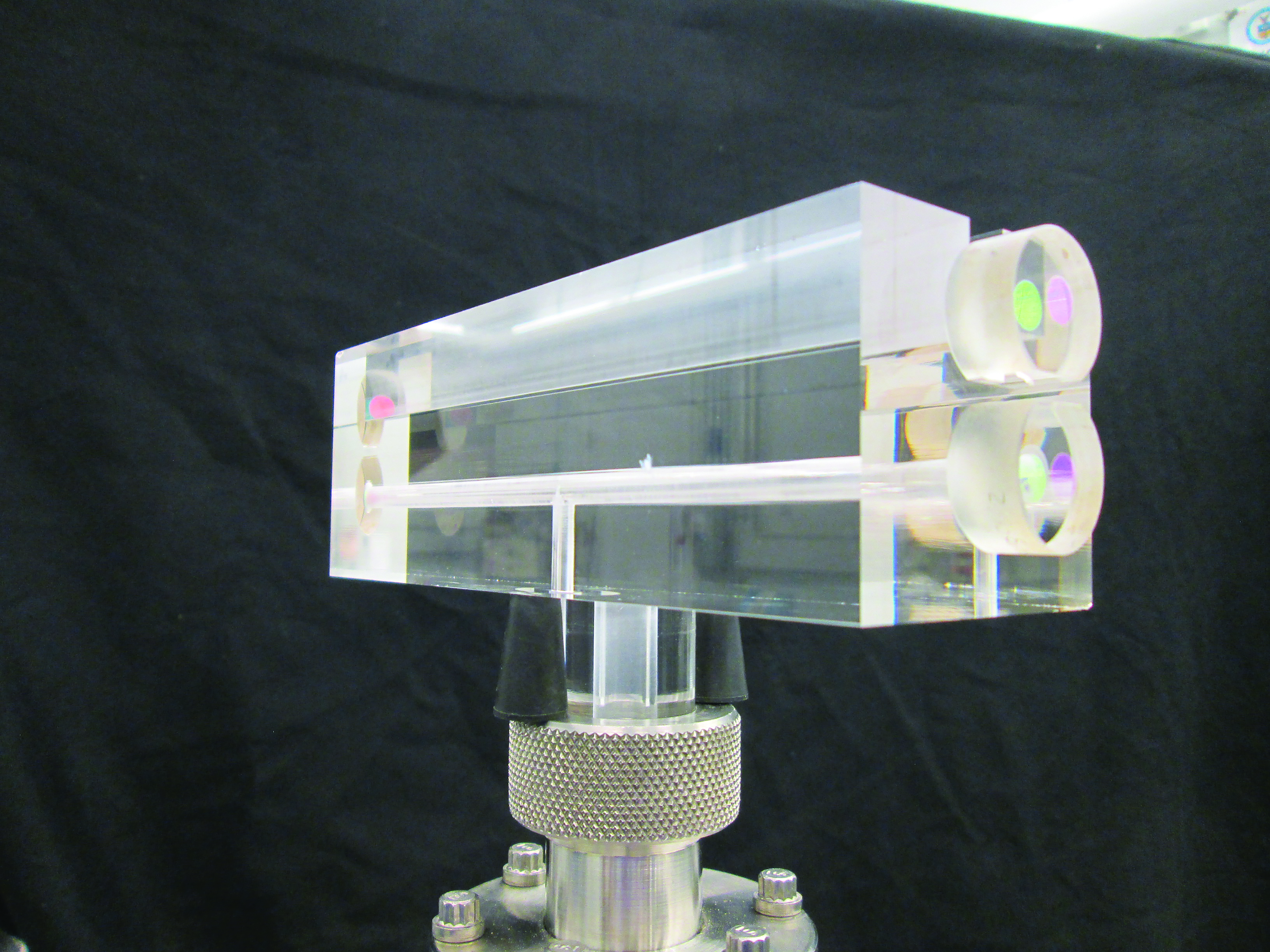
To realize pressure with a quantum-based approach, researchers can make optical measurements of the refractivity of a gas. The NIST fundamental thermodynamics group has designed an optical pressure standard (OPS) whose design is based on a dual-channel fixed-length optical cavity (FLOC) and that consists of a glass cell with two laser cavities, as figure 2 shows. One cavity is kept evacuated and serves as a reference cavity while a researcher exposes the measurement cavity to the pressure of interest. Light with frequency ν from identical lasers traverses each FLOC channel and is combined at the outlet.
Figure 2.

The fixed-length optical cavity is the heart of the NIST optical pressure standard. A researcher fills the upper channel with gas at the pressure of interest and evacuates the lower chamber. Then, laser beams are locked into resonance with the respective channels that they traverse. Once the two beams are combined on the other end of the channels, the measured beat frequency can be used with other properties of the gas to develop a primary realization of pressure.
(Photo courtesy of Jacob Ricker and Jay Hendricks.)

The lasers are tuned to be in resonance with their respective cavities. The light that travels through the measurement cavity is slower than that in the reference cavity because of the presence of a gas with a nonunity refractive index, so its resonant frequency is lower. The result of combining the locked laser light is thus a measurable beat frequency.
If the refractive index is indeed known from first principles, the optical measurement becomes a primary realization of pressure.
3
That realization can be obtained through a measurement of the effective pressure-induced frequency shift ∆f, which is approximately equal to the beat frequency. To first order—and ignoring distortion effects and some details about the interrogation—that frequency is related to pressure through
The dipolar polarizability α and diamagnetic susceptibility χ of the gas relate to its refractive index. Those could be measured through an independent experiment, but to make the technique fully primary, the experiment would need to avoid using a pressure gauge, which is a virtually impossible task. To make it fit the quantum-SI paradigm, researchers should calculate α and χ theoretically, and they have done so for helium using quantum electrodynamics.
NIST has partnered with a pressure-measurement company to develop an OPS product prototype. Preliminary demonstrations of several OPS designs show better performance than the most accurate manometers. 4 NIST is also partnering with metrologists from the US Department of Defense to develop OPS instruments for use on military bases. Both efforts could reach maturity in the next few years, so quantum-SI pressure devices may be seen outside the lab soon.
A new vacuum standard
The traditional definition of pressure as force per area remains impractical at the extremely low pressures that are found in accelerators, gravity interferometers, and outer space. At such pressures, measurement signals are on the order of 10−6 Pa, whereas the atmospheric background is 105 Pa.
Metrologists have traditionally achieved realizations at extremely low pressures by using successive comparisons of gauges and techniques with different but overlapping pressure ranges. Recently, researchers at NIST have developed a quantum-based primary realization of pressure at ultrahigh vacuum. The development is possible because in the 1980s, atomic physicists discovered that lasers can cool clouds of neutral atoms to temperatures near absolute zero and that the barely moving atoms can then be trapped in magnetic fields. (For more on such capabilities, see the 1987 PT article “Laser cooling ,” by David Wineland and Wayne Itano.)
Cooling and trapping the atoms require an exquisitely clean vacuum environment. Indeed, the lifetime of atoms in a trap depends inversely on chamber pressure so predictably that it can be used as a pressure sensor. The use of trapped atoms as vacuum realizations is possible because of the redefinition of the SI and advances in collision physics.
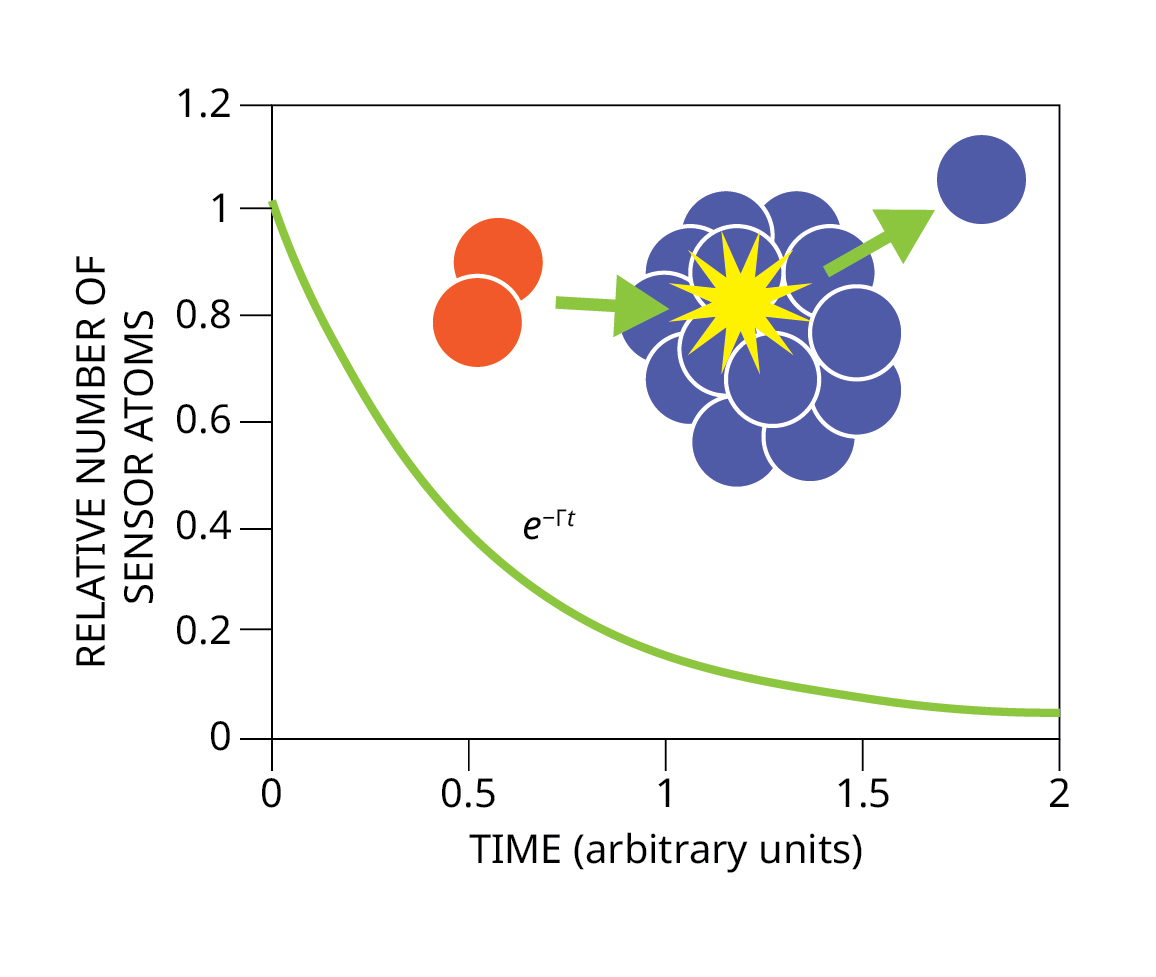
Once again, the measurement equation is based on the ideal-gas law. In this case, knowing the density of the gas in the chamber boils down to counting the background particles. The cold-atom vacuum standard (CAVS) is an atom trap that, once correctly configured and operated, does just that. Each time a room-temperature background particle, such as hydrogen or an atmospheric gas, collides with a sensor atom, it ejects the atom from the trap. As the process continues, from fractions of a second to hours, the number of atoms Ns that remain in the trap follows an approximately exponential decay Ns(t) = Ns(t = 0)e−Γt, where Γ is the loss rate. The number of atoms that remain in the trap follows an approximately exponential decay ρs(t) = ρs(t = 0)e−Γt, where ρ is the density of the gas in the chamber and Γ is the loss rate. Figure 3 plots the decay equation.
Figure 3.

When a room-temperature background particle (red) collides with a cold sensor atom (blue), it ejects the atom from the trap. Each time the process is recorded, researchers count one background particle, and the count is determined by the number of trapped sensor atoms, which decays exponentially with time. Once the decay constant Γ is measured, it’s combined with the ideal-gas law and the calculated collision cross section to produce a primary, quantum-based pressure measurement.

A measurement of the change in the number of atoms in the trap over some elapsed time, therefore, counts the number of collisions. That process, combined with the thermally averaged collision cross section kloss and the ideal-gas law, results in a measurement and a realization of pressure: . 5 Through ab initio quantum calculations of the collision cross sections, researchers have made the CAVS into a primary pressure standard.
The cross-section calculations of kloss, which were previously possible only with approximate methods of limited applicability, are now in reach because of advances in computing capabilities. Calculations have been carried out for a large sample of possible sensor–background particle pairs 6 and have enabled researchers to test theory against experiment. 7
A lab-sized version of the CAVS device has been built so that all aspects of the experiment can be fully controlled. The magnetic fields are produced by electromagnets with an elaborate coil geometry, and various field configurations are possible. 8 Either lithium or rubidium can be used as the sensor atoms, and the trap depth can be fine-tuned. Using a purpose-built traditional vacuum apparatus called a dynamic-expansion chamber, researchers can inject an arbitrary gas into the CAVS device at pressures as low as 10−12 Pa, the lowest level achievable on Earth. Full control of experimental conditions allows for the uncertainty of the technique to be characterized. Measuring uncertainty is important in any experiment but is essential for modern metrology—driving down uncertainty is often the entire point of a project.
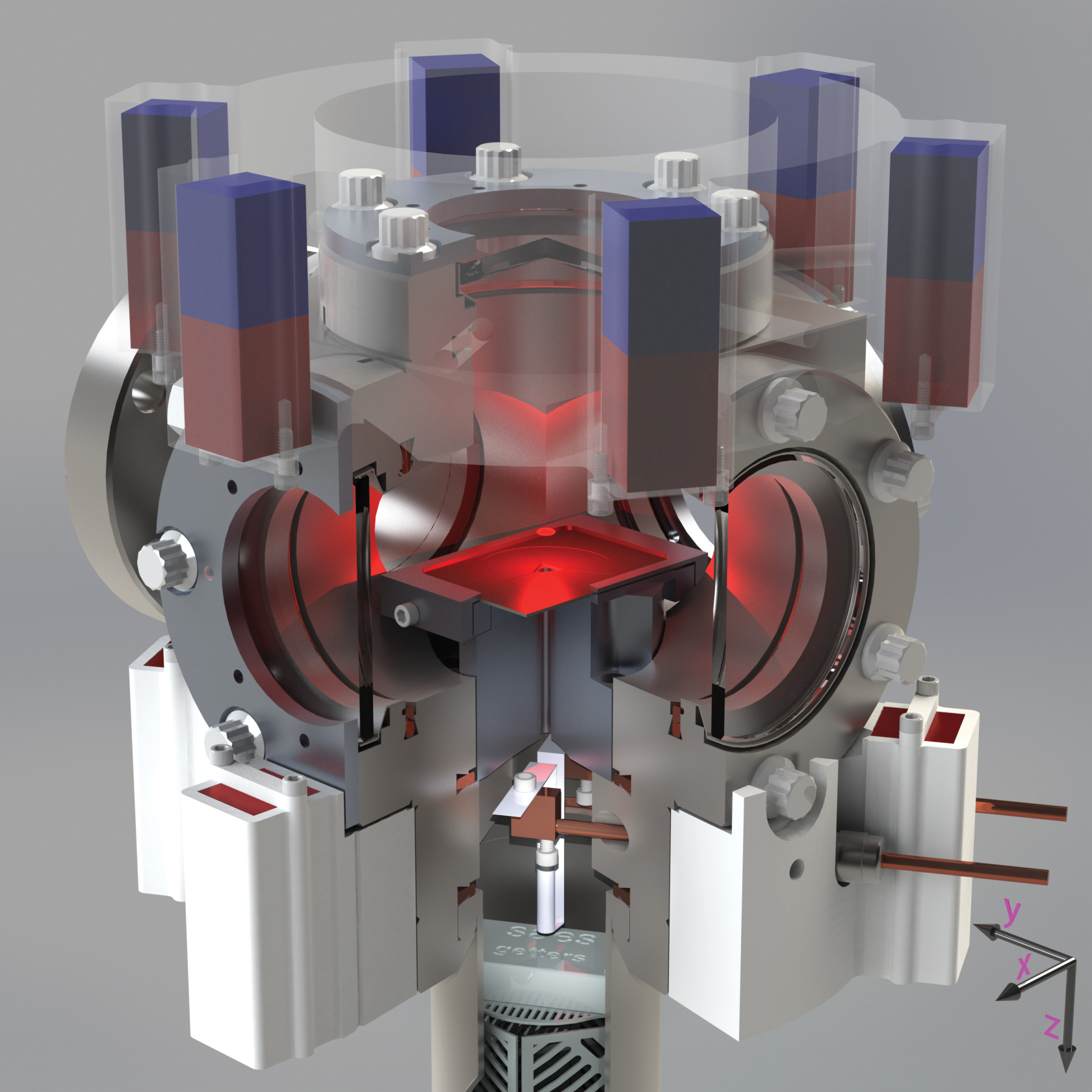
A room-sized apparatus, of course, has no future as a metrological instrument, except maybe at a national metrology institute. So NIST developed a portable version, pCAVS. It uses a grating to replace most of the optical components. Figure 4 shows a rendering of the device, which is about 1.3 L in volume and is supported by multiple lasers and electronics. 9 Practically all systematic uncertainties are negligible, and the pCAVS instrument is more than adequate for deployment in various circumstances, including on accelerator beamlines and in nanofabrication foundries.
Figure 4.

The portable cold-atom vacuum system was developed at NIST. It is designed to use the ideal-gas law and collision physics to measure pressure from first principles. The goal of the quantum-based metrology approach is to develop a practical, deployable device for various high-precision applications.
(Image courtesy of Daniel Barker and Stephen Eckel.)

In a recent experiment, the CAVS and pCAVS devices were used to measure the loss rate Γ, the dynamic-expansion chamber was used to set and measure the pressure p, and then kloss was determined. 7 In all cases, theory and experiment agree within the error bars. If the pCAVS and CAVS instruments were deployed, the theoretical collision cross sections would be used to be consistent with the quantum SI.
The pCAVS prototype constructed at NIST is ready to be developed into a product, and the NIST OPS is under development both as a commercial pressure gauge that doesn’t require calibration and as a standard for the direct calibration of aircraft sensors. With a direct calibration, the traceability chain has only one link.
The future of the quantum SI
Other groups are pursuing realizations of quantum-SI pressure. To make trapped atoms into vacuum standards, researchers in Canada are using quantum diffractive collisions with trapped rubidium 10 and, in collaboration with scientists in Germany, developing a dual-species device that uses rubidium and potassium. 11 In China, researchers are taking an approach similar to that of NIST. 12 Likewise, several efforts around the world aim to develop OPS devices for use on airplanes, in commercial factories, and in national metrology institutes. 13 14 15 16 Although quantum-SI devices may become widespread in the near future, such systems will still need quality checks and regular maintenance.
The originators of the metric system wanted it to be “for all times, for all people.” Now that the physics underpinning the metrology measurements is no longer a cause of disagreement, the promise of the slogan is coming into being. Perhaps the most important aspect of the quantum SI is that it’s available to anyone who has access to the cavities, lasers, magnets, and other equipment necessary to interrogate the physics. No trip to France is required.
The mention of commercial equipment, instruments, or materials in this article does not imply recommendation or endorsement by NIST, nor does it imply that the materials or equipment identified are necessarily the best available for the purpose.
References
1. P. J. Mohr, “Defining units in the quantum based SI ,” Metrologia 45, 129 (2008).
2. M. Stock et al., “The revision of the SI—the result of three decades of progress in metrology ,” Metrologia 56, 022001 (2019).
3. P. F. Egan et al., “Performance of a dual Fabry–Perot cavity refractometer ,” Opt. Lett. 40, 3945 (2015).
4. J. E. Ricker et al., “Gas pressure calibration from 0.01 Pa to 400000 Pa using a portable quantum traceable standard ,” Meas.: Sens. 38, suppl., 101676 (2025).
5. D. S. Barker et al., “Precise quantum measurement of vacuum with cold atoms ,” Rev. Sci. Instrum. 93, 121101 (2022).
6. J. Kłos, E. Tiesinga, “Elastic and glancing-angle rate coefficients for heating of ultracold Li and Rb atoms by collisions with room-temperature noble gases, H2, and N2 ,” J. Chem. Phys. 158, 014308 (2023).
7. D. S. Barker et al., “Accurate measurement of the loss rate of cold atoms due to background gas collisions for the quantum-based cold atom vacuum standard ,” AVS Quantum Sci. 5, 035001 (2023).
8. J. L. Siegel et al., “A Bitter-type electromagnet for complex atomic trapping and manipulation ,” Rev. Sci. Instrum. 92, 033201 (2021).
9. L. H. Ehinger et al., “Comparison of two multiplexed portable cold-atom vacuum standards ,” AVS Quantum Sci. 4, 034403 (2022).
10. P. Shen, K. W. Madison, J. L. Booth, “Realization of a universal quantum pressure standard ,” Metrologia 57, 025015 (2020).
11. J. Halbey et al., “Design advances on the dual species cold atom based pressure standard ,” Meas.: Sens. 38, suppl., 101695 (2025).
12. W. Sun et al., “Cold atom technology applied to ultra-high vacuum (UHV) measurements ,” Vacuum 222, 113079 (2024).
13. C. Forssén et al., “An optical pascal in Sweden ,” J. Opt. 24, 033002 (2022).
14. D. Mari, M. Pisani, M. Zucco, “Towards the realization of an optical pressure standard ,” Measurement 132, 402 (2019).
15. Y. Takei et al., “Development of an optical pressure measurement system using an external cavity diode laser with a wide tunable frequency range ,” Measurement 151, 107090 (2020).
16. Y. Yang, T. Rubin, J. Sun, “Characterization of a vacuum pressure standard based on optical refractometry using nitrogen developed at NIM ,” Vacuum 194, 110598 (2021).
More about the authors
Julia Scherschligt is a staff scientist at NIST in Gaithersburg, Maryland. She is the chair of the Working Group on Pressure and Vacuum, which is part of the Consultative Committee for Mass and Related Quantities at the International Bureau of Weights and Measures near Paris. She is also a former leader of the NIST group responsible for developing quantum-based standards for pressure measurements.