New Designs for the Nuclear Renaissance
DOI: 10.1063/1.1480783
Nuclear power originally burst on the horizon some 50 years ago, full of promise and great expectations. This source of energy, it was hoped, would provide an almost unlimited supply of cheap, clean electricity during a time when electric power usage was growing rapidly to meet the demands of new, energy-intensive technologies. When reality failed to meet expectations and anticipated demand growth slowed, nuclear power fell into varying degrees of disfavor around the world. It was seen as too costly and too complicated, and it carried with it the burden of waste disposal. Reactor accidents at Three Mile Island, Pennsylvania, and Chernobyl, Ukraine, also undermined public confidence in the technology.
Recently, however, nuclear power has attracted renewed interest in the US. The reasons for this revival are many, but perhaps the most important is the growing concern about global warming. Apart from hydroelectric power, whose implementation is limited to mountainous regions with abundant rainfall, nuclear power is the only presently available, large-scale supplier of electricity that does not generate greenhouse gases. Coupled with this environmental advantage is the improved economic and—perhaps most important—safe operating performance of nuclear power plants in recent years. Meanwhile, competing gas-fired plants face increasing natural gas prices. Moreover, and quite unexpectedly, the deregulation and restructuring of the US electric power industry—long thought to be detrimental to nuclear power—has turned out to be a boon to existing nuclear plants. It is far cheaper to maintain an existing facility whose capital cost has been largely amortized than to build a new one.
The increasingly positive view of nuclear power is reflected in recent public opinion polls, in statements by political leaders, and in President Bush’s National Energy Policy, which “recommends that the President support the expansion of nuclear energy in the United States as a major component of our national energy policy.”
Other developed countries, concerned about climate change and self-sufficiency, also are reevaluating nuclear power, even though in some of them opposition to nuclear power continues to be a factor. And smaller, developing countries hope that nuclear power will help drive technological development. Thus, the nuclear industry anticipates a much broader market than presently exists for nuclear power plants.
This nuclear renaissance comes at an opportune time. R&D over the past few years suggests that advanced concepts for nuclear power plants and fuel cycles may achieve significant advantages over current plants in areas such as cost, safety, and proliferation resistance.
A brief history of reactor technology
The heart of a nuclear power plant is the reactor, in which a core of fissile materials generates heat in controlled fission reactions. A liquid or gas coolant extracts the heat, which drives a turbine to produce electricity. Most nuclear power plants today are fueled by uranium that has been enriched slightly in the isotope 235U, which fissions more readily than the more abundant isotope 238U. In these modern reactors, neutrons are “moderated”—that is, slowed down—to drive the fission process. Because moderation brings the neutrons to thermal equilibrium with the environment, such reactors are known as thermal reactors.
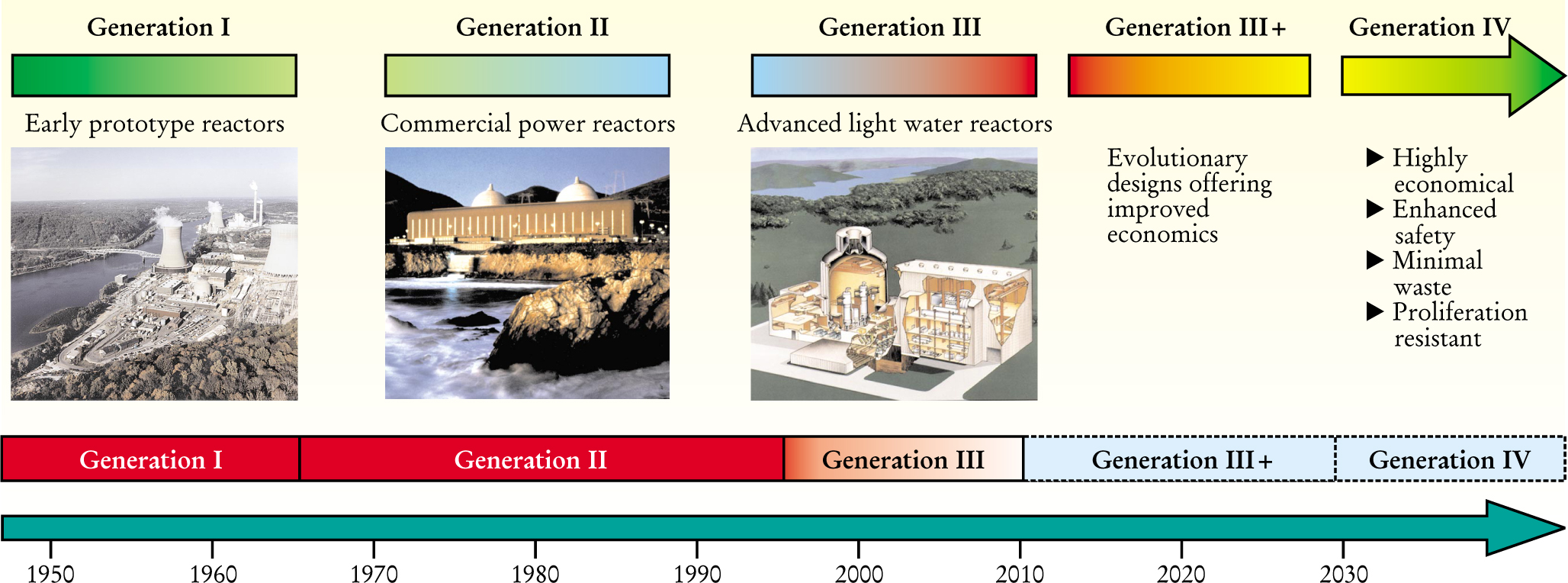
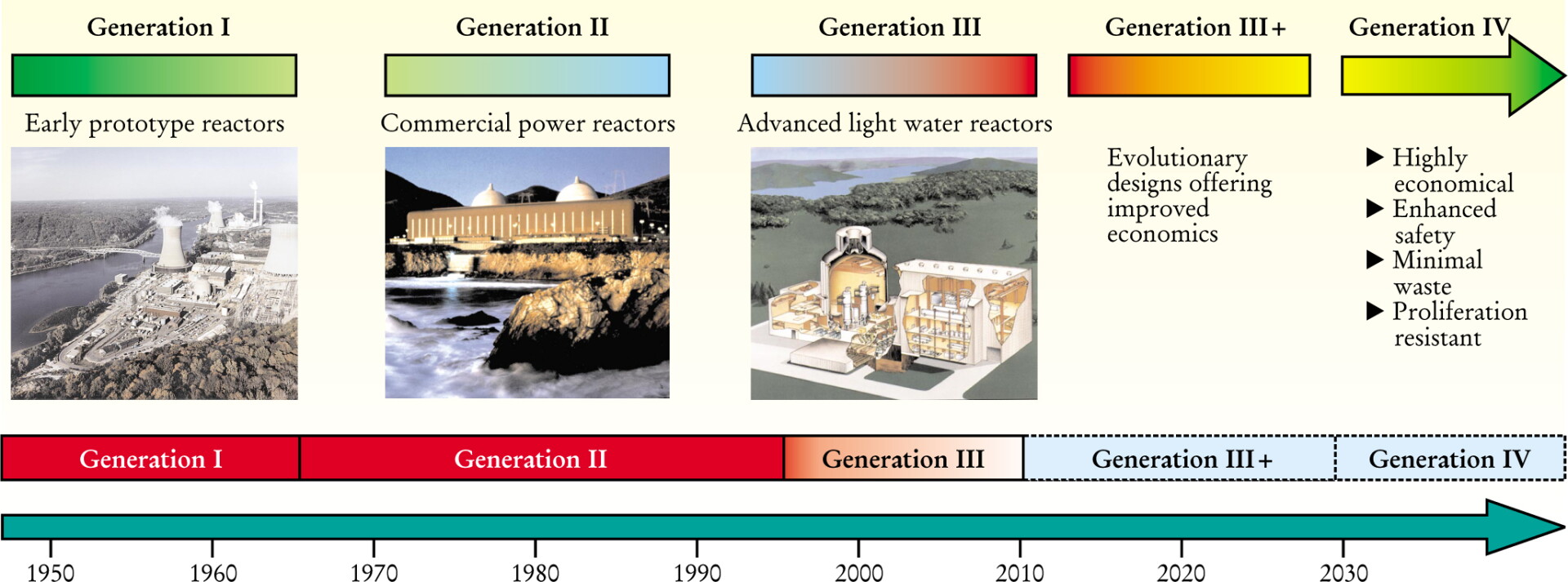
It is convenient to think about the evolution of nuclear technology in terms of generations of designs (see figure, top of next page), although the boundaries between the generations are not necessarily distinct. In the early development of nuclear power, many types of reactor designs were proposed with a wide range of coolants (for example, light water, heavy water, organic liquids, liquid metals, molten salts, gases), fuel materials (for example, uranium-235, uranium-238/plutonium-239, thorium-232/uranium-233, oxides, carbides, or metal alloys), and system configurations. Based on these early reactor designs, a number of prototypes and demonstration plants were built and operated. These one-of-a-kind plants form Generation I. Most of them have been shut down for many years, but they were valuable tools for exploring the potential of nuclear energy. For example, the first reactor to generate electricity, in 1951, was a fast reactor cooled by liquid metal, which does not slow the neutrons effectively. This technology was among several that did not achieve commercial success.

The evolution of commercial nuclear power plants, though continuous, can be thought of as a series of generations that extends from the first prototype plants of Generation I, through the existing and planned plants of Generations II, III, and III+, to the speculative concepts of Generation IV.
Gradually, technical challenges and economic considerations narrowed the choices for commercial development to relatively few designs. These Generation II plants were the first to be commercially successful. Generally larger than those of Generation I, Generation II plants typically generate 700–1300 megawatts and are mainly cooled by light water. In light water reactors (LWRs), the reactor core sits in a steel pressure vessel filled with ordinary water. By slowing the neutrons produced in fission reactions, the water makes the neutrons more effective at initiating further fissioning of 235U, thereby reducing the necessary degree of enrichment.
There are two types of LWRs: pressurized water reactors (PWRs) and boiling water reactors (BWRs). In the PWR shown in
The physics and engineering of reactors are considerably more complicated than this simple picture suggests. In reality, reactors include additional features and systems for routine and emergency control. Atypical Generation II reactor uses control rods to regulate the rate of the reaction and to shut the reactor down. If the control rods cannot be inserted, backup systems halt the nuclear reaction. And in case the primary cooling is lost, emergency systems assure a supply of coolant. These systems, some of which were added to original designs as experience developed, have increased the cost and complexity of operations.
Some Generation II reactors, such as those developed in Canada, use heavy water, D2O, as a coolant and moderator. Because deuterium atoms absorb neutrons less readily than hydrogen atoms do, heavy-water reactors can use unenriched uranium as fuel. In the past, enriching uranium has tended to be quite expensive, so heavy-water reactors had an economic advantage over LWRs. However, the use of D2O increases reactor size for a given output (compared to an LWR) because deuterium is a less effective moderator. Moreover, whereas producing D2O continues to be expensive, worldwide competition has reduced the cost of enriched uranium to the point where the designers of heavy-water reactors are considering using light water as a coolant. (The reactor design would still use heavy water as a moderator.)
Other reactors are cooled by a gas, such as helium or carbon dioxide. Gas-cooled reactors must use a separate, graphite moderator because gas is not dense enough to slow neutrons effectively. Compared with water-cooled reactors, GCRs tend to be more robust in response to accidents that involve a loss of coolant, because a graphite moderator, thanks to its high heat capacity, can absorb a great deal of energy. Moreover, because GCRs are free from concerns about phase changes in either the coolant or the moderator, they can operate at higher temperatures than LWRs. As a result, GCRs are thermodynamically and economically more efficient than LWRs. However, because carbon atoms are heavier than hydrogen or deuterium atoms, graphite is a much less effective moderator. Graphite moderators, and therefore the entire plant, have to be large, so GCRs tend to be larger than LWRs.
Several designs have been developed that represent more-or-less evolutionary advances over the current generation of reactors. Termed Generation III, these reactors are all LWR designs with advanced safety features. Among the new features is a greater dependence on so-called passive safety, which relies on stored energy and natural processes rather than electrical power. One Generation III design, General Electric Co’s Advanced BWR (ABWR), has achieved a measure of commercial success. Two are in operation in Japan, and several others are under construction in Japan and Taiwan.
The ABWR and two other Generation III designs—Westinghouse Electric Co’s System 80+ and AP600 (see
Pressurized water reactors
About 75% of the light water reactors in commercial use today are pressurized water reactors (PWRs). A conventional PWR uses ordinary water as both coolant and moderator. In the primary loop (shown here in pink), water at 300°C and a pressure of about 15 megapascals is pumped through the reactor core, where it is heated by the nuclear fuel. The coolant then flows through tubes in the steam generator, where its thermal energy is transferred to the lower-pressure (about 6 MPa) secondary loop (shown in blue). The primary coolant returns to the reactor, while steam from the steam generator, at about 275°C, is used to drive the turbine and generate electricity. The steam is then condensed (with the remaining energy rejected to the environment) and the condensate is pumped back to the steam generator.

This arrangement segregates the radioactive water in the primary system from the steam cycle and the environment. In boiling water reactors, water boils in the reactor to create the steam used to drive the turbine. This arrangement does away with the steam generator, but the steam produced is slightly radioactive. As a result, the turbine and related equipment must be shielded.
A sample generation III reactor
Westinghouse’s AP600 is a Generation III design with a capacity of about 600 megawatts. Although the AP600 primary system is not much different from the conventional pressurized water reactor shown in

In the event of a reactor emergency, a passive residual heat removal (PRHR) heat exchanger removes heat from the core. The PRHR, which works by natural convection, is submerged in the in-containment refueling water storage tank (IRWST). Further cooling can be achieved by injecting the high-pressure coolant that circulates naturally in the core makeup tanks (CMTs) attached to two of the cold legs (the pipes shown in gray).
In a small loss-of-coolant accident, automatic depressurization valves on the pressurizer open to reduce reactor pressure so that gas-pressurized accumulators can inject emergency core coolant. Additional DPVs on the hot legs (the pipes shown in red) open at lower pressure to permit gravity-drain injection from the IRWST. (A large LOCA will depressurize the reactor through the break.) Ultimately, heat is removed through the steel containment shell (not shown), which is cooled externally by water deluge from a tank above it. Steam condenses on the shell’s inside surface, and the condensate returns to the IRWST or the containment sump for recirculation to the reactor.
The AP600 has been certified by the US Nuclear Regulatory Commission. The AP1000, a higher-power version of this concept, is currently in the final stages of a preapplication review by the NRC.
Emerging needs
Any new nuclear technology must address and surmount the real and perceived barriers that impede the further deployment of currently available designs. Cost is the highest barrier, but the issues of safety, proliferation resistance, and waste disposal are also important.
Current plants are safe and highly resistant to the proliferation of nuclear material, but the increased use of nuclear power in the future will likely lead to demands for even better performance in these areas. Especially in developing countries, the need will increase for technological features that limit the need for operator intervention, assure proliferation resistance, and make the reactors robust with respect to losses of offsite power from their less stable electrical power grids. In the US, the continued difficulty in resolving the problem of waste disposal suggests that plants that generate less waste or that produce waste in forms that reduce the demands on repositories will have a considerable advantage.
It is not clear what degree of improvement is needed in each of these areas, but current R&D on advanced nuclear plant concepts is addressing all of them. Many characteristics of new designs can contribute to improvements in more than one of the areas. For example, safety can be improved through low power density and low absolute power, which make it possible to exploit natural processes, such as gravity-driven coolant flow, in both normal and emergency operating modes. Because many of these safety enhancements also reduce the overall size of the reactor and the need for dedicated emergency systems—or even for components such as primary coolant pumps—they also reduce the cost of plants. Systems that can be operated with a high degree of automation also convey both safety and cost benefits.
Modular construction and prefabrication provide another route for reducing construction costs. Traditionally, larger nuclear power plants have been considered more economical than smaller ones because of economies of scale. But modularity, design simplifications, and concepts of operating multiple small plants in energy parks are causing experts to revisit that assumption (see
Long-life core designs reduce fuel throughput and waste volume, thus potentially contributing to proliferation resistance, waste reduction, and operating cost savings. Low-enrichment fuels, small inventories of nuclear material, and factory-fabricated sealed reactor vessels also improve proliferation resistance. Waste disposition can be improved considerably by moving away from the current philosophy of a once-through fuel cycle, in which the used fuel is removed from the reactor and disposed of in its original form. Instead, new technologies could extract fuel from radiotoxic fission products in forms that are proliferation-resistant. New technologies could also transmute waste products to reduce both waste volume and the sequestration demands on a waste repository.
The next generations
The next phase of reactor development, sometimes designated Generation III+, includes designs that could conceivably be developed and constructed within the next decade or so. Although several other countries are also developing Generation III+ reactors, this article focuses on designs that are actively being considered in the US. These designs include both LWR and GCR concepts. Among the LWRs are the AP1000 (an upgraded, higher-power version of the AP600 design) and Westinghouse’s International Reactor Innovative and Secure (IRIS). IRIS is known as an integral PWR because its steam generators are housed inside the reactor pressure vessel. Although it is an extrapolation of existing technology, the IRIS design represents a greater departure from conventional LWR design than the AP1000. As such, it would likely require somewhat more time to become commercially successful.
GCR designs include the pebble bed modular reactor (PBMR) and the gas turbine modular helium reactor (GT-MHR). The PBMR is a small, helium-cooled reactor, based on a German design developed in the late 1960s. Its fuel takes the form of tennis-ball–sized graphite spheres that incorporate poppy-seed–sized spheres of graphite-encapsulated uranium oxide. The power generation cycle uses the reactor coolant to remove the heat and follows a direct Brayton cycle of two constant-pressure steps interspersed with two constant-entropy steps.
Compared to the PBMR, the GT-MHR is similar in size and overall configuration and uses the same fuel material. But the GT-MHR generates more power than the PBMR and uses fuel microspheres that are incorporated into hexagonal graphite blocks, a design referred to as a prismatic core (see
The US Department of Energy (DOE) is working with the nuclear industry and the NRC to address any near-term impediments to the deployment of Generation III+ technologies. The focus of this effort is on previously untested regulatory processes (including the early site permit process and the combined construction permit–operating license process) and new regulatory issues, such as gas reactor fuel qualification. However, extensive R&D is not considered necessary for the deployment of Generation III+ plants. It is expected that power generation companies may order one or more of these designs within the next few years and start operating them around the end of the decade.
Looking ahead a couple of decades or so, there are potentially more revolutionary nuclear reactor concepts that will require substantial R&D to realize. But if successful, they will offer significant improvements in performance. These have been dubbed Generation IV. Whereas some of the concepts are quite new, others represent enhanced revivals of old ideas. Although many Generation I designs were not commercially viable when first conceived, further research on these technologies has improved their future prospects. And thanks to more than 30 years of development in areas such as high-temperature materials, some previously abandoned reactor concepts are being reconsidered. Other Generation IV designs continue to build on ideas from previous generations. So, despite being in an early stage of development, many Generation IV concepts are based in some fashion on technology that has already been put in operation and for which relevant experience exists.
Some of the more exotic and speculative concepts that have been proposed for consideration are identified in
It is important to recognize that the Generation IV effort is broad in scope. Concepts are not simply for reactors or power plants, but for technologies that address all aspects of nuclear power, including the fuel cycle, waste handling and disposition, and infrastructure requirements.
In evaluating the Generation IV designs, the challenges of bringing a concept to commercial realization must be considered. Nearly 80% of current reactors worldwide are LWRs, which represents an enormous investment in that technology. Not surprisingly, one school of thought holds that the most efficient path for the future would be to continue to develop LWR technology. Another school of thought believes, however, that water reactor technology has inherent limitations that only other technologies can overcome. Clearly, concepts that use untested technology will require substantially more R&D than concepts based on established designs, but more speculative designs could end up bringing the greater benefits.
Nuclear power has been mostly thought of as a means of generating electricity, but it can also meet other needs. A plant’s heat can provide hot water for the surrounding district and energy for miscellaneous processing, desalinization of seawater, and hydrogen production. In general, hydrogen production and other industrial uses of the direct thermal output of power plants need thermal energy of a higher temperature than existing nuclear power plants can provide. Many of the Generation IV concepts being explored do run at high temperatures, so nuclear power plants could become the fuel source for hydrogen-powered vehicles. (For more on hydrogen as an energy carrier, see Joan Ogden’s article on page 69.)
Because interest in future nuclear technology options is growing, DOE is leading an international effort to identify the most promising technologies. This approach involves exploratory research, a process to select promising technologies and develop a roadmap for their realization, and the formation of an international team to guide these efforts and engage in collaborative research projects related to new technology development. The objective of these endeavors is to identify a small number of concepts that can be ready for commercial deployment by 2030. To explore the feasibility of candidate concepts, both new and recycled, DOE initiated a small research program in 1999 known as the Nuclear Energy Research Initiative.
It is particularly important that the development of Generation IV concepts be international. No country or power company today is willing to invest enough to develop a new technology on its own, and all countries and companies recognize that the market for future technologies will be global. An additional incentive to collaborate is that current budgets for new reactor research are much smaller than they were in the 1960s and 1970s. The need to pool resources has led to the formation of an international group called the Generation IV International Forum (GIF). The countries presently committed to GIF comprise Argentina, Brazil, Canada, France, Japan, the Republic of Korea, the Republic of South Africa, Switzerland, the UK, and the US. More countries are expected to join. At present, GIF members are active in various aspects of selecting concepts and developing the R&D roadmap. All expect to engage in collaborative research on new reactor designs in the future.
Large versus small reactors
The question of whether it is preferable to build large (1000 megawatts and above) or small (100–400 MW) nuclear power plants has generated much discussion and debate. The high costs of building nuclear plants are balanced by the relatively low costs of operating, maintaining, and fueling them. When economies of scale are applied, the balance tips in favor of large plants. However, there is a growing belief that smaller plants can offset economies of scale by extensive factory construction and modularization. Smaller units are more appropriate for the demand levels and power grids of smaller countries, so designs that are economical in smaller sizes may find a broader market than technologies that are limited to larger sizes.
A main advantage of smaller reactors is that additional capacity can be added quickly in response to growth in demand. By contrast, constructing a large unit ties up capital that will not be fully used for a number of years. And when a large unit does come on line, it tends to depress the local electricity market by the sudden introduction of a large new source of power. The collocation of several smaller units at a site can also save money in connection with those components, such as access roads, that do not scale with the number of operating units. And refueling, which requires a reactor to be turned off, can be staggered across a number of small units, thus reducing the need to import electricity.
A sample generation III+ reactor
General Atomics’s gas turbine modular helium reactor (GT-MHR) is a Generation III+ design that is currently in the early stages of a preapplication review by the US Nuclear Regulatory Commission. 1 The GT-MHR has a generating capacity of about 285 megawatts. The relatively simple design features two vessels, one containing the reactor and the other containing a vertically mounted gas turbine.
The reactor vessel (at right in the figure) contains a so-called prismatic core composed of stacks of hexagonal graphite blocks. The core is cooled by high-pressure helium, which flows downward through the core, through the hot-leg pipe connecting the reactor to the turbine vessel, and through the turbine, before being returned to the top of the reactor vessel. In the event of an accident, natural convection and radiation can provide emergency cooling. The GT-MHR avoids the need for active systems thanks to the small size of the reactor and the high heat capacity of the graphite, combined with the robustness of the silicon carbide–coated fuel, which begins to degrade only when the temperature rises above 1600°C.

Potential generation IV concepts
Several exotic and speculative concepts have been proposed for Generation IV reactors. Among them are
A plant in which the fission-generated heat is transferred from the primary to the secondary coolant through the reactor wall, eliminating through-vessel fluid or mechanical connections.
The use of an alkali metal thermal-to-electric converter.
Reactors that have no moving parts, and use advanced materials such as graphite foam to transfer heat from the core.
Reactors that collect the energy of fission fragments directly, as in an electric cell or magnetic collimator.
Reactors with gaseous cores, including uranium vapor vortex flow concepts and uranium tetrafluoride with a closed magnetohydrodynamic power generation cycle.
Reactors with liquid cores, including molten salt of natural thorium, liquid uranium and thorium fluorides, or liquid-metal magnesium–plutonium eutectics.
A fast reactor using sodium evaporation cooling and sodium vapor gas turbines.
Solid-state, heatpipe-cooled reactors.
The terrorist threat
The attacks of September 11th have brought a new concern into focus: that a nuclear power plant could become the target of a terrorist attack, especially the kind of attack that wrought such murderous devastation on that tragic day.
Currently operational nuclear power plants are robust structures designed to withstand earthquakes and other violent events. Compared with skyscrapers, nuclear power plants consist of relatively small, low structures. They already have numerous safety and security measures that would make a successful terrorist attack very difficult. Nevertheless, the potential of using an airliner as a weapon to attack civil structures, including nuclear power plants, had not been considered before September 11th. Now, the effects of such an attack are being analyzed further, and security at nuclear plants is being increased against a variety of potential threats. The nuclear industry, of course, is not alone in facing this new concern, and necessary measures for nuclear plants are being considered in the context of nationwide antiterrorism initiatives.
For future nuclear power plants, additional security measures are possible. Because many of the advanced designs are much smaller than present plants, they present an even smaller target. Some concepts already called for underground construction of the most critical components, and other designs could likely be adapted for underground construction. Underground siting may increase the initial cost somewhat, but has the advantage of presenting a smaller, more hardened target for both land- and air-based attacks. Important auxiliary components and systems can also be buried, bunkered, or otherwise hardened against attack. Other features of various advanced concepts that confer intrinsic safety (for example, the ability of the fuel to withstand higher temperatures) would also provide a greater degree of protection in the event of a reactor breach in a terrorist attack. Thus, the overall resistance of nuclear power plants to outside threats is likely to increase in the future.
Conclusions
The Generation IV enterprise is not expected to produce quick results. It will require the sustained commitment of the US and its major research partners. In the end, the benefit will be a true next generation nuclear technology that will contribute significantly to meeting the world’s energy needs for most of the 21st century and that can help lead the world to a hydrogen-based economy.
We thank Shane Johnson, Tom Miller, and Rob Versluis for their review of this article and their helpful suggestions. The views expressed in this article are our own and do not necessarily reflect those of the US Department of Energy or the Nuclear Regulatory Commission.
References
1. Nuclear Energy Research Advisory Committee, Subcommittee on Generation IV Technology Planning, A Roadmap to Deploy New Nuclear Power Plants in the United States by 2010, vols. 1 and 2, US Deptartment of Energy, Washington, DC (2001). Volume 1 is available online at http://www.nuclear.gov/nerac/ntdroadmapvolume1.pdf . Volume 2 is available online at http://www.nuclear.gov/nerac/ntdroadmapvolii.pdf .
2. US Department of Energy, Nuclear Energy Research Initiative Annual Report 2001, rep. no. DOE/NE-0121, US Department of Energy, Washington, DC (May 2001).
3. D. Talbot, Technol. Rev. 105(1), 54 (2002).
4. W. D. Magwood IV, Nuclear News, November 2000, p. 35. Also available online at http://www.nuclear.gov/home/nuclearnewsart.html .
5. G. H. Marcus, The Bridge [National Academy of Engineering] 3(3), (2001).
6. J. A. Lake, R. G. Bennett, J. F. Kotek, Sci. Am., January 2002, p. 72.
More about the authors
Gail Marcus is the principal deputy director of the Office of Nuclear Energy, Science, and Technology at the US Department of Energy in Washington, DC. She is also the president of the American Nuclear Society. Alan Levin is senior assistant for reactors in the Office of the Chairman of the US Nuclear Regulatory Commission in Rockville, Maryland.
Gail H. Marcus, 1 US Department of Energy, Washington, DC,US .
Alan E. Levin, 2 Nuclear Regulatory Commission, Rockville, Maryland, US .