A brief guide to science outreach

(Design by Masie Chong with icons by Freddie Pagani and artwork adapted from iStock.com artists cnythzl and Alabady.)
As a child, I was interested in all things scientific, from dinosaurs to space travel. But there was a problem. The environment in which I grew up was woefully devoid of scientists as role models and sources of information. My parents never went to college; indeed, my father never finished high school. My high school guidance counselor had no clue what a physicist did or how to begin a career in the field.
Luckily, as a young science enthusiast in the 1970s, I had access to the writings of people like Isaac Asimov, Carl Sagan, and George Gamow, who took care to share the world of science with public audiences. And I was a voracious reader, which allowed me to learn from those legendary communicators. Without them, I would likely not have become a physicist. I owe them and others a great debt.
After earning a PhD, I was determined to settle my intellectual tab by paying it forward, hoping to help some other young person living in an academically impoverished environment view the world with scientific eyes. I began visiting schools and giving tours of my particle-physics laboratory, and I believe that I sparked interest in a few youngsters. A handful went on to receive PhDs in science. It was quite gratifying.
As the years rolled on, my interest in science outreach broadened. Because I saw too many examples of public policy that ran afoul of established science, I decided not to limit my interest in science outreach to only young people. Over the past few decades, I have spent an increasing fraction of my time doing public engagement with other sets of audiences, and I have tried to persuade other scientists to join me (see my recent Physics Today piece “A defense of science communication ” and reference 1).
Although I have not been universally successful in convincing my peers, I have encountered a few who also want to share both the fascinating principles that govern the behavior of matter and energy in the universe and their own personal journeys into the world of professional science. A few wish to concentrate on the science itself, while others are more interested in teaching their audience the importance and power of the scientific method. And, of course, there are those who don’t see people like themselves represented in common historical narratives of science. For them, letting others like them know that they belong is of utmost importance. Each person has their own motivations. Over the years, some of these aspiring communicators have asked me for advice on how to communicate science effectively. This article outlines some of what I’ve learned.
Education versus outreach
So you’re interested in doing science communication. The first thing to do is understand exactly what you mean. Many physicists tell me they want to educate when they mean do outreach and vice versa.
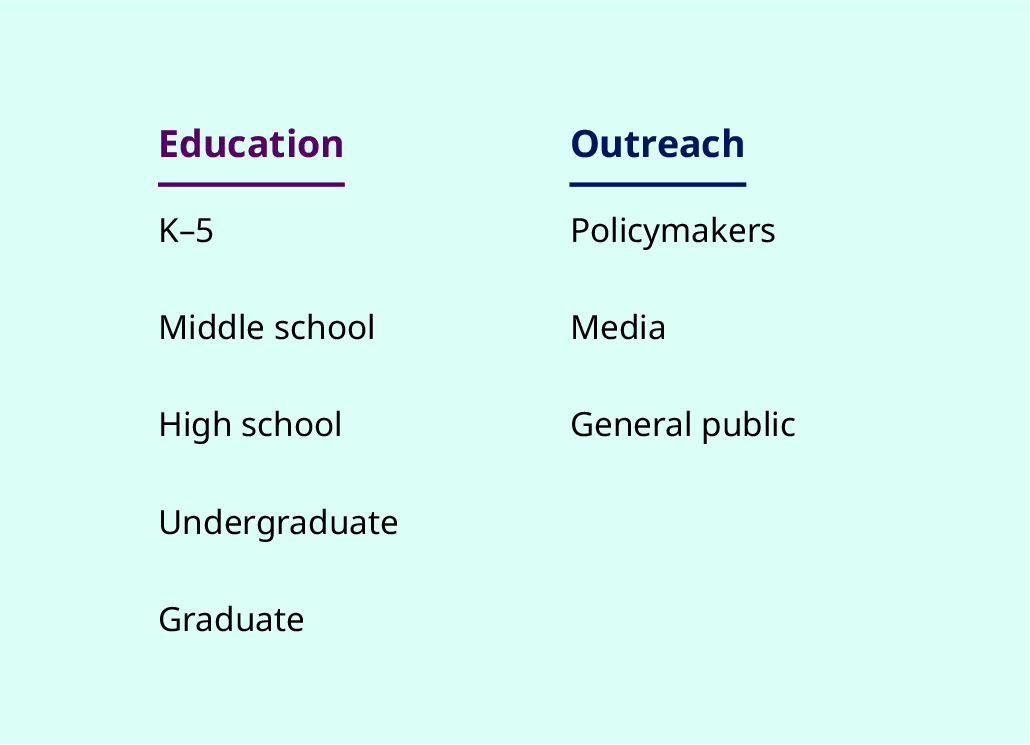
Education presupposes that the recipients—the students—want the knowledge the teacher is giving them, whether for the sake of learning, applying the ideas to a career, doing well on a test, or something else. Outreach presupposes no such desire. It is a bit more like advertising, which is to say that you are trying to connect with an audience with little to no prior interest. Both education and outreach are themselves subdivided into even smaller audiences, as illustrated in figure 1 .
Figure 1.

Education and outreach are distinct efforts, and each can be subdivided. Outreach can happen on different scales, such as national or local, and with different levels of formality.
(Figure by Freddie Pagani.)

Given that most scientists I speak with have ample experience being a student and possibly have teaching experience, education is often the easier of the two for them to engage with. In education, the audience is expected to put in effort, and, accordingly, the task of transferring information requires less work for the presenter.
On the other hand, in outreach, you must grab your audience’s attention and hold it. If you don’t, people will flip the page, change the channel, or move on to the next YouTube video.
Note that you’re not going to interest all people, so don’t try. And if your goal is to do outreach to people who don’t have a preexisting interest in science, realize that doing so will require considerably more effort and different techniques than you would use for science enthusiasts. For those new to outreach, I recommend beginning with audiences that might be called “sci curious.”
The message you want to convey is very important. Many scientists who do outreach have in the back of their mind a young version of themselves, and they want to try to nurture a lifelong interest in science in similar individuals. That sort of outreach looks to the distant future. Others have more of an interest in the now and are worried about the vocal and influential antiscience voices that one finds both in society at large and, more worryingly, the corridors of power. The message you want to convey will influence the manner in which you tell it.
The audience you are trying to reach will also influence how you give the message. If you were giving a lecture in the Piazza Navona in Rome and you wanted to communicate effectively, you’d speak in Italian. You must make similar considerations for any audience. If you are speaking with teenagers, you cannot assume that they know the language of even an introductory physics class. And even many older audience members never learned (or don’t remember) Newton’s laws. Of course, if your audience is a roomful of retired engineers, you can use the overlapping vocabulary you have with them and don’t need to do as much work to make your material seem relevant.
Knowing your audience is more than knowing their language. It’s knowing their values. You would take a very different approach when speaking with a group of high school physics teachers than you would with a community group focused on social change. You would take another approach for a group of retired veterans, as they might be more interested in funding Veterans Affairs hospitals than scientific research.
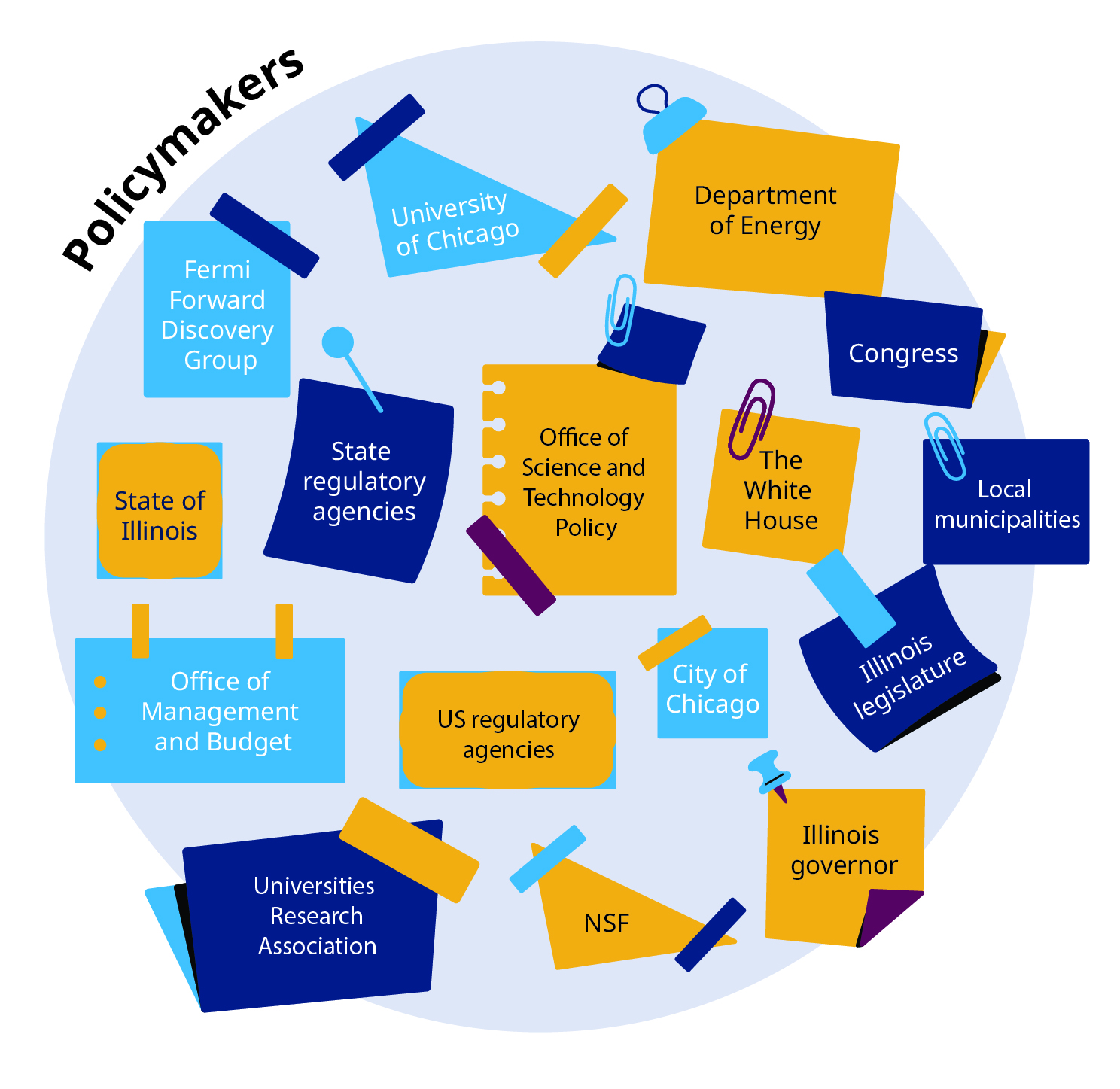
Furthermore, the better you know your audience, the better you can tailor both your message and your approach. Figure 2 gives a sense of the diversity of audiences you might encounter if you were interested in lobbying policymakers. Each group has its own language, values, and arenas of interest.
Figure 2.

For a person interested in informing or guiding public policy, there are many possible audiences, each with their own concerns and sensitivities. If you want to speak to those in power, the better you understand the people to whom you’re speaking, the more effective you will be. So, for example, if I was lobbying for resources or simply hoping to connect with influential people, these are some of the policymakers I would consider contacting. For your institution or needs, different organizations would apply.
(Figure by Freddie Pagani with artwork adapted from iStock.com artist designrecs.)

For those looking for advice for a specific effort, this article will not answer all questions, as each situation is different, but here is a checklist of some of the questions you need to ask yourself before undertaking an outreach or education effort:
- What are you trying to do?
- What audience do you need to engage with to accomplish your outcome?
- What language (broadly defined) should you use?
- Are there cultural sensitivities you should consider? (For example, a religious audience will require a different approach than an atheist one.)
- Are you speaking to inspire? To inform? To persuade? To call to action?
- What is the approach that you want to employ?
- How will you know if you are successful?
Answering those last two questions requires knowing what approaches are effective and what considerations you might encounter for each one.
Approaches
As I mentioned earlier, many readers of Physics Today will have many years of experience with education from their time as students and perhaps also as teachers. Furthermore, the American Physical Society has a great deal of resources for educators and offers the ability to join its Forum on Education. 2 Because of that, I will concentrate more on the field of public outreach, often called engagement.
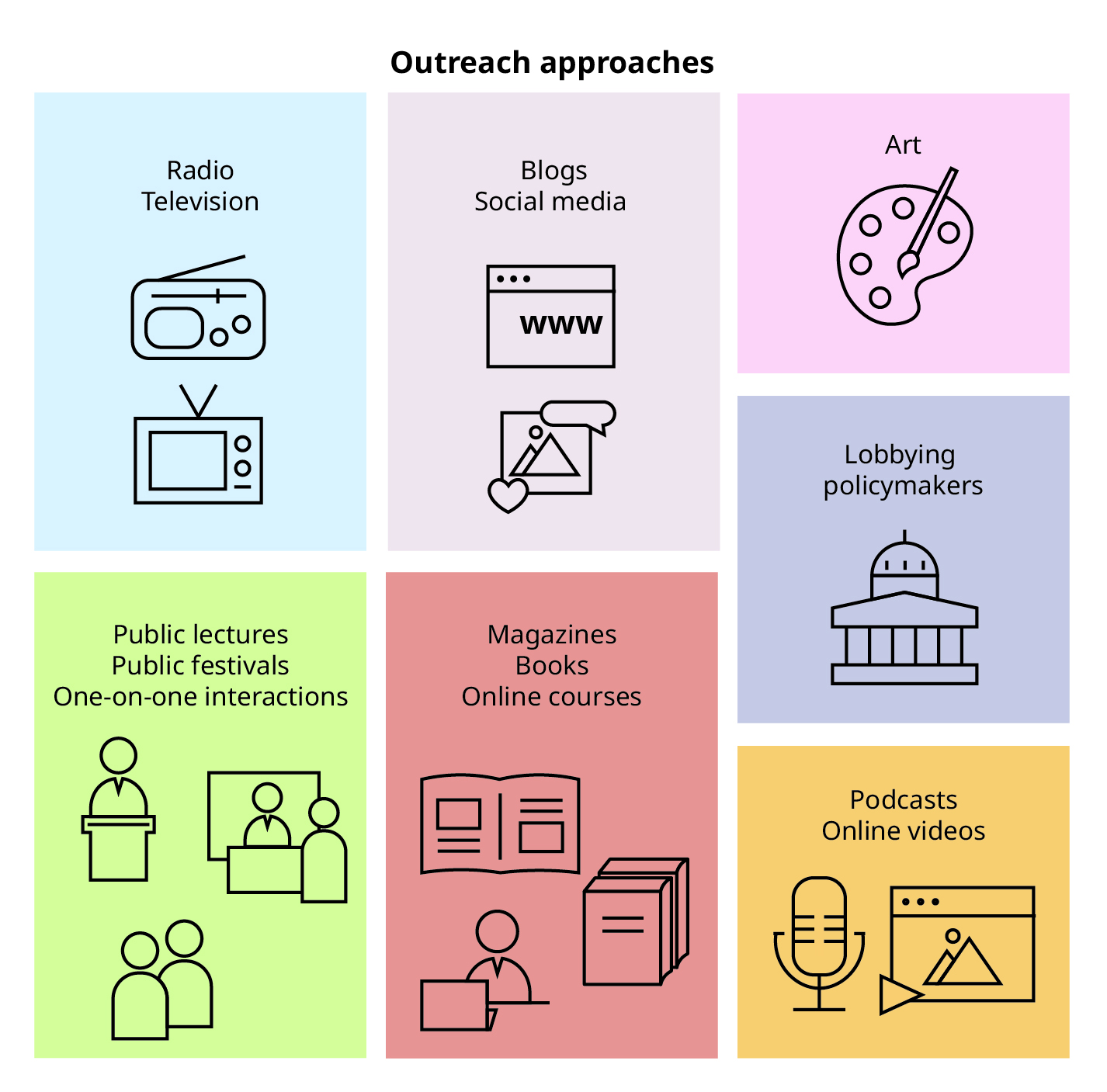
Many approaches can be used, including giving public lectures in small or large venues, using traditional media, and attempting to harness the vast potential of the internet. Figure 3 lists a few ways to do outreach. Although there is some overlap in the way the different approaches work, each one has its own idiosyncrasies. Before you pursue some sort of outreach effort, I suggest that you talk with someone who is successfully doing outreach and using a technique that’s similar to the one you envision using. There is no need to reinvent the wheel.
Figure 3.

If you want to do outreach, first consider how you want to connect with your desired audience. The above graphic shows some possible approaches.
(Figure by Freddie Pagani.)

Public talks
Probably the simplest way to do outreach is to give a public talk. It could be done as part of an event, like a conference, or another established effort, like a monthly meeting of a civic or social group. The important thing is to speak with your host to better understand your audience. Sometimes, venues will host gatherings such as Nerd Nites and Cafes Scientifiques that combine having drinks, socializing, and learning. You can also nominate yourself online to speak at a TED conference, which features talks, interviews, workshops, and other events that highlight ideas from various fields, or contact a TEDx organizer about speaking at an event. Those talks are often posted online as well. (For more about those events and other resources, see the box .)
If you are giving a talk at a recurring social event, consider attending one or two before you speak to get the vibe of it.
Lobbying Congress or other policymaking bodies
One action that can be influential is lobbying policymaking bodies, such as Congress, because they have the resources and power to effect real change. But how do you convince people who make policy to execute some action that you want?
Now, it could be that you happen to be both charming and persuasive. But charm is not always enough. What convinces most members of elected bodies are the elections that put them there, and winning elections means getting votes. Furthermore, it is rare that convincing one person is sufficient to change public policy. Thus, it’s most effective to try to mobilize many voices to influence many policymakers. That means joining a large group effort, such as the American Physical Society’s annual Congressional Visits Day. If you prefer to get your own group going, then speak to people who have participated in the society’s visits or similar efforts to get some pointers.
Art
Art and science are often thought to be diametrically opposed disciplines: One is concerned with aesthetics and perceptions, and the other revolves around facts and numbers. But some people combine the two in what are called STEAM (science, technology, engineering, the arts, and math) events. The motivation for many of these efforts is the hope that science-averse audiences can be more receptive if information is presented in an aesthetic and engaging way.
Figure 4.

Dancer Emily Coates (left) and physicist Sarah Demers (right) have collaborated to share the physics of dance. Their work Incarnations, which explored science–dance connections through both lecture and performance, was featured in The New York Times arts section .
(Photo by Paula Lobo.)
Perhaps the most effective way to reach art enthusiasts is to work with someone who is already established in the field. By collaborating with artists and carefully translating scientific topics into an artistic form, you can teach a little science at art events. It is important to leave the nuts-and-bolts numbers behind and talk about big ideas. It’s also important to remember that even if the audience absorbs only a little of the science, simply destigmatizing and humanizing technical topics is a valuable outcome.
Many art–science efforts have had success. For example, at Yale University, physics professor Sarah Demers has collaborated with dance professor Emily Coates 3 (both are pictured in figure 4 ) on a class about the physics of dance, on public events, and even on a book. 4 Their Incarnations project was performed in New York’s East Village and was mentioned in The New York Times.
Fermilab, where I work, has a guest artist and composer program, 5 and CERN has similar programs. 6
Books
Books are a more conventional way to connect with large audiences, although the publishing industry is facing challenges. The keys to writing a book are being able to write clearly and engagingly and having something interesting and innovative to say. A popular book is quite different from a textbook, and the competition is fierce. Brian Greene’s 1999 book, The Elegant Universe: Superstrings, Hidden Dimensions, and the Quest for the Ultimate Theory, was successful because it was written in the early days of the public awareness of M-theory. Nowadays, a similar book would have a harder time gaining an audience. And if you wanted to write about dark matter, you would have to say something new about what has become well-trodden ground.
If you want to write a popular-science book, you begin with a book proposal, a writing sample (say, a chapter), and a specialized CV that highlights both your expertise and why you’re the right person to write the book. You send these documents to an agent or acquisitions editor. If they accept your proposal, then you write your book.
Publishing a book can be accomplished through a university press, a popular press, or self-publishing. (I’m not a fan of the last one, primarily because of the lack of marketing and editorial oversight that could establish that your book is commercially viable in the first place.) University presses tend to be looking for more niche books and will accept more modest sales numbers. Even better, academic credentials will make you more attractive as an author to university presses. For them, you send your proposal package directly to the university press’s acquisitions editor.
In contrast, publishing with a publisher not affiliated with a university usually requires that you have an agent, who can be quite difficult to get. The competition is fierce, and popular presses typically want to see books that will sell a lot of copies.
Except for a lucky few, book publishing is not particularly lucrative. But having a popular-science book published is often a way to demonstrate that you are a serious writer, which can open up other opportunities—such as media exposure, paid speaking engagements, and even offers to appear on documentaries.
Blogging, social media, online videos, and podcasts
In today’s world, many of the most influential voices in popular science have a significant online presence. The good thing is that only a small initial investment is needed to generate online content. The bad thing is that only a small initial investment is needed to generate online content. Low initial investment means that countless people are out there, all wanting to be heard. Rising above the cacophony is incredibly challenging.
For those who rise to the top, however, the returns can be significant. Given how search engines work, people with a significant online presence are often found by journalists when they need someone to supply a comment for an article or (occasionally) when they need someone to appear on radio or television.
Figure 5.

The initial phase of attempting to do online science outreach can be disheartening.
(Image adapted from iStock.com/Tatiana Smirnova.)
There are several keys to success online. The first is creating high-quality content: You want to provide a product that is entertaining and insightful. The second is releasing content reliably and regularly. Depending on the outlet, your readers or viewers may expect to see content weekly, daily, or even several times a day.
You can have an online presence in many sorts of ways, including blogs, social media, videos, and podcasts. But you have to be patient: Don’t expect to immediately become a viral phenom. It’s a long and difficult grind. Initially, you will wonder if anyone is paying attention, a sentiment illustrated in figure 5 . One of my favorite sayings about this sort of thing is that it takes 10 years of soul-crushing and persistent effort to become an overnight sensation.
Connections can help you achieve online success. A guest appearance or mention on a popular website can do wonders for your viewership numbers. For example, it took years for me to grow my Facebook following to 500 people. Then, I was mentioned on a successful site, and I gained 1000 followers overnight. My current following consists of nearly 30 000—a small number compared with professional communicators but a reasonable one for a person who continues to stay connected to the research world.
Each online platform is quite different. Podcasts and YouTube can require a larger monetary investment than many others do because you will need recording equipment and editing software. Producing a high-quality episode is considerable work and, if your approach involves interviewing others, you’ll have the constant grind of finding guests.
Resources for outreach
- The American Physical Society (APS) has several initiatives focused on public engagement.
- The American Association for the Advancement of Science offers trainings in science communication and diplomacy.
- The Alan Alda Center for Communicating Science at Stony Brook University offers in-person and virtual professional development programs in science communication.
- Thinking Like Your Editor: How to Write Great Serious Nonfiction—and Get It Published , by Susan Rabiner and Alfred Fortunato (published by W. W. Norton in 2002), offers wisdom for aspiring authors.
- Don’t Be Such a Scientist: Talking Substance in an Age of Style , by Randy Olson (published by Island Press in 2009, 2nd ed. in 2018), provides lessons from the author’s journey from professor to filmmaker.
- APS Congressional Visits Days are an opportunity for the society’s members to get together and meet with policymakers on Capitol Hill.
- Nerd Nite , TED , and Cafe Scientifique offer opportunities to give presentations.
For social media, the entrée is easier, but you need to know the personality of your platform. Not all messages are well matched to all platforms. Facebook is great for sharing material, and the demographic skews older than the youth-friendly Instagram, which is more of a visual and image-centric platform.
In addition, you should consider recent evolutions in the world of social media. Twitter, now X, is not as influential as it once was. TikTok has been on the rise. Expect to constantly reinvent yourself.
Furthermore, you should take regional preferences into consideration. For example, in 2023, a survey showed that WhatsApp was used by 83% of adults in Mexico but only 29% of adults in the US. 7 Depending on the audience you want to reach, you should pick your platform carefully.
Big picture
Attempting to communicate with the public can be a daunting prospect. Many people are indifferent to science. Some may have learned in school that mitochondria are “the powerhouse of the cell” but do not understand what science really is: a way of figuring things out. Others are frankly hostile toward the scientific enterprise. The world is rife with mis- and disinformation. If fighting that deluge is your goal, it can feel like a thankless, never-ending game of Whac-A-Mole.
And yet science outreach can be greatly rewarding. You can open new vistas to young people who will one day be scientists or encourage people to be interested in and supportive of science. You can shape public opinion and nudge science policy in the direction of research and reason. On a practical level, you can possibly increase public funding of science and, more self-centeredly, persuade funding agencies to support the work that interests you.
If you’re inclined to do science outreach, I hope you start. If you’d prefer to let others take on that burden, that’s OK too, but you should be supportive of—indeed, grateful for—their work. After all, effective communicators are making society more open to hearing about your research and public officials more likely to support you when you ask for resources.
We live in a connected world, with a sometimes-deafening hubbub of voices. We should work together to ensure that the voice of science is heard.
References
1. M. Smith, D. Lincoln, “To save science, talk with the public ,” APS News, 8 December 2022; D. Lincoln, “To the ramparts: Defending science! ,” SPS Observer, 1 May 2018; American Physical Society (APS), “Statement on public engagement ,” ethics and values statement (18 November 2024).
2. For more on APS’s educator resources, see “Preparing future physicists ” and its Forum on Education .
3. J. Heimlich, “Are dancers secretly physicists in disguise? ,” Dance Magazine, 16 January 2019.
4. E. Coates, S. Demers, Physics and Dance , Yale U. Press (2019).
5. For more on the arts at Fermilab, see the Guest Artist and Guest Composer Program at Fermilab, https://events.fnal.gov/art-gallery/guest-artist-and-guest-composer-program-at-fermilab/ .
6. For more on CERN’s arts program, see “Arts at CERN,” https://arts.cern/ .
7. J. Poushter, WhatsApp and Facebook Dominate the Social Media Landscape in Middle-Income Nations , Pew Research Center (22 March 2024).
More about the authors
Don Lincoln (lincoln@fnal.gov ) is a senior scientist at Fermilab. He is a frequent host of a popular YouTube channel, has written books for public audiences, and has taught virtual classes on the Great Courses Plus platform.