How the twist of a molecule affects electron spin


From time to time, a phenomenon is uncovered that eludes the commonly accepted theoretical frameworks. Such was the case for the chiral-induced spin selectivity (CISS) effect, which challenges widely used simplified molecular models for electron transport and transfer. The CISS effect reflects the innate ability of chiral materials to orient electron spins. It reveals a fundamental connection between chiral structure and electron spin in molecules and materials, and its implications for chemistry, biology, materials science, and other disciplines remain to be fully explored and mapped.
Chiral materials are those whose structure lacks mirror symmetry. A common example of chirality is hands: Your left and right hands cannot be superimposed, but they are mirror images of each other. In chemistry, molecules with that symmetry feature are called enantiomers. Many biological compounds, such as certain amino acids and components of RNA and DNA, are not only chiral but homochiral, meaning that they exist as only one or the other form—either left- or right-handed. The origins of homochirality in biology remain unclear. Research that uncovers the mechanisms underlying CISS might also shed light on the homochirality of biomolecules. 1 (To learn about chiral spin structures known as skyrmions, see the recent PT article “Magnetic skyrmions: A new frontier for quantum computing ,” by Christina Psaroudaki and Christos Panagopoulos.)
Spin selectivity in chiral matter manifests across a wide range of materials and conditions, and more than 50 research groups around the world are exploring the phenomenon. The first report of the CISS effect came in 1999 from experiments in which it was found that the ratio of spin-up to spin-down electrons, transmitted through a film of chiral material, depended on the material’s handedness. 2 (For more details about that initial experiment, see the box below.)
Although many of the early studies of CISS were performed with organic molecules and biomolecules, the effect has subsequently been reported for chiral quantum dots, hybrid organic–inorganic perovskites, metal oxides, metals, semiconductors, polymers, and supramolecular assemblies. In using different mechanisms and measurement methods, researchers report spin-selective transmission over sample lengths ranging from nanometers to millimeters. A variety of methods, including time-resolved electron paramagnetic resonance spectroscopy and scanning tunneling microscope measurements of single molecules, have been used to observe CISS. 3
Describing observations of CISS requires a more sophisticated treatment of electron and nuclear dynamics than what is conventionally used when modeling electron transfer and transport. The standard theoretical framework is to start with the Born–Oppenheimer approximation, which separates the treatment of atomic nuclei and electrons, and a single-electron model, in which the motion of one electron is considered in the mean field that is created by the other electrons and the nuclei. That approach to the electronic structure has been useful for describing charge-transfer reactions and the conduction of electrons through molecules. 4 Historically, however, most experiments have not probed the electron’s spin degree of freedom, and recent work examining such a spin aspect shows that chiral matter distinguishes between the electron spin orientations.
Key experiments in the history of CISS
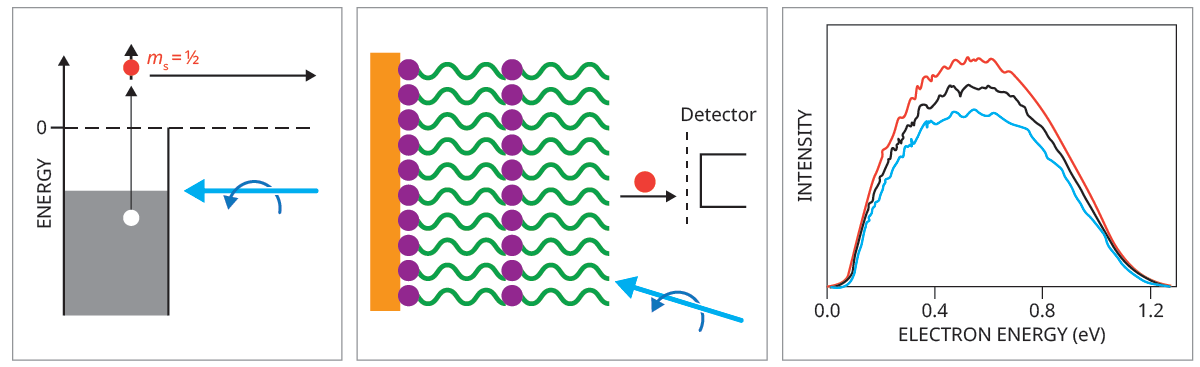
The first report of chiral-induced spin selectivity (CISS) came from measurements of low-energy photoemission from gold surfaces coated with films of chiral fatty acids. 2 The diagram illustrates the principle of the measurement.

(Right panel adapted from ref. 2 .)

A circularly polarized photon excites an electron above the vacuum level (left panel). The electron’s spin orientation is governed by the optical selection rules and the metal’s spin–orbit coupling. Escape competes with electron recombination in the metal, and the probability for the spin-oriented electron to escape through the chiral layers (middle panel) depends on the handedness of the chiral molecules.
The intensity of detected electrons (right panel) depends on their light polarization (blue is for left-circularly polarized light; black, linearly polarized; and red, right-circularly polarized) for a chiral film made of five monolayers of the right-handed enantiomer of a fatty acid. Subsequent experiments measuring the spin polarization of ejected electrons found that, when chiral molecules are on the surface, the spin distribution depends only on the molecules’ handedness and does not depend on the circular polarization of the light.
Although the first measurements of CISS for electron tunneling used a similar approach to that just described, it is now more common to magnetize a ferromagnetic electrode in a tunnel junction to sense the spin-dependent transmission, as shown in figure 3 . Another breakthrough occurred in 2017 when researchers found that chiral molecular films generate a Hall voltage when they are charge polarized. 18 The finding demonstrates that charge polarization of a chiral molecule is accompanied by spin polarization, as sketched in figure 1 .
The CISS effect challenges conventional wisdom about electron transport. For example, chiral organic molecules display high spin selectivity at room temperature, despite their weak spin–orbit coupling. Research on the CISS effect stands at an unusual crossroads for 21st-century physical sciences: Experiments measure signals that are quite large, and many results have been reproduced in different laboratories, yet theory has not converged on a mechanism. Given the range of molecules and materials displaying the CISS effect, it may be that beyond a basic mechanism, there are multiple manifestations of the effect, with each one being appropriate for the type of system—for example, metals versus insulators—and each linking to underlying features of chirality and how it breaks the simplifying symmetries of achiral matter.
What makes CISS special
When researchers consider electron conduction through a molecule or material, they usually model electron motion in a straight line. In such a case, interactions with vibrations—that is, phonons—or with other electrons decrease the transmission; experiments are often performed at low temperatures to avoid scattering events. Because the motion is assumed to be in a straight line between collisions, the issue of angular momentum conservation is often neglected.
In contrast, electron transmission through a chiral system follows a curved path, and the electron must exchange momentum with the system. For solids with a high density of electronic states, one electron can exchange momentum with another passing electron. In the case of insulators or organic molecules, however, the electrons of the system are localized; changing their momentum requires a large amount of energy that is rarely available. Nevertheless, chiral systems can possess low-frequency chiral phonons, which carry angular momentum, and electrons can exchange momentum with them. Many researchers in the field believe that angular momentum considerations will be important for any CISS mechanism.
What makes the electron–vibration interaction efficient? As a simplification, consider a chiral molecule to be a helical chain of atoms. As a passing electron interacts with the helical potential, it polarizes the electron clouds on the atoms. The amount of charge displacement during such collisions depends on the kinetic energy of the electron (typically 3–5 eV for conduction electrons injected from an external electrode) and on the system’s polarizability. That charge redistribution affects the charge density on the chemical bonds and causes vibrational excitation.
In addition, backscattering of electrons to directions that do not lead to transmission can occur, and any change in energy must be dissipated. That picture implies that dissipation and nuclear motion are important to include when describing electron transport in chiral matter.
From experiments to a mechanism
The early photoemission experiments on CISS, described in the box above, imply that the electron spin is locked either parallel or antiparallel to the electron’s velocity. That supposition is consistent with a wide range of experiments. 3 Recent measurements of pure spin currents show a strong dependence of transmission on material chirality. A robust theory should capture that feature.
An alternative route to unveiling the CISS mechanism (or mechanisms) is through the exploration of structure–function relations that serve as predictors for spin selectivity. Although chiral structure is often considered a binary quantity—left-handed versus right-handed—the chiro-optical properties of chiral matter vary in strength, and that behavior also applies to the CISS effect. In fact, numerous experiments have shown that the CISS response correlates with the strength of a molecule’s differential absorption of circularly polarized light. Such a correlation implies that the transmission probability for electrons through a chiral molecule and the anisotropic polarizability of that molecule are related. The length of a chiral molecule has also been shown to correlate with its spin selectivity, but those correlations cannot be easily disentangled from the dependence of rotatory strength on molecular size.
The hypothesis that chiral phonons play a role in the CISS mechanism has spawned numerous studies into the temperature dependence of the CISS effect because the density of phonons depends on temperature. Several studies confirm that CISS increases with temperature, from tens of kelvin up to room temperature. Other studies, however, show different behaviors that may be a result of a different underlying mechanism—for example, electron–electron interaction rather than electron–phonon interaction—or other effects in the samples.
Temperature-jump experiments, which use a laser pulse to locally heat chiral materials and create a nonequilibrium population of chiral phonons, have demonstrated strong spin-dependent electromotive forces in the heated material. 5 In a more incisive study relayed to the three of us in personal communication, Renee Frontiera at the University of Minnesota Twin Cities has found that chiral phonons are generated when charge transport occurs through chiral materials. Thus, the role of chiral phonons for CISS is strongly implicated, and there are grounds to be optimistic that this role may be fully revealed over the next few years.
Figure 1.

The connection between charge polarization and spin polarization in a chiral molecule. The electrical polarization (green arrow) of a molecule, here represented by a spring, creates a spin polarization that depends on the molecule’s handedness. Interaction between a magnetized ferromagnetic surface and chiral molecules yields either a low- or high-spin potential depending on the direction of magnetization of the ferromagnetic substrate and the handedness of the molecule.
(Illustration adapted from ref. 15 .)
Hall effect measurements 6 and studies of magnetic imprinting by chiral molecules on soft ferromagnets 7 imply that charge redistribution in a chiral molecule is accompanied by a spin polarization, as illustrated in figure 1 . That induced spin polarization is transient unless it is stabilized by an interaction with another spin of a reaction partner or of a surface. When chiral molecules are adsorbed on a ferromagnetic substrate, the magnetization of the substrate can flip to orient its spins in antiparallel alignment with the excess spin density of the adsorbed molecules. That creates a metastable magnetization in the substrate. Hence the direction of the substrate’s magnetization can depend on the handedness of a chiral molecule. That aspect of the CISS effect has implications for enantioselective chemistry and the origins of homochirality in biology. 1
Challenges for creating a CISS model
The weak spin–orbit coupling, which is expected for chiral organic molecules, raises the question of how such molecules can impose strong spin selectivity. Because many experiments are performed with molecules adsorbed on surfaces, several researchers have proposed a proximity effect—the borrowing or spillover of spin–orbit coupling from a metallic substrate—that improves the spin selectivity. Other approaches invoke orbital angular momentum selection by helical molecules and orbital-to-spin angular momentum conversion to describe the spin selectivity. But many of the systems demonstrating spin selectivity lack secondary helical structure, and in many cases, the system contains significant parts that are not chiral. 8 More recent studies that probe pure spin currents imply that spin selection takes place within the chiral materials themselves. 9 10
Ascertaining the relative importance of spin versus orbital angular momentum in CISS is not simple. As an electron passes through a chiral system with an effective spin–orbit coupling, the spin couples to the orbital angular momentum. By way of analogy, consider a frisbee bouncing off a wall, as depicted in figure 2 . When a clockwise-spinning frisbee is thrown at a wall located on the right of the thrower, it is reflected forward. A counterclockwise-spinning frisbee, however, is reflected backward and loses momentum, and its trajectory is destabilized. The opposite is true for reflection from a wall located on the left of the thrower.
Figure 2.

A frisbee bouncing off a wall provides a useful analogy to chiral-induced spin selectivity. (left) If a frisbee is rotating clockwise and hits a wall on the right of the thrower, it is scattered forward and upward in a stable trajectory. (right) If a frisbee is rotating counterclockwise and hits a wall on the right of the thrower, it loses momentum and scatters backward and downward into a less stable trajectory. The opposite is true for a wall located on the left.
(Illustration by Freddie Pagani with artwork adapted from iStock.com/jameslee1.)
The coupling of the frisbee’s spin and its momentum by the friction with the wall is qualitatively analogous to the situation in CISS, where the right- and left-side walls relate to the different handedness of a chiral molecule. When measuring the spin of frisbees bounced off the wall, one would observe a higher probability of clockwise spins for bounces off the right wall. Correspondingly in the CISS effect, there is a higher probability of transiting electrons having one spin direction over the other, with the preferred orientation changing with the system’s handedness.
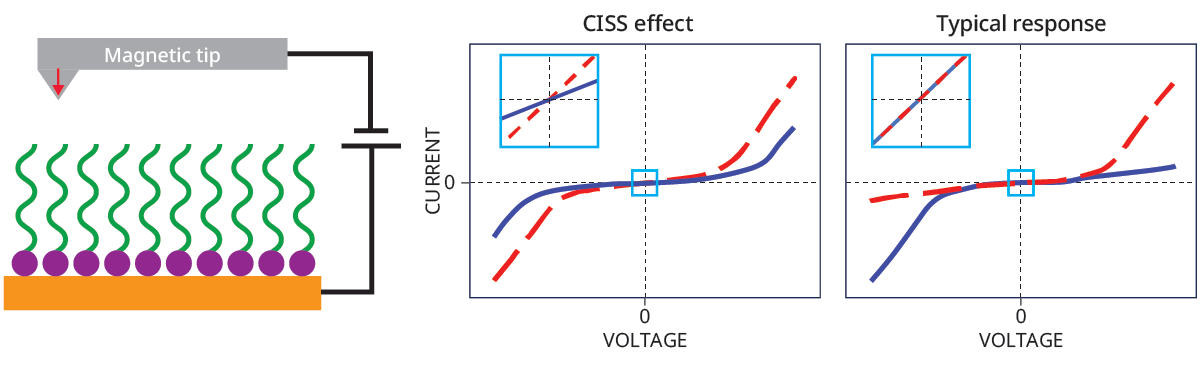
Another way that CISS challenges the conventional theoretical description for electron transport and transfer is the apparent breaking of time-reversal symmetry in magnetoresistance experiments on chiral materials. For typical systems near equilibrium, such as spintronic devices, time-reversal symmetry applies and magnetoresistance curves are antisymmetric: They overlap near the origin and exhibit distinct responses to positive and negative voltages, as shown in the right panel of figure 3 . In the case of CISS, however, the magnetoresistance curves, shown in the middle panel, are symmetric: They exhibit equal but opposite responses to negative and positive voltages and have distinct and nonoverlapping curves for north and south magnetizations. The implication that the CISS effect breaks time-reversal symmetry has generated considerable discussion among researchers.
Figure 3.

An experimental setup (left) for taking magnetoresistance measurements of a chiral material film in electrical contact with a metal substrate, such as gold. Current–voltage curves are collected for both north- (blue curves) and south- (red curves) magnetized tips, as shown in the middle and right panels. Common achiral magnetoresistive devices (right) exhibit time-reversal symmetry: The measured curves look the same if the magnetization direction and applied voltage are both reversed, and near the origin the curves overlap, as shown in the inset. But in chiral molecules (middle), the north and south curves cross but do not overlap, and reversing the voltage just flips the current. Such behavior reflects the violation of time-reversal symmetry by chiral materials.
(Figure adapted from ref. 17 .)

One proposed origin of that experimental behavior is nonlinearities that arise from electron tunneling. Another is that measurements are performed on open systems, which allow energy and electron dissipation. For example, the generation of chiral phonons, which would create a temperature gradient, could explain the breaking of time-reversal symmetry. Thus, dissipation could be an important or even necessary component of CISS.
How can scientists rigorously include energy dissipation, some form of time-reversal symmetry breaking, and chiral phonons in an ab initio model? One idea is to replace the standard Born–Oppenheimer electron Hamiltonian, which is parameterized by nuclear position, with a phase-space electron Hamiltonian that is parameterized by nuclear position and momentum. 11 If researchers parameterize electronic states in that fashion, they can readily incorporate momentum exchange between electrons and nuclei while conserving total momentum. Within that framework, CISS may be a new phenomenon that appears when chemical physics is analyzed with a more accurate treatment of electronic–vibrational coupling (in other words, without the Born–Oppenheimer approximation), and other phenomena will appear as well.
More than a curiosity?
CISS requires that scientists change their view of how electrons move in chiral molecules and materials. Its importance for applications is not as well explored.
Spintronics. The ability to manipulate spin with nonmagnetic, chiral materials rather than with magnetic materials has engendered interest in the development of new types of spintronic and spin-optoelectronic devices. For example, efforts to use chiral materials for spin valves—devices whose spin-dependent electrical resistance preferentially permits spins of one direction to pass through them—have proceeded broadly. Although many such studies report charge currents with extremely high spin polarization, approaching 100% in atomic force microscopy measurements, only in the past few years have researchers shown nearly 100% spin polarization in a device structure consisting of layered metal and chiral oxide films. 12 In addition, long-range spin transport in chiral systems, and especially chiral metals, 13 suggests the possibility of applying them as spin interconnects.
Along separate lines, the parallel or antiparallel locking of the charge carrier’s angular momentum to its velocity direction has been exploited to realize a spin-polarized LED at room temperature and to electrically drive LEDs that emit circularly polarized light with opposite handedness (right versus left) in the forward or reverse direction with respect to the current direction. Emission of opposite-handed light in the two directions allows for the constructive interference of circularly polarized light in devices with simpler structures and improved efficiency. 14
Although chiral transport layers, a few nanometers in width, can display nearly 100% spin polarization at room temperature, they have not been implemented in real spintronics devices. At present, efforts are aimed at developing device designs and demonstrating their operation rather than developing processes that incorporate such structures into commercial devices.
Chemistry. CISS offers important opportunities in chemistry, including improved selectivity in chemical reactions, enantioseparations, and a new approach to asymmetric reactions. Numerous researchers around the world have demonstrated the importance of spin considerations in water splitting and the use of chiral electrocatalysts. Such materials can immobilize reaction intermediates with defined spin-orientation relationships and can thus restrict the possible reaction pathways in a multistep chemical reaction sequence and improve reaction selectivity. Enhancing the spin selectivity of electrocatalysts promises to strengthen both efficiency and selectivity of numerous important chemical reactions, such as nitrogen fixation, carbon dioxide reduction, and urea oxidation. Those ideas are starting to appear in the engineering literature and to be implemented by startup companies.
Another important application in chemistry relates to enantioselectivity, the distinction between a chiral molecule and its mirror image. CISS provides a strategy for using oriented electron spins to initiate redox chemistry that transforms achiral reactant molecules to a particular enantiomer of a chiral product. Several groups have demonstrated the concept, but enantioselectivity has not yet reached a level of enantiopurity that makes it useful in practical chemical synthesis.
In a related approach, the interaction of chiral molecules with a magnetic surface is enantiospecific, as illustrated in figure 3 . When a chiral molecule approaches a ferromagnet, it becomes charge polarized and hence spin polarized. If the spins in the magnet are aligned antiparallel to the spin of the molecule approaching the surface, then the interaction will be different from the case when the spins are parallel. The spin direction in the polarized chiral molecule depends on its handedness, so interaction with a ferromagnet can select for a particular enantiomer. 15 Enantioselectivity in chemical reactions and binding of molecules can thus involve a spin-exchange interaction, in addition to the steric geometric interactions that are commonly assumed to control enantiospecificity in molecular interactions.
Biology. Chiral biological molecules are homochiral, which raises the question, Does CISS have implications for biology? Numerous studies have shown spin-selective electron transfer through or within biomolecules, including nucleic acids, oligopeptides, and proteins, 16 and more recent work points to CISS effects manifesting in protein and enzyme interactions, proton-coupled electron-transfer processes, and cell respiration. Research on spin effects on biochemical reactions is still in its infancy, but it could offer a new perspective on biochemical processes and biological metabolism, with provocative implications for the origins of homochirality and the role of magnetic fields in life processes.
The breadth of molecules and materials in which CISS manifests suggests a fundamental connection between chiral structure and electron spin. While the importance of electron spin for describing chemical bonding and electronic structure is widely appreciated, too often researchers focus on the relatively weak magnetic interactions when considering electron dynamics and neglect full consideration of Pauli exclusion and the role of spin-exchange interactions. The CISS effect presents a challenge for theoreticians and experimentalists alike. For the first, it requires that they leave the comfort zone of the common approximations, and for the second, it opens a wide spectrum of applications that have yet to be explored.
Our cherished friend, colleague, and coauthor David Waldeck passed shortly before this article was published. He was a pioneer in CISS, and we dedicate this article to his memory.
—Ron Naaman and Joseph Subotnik
References
1. S. F. Ozturk, D. D. Sasselov, “Life’s homochirality: Across a prebiotic network ,” Proc. Natl. Acad. Sci. USA 122, e2505126122 (2025).
2. K. Ray et al., “Asymmetric scattering of polarized electrons by organized organic films of chiral molecules ,” Science 283, 814 (1999).
3. B. P. Bloom et al., “Chiral induced spin selectivity ,” Chem. Rev. 124, 1950 (2024).
4. M. Bixon, J. Jortner, eds., Electron Transfer—From Isolated Molecules to Biomolecules , parts 1 and 2, Wiley (1999).
5. K. Kim et al., “Chiral-phonon-activated spin Seebeck effect ,” Nat. Mater. 22, 322 (2023).
6. A. Inui et al., “Chirality-induced spin-polarized state of a chiral crystal CrNb3S6 ,” Phys. Rev. Lett. 124, 166602 (2020).
7. O. Ben Dor et al., “Magnetization switching in ferromagnets by adsorbed chiral molecules without current or external magnetic field ,” Nat. Commun. 8, 14567 (2017).
8. G. Bullard et al., “Low-resistance molecular wires propagate spin-polarized currents ,” J. Am. Chem. Soc. 141, 14707 (2019).
9. R. Sun et al., “Colossal anisotropic absorption of spin currents induced by chirality ,” Sci. Adv. 10, eadn3240 (2024).
10. A. Moharana et al., “Chiral-induced unidirectional spin-to-charge conversion ,” Sci. Adv. 11, eado4285 (2025).
11. X. Bian et al, “The phase-space way to electronic structure theory and subsequently chemical dynamics ,” https://arxiv.org/abs/2506.15994 .
12. H. Al-Bustami et al., “Atomic and molecular layer deposition of chiral thin films showing up to 99% spin selective transport ,” Nano Lett. 22, 5022 (2022).
13. T. K. Das et al., “Long-range spin transport in chiral gold ,” Adv. Mater. 37, 2506523 (2025).
14. F. Furlan et al., “Chiral materials and mechanisms for circularly polarized light-emitting diodes ,” Nat. Photon. 18, 658 (2024).
15. K. Banerjee-Ghosh et al., “Separation of enantiomers by their enantiospecific interaction with achiral magnetic substrates ,” Science 360, 1331 (2018).
16. R. Naaman, Y. Paltiel, D. H. Waldeck, “Chiral induced spin selectivity and its implications for biological functions ,” Annu. Rev. Biophys. 51, 99 (2022).
17. G. L. J. A. Rikken, N. Avarvari, “Comparing electrical magnetochiral anisotropy and chirality-induced spin selectivity ,” J. Phys. Chem. Lett. 14, 9727 (2023).
18. A. Kumar et al., “Chirality-induced spin polarization places symmetry constraints on biomolecular interactions ,” Proc. Natl. Acad. Sci. USA 114, 2474 (2017).
More about the authors
David Waldeck was a professor in the chemistry department in the Dietrich School of Arts and Sciences at the University of Pittsburgh in Pennsylvania.
Ron Naaman is a professor in the department of chemical and biological physics at the Weizmann Institute of Science in Rehovot, Israel.
Joseph Subotnik is the David B. Jones Professor of Chemistry at Princeton University in New Jersey.