Fermi and Pooh: A strange mix
DOI: 10.1063/1.2364245
When one studies the atomic bomb era, it is easy to get lost in the brilliance of the science and forget about the personal lives of the men and women involved. And sometimes, those personal lives are incorporated into their work.
A case in point is renowned physicist Enrico Fermi. In 1939 at New York’s Columbia University, Fermi confirmed the discovery of fission and began work on the first sustained nuclear reaction. In 1942 he moved to the University of Chicago, where he continued his work on that project, which culminated in such a reaction in December of that year.
During my own research into the early development of the atomic bomb, I ran across several references to Fermi’s fondness for Winnie-the-Pooh stories, apparently as a way to help him learn English. 1 In particular, it seemed that Fermi named some of his instruments after characters in the Pooh stories. How charming, I thought. However, there did not appear to be any direct evidence to support the assertions beyond the recollections of some of his colleagues and students. Was this just some kind of urban legend?
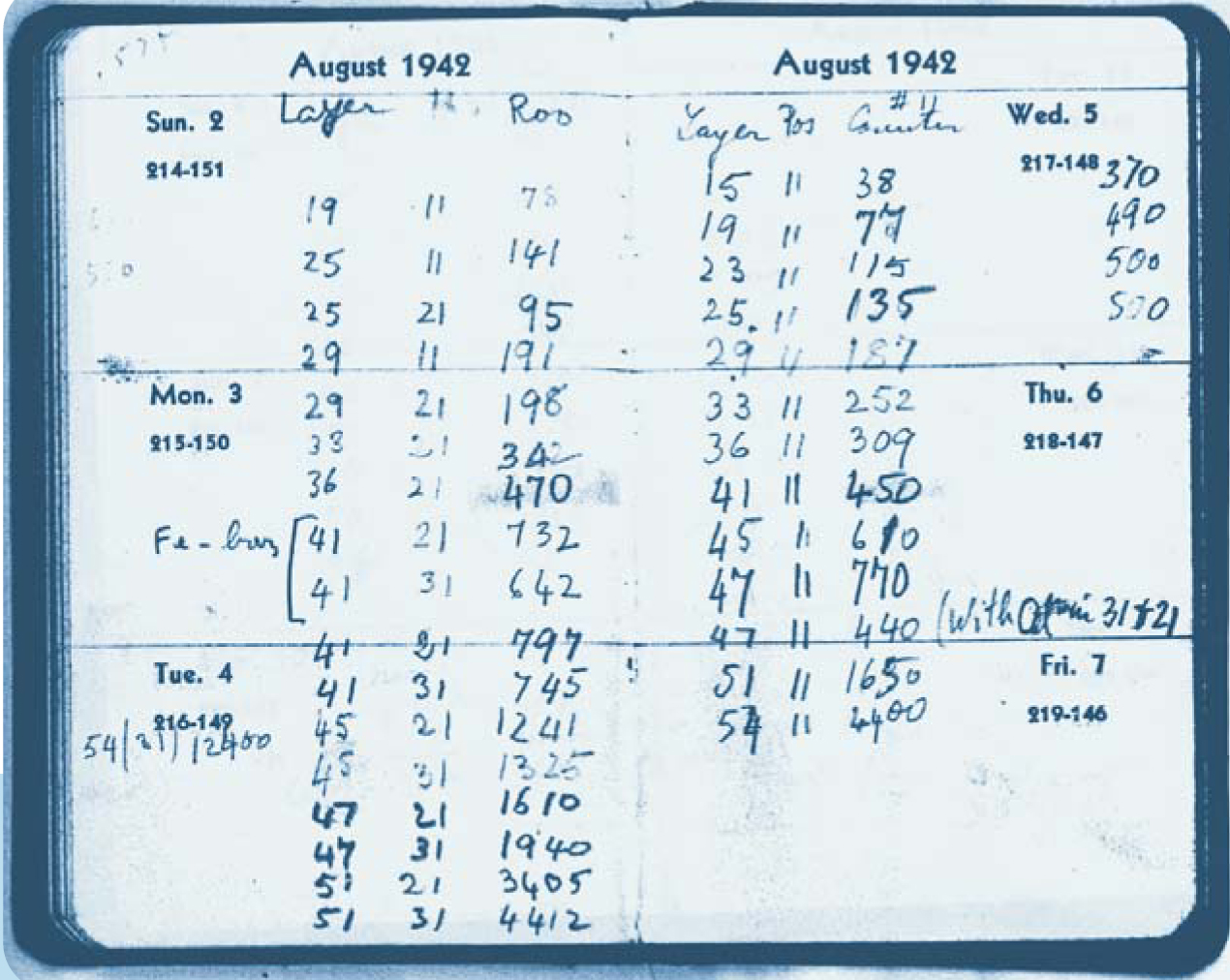
Then, while looking for information on the contribution of St. Louis’s Mallinckrodt Chemical Works to the atomic project at the University of Chicago, I came across a small pocket calendar used by Fermi in August 1942. Something in the week of 2–7 August caught my eye (see figure 1). Three columns were written in the calendar: The first indicated the layer number of the graphite pile; the second was simply labeled “Pos” and contained what appeared to be a series of readings; the third column was labeled “Roo.” 2 Here was proof that Fermi had indeed named at least one of his instruments after a character in Winnie-the-Pooh.

Figure 1. Enrico Fermi’s pocket calendar.

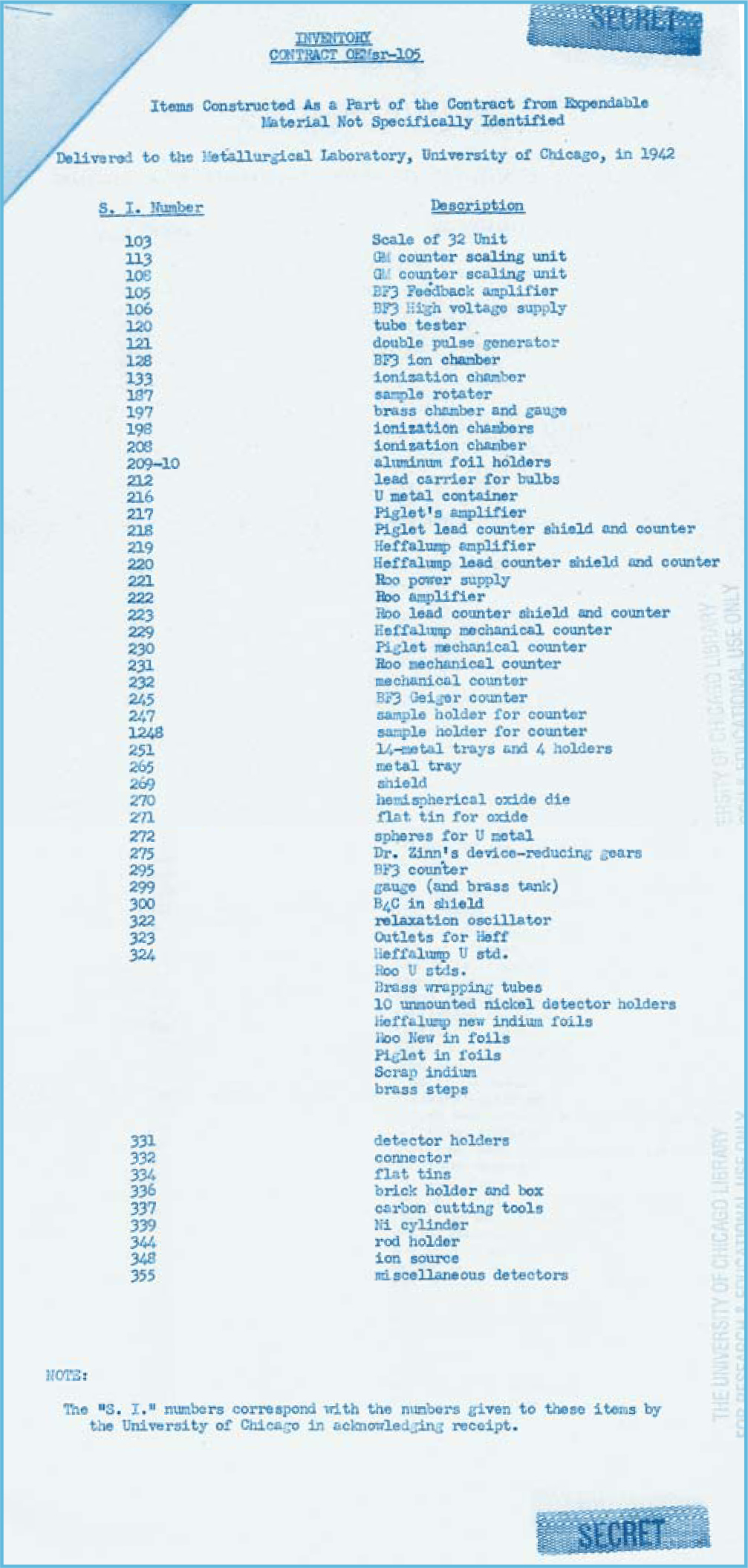
Another document turned up a few days later: an inventory list of Fermi’s equipment that had been transferred from Columbia University to the Metallurgical Laboratory at the University of Chicago in 1942. As seen in figure 2, the list had several instruments named after Winnie-the-Pooh characters—Piglet, Heffalump, and Roo. 3 Not only had the individuals who had packed up this equipment at Fermi’s Columbia University lab respectfully labeled the instruments as Fermi referred to them, the University of Chicago logged the items into its own inventory by those names.

Figure 2. Inventory list of Enrico Fermi’s instruments.

Why did Fermi choose Winnie-the-Pooh as a means to learn English? Maybe another set of documents will be found some day to reveal the answer. It is important to remember that history is composed of more than just scientific achievements. It is also composed of people who often found the world of nucleonics and its application to the war effort a daunting and disturbing undertaking. It might very well be the case that Fermi found his world a bit more approachable by mixing fact with a bit of fiction.
I thank Jay Satterfield, head of reader services at the Special Collections Research Center at the University of Chicago, and Sam Golden in the office of legal counsel at the University of Chicago for their assistance.
References
1. See, for example, H. Agnew in Fermi Remembered, J. W. Cronin, ed., U. Chicago Press, Chicago (2004).
Also see Argonne National Laboratory’s webpages, beginning with The “ Last Universal Scientist” Takes Charge, http://www.anl.gov/Science_and_Technology/History/Anniversary_Frontiers/unisci.html2. E. Fermi, Collection, box 2, folder 6, Special Collections Research Center, University of Chicago Library, Chicago.
3. Office of the vice president for special projects, Records, 1940–69 (inclusive), box 63, folder 6, Special Collections Research Center, University of Chicago Library, Chicago.
More about the authors
Denise DeGarmo is an assistant professor of international relations in the department of political science at Southern Illinois University Edwardsville.
Denise DeGarmo, Department of Political Science, Southern Illinois University, Edwardsville, US .