Erskine Williamson, extreme conditions, and the birth of mineral physics
DOI: 10.1063/1.2207038
In the summer of 1914, Erskine Williamson, a 28-year-old Scottish mathematical physicist, joined a new laboratory in Washington, DC. Although he had been hired as a research assistant in geology, he began to attack a broad range of problems in physical chemistry, thermodynamics, and heat flow. His efforts soon extended to high-pressure geophysics, culminating with his derivation of the pressure–density relation for Earth’s interior and the procedure for determining the pressures and densities as a function of depth in the planet. 1 Though his equation is well known as one of the fundamental relations in geophysics, few are familiar with its discoverer, the breadth of his research, and the background behind its development. Williamson died unexpectedly in 1923 at the peak of his productivity, but during his short career he helped lay the foundations for the modern study of planetary interiors.
The scientific and political worlds were both in transition as Williamson arrived in Washington to begin his work. It was the eve of World War I, midway between the appearance of Einstein’s landmark 1905 papers and the development of wave mechanics in the mid-1920s.
2
Experimental physics and chemistry, through the emerging fields of x-ray crystallography and spectroscopy, were beginning to elucidate the structures of molecules and solids. The field of modern physical chemistry was becoming established, and the statistical thermodynamics of J. Willard Gibbs was taking hold, although the implications of its formalisms for a broad range of chemical problems were not yet fully realized. Scientists were becoming increasingly aware of the importance of these developments for understanding Earth. Geology was also undergoing change from a purely descriptive to a quantitative science. The discovery of radioactivity provided a cosmic heat source that could reconcile the geological evidence for a far-older Earth with what had been deduced from classical physics.
2
These advances prompted fresh new questions about Earth’s formation, its component minerals, and its global structure. Addressing those questions was the mission of the Carnegie Institution of Washington’s Geophysical Laboratory, Williamson’s new home (see
Pressures and densities
Earth’s density distribution had long fascinated the world’s great thinkers. Formal descriptions of the density as a function of depth dating back to Isaac Newton were developed and refined by leading mathematicians through the 19th century. These descriptions ranged from the ad hoc to the mathematically elegant, but could not be reconciled with the growing body of geophysical data being collected. The average density of Earth was known to be 5.5 g/cm3, but the density of rock at the surface considerably less, about 2.7 g/cm3. The question was therefore the extent to which the higher mean density of the planet was due to changes in composition versus compression of the rock. The presence of an iron–nickel core had been proposed but not universally accepted, nor could its size be determined. Data from the emerging field of seismology were beginning to shed light on the planet’s deep interior. Yet there was no link between the mathematics of a self-gravitating body, seismological measurements, observational geology, and the behavior of materials within the planet.
Leason Adams was an experimentalist who had arrived at the laboratory just before Williamson. Together, they articulated four principal sources of available information about Earth’s deep interior: 1 the total mass and average density, determined from the size of the planet and its gravitational constant; the radial distribution of mass, determined by the moment of inertia; elasticity of material, obtained from seismology; and the flattening of Earth due to its rotation. Starting with the first point, they assumed a homogeneous, adiabatically self-compressing body. In a few short steps, they derived the appropriate relations in an equation that also gives seismic wave velocities as a function of depth:
where ρ is the density, r the radius, G the gravitational constant, and Mr Earth’s mass within radius r; V P and V S are the compressional- and shear-wave velocities, which can be written in terms of the adiabatic bulk and shear moduli, K s and µ, as
Together, the velocities define the seismic parameter Φ, or K s/ρ. Related functions for stellar interiors had been proposed earlier (the Lane–Emden equations) but these were for a compressed gas with assumed equations of state.
3
The solution to equation

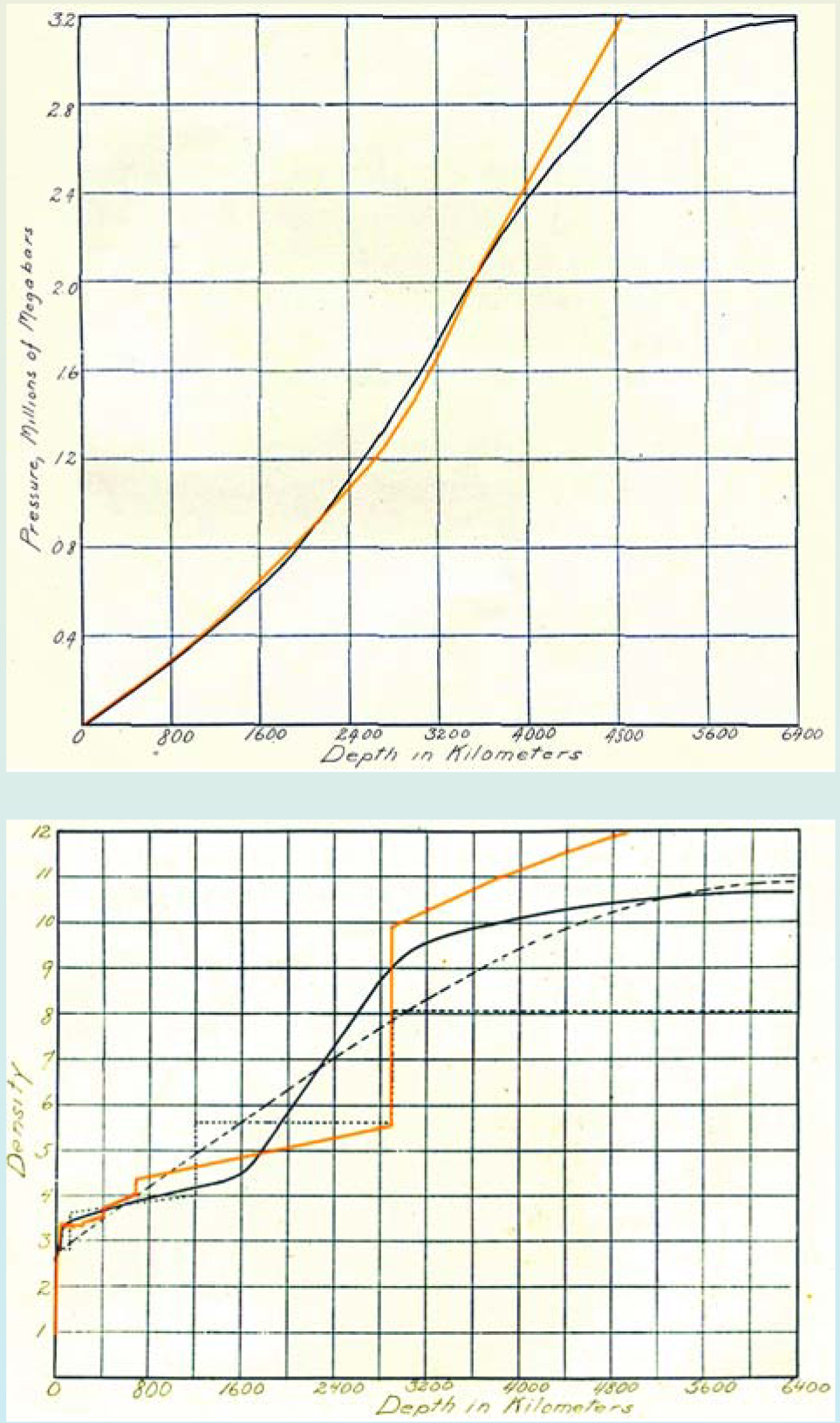
Figure 1. The 1923 paper “Density Distribution in the Earth”

Erskine Williamson and his colleagues

Erskine Douglas Williamson was born in Edinburgh on April 10, 1886. After graduating with bachelor’s and master’s degrees from the University of Edinburgh, he earned a fellowship with the Carnegie Trust of Scotland. There his reputation expanded, crossing the Atlantic to the Carnegie Institution of Washington’s new Geophysical Laboratory. The lab’s director, Arthur Day, lured Williamson from his homeland in the spring of 1914. Williamson died of a cerebral hemorrhage on Christmas Day, 1923, following an operation for an ulcer.
The early staff of the laboratory included a number of notable scientists. In this 1920 photograph, Williamson is standing third from the right in the back row, his colleague Leason Adams is second from the left in the front row, and Day is seated in the front row center. Ceramics specialist Robert Sosman is fifth from the left in front; chemist and glass scientist George Morey and early x-ray crystallographer Ralph Wyckoff are third and fourth from the left in back. Seated at the far right is Norman Bowen, a pioneer in experimental petrology, which was a primary focus of the laboratory for many decades. (Photos courtesy of the Geophysical Laboratory Archives.)
Elasticity and high pressure
The solution to equation

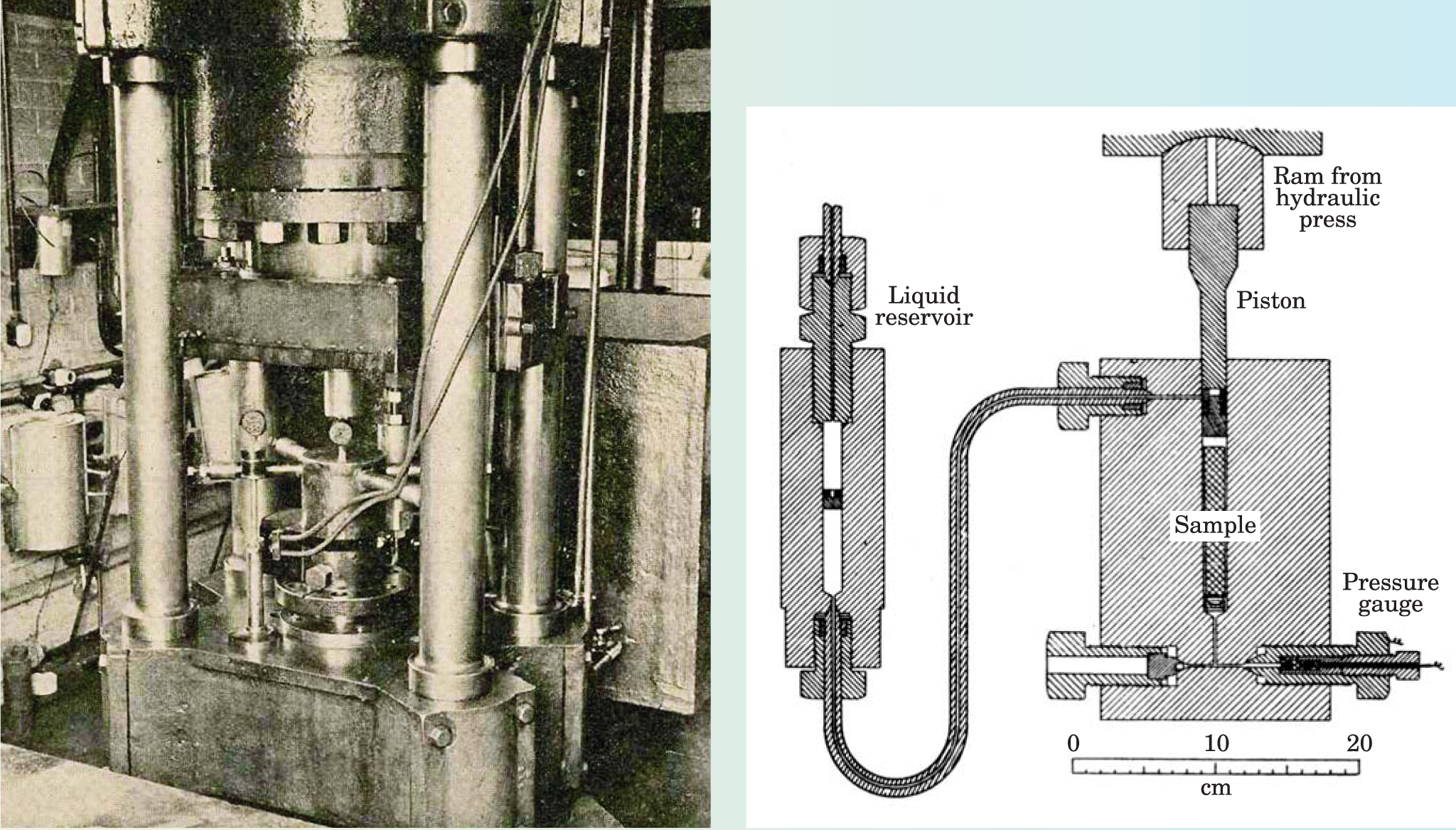
Figure 2. A four-post, 500-ton high-pressure apparatus used by Williamson and others at the Carnegie Institution of Washington’s Geophysical Laboratory. The picture shows the hydraulic press, pressure vessel, micrometers, and connections; the overall design is similar to that used in modern presses. The schematic shows the pressure vessel mounted in the hydraulic press used for compressibility measurements. The movement of a piston in the vanadium vessel was used to determine the volume change of the sample, and the change in electrical resistance of a manganin wire provided a measure of the pressure.
(Adapted from L. H. Adams, E. D. Williamson, J. Johnston,

These were challenging experiments, given the incompressibility (that is, high K s) of materials expected to reside within Earth. Indeed, the team found that all materials studied became more incompressible under pressure. Moreover, such materials as those found at Earth’s surface cannot be sufficiently compressed to create the densities expected based on the planet’s average density. Williamson and Adams were the first to report the compressibility of diamond, a major accomplishment given the difficulty of measuring a change in volume of such an incompressible solid; their result is remarkably close to the currently accepted value.
The pair investigated not only single phases—individual minerals, for example—but also whole rock samples subjected to pressures of Earth’s deep crust. Their determination of the elastic properties of rocks revealed a sharp decrease in the compressibility (1/K s) under pressure up to 2 kbar for some rocks; that decrease was correctly interpreted as arising from the closure of cracks in the bulk rock. They went on to measure electrical conductivities, viscosities, and other physical properties of materials at high pressures.
By integrating equation
The pair’s conclusions represented a remarkable achievement. Given the data available at the time, their calculation of the mantle’s average density and composition and their depiction of the core are both remarkably close to our current understanding. It is no surprise, then, that their 1923 article “Density Distribution in the Earth,” 1 published one month before Williamson’s death, is a landmark paper in geophysics (see figure 1).
Chemistry and thermodynamics
This work was the outgrowth of several lines of investigation and was the culmination of a research program that involved major contributions to fields beyond geophysics (see
That research eventually grew into a broader program focused on further developing and applying equilibrium thermodynamics. Gibbs had defined various “potentials,” but the relevance of his formalisms was not appreciated, despite the growing number of papers on the topic. 6 Williamson and George Morey’s 1918 paper “The Laws of Chemical Equilibrium” appears to be the first to spell out a clear meaning of the term “chemical potential.” 7 They wrote, “The variable µ, which bears to the mass of a component the same relation that pressure bears to volume, temperature to entropy, or electrical potential to the quantity of electricity, is what we call the ‘chemical potential.’” This simple yet elegant analogy is now embedded in the lexicon of chemical thermodynamics.
Optical glass and the war
World War I interrupted this diverse research program, but it was a hiatus that led to still other groundbreaking discoveries. Like other scientists at the Geophysical Laboratory, Williamson decided to help with the war effort. A critical problem facing the nation was how to enhance the quality of optical glass, which until then had been obtained from Germany. Williamson relocated to glass-making plants in Pennsylvania and New York to help improve the manufacturing process. By mathematical treatments of heat flow in a variety of geometries and of structural relaxation, he showed how the annealing of glass could be optimized, which dramatically reduced cracking and devitrification. The work also addressed such simple but important engineering problems as the proper motion of stirrers in the melt and the placement of thermocouples in the manufacturing apparatus. The results of that work were published in a series of papers following the war and include fundamental equations still in use that describe heat conduction in solids. 8 In fact, entirely different Williamson and Adams equations came to be known in the glass and ceramics literature. 9
When the draft was introduced in Britain to feed the growing trench warfare, Williamson and other expatriates were called up. Only a letter from the Geophysical Laboratory’s director, Arthur Day, to the British ambassador spared Williamson from the front. Indicating his greater value to the Allied cause by his service to the fledgling glass industry, Day saved him from the fate of other young Britons (such as Henry Moseley, who discovered the origin of the atomic numbers of the elements). Day’s intervention paid off, as some 95% of the production of optical glass during the war was carried out under the direction of Williamson and other scientists from the Geophysical Laboratory. The industry partnership, which Day had begun before the war, contributed to the development of glass technology at Corning Glass Works in New York, including the invention of new glasses such as Pyrex.
Developments and extensions
Williamson and Adams had proposed a methodology for a quantitative understanding of planetary interiors, but their specific model was limited by the paucity of information then available. 1 In their model, the largely granitic crust gives way at a critical depth—starting at about 60 km from the surface—to more basic material. From 60 to about 1600 km is a region dominated by iron– magnesium silicate minerals. Below that lies pallasite, a mixture of silicates and iron–nickel alloy, and below about 3000 km lies the iron–nickel core.
The mantle and core zones represent regions of constant composition with the density increasing as a result of compression. The pioneering geochemist Viktor Goldschmidt had proposed similar changes in composition with depth, 1 but the Williamson–Adams model was the first to be supported by solid experimental data on material properties at high pressures and temperatures. Many details remained to be worked out, most notably the identification of the seismic discontinuities at various depths. In 1936 Irish crystallographer John Bernal suggested that the discontinuity at 400 km arises from the phase transition in the mineral olivine to a denser spinel structure, and Inge Lehmann discovered the discontinuity between the outer and inner core. 10
Williamson and colleagues correctly suspected that the temperatures deep within Earth must be several thousand degrees, 1 but could not address the effects of temperature at high pressure. They conjectured that materials must be in some sort of glassy state, because it was unclear that melting points of minerals could rise by so large an amount under pressure; indeed, there was much speculation about melting lines ending in critical points. 3 Following the notions of geologist Reginald Daly, 11 they suggested that glassy material exists in the deep mantle at temperatures above what they thought were the maximum melting points of minerals; the high pressure was assumed to maintain the material’s rigidity. Only years later would experiments indicate that melting temperatures of most minerals increase substantially with pressure, obviating any need to invoke the presence of a glass.
In 1952, using new experimental data that had been collected in the three decades since Williamson and Adams’ analysis and an improved understanding of how materials transform under pressure, Francis Birch worked out a more general treatment. Specifically, he incorporated seismic discontinuities and the role of temperature on such transformations throughout Earth’s deep interior.
12
In particular, Birch extended equation
where α is the coefficient of thermal expansivity and τ is the difference between the adiabatic gradient and the true temperature gradient. New Zealand–born mathematician and seismologist Keith Bullen quantified the departure from uniform chemical composition by defining a homogeneity parameter η,
which should be near unity for homogeneous regions that are close to adiabatic. 13 Here, P represents pressure and g the acceleration of gravity.
The modern legacy
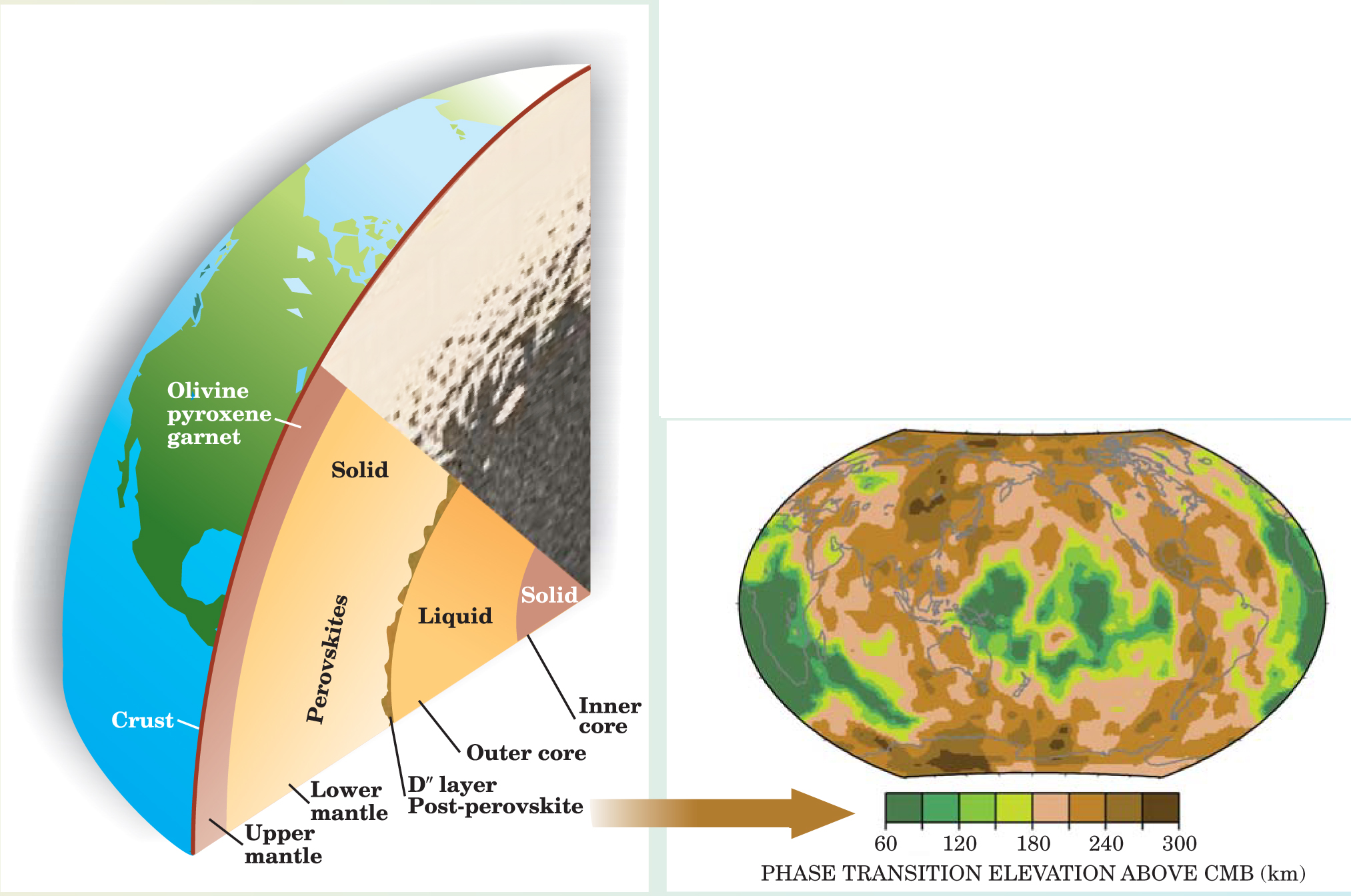
Although those early Earth models predate the plate-tectonic revolution, their authors understood the concept of planetary differentiation—that the combined forces of gravity and internal heat can segregate materials within planetary bodies. Indeed, modern dynamical treatments of planetary structure and evolution take the Williamson–Adams equation as one of their starting points. The modern versions of the Williamson–Adams approach for Earth are the radially symmetric reference Earth models, as shown in figure 3. According to the current view, the continuous density and sound-velocity profiles of the deep mantle are consistent with the presence of dense simple oxides and perovskite-structured silicates surrounding a much denser core rich in liquid iron–nickel (see the article by Raymond Jeanloz and Barbara Romanowicz in Physics Today, August 1997, page 22 ).

Figure 3. Williamson and Adams’s schematic model of Earth’s deep interior, the northern slice of the planetary sketch at left, illustrates the concentration of iron (in black) within Earth’s core.
(Right image from D. Helmberger et al.,

The region near the core–mantle boundary is an area of considerable current research—two years ago new pressure-induced structural transitions were discovered to occur there 14 —as are continued studies of the outer and inner core. A new generation of experimental techniques—from multimegabar high-pressure devices to probes of deep planetary structure—together with the Williamson–Adams relation underpin modern planetary models, including those of planets outside our solar system. 15 The actual experimental data obtained by the early investigators have naturally been superseded in the wake of improved measurement techniques. But many early observations stand to this day, including the effects of crack closure on the elasticity of whole rocks, which is central to interpreting data on the lithosphere, elastic anisotropy in the mantle, and earthquake prediction. 16 (For modern studies of related problems, see the article by Robert Guyer and Paul Johnson in Physics Today, April 1999, page 30 .)
Modern research in the broader field of matter under extreme conditions can also be traced back to those early advances. Studies of organic systems today build on the investigations of Williamson and Adams on mustard gas [(C2H4Cl)2S] carried out for the war effort. 17 Megabar pressures set the scale for the condensed matter physics and chemistry of extreme conditions, a regime characterized by numerous profound changes in material properties. Just after Williamson died, scientists recognized that atoms could be effectively destroyed by pressure (and temperature), and that quantum mechanics provided a means for understanding phenomena such as the extreme densities encountered inside stars. 18 That recognition led to the conjecture that all materials must eventually transform to metals or dense plasmas under compression. Testing this postulate has motivated much of high-pressure research for 80 years and led to numerous surprises, among them the observation not only of pressure-induced metallization, but also unexpected examples of pressure-induced superconductivity (see the article by Russell Hemley and Neil Ashcroft, Physics Today, August 1998, page 26 ). Recent work suggests more exotic behavior in a growing number of materials.
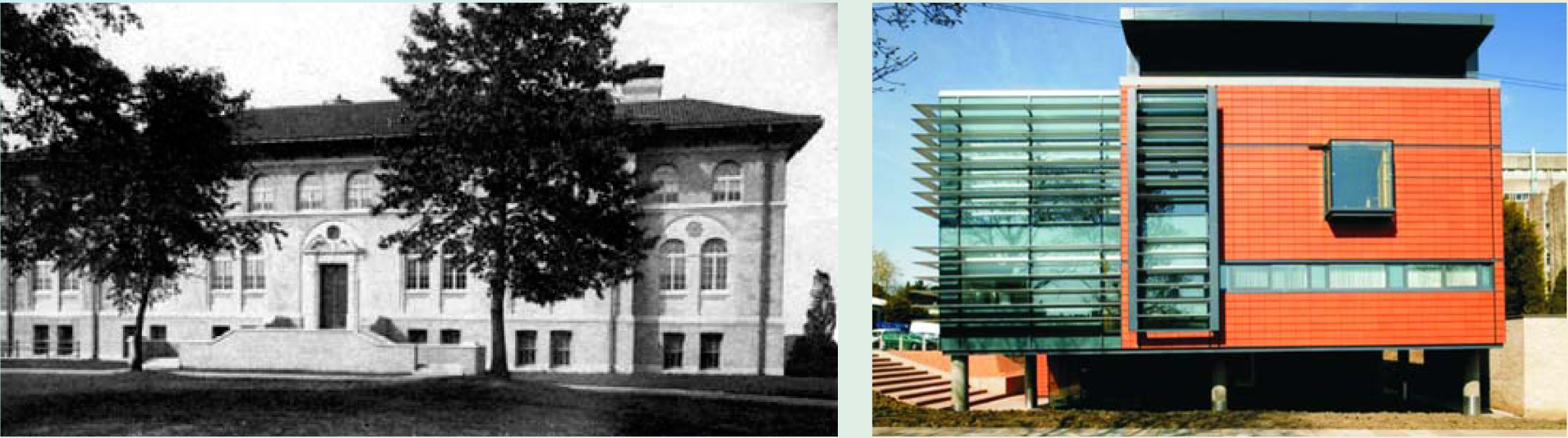
Williamson did not live to appreciate the flourishing field that he helped to create on the eve of the quantum revolution in physics. In some 20 papers published during a span of eight years, including the interruptions of World War I, he and a small cadre of fellow scientists laid the foundation for mineral physics and the broader study of matter under extreme pressures and temperatures (see figure 4). The modern field thrives at the interface of many disciplines—it bridges the gap between geology and astrophysics, between condensed matter physics and plasma physics, and between planets and stars.

Figure 4. The Geophysical Laboratory (left) in Washington, DC, when Williamson worked there, and the new Erskine Williamson Building (right), dedicated April 2004 at the University of Edinburgh, UK. The Erskine Williamson Building houses the Centre for Science at Extreme Conditions, which, like the modern Geophysical Laboratory, is one of several high-pressure centers worldwide.
(Left photo adapted from H. S. Yoder Jr,

Other significant pursuits
Several of Williamson’s papers addressed chemical thermodynamics, including the 1918 article “The Laws of Chemical Equilibrium,” 7 which clarified the notion of the chemical potential. Interestingly, Gilbert Lewis and Merle Randall’s 1923 textbook Thermodynamics (McGraw-Hill, New York), read by generations of graduate students, used the term “partial molal free energy” instead of chemical potential. In the second, revised edition of the text published in 1961, Kenneth Pitzer and Leo Brewer added a discussion with terminology virtually identical to that used by Williamson and George Morey.
“Temperature Distribution in Solids” 8 became the fundamental paper for glass annealing. The article “Change of the Physical Properties of Materials with Pressure” (E. D. Williamson, J. Franklin Inst. 193, 491, 1922) outlined the progress in the emerging field of high-pressure physics. In it, Williamson wrote, “The difficulties of making exact measurements of any physical quantity whatever under the conditions outlined are very considerable and much time is consumed merely devising tools for the enterprise.” The use of x rays to reveal the structure of matter was in its infancy at the time. In that paper he also made the prescient remark, “X-ray analysis has elucidated the arrangement of the atoms in many of the simple crystals, so that the compressibility [studied in this way] should give some idea for the laws governing the forces of attraction or repulsion. … The change in compressibility has not been examined from this point of view, so far as I know.” This statement underlies the rationale behind much of modern high-pressure physics—understanding the forces of attraction and repulsion of atoms in condensed matter. We now know that structures can be surprisingly complex under pressure, an unexpectedly rich realization of Williamson’s prediction. The photo shows an early x-ray diffractometer used at the Carnegie Institution of Washington’s Geophysical Laboratory in a program begun by Ralph Wyckoff (courtesy of the Geophysical Laboratory Archives).

I thank C. T. Prewitt, S. Gramsch, S. Hardy, N. W. Ashcroft, S. C. Solomon, J. Katz, R. Jeanloz, A. Davis, L. Sawyer, R. J. Nelmes, B. O. Mysen, S. G. Brush, and the late H. S. Yoder Jr for valuable input and discussions.
References
1. E. D. Williamson, L. H. Adams, J. Wash. Acad. Sci. 13, 413 (1923).
2. A. Pais, Inward Bound: Of Matter and Forces in the Physical World, Oxford U. Press, New York (1986);
J. D. Burchfield, Lord Kelvin and the Age of the Earth, U. of Chicago Press, Chicago (1990);
S. G. Brush, Nebulous Earth: The Origin of the Solar System and the Core of the Earth from Laplace to Jeffreys, Cambridge U. Press, New York (1996).3. P. S. Chandrasekhar, An Introduction to the Study of Stellar Interiors, U. of Chicago Press, Chicago (1939), chap. 4.
4. P. W. Bridgman, The Physics of High Pressure, G. Bell and Sons, London (1931);
for a recent retrospective, see P. M. McMillan, Nat. Mater. 4, 715 (2005) https://doi.org/10.1038/nmat1488 .5. E. D. Williamson, Phys. Rev. 10, 275 (1917) https://doi.org/10.1103/PhysRev.10.275 .
6. J. W. Servos, Physical Chemistry from Ostwald to Pauling: The Making of a Science in America, Princeton U. Press, Princeton, NJ (1990).
7. E. D. Williamson, G. W. Morey, J. Am. Chem. Soc. 40, 49 (1918) https://doi.org/10.1021/ja02234a005 .
8. E. D. Williamson, L. H. Adams, Phys. Rev. 14, 99 (1919); https://doi.org/10.1103/PhysRev.14.99
E. D. Williamson, J. Wash. Acad. Sci. 9, 209 (1919);
E. D. Williamson, H. S. Roberts, Trans. Am. Inst. Min. Metall. Pet. Eng., 1445 (1919);
E. D. Williamson, L. H. Adams, J. Am. Ceram. Soc. 3, 671 (1920);
E. D. Williamson, J. Wash. Acad. Sci. 12, 1 (1922).9. G. W. Morey, The Properties of Glass, Reinhold, New York (1954);
I. Gutzow, T. Grigorova, I. Avramov, J. W. P. Schmelzer, Phys. Chem. Glasses 43C, 477 (2002).10. J. D. Bernal, The Observatory 59, 268 (1936);
I. Lehmann, Publ. Bur. Centr Seism. Int. Trav. Sci. 14, 3 (1936).11. R. A. Daly, Igneous Rocks and Their Origin, McGraw-Hill, New York (1914).
12. F. Birch, J. Geophys. Res. 57, 227 (1952) https://doi.org/10.1029/JZ057i002p00227 .
13. K. E. Bullen, Introduction to the Theory of Seismology, 3rd ed., Cambridge U. Press, Cambridge, UK (1963);
for a short history of proposed pressure–density relations for Earth, see K. E. Bullen, The Earth’s Density, Wiley, New York (1975).14. M. Murakami, K. Hirose, K. Kawamura, N. Sata, Y. Ohishi, Science 304, 855 (2004); https://doi.org/10.1126/science.1095932
A. Oganov, S. Ono, Nature 430, 445 (2004); https://doi.org/10.1038/nature02701
W. L. Mao et al., Proc. Nat. Acad. Sci. USA 101, 15867 (2004) https://doi.org/10.1073/pnas.0407135101 .15. A. Y. Ignatiev, R. R. Volkas, Phys. Rev. D 62, 023508 (2000); https://doi.org/10.1103/PhysRevD.62.023508
D. Valencia, R. J. O’Connell, D. Sasselov, Icarus (in press).16. F. Niu, P. G. Silver, R. M. Nadeau, T. V. McEvilly, Nature 426, 544 (2003); https://doi.org/10.1038/nature02151
R. Ikuta, K. Yamaoka, J. Geophys. Res. 109, B09305 (2004) https://doi.org/10.1029/2003JB002901 .17. L. H. Adams, E. D. Williamson, J. Wash. Acad. Sci. 9, 28 (1919).
18. R. H. Fowler, Mon. Not. R. Astron. Soc. 87, 114 (1926);
P. W. Bridgman, Phys. Rev. 29, 188 (1927); https://doi.org/10.1103/PhysRev.29.188
E. Wigner, H. B. Huntington, J. Chem. Phys. 3, 764 (1935) https://doi.org/10.1063/1.1749590 .
More about the authors
Russell J. Hemley is a staff scientist at the Carnegie Institution of Washington’s Geophysical Laboratory in Washington, DC.
Russell J. Hemley, Carnegie Institution of Washington’s Geophysical Laboratoty, Washington, DC, US .