Demystifying graviton detection


The graviton has long occupied a strange place in physics. It is central to a quantum description of gravity, yet it is seemingly forever beyond experiment. If gravity obeys quantum mechanics, then the gravitational interaction should be mediated by a quantum particle, the graviton, analogous to the photon and other bosons that mediate the other fundamental forces. But gravity is much weaker than those other forces, and detecting gravitons has appeared unattainable.
Steven Weinberg, for example, calculated that an atom would take far longer than the age of the universe to spontaneously emit even a single graviton. 1 And although the Laser Interferometer Gravitational-Wave Observatory has detected classical gravitational waves, Freeman Dyson has shown that for a LIGO-like detector to sense a single graviton, it would have to be so massive that it would collapse into a black hole. 2
Another avenue that Dyson and others considered is a gravitational analogue of the photoelectric effect. Similarly to how an atom can absorb photons from electromagnetic radiation, an atom interacting with passing gravitational waves may absorb a single graviton and transition to a different electronic state. 2 3 But that method would require a detector the size of Jupiter orbiting a neutron star. 3 Notwithstanding the challenge of background noise, such analyses (and common sense) suggested that graviton detection may forever be out of reach.
Yet a new approach, fueled by quantum optics and emerging quantum technologies, suggests that such difficulties can be circumvented. 4 Like the photoelectric effect, the new approach is based on the premise of energy absorption. The critical advance is the emerging ability to resolve individual quanta of energy in macroscopic systems.
The approach opens a realistic experimental avenue for graviton detection. A successful detection would not provide final proof of a quantum theory of gravity. (For more about the signatures of quantum gravity, see the June PT article by Markus Aspelmeyer and Daniel Carney.) That is because particle detection can be interpreted through a semiclassical model if energy conservation is abandoned. But in the quantum framework, graviton detection would provide direct access to the single-particle regime of the interaction between gravity and matter and thus open the door to broader experimental exploration of quantum gravity.
Catching gravitons
Mathematically, gravitons naturally emerge from the quantizing of the linearized, weak-field limit of general relativity, as summarized in box 1 . What makes single-graviton detection potentially realizable is the resonant exchange of energy between a gravitational wave and matter. The interaction can be described in terms of the cross section σ, which is the ratio of the absorbed power to the incident flux of gravitational energy. The cross section captures how efficiently matter absorbs passing gravitons.
Box 1. Linearized quantum gravity
General relativity describes gravity through nonlinear field equations that are the manifestation of spacetime geometry. But for weak gravitational fields, general relativity looks like an ordinary field theory on flat spacetime, similar to the other interactions of particle physics’s standard model. Despite its simplicity, the linear approximation reproduces much of the observed phenomenology of general relativity, including gravitational waves. 1
Quantizing the linearized gravitational field introduces graviton particles, which are analogous to photons in electromagnetism. 15 Gravitons play two complementary roles: As virtual particles, they mediate gravitational interactions; as real particles, they carry gravitational waves’ energy quanta , where ℏ is the reduced Planck’s constant and ω is the wave frequency. Whereas photons are spin-1 particles that couple to electric charge, gravitons are spin-2 particles that couple to mass and energy.
Linearized quantum gravity is a mathematically consistent framework that breaks down once gravity becomes strong enough that the gravitational field interacts nonlinearly with itself. Any successful theory of quantum gravity is expected to reduce to linearized quantum gravity in the weak-field limit—and thus to contain gravitons.
Atomic transitions have an extremely small cross section , where , with ℏ being the reduced Planck’s constant, G the gravitational constant, and c the speed of light. 2 3 Here LP, the Planck length, is the length at which quantum gravity effects are typically expected. An atom, whose physical area is roughly the Bohr radius squared, approximately 10−20 m2, is essentially transparent to gravitons. The small Planck-scale cross section, which is a direct reflection of the weakness of gravity, is often cited as the fundamental obstacle to detecting gravitons.
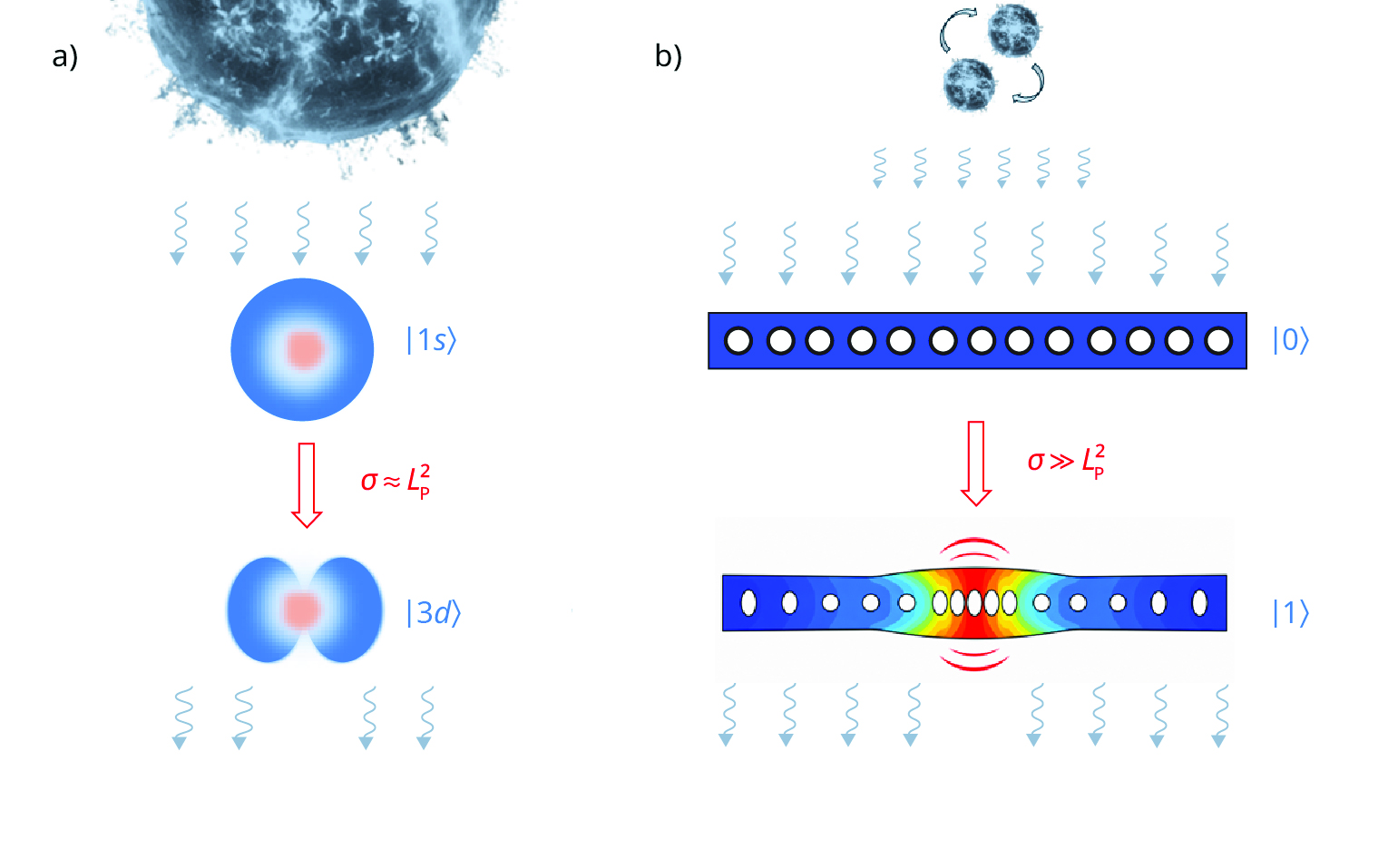
Yet that obstacle can be circumvented. The Planck-scale cross section applies only when an electron in an atom absorbs a single graviton from a passing gravitational wave. That process is illustrated in figure 1(a) . But it isn’t the only possible process to consider for graviton detection—nor is it the most suitable one.
What if the detector were, instead of an electron, a much larger mass that could still undergo measurable quantum jumps in energy? Massive quantum systems, such as superfluid helium resonators, can serve as modern variants of the resonant bars pioneered by Joseph Weber for conventional gravitational-wave detection. 5 6 In such systems, transitions between individual quantized energy levels could be measured, much like transitions in an atom can be, but these systems would involve a vastly larger mass. The possibility of that measurement arises from recent experimental developments that bring increasingly macroscopic systems into the quantum regime—quantum effects have been observed in systems with milligram-scale masses. 7 And that’s precisely where the long-standing intuition about graviton detection gets overturned.
Building on the reasoning described above, my group and I calculated a macroscopic system’s exact transition probabilities for when a single graviton is absorbed. 4 The essential scaling can be understood from a simple argument described in box 2 : The general cross section of gravitons interacting with matter is not fundamentally the Planck area . Rather, it is given by , where ω is the frequency and Q is the detector’s mass quadrupole, which is a measure of its mass and size.
Box 2. The graviton cross section
Albert Einstein’s quadrupole formula describes how a changing mass distribution emits gravitational waves with power , where G is the gravitational constant, c is the speed of light, and is the third time derivative of the emitter’s mass quadrupole, which scales with mass m and size x as . The same expression can also predict how a detector would absorb energy, which led Joseph Weber in 1960 to propose the first gravitational-wave detector. 5 The difference for single-graviton detection is that only a single quantum of energy is absorbed. That results in a detector strain on the order of .
For a monochromatic wave resonant with the detector, the power P associated with a single-graviton transition becomes
. The single-graviton flux is
, which corresponds to one quantum of energy spread over roughly one wavelength during one oscillation period. Together, those results yield the absorption cross section
. That general expression, which depends on Q, captures the key to graviton detection.
With that expression, an electron in an atom indeed yields the above result of , which led Dyson and others to conclude that a Jupiter-sized detector is required. But that cross section describes only how an electron absorbs energy from the gravitational wave. Physically, that is like trying to generate electricity from passing gravitational waves!
Instead of electrons, other systems with vastly larger mass quadrupoles can be considered. A resonant bar of length L and mass M, for example, yields . In that case, the energy is absorbed not by an electron but by a phonon, the quantum of sound, which results in graviton-to-phonon conversion. The cross section for that process can be roughly 40 orders of magnitude larger than that of the electronic transition because of the bar’s larger mass quadrupole. Because of that difference in scale, a possible graviton detector—sketched in figure 1(b) —can be brought from astronomical dimensions to laboratory-sized ones.
Figure 1.

Detecting a graviton, the hypothesized quantum of energy that makes up gravitational waves. (a) When a star or another source of gravitational waves emits radiation (squiggly lines), single gravitons can be absorbed by an electron in an atom and result in an electronic quadrupole transition from the 1s to 3d orbital. 1 2 3 The cross section σ is roughly equal to the tiny Planck area , and few gravitons are expected near the frequency of the atomic transition. Graviton detection through that approach, therefore, is nearly impossible. (b) A more realistic approach could measure lower-frequency gravitons from a binary star merger using a macroscopic acoustic resonator (blue bar). 4 When the resonator absorbs a single graviton from a passing gravitational wave, the energy is converted to a detectable phonon, and that process has a much larger cross section.

Quantum sensing at the macroscale
The ability for macroscopic matter to absorb gravitational-wave energy has been well known for decades. 1 5 The novelty is that if that energy absorption is observed in discrete steps, similarly to how a quantized electron transition in an atom is measured, then a graviton could be detected. (Many particles, including photons in photon counters, are registered through discrete energy exchange.) But detecting a single graviton requires a different kind of measurement than conventional gravitational-wave detection does. Rather than measuring the continuous displacement caused by a passing wave, which is the standard approach used by LIGO, it requires monitoring the resonant detector’s energy and resolving a change by a single quantum of energy .
In recent years, such capabilities have begun to emerge through the quantum control of macroscopic systems. One example is in the field of quantum acoustics. Quantum acoustic systems come in many forms, and the phonons can be controlled and measured by auxiliary superconducting qubits, photons, or other coupled systems. Although phonons have been essential to solid-state physics for at least a century, the ability to manipulate, detect, and count individual phonons has been demonstrated in various platforms only recently because of advances in opto- and electromechanics. 8
Although the new capabilities suggest that detecting gravitons may now become a quantum engineering problem, the task still remains difficult. Existing systems are still too small to be practical for graviton absorption and would need to be scaled up in mass. Additionally, the energy resolution must be improved if quanta at kilohertz frequencies are to be detected. But the tools are developing rapidly, and those goals may well be achievable.
Where the gravitons come from
Using macroscopic quantum systems and monitoring their changes in energy provides a blueprint for detecting gravitons. The approach, based on a resonant exchange of energy, is illustrated in figure 2 . It’s generic and can take many forms. In addition to graviton-to-phonon conversion, resonant detection could also be achieved through graviton-to-photon conversion, for example, via strong magnetic fields 9 or light beams. 10
Another challenge remains, however: A large flux of background gravitons is needed. But whereas many potential kinds of detectors, including electronic transitions, operate far above kilohertz frequencies, no strong sources of gravitons are expected in that frequency range. The graviton flux from the stars that Dyson and others considered is exceptionally low at those frequencies and would thus require a large detector to be placed in close orbit.
But the flux problem can be solved in the same way as the cross section issue. The best graviton sources are the gravitational waves already detected by LIGO. Compact binary mergers produce a tremendous flux of gravitons at subkilohertz frequencies. For typical detected gravitational waves with strain amplitudes of about 10−22, the graviton flux F ≈ 1028 s−1 m−2 is substantial enough to compensate for the small (although no longer Planck-scale) cross section. Because acoustic resonators can operate at those subkilohertz frequencies, the graviton-source problem is also solved: A macroscopic resonant detector in the frequency band of standard LIGO detections can register the absorption of a single graviton from the same wave that’s measured by conventional methods.
Most known gravitational waves sweep through the detector’s resonant frequency too quickly to deposit energy efficiently. But waves from one type of source, neutron star mergers, could be detectable. They last long enough for a kilogram-scale system to absorb a single graviton. 4 With detectors that have sufficiently good phonon-number resolution or with transduction, gram-scale systems might even be sufficient.

Two essential ingredients of a graviton detector are a macroscopic system and a means to measure individual quanta of energy. A graviton can be converted from a passing gravitational wave into a single excitation of a harmonic mode of some massive system (blue boxes) through resonant energy transfer. The excitation can then be read out through a quantum sensing technique (red boxes), such as the excitation of a coupled superconducting qubit, quantum nondemolition (QND) measurements, or a photon conversion technique. 8

Solving noise through correlation
With the cross section and graviton source addressed, the remaining, seemingly insurmountable challenge is background noise. How can one distinguish genuine graviton absorption from any other source of energy?
One solution is to cross-correlate the graviton detector output with standard gravitational-wave detections. The gravitational-wave signal from the final stages of a compact-binary merger lasts only an exceedingly short time, typically less than a second. During that interval, the enormous graviton flux far exceeds that of other potential sources. And only specific detector modes—those that couple to a spin-2 particle—are excited. The critical step is to characterize the detector when no wave is present.
Taking again the example of an acoustic resonator, the desired mode must be cooled to its ground state. Cooling of macroscopic systems to their ground state has already been achieved, 7 8 and ground-state lifetimes of minutes or more are realistic. 6 7 For graviton detection, only the selected mode needs to be in its quantum ground state. Adequate noise suppression requires the rest of the system to be cold and sufficiently isolated from that mode. The required damping and overall cooling of the whole system to about 1 millikelvin are also in reach and have already been demonstrated in related systems. 7 The noise is thus becoming manageable enough for energy jumps and LIGO detections to be cross-correlated.
Beyond classical wave physics
Graviton detection appears to be a viable experimental goal. But even once achieved, it would not by itself constitute final proof of a quantum theory of gravity. That reflects a fundamental feature of physics: An experiment can show consistency with a theory, but it cannot unambiguously prove it. Proof would require ruling out all possible alternatives, which is rarely how physics progresses. The real question is how contrived the alternative explanations would have to become before they are no longer scientifically compelling.
The photoelectric effect offers a helpful perspective. The effect is often interpreted in two opposing ways, but neither captures its full significance. The first is that the photoelectric effect by itself proves the existence of photons. The second is that the interaction of classical radiation with quantized matter is sufficient to explain the effect, so photons are not necessary. Both views are subtly inadequate.
The photoelectric effect can be described without an explicit quantization of the electromagnetic field, and the same is true for graviton detection and the gravitational field. With suitable statistical assumptions, specific semiclassical models can reproduce the signal that gravitons would produce in any type of particle detector. Such semiclassical models could be ruled out by refined correlation measurements, but those are more challenging than particle detection alone.
Semiclassical models, however, do not describe ordinary, classical wave physics. For individual particle detections, those models face a problem with energy conservation: Energy is deposited in the detector while the classical field remains unchanged. Conversely, if energy conservation is assumed, the field must lose exactly one quantum of energy, and graviton detection is inferred. It was Albert Einstein’s correct insight in 1905 that to reproduce all the hallmarks of photoelectric observations in a consistent framework, a full quantization of both matter and light is most natural. Indeed, even today, most photon detectors rely on the photoelectric effect. It is a bona fide particle-detection method.
Similarly, the detection of gravitons cannot rule out some semiclassical explanations of gravity. But neither is graviton detection a classical phenomenon that’s being reinterpreted in quantum language. Graviton detection would be a measurement of how a single quantum of energy is absorbed and converted from a gravitational wave, and such a detection would provide direct access to the single-particle process at the quantum level. Although not a final proof of a quantum theory of gravity, detecting gravitons would mark the first empirical input of the expected quanta of gravity.
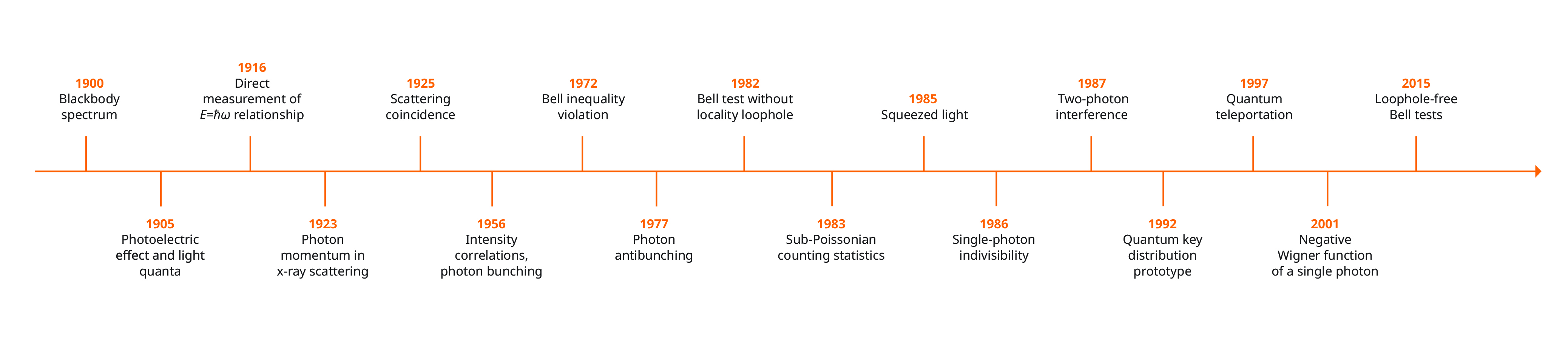
From the beginning of quantum physics, a hierarchy of increasingly stringent tests of quantum phenomena have made a purely classical picture increasingly untenable—the timeline in figure 3 highlights some of the critical experiments for light. The strongest evidence to date against a fully classical description comes from loophole-free violations of the correlation limits, known as Bell inequalities, that are imposed by underlying, local classical models. But even those violations do not rule out underlying superdeterministic and nonlocal classical models. Particle detection is similarly not the final word, but it would be a nontrivial early step.
Figure 3.

A timeline of landmark experiments that probed the quantum nature of light. The sequence represents a hierarchy of increasingly refined tests that make classical explanations less natural and more constrained than a quantum description. Detecting gravitons would be a first step in such an experimental progression for quantum gravity. That feat would enable researchers to conduct more refined tests, such as probing the quantum statistics of gravitational waves. 11 12

Toward tests of linearized quantum gravity
As gravitons become poised to move from a theoretical curiosity to a realistic experimental target, a broad experimental program is emerging. Does the graviton carry the expected spin-2? Does it have mass? Does it obey ? Such particle properties would reveal themselves through selection rules governing observable transitions, excitation probabilities, and the coupling of gravitons to specific detector modes; the study of photons through atomic spectroscopy offers several parallels.
Potential quantum features of gravitational radiation may also become accessible. Excitation probabilities involving more than one graviton can reveal whether the radiation field differs from a coherent state. 11 In fact, the full statistical properties of the wave are accessible in the detector even when only a few gravitons are deposited. 12 That possibility opens the door to quantum-state characterization of gravitational radiation, which might carry nonclassical statistical features. Graviton detection could, therefore, reveal a new layer of information in gravitational waves and act as a quantum-level probe of both gravity and its astrophysical sources.
Additionally, graviton detection is part of a broad transformation in fundamental physics. Independent ideas for probing other quantum features of gravity have emerged over the past decade. Those ideas have included looking for quantum noise from gravitational radiation 13 and testing whether gravity could generate entanglement and thus act as a quantum channel. 14
A new experimental program is beginning to take shape, one in which the quantum nature of gravity can be tested step by step, with each experiment revealing a different facet of the interface between quantum physics and gravity. Dyson—who was skeptical that gravitons could ever be detected—also wrote in a 1995 article in The New York Review of Books that “the great advances in science usually result from new tools rather than from new doctrines.” With new quantum tools, quantum gravity may now be advancing toward experiment.
References
1. S. Weinberg, Gravitation and Cosmology: Principles and Applications of the General Theory of Relativity , Wiley (1972).
2. F. Dyson, “Is a graviton detectable? ,” Int. J. Mod. Phys. A 28, 1330041 (2013).
3. T. Rothman, S. Boughn, “Can gravitons be detected? ,” Found. Phys. 36, 1801 (2006).
4. G. Tobar et al., “Detecting single gravitons with quantum sensing ,” Nat. Commun. 15, 7229 (2024).
5. J. Weber, “Detection and generation of gravitational waves ,” Phys. Rev. 117, 306 (1960).
6. S. Singh et al., “Detecting continuous gravitational waves with superfluid 4He ,” New J. Phys. 19, 073023 (2017).
7. S. Barzanjeh et al., “Optomechanics for quantum technologies ,” Nat. Phys. 18, 15 (2021).
8. P. Arrangoiz-Arriola et al., “Resolving the energy levels of a nanomechanical oscillator ,” Nature 571, 537 (2019); L. R. Sletten et al., “Resolving phonon Fock states in a multimode cavity with a double-slit qubit ,” Phys. Rev. X 9, 021056 (2019); U. von Lüpke et al., “Parity measurement in the strong dispersive regime of circuit quantum acoustodynamics ,” Nat. Phys. 18, 794 (2022).
9. D. Carney, V. Domcke, N. L. Rodd, “Graviton detection and the quantization of gravity ,” Phys. Rev. D 109, 044009 (2024); T. Ikeda et al., “Toward graviton detection via photon-graviton quantum state conversion ,” Phys. Rev. D 112, 103504 (2025).
10. R. Schützhold, “Stimulated emission or absorption of gravitons by light ,” Phys. Rev. Lett. 135, 171501 (2025).
11. S. K. Manikandan, F. Wilczek, “Testing the coherent-state description of radiation fields ,” Phys. Rev. A 111, 033705 (2025).
12. K. Toccacelo et al., “Quantum state characterization of gravitational waves via graviton counting statistics ,” https://arxiv.org/abs/2602.09125 .
13. M. Parikh, F. Wilczek, G. Zahariade, “The noise of gravitons ,” Int. J. Mod. Phys. D 29, 2042001 (2020).
14. S. Bose et al., “Spin entanglement witness for quantum gravity ,” Phys. Rev. Lett. 119, 240401 (2017); C. Marletto, V. Vedral, “Gravitationally induced entanglement between two massive particles is sufficient evidence of quantum effects in gravity ,” Phys. Rev. Lett. 119, 240402 (2017).
15. M. Bronstein, “Republication of: Quantum theory of weak gravitational fields ,” Gen. Relativ. Gravit. 44, 267 (2012).
More about the authors
Igor Pikovski is an associate professor in the department of physics at Stevens Institute of Technology in Hoboken, New Jersey, and an associate professor at Stockholm University in Sweden.