Astronomy and astrophysics with neutrinos
DOI: 10.1063/1.2930733
The idea of the neutrino was put forward in 1930 by Wolfgang Pauli in a desperate attempt to preserve energy conservation in nuclear beta decay. Soon Enrico Fermi exploited the idea to create a theory of the weak interactions that laid the foundation for the now-standard model of particle physics. Because of the putative neutrino’s small interaction cross section, Pauli dubbed it “the particle that cannot be detected.” But in 1956 Frederick Reines proved him wrong. Reines realized that one could compensate for the tiny cross section with a large detector and a copious neutrino source. After toying with the idea of an atomic bomb as the source, Reines settled on a nuclear reactor and discovered the neutrino with a detector that would look familiar today: a 200-liter liquid scintillator target monitored by photomultiplier tubes. 1
Reines has said that the idea of the neutrino as an astronomical messenger came to him immediately after its discovery. Now, half a century later, two first-generation high-energy neutrino telescopes, the Lake Baikal telescope in Siberia and AMANDA at the South Pole, are operating. And a third, ANTARES, off France’s Côte d’Azur, is nearing completion. They transform fresh water, ice, and seawater, respectively, into particle detectors. A second-generation experiment, IceCube, which will encompass a cubic kilometer of Antarctic ice, is halfway toward completion. Those experiments are designed to search the neutrino sky beyond the Sun, possibly to the edge of the Universe.
Although those projects are the focus of this article, neutrino astronomy predates them: Physicists have “seen” the Sun and a 1987 supernova in neutrinos. Both observations were of tremendous importance. The former showed that neutrinos have a tiny nonzero mass, which opened the first small crack in the standard model, and the latter confirmed that supernovae are indeed nuclear explosions.
Cosmic messengers and local backgrounds
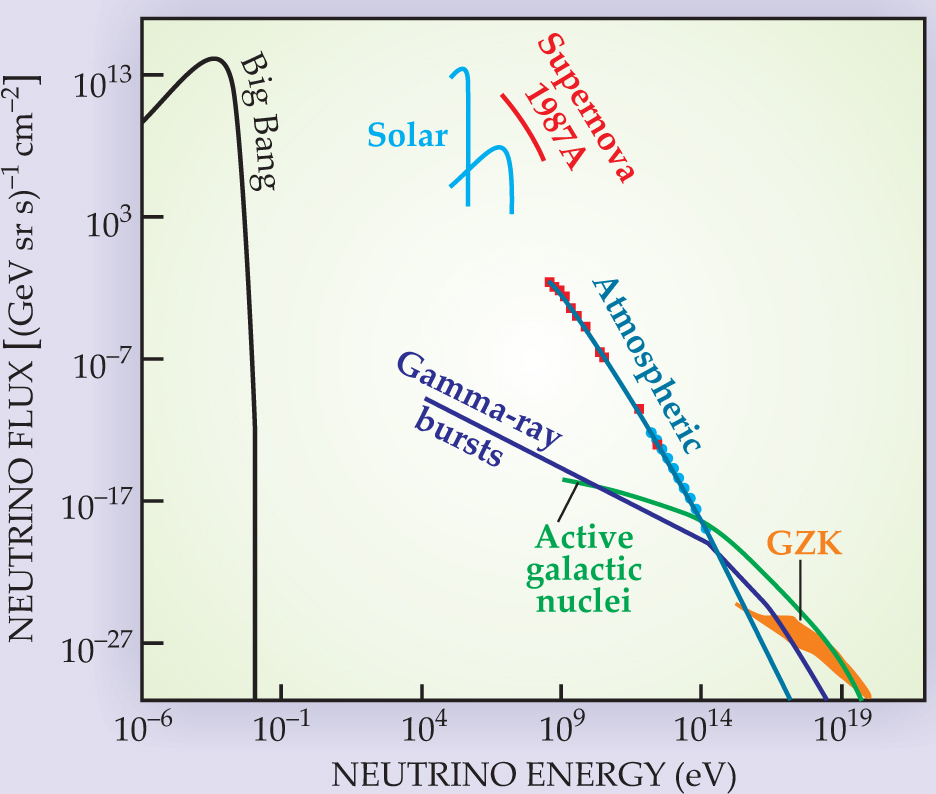
Figure 1 shows the neutrino energy spectrum at Earth’s surface. It spans an enormous energy range, from microwave energies (10−4 eV) up to the highest cosmic-ray energies (1020 eV). The lowest-energy neutrinos in the present cosmos were produced in the Big Bang; they’ve been losing energy ever since in the cosmic Hubble expansion. The energies are so low that those neutrinos cannot be detected by present technology. But other evidence points clearly to the existence of that primordial neutrino background. Fortunately for the enterprise of neutrino astronomy, the neutrino’s cross section for interaction with detector materials increases with its energy.

Figure 1. The cosmic neutrino spectrum. A low-energy background left over from the Big Bang is believed to suffuse the cosmos. Neutrinos from the Sun confirmed the fusion processes that provided its heat, and they yielded the first evidence of neutrino flavor oscillation. Neutrinos have also been detected from the nearby supernova explosion 1987A. Much of the spectrum of atmospheric neutrinos from cosmic-ray air showers has been measured by the Fréjus underground detector (orange data points) in France and the AMANDA detector (blue dots) deeply embedded in ice near the South Pole. Not yet observed are neutrinos expected from cosmological point sources such as gamma-ray bursts and active galactic nuclei. The most energetic neutrinos are expected from the decay of pions created in collisions between cosmic-microwave-background photons and cosmic-ray protons with energies above 4 × 10¹⁹ eV (the Greisen-Zatsepin-Kuzmin threshold).
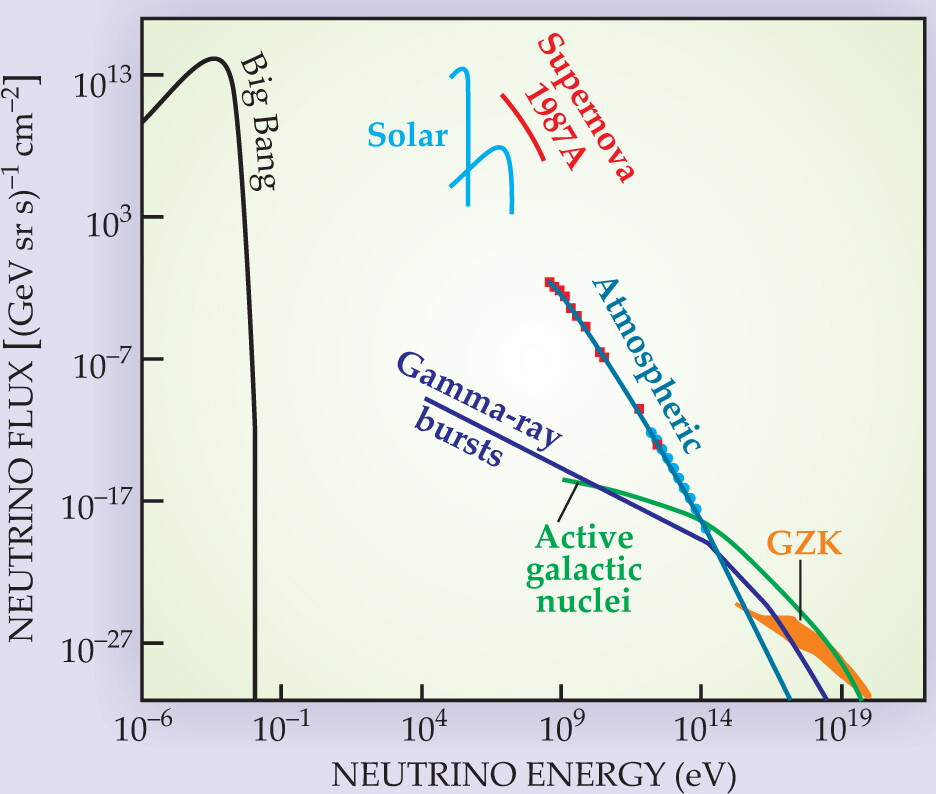
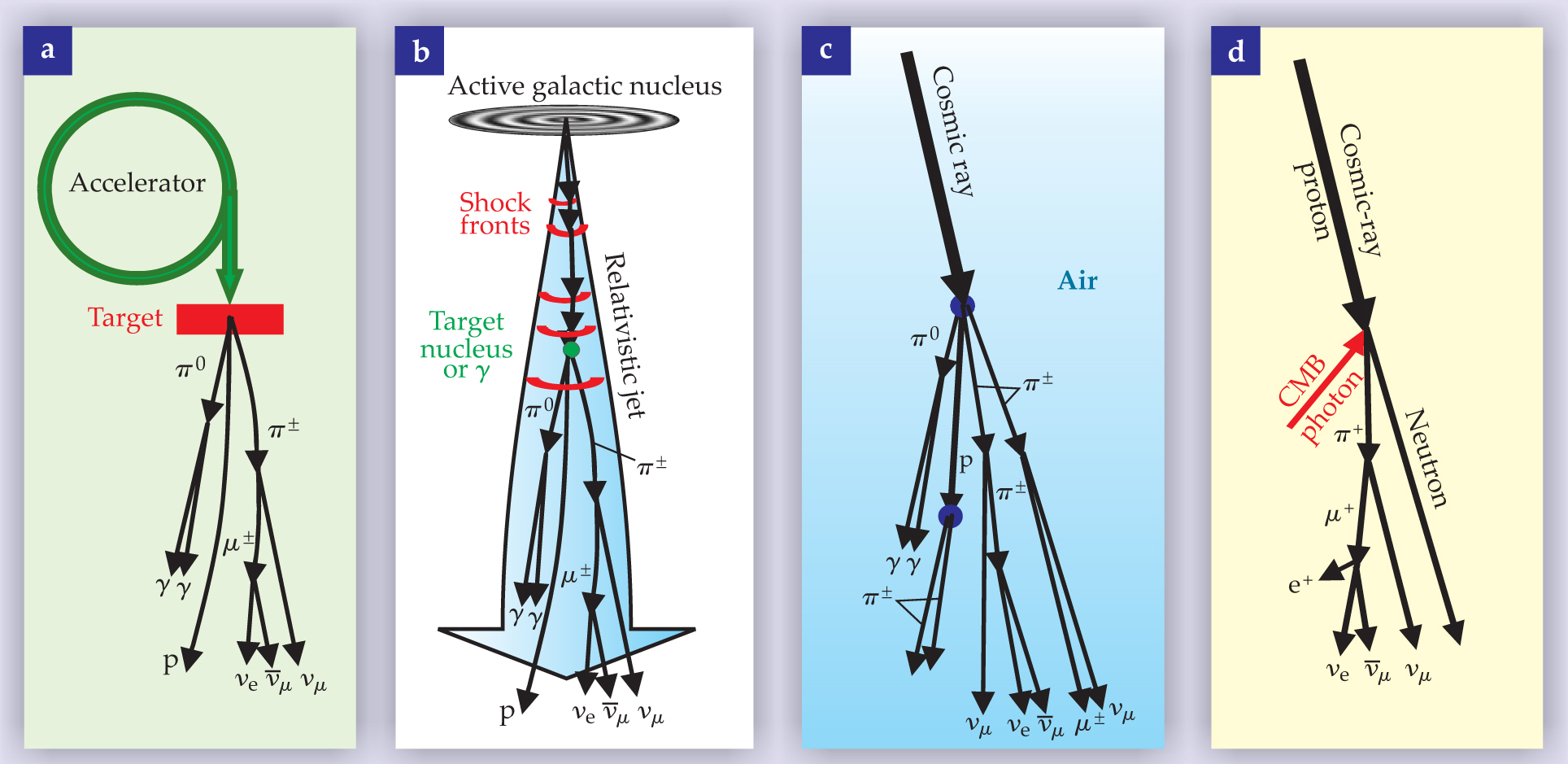
Neutrinos with MeV energies are produced by nuclear burning in stars and supernova explosions. Going to higher energies in figure 1, the atmospheric neutrinos are the decay products of π and K mesons created in showers of hadrons engendered by high-energy cosmic-ray protons and nuclei hitting the top of the atmosphere (

Figure 2. Four neutrino sources. (a) An accelerator proton beam collides with nuclei in a target to produce mesons. Their decay products include neutrinos of various flavors (see

The highest-energy neutrinos in figure 1 are the decay products of pions produced in the interactions of ultra-high-energy cosmic rays with microwave photons. Above a threshold of about 4 × 10¹⁹ eV, the so-called Greisen-Zatsepin-Kuzmin (GZK) cutoff, cosmic-ray protons interact with the cosmic microwave background to produce pions (see Physics Today, May 2007, page 17 ). The upshot is that the range of extragalactic cosmic rays is limited to roughly 250 million light-years. High-energy gammas are also restricted in how far they can travel. They lose energy by colliding with the cosmic background of infrared photons to create electron-positron pairs.
That leaves neutrinos as the only known probes of the high-energy universe at larger distances. What they will reveal is a matter of speculation. In the November 2003 issue of Physics Today (November 2003, page 38 ), Martin Harwit reminded his readers that each time astronomers have opened a new window in the sky, they’ve made major discoveries. One should expect no less from neutrinos.
High-energy neutrinos and cosmic rays
At energies above 1 GeV, cosmic rays, rather than neutrinos or photons, dominate the sky. Up to about 1015 eV, cosmic rays are believed to originate in our own galaxy. Above 1018 eV, extragalactic sources are thought to dominate.
The trajectories of galactic cosmic rays are governed by diffusion in the galaxy’s magnetic fields. For a typical cosmic ray, say a 1012-eV (TeV) proton, the confinement lifetime in the galaxy is on the order of a million years. The steady-state energy density of cosmic rays in the galaxy is about 10−12 ergs (10 MeV) per cubic centimeter. One supernova explosion somewhere in the galaxy every 30 years, contributing 1050 ergs to the creation of cosmic rays, provides just enough energy to maintain that steady state. Furthermore, the supernova ejecta also match the nuclear composition of cosmic rays.
The supernova shock wave, expanding into the interstellar medium over about 1000 years, builds magnetic fields that provide an environment in which cosmic rays could be accelerated to 1015 eV. Atmospheric Cherenkov telescopes have observed TeV photons associated with supernova remnants, perhaps produced where the expanding shock fronts collide with molecular clouds (see Physics Today, January 2005, page 19 ). Cosmic rays in the expanding shock wave could interact with those clouds and produce neutral pions, which decay into TeV gamma rays, and charged pions, whose decays create neutrinos.
The origin of galactic cosmic rays is not settled. The TeV photons might come from inverse Compton scattering of low-energy photons off energetic electrons, a mechanism familiar from other nonthermal photon sources. The detection of high-energy neutrinos from the shock front would be clear evidence that supernova remnants are, indeed, the sources of the galactic cosmic rays. 2 Detecting those neutrinos, however, will require a detector with an active volume on the order of a cubic kilometer. And if galactic cosmic rays come not from supernovae but from other sources, one would expect such a gargantuan detector to capture neutrinos from those sources instead.
The origin of extragalactic cosmic rays is even less certain. The Pierre Auger Observatory in Argentina has recently found that the arrival directions of the highest-energy cosmic rays are correlated with the distribution of matter within a few hundred million light-years of our galaxy. 3 Nearby active galactic nuclei are the prime suspects (see Physics Today, January 2008, page 16 ).
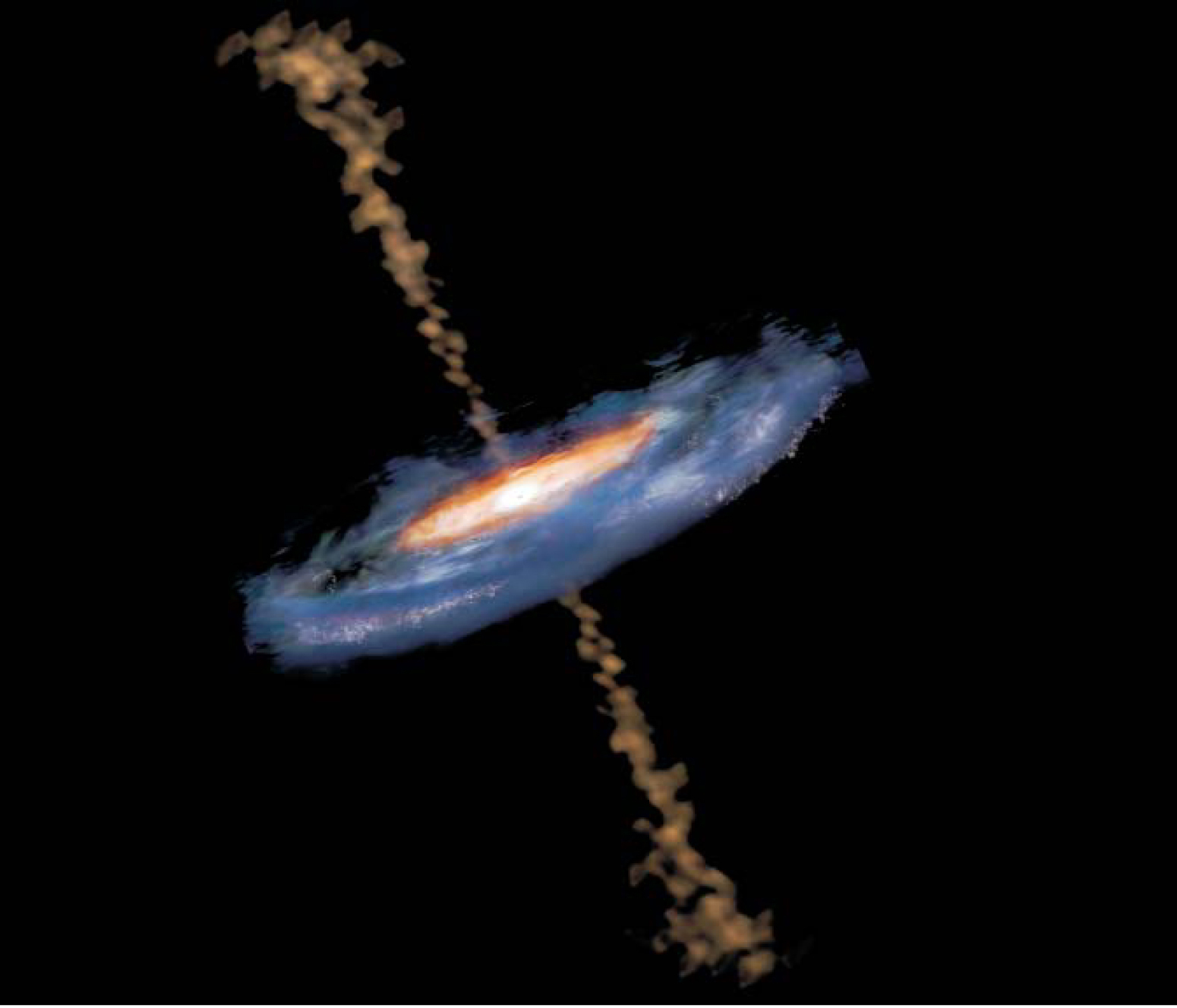
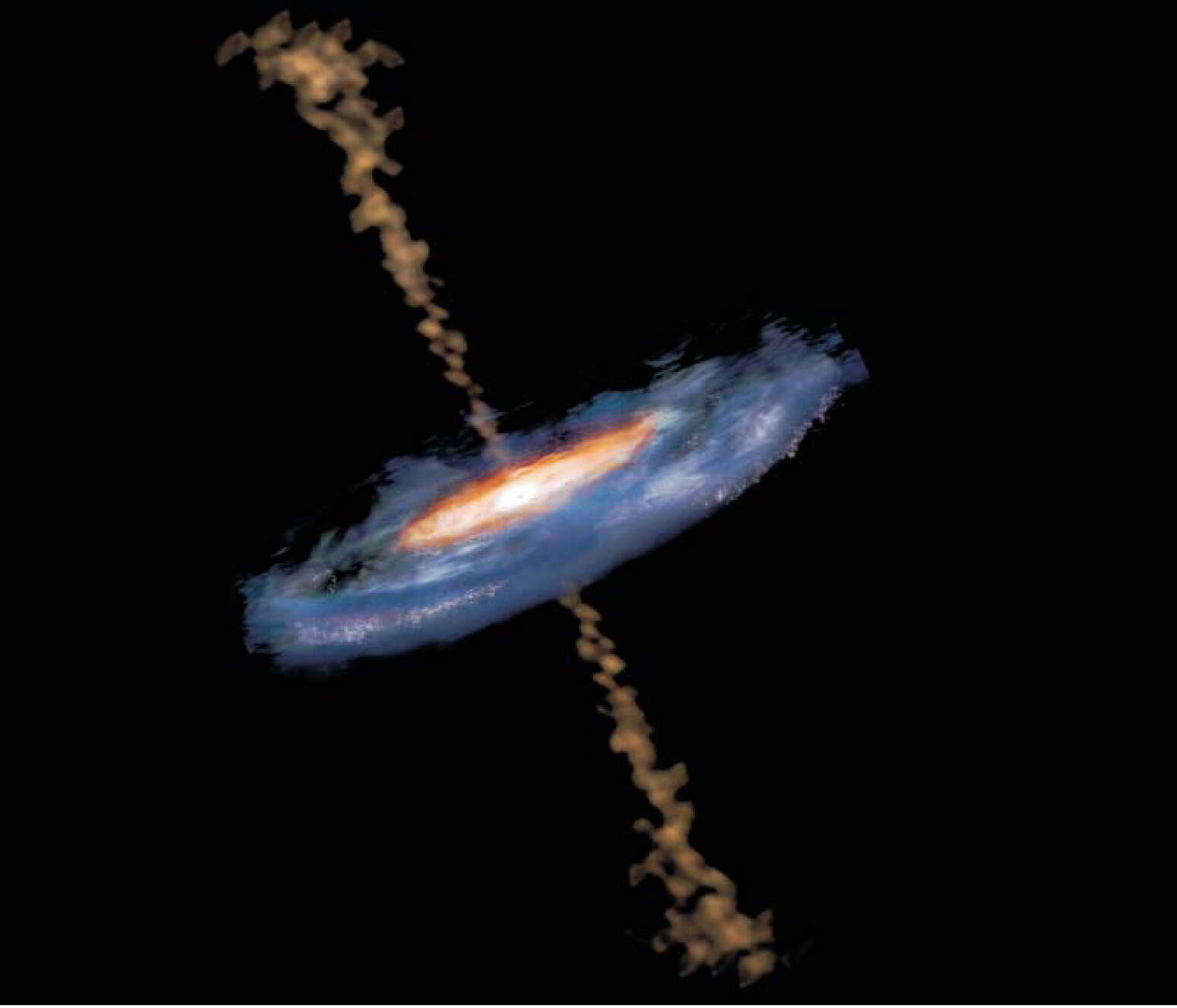
Accelerating particles to 1020 eV would seem to require massive bulk flows of relativistic charged particles. Such flows could originate from the extreme gravitational forces near the supermassive black holes at the cores of active galaxies, as illustrated in figure 3. Gamma-ray bursts, which are thought to originate in cataclysmic extragalactic events like the collapse of a massive star or a collision between stellar black holes, could also provide the requisite environment for acceleration to such ultrahigh energies. Predicting the flux of neutrinos that accompany extragalactic cosmic rays is less straightforward than in the galactic case. But the results point once again to a requisite detector volume on the order of a cubic kilometer. 4

Figure 3. An active galactic nucleus. The drawing shows the spinning disk of material accreting onto the supermassive black hole at the galaxy’s center and the resultant jets of radiation and relativistic material emerging along the disk’s axis. Shock waves propagating along the jets may be the sources of the highest-energy cosmic rays.
AURORE SIMONNET
Making neutrinos
When cosmic rays reach the top of the atmosphere, they collide with oxygen or nitrogen nuclei, producing showers of mesons, mostly pions and kaons, and some baryons. For example, π+ and K+ make neutrinos via the decay chain
From these decay modes, one would expect air showers to produce twice as many muon neutrinos as electron neutrinos. (Neutrino telescopes can’t differentiate between neutrinos and antineutrinos.) But neutrino flavor oscillation during transit through Earth reduces the flux of muon neutrinos at energies below 1011 eV. And the flux of high-energy electron neutrinos is reduced because high-energy muons typically lose much of their energy in transit before they decay. The reduced v e flux at high energies simplifies the search for extraterrestrial electron neutrinos.
Figure 2 shows how neutrino production in air showers (panel c) parallels that in terrestrial accelerators (panel a) and relativistic astrophysical jets (panel b). Protons and nuclei accelerated to high energy in such a jet emanating, say, from a supermassive black hole at the heart of an active galaxy interact with radiation or gas surrounding the black hole. Such interaction should produce roughly a 2:1 ratio of v μ/v e. Over cosmological distances, neutrino oscillation turns that output into a nearly equal mixture of all three neutrino flavors. Tau neutrinos, associated with the tau lepton, the much heavier cousin of the electron and muon, are particularly attractive for extraterrestrial searches because their production in even the most energetic cosmic-ray air showers is negligible. If it turns out that cosmic rays have a large nuclear component, then beta decays of unstable nuclei can produce a significant flux of electron neutrinos.
Looking down at the heavens
At Earth’s surface, cosmic-ray air showers produce a huge background of charged particles in particle detectors. Therefore, neutrino telescopes attempting to see beyond the atmosphere must go underground. Even then, they have to peer mostly downward, looking for neutrinos that have passed through the entire Earth, which serves as a filter that lets nothing else through. Looking upward from even the deepest mineshaft, one would have to contend with a non-negligible flux of muons from cosmic-ray showers.
Neutrino astronomers are looking for muons, but not for those. A TeV muon can penetrate a few kilometers through rock or water. So neutrino telescopes seek out upward-moving muons created in collisions between high-energy muon neutrinos (v μ) from below and material within the detector or its surroundings.
In the 1960s, searches for extraterrestrial neutrinos began in two deep mines: India’s Kolar Gold Field and South Africa’s East Rand mine. 4 With scintillation detectors a few meters on each side, both experiments detected a handful of upward-going muons from atmospheric neutrinos that originated on the other side of the Earth. By the late 1980s, scintillation detectors had evolved into the 72-m-long MACRO detector in the Gran Sasso underground laboratory. The detector recorded about 400 neutrinos over the course of a decade. Further progress would require a new technique.
In place of scintillation light, the new technique exploited Cherenkov radiation generated by charged particles. Cherenkov light is radiated by a charged particle moving faster than the speed of light in the medium it’s traversing. The emission is akin to a ship’s bow wave. In ice, the requisite velocity is about 75% of the speed of light in a vacuum. Photomultiplier tubes detect the blue and near-UV Cherenkov light. With enough phototubes, one can reconstruct tracks emerging from the collisions of neutrinos with energies as low as a few MeV.
In the 1980s two early water-Cherenkov experiments were built. The Irvine-Michigan-Brookhaven detector in an Ohio salt mine and the Kamiokande detector in a Japanese zinc mine were tanks containing thousands of tons of purified water, monitored with phototubes. The two detectors launched the field of neutrino astronomy by detecting some 20 low-energy (about 10 MeV) neutrinos from Supernova 1987A—the first supernova since the 17th century that was visible to the naked eye.
Those exciting observations stimulated the development of two second-generation detectors. Super-Kamiokande was a copy of its progenitor, scaled up 50 kilotons. And the Sudbury Neutrino Observatory, deep inside an Ontario nickel mine, has a kiloton of heavy water at its heart. By observing flavor metamorphoses of atmospheric 5 and solar 6 neutrinos, the two facilities demonstrated that neutrinos have nonvanishing masses (see Physics Today, August 2001, page 13 ). They also showed that GeV atmospheric neutrinos would constitute a major background to extraterrestrial searches. Future experiments would require larger active volumes, and they would have to go after neutrinos at higher energies, where there’s less background.
In the 1980s the DUMAND collaboration, based at the University of Hawaii, was the first group to pursue a substantial deep-ocean detector. 7 At the DUMAND site, 40 km off the coast of the island of Hawaii, buoyant strings of phototubes were to be anchored to the seabed and connected to the shore by a long underwater cable. The challenges were formidable for 1980s technology: high pressures, corrosive salt water, and large backgrounds from bioluminescence and radioactive decay of potassium-40. DUMAND was unfortunately canceled after a pressure vessel leaked during the very first deployment, but the undertaking did pioneer many of the techniques used today.
In 1993, a Russian–German collaboration began building a detector in the very deep Lake Baikal. The group observed the atmospheric neutrino flux with a detector consisting of 192 phototubes on eight strings. The ice that covers the lake for several months every winter actually provides a convenient platform for detector construction and repair.
At the South Pole
In the late 1980s, the AMANDA collaboration, of which one of us (FH) was a member, began exploring Antarctic ice as an alternative detection medium. The absence of bioluminescence and 40K greatly simplified the electronics. Moreover, the solid surface simplified construction. One drills holes in the ice with hot water and lowers strings of phototubes into them before they refreeze. With its 3-km-thick icecap and attractive logistical capabilities, the Amundsen–Scott South Pole Station is an ideal base for supporting such efforts. Of course the Antarctic environment can be daunting. The austral-summer construction season is short, and every piece of equipment must be transported in ski-equipped LC-130 turboprop aircraft. In the winter, a skeleton staff of hardy souls keeps the detector running.
Overcoming such difficulties, the collaboration deployed 80 photomultipliers into a kilometer-deep hole on Christmas Eve 1993. (Santa Claus keeps New Zealand time down there.) Although most of the sensors survived the unexpectedly high pressures produced as the water in the hole froze, the first array could not reconstruct particle tracks. The problem was the ice, which trapped 50-micron air bubbles. In the bubbly ice, light had a scattering length of less than 50 cm.
Happily, the problem came with a solution. Measurements of the bubble density led to predictions that near a depth of 1400 meters the bubbles would eventually collapse. That turned out to be correct. And unexpectedly, blue light was measured to have an incredibly long absorption length of more than 200 meters in the extremely pure ice. This fortuitous discovery ultimately made the IceCube project feasible. With the optical properties of the deep ice understood, AMANDA deployed four strings of detectors at depths between 1500 m and 2000 m in the austral summer of 1995–96 (see Physics Today, March 1999, page 19 ).
The next challenge was to separate a single upward-going muon from a million downward-going background muons from cosmic-ray air showers. Robust tools were developed for that job (see
However, AMANDA’s limitations were becoming obvious. It was too small, and it required manpower-intensive annual calibrations. Furthermore, analog transmission of phototube signals to the surface limited their time and amplitude resolution. Those problems effectively precluded simply scaling AMANDA up in size.
A cubic kilometer
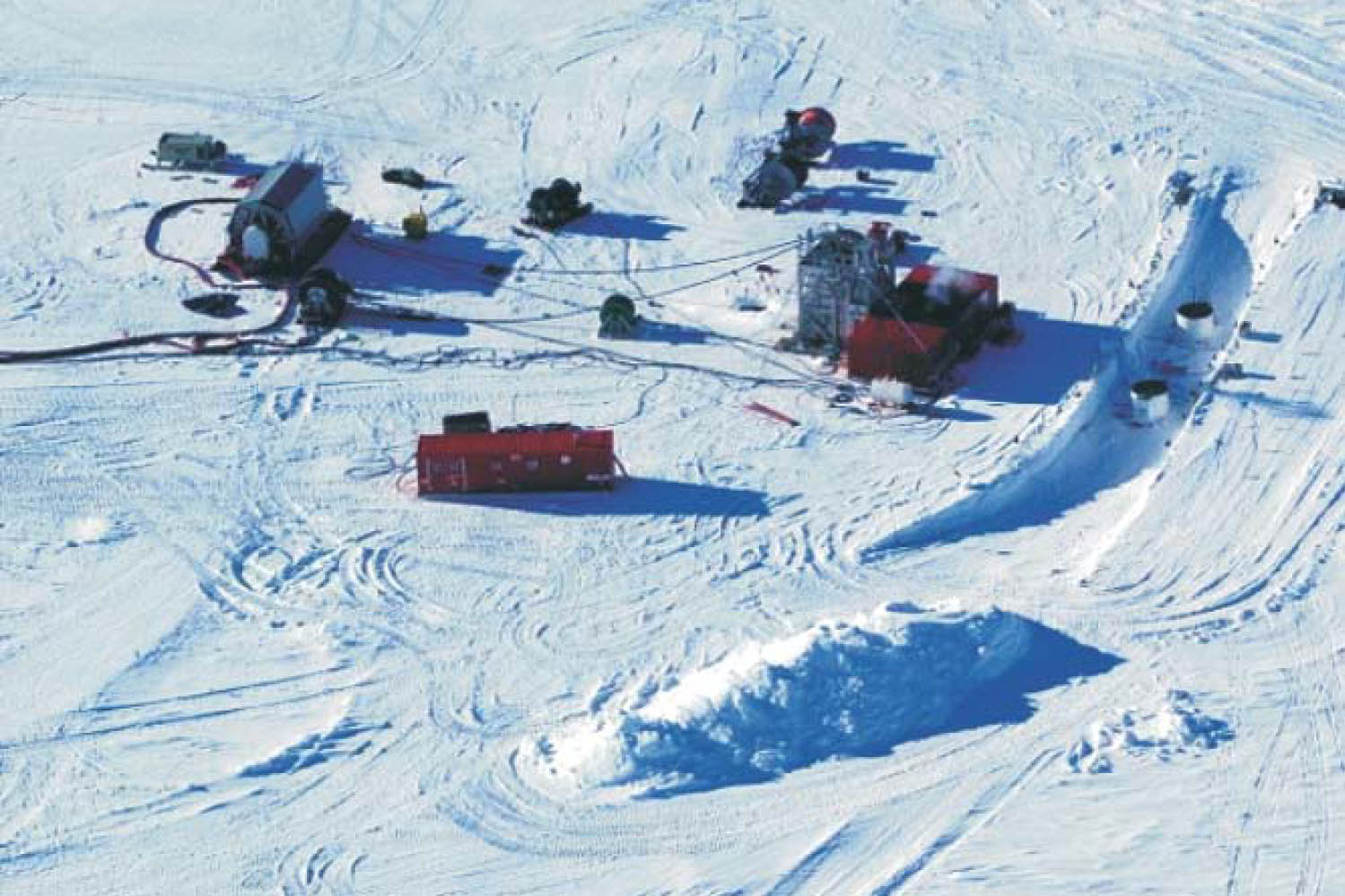
The IceCube neutrino observatory, shown under construction in figure 4, is designed to avoid all those problems. 9 When it’s complete in 2011, it will instrument 1 km3 of ice with 4800 digital optical modules on 80 vertical strings. The facility was designed for simple deployment, calibration, and operation. Photomultiplier signals are recorded using fast waveform digitizers attached to every phototube. Each module acts autonomously, receiving power, control, and calibration signals from the surface and returning digital data packets. The first string was deployed in January 2005. Today IceCube is half complete.

Figure 4. Construction of the IceCube neutrino telescope at the Amundsen–Scott South Pole Station.
FOREST BANKS, NSF

The facility includes a surface array, IceTop, which serves to veto cosmic-ray air showers as candidates for extraterrestrial neutrinos. It also tags individual air-shower muons so they can be used to calibrate the detector. And air-shower muons will be exploited to study the spectrum and nuclear composition of cosmic rays in the 1015−1018 eV energy range not well covered by other facilities.
IceCube is a discovery instrument with multiple search strategies. It will look for steady point sources of muon neutrinos in the northern sky—for example, active galactic nuclei or supernova remnants. Other searches will target transient point sources such as gamma-ray bursts or supernovae in progress. An additional search strategy is to look for an extraterrestrial neutrino flux coming from the entire sky or from a large part of it—for example, the Milky Way. The searches for such extensive sources will look not just for muon neutrinos, but also for the other two neutrino flavors (see
Reconstructing neutrino events
Neutrinos can instigate both charged-current (CC) and neutral-current (NC) collisions. NC interactions are mediated by the exchange of the neutral, weakly interacting Z0 boson. The neutrino transfers energy to the nucleus with which it collides, but it remains a neutrino. The energy imparted to the nucleus produces a shower of hadrons in the surrounding material. NC interactions look the same for all three neutrino flavors.
In CC interactions, the neutrino exchanges a charged W± boson with the nuclear target and emerges from the collision as the charged lepton prescribed by the neutrino’s flavor. Because the electron, the muon, and the tau lepton behave differently, they have distinctive signatures in a detector.
The figure shows simulated CC events in the IceCube neutrino telescope for the three neutrino flavors. In each case the instigating neutrino has an energy of 1016 eV. The charged lepton emerges roughly in the incident neutrino’s direction, typically with about 80% of its energy.
Each of IceCube’s 80 strings of 60 digital phototube modules extends downward from 1.4 km to 2.4 km below the surface. Despite the name, the detector’s horizontal cross section is not a square but a 1-km-wide regular hexagon. Adjacent strings are 125 m apart and the vertical spacing between modules on a string is 17 m. Each colored circle shows one activated module. The circle’s size indicates the number of detected Cherenkov photons, and its color represents their arrival time, from earliest (red) to latest (blue).
Panel (a) shows the reaction v μ N → μ− X, where N is the struck nucleus and X is the resulting hadron shower. The collision was several kilometers off to the right of the detector. But muons lose energy slowly, so they produce long tracks. A 1015-eV muon travels about 20 km in ice. The modules record Cherenkov light from the muon’s trajectory through IceCube. These long tracks offer angular resolution of 1° or better. The white core along the muon’s trajectory shows the variability in its local energy deposition.
In (b), v e N → e− X. The collision takes place within IceCube, and the resulting high-energy electron loses all its energy in an electromagnetic shower that extends only a few meters from the collision point. That shower mingles with the equally short hadron shower to create an almost spherical region of Cherenkov light with limited directional information. And it can’t be distinguished from an NC collision of any flavor. The overall light output does measure the total shower energy. But one can’t tell whether that’s 100% of the incident energy in a charged-current v e collision or 20% of the incident energy in a more energetic NC collision.
In (c), v τ N → τ− X. At energies above about 1015 eV, this CC reaction yields a double-bang signature. The tau’s lifetime is only 3 × 10⁻¹³ s. But the Lorentz boost lets it travel hundreds of meters before decaying and generating a distinct second shower.
The properties of the colliding neutrino are reconstructed by fitting the observed spatial and temporal light pattern to these scenarios. The fits must correct for the scattering and absorption of the light in the ice, whose optical properties depend on depth. The biggest observational challenge is to distinguish true v μ events from the enormous background of cosmic-ray muons.

In the Mediterranean
IceCube will have limited sensitivity to neutrinos from sources in the southern sky because any real signal from above has to be separated from the large flux of muons in cosmic-ray air showers. That’s a strong argument for deploying neutrino telescopes in the Northern Hemisphere. Extensive research and development by the NESTOR, ANTARES, and NEMO collaborations in the Mediterranean Sea make for optimism that neutrino telescopes can function in deep seawater. 10 The groups have demonstrated their capability to deploy, operate, and retrieve optical sensors. The Greek–German NESTOR collaboration has reconstructed downward-going cosmic-ray muons with a prototype system off the southwestern coast of Greece. The collaboration expects to augment the system in the near future.
Construction of the multinational ANTARES telescope, whose total volume is similar to AMANDA’s, is almost complete. Most of its 900 photomultiplier tubes are deployed and taking data. It has already recorded its first neutrinos. ANTARES sits in 2400-m-deep water off Toulon. Each string of 75 buoyant phototubes is anchored to the sea floor and connected to shore by a common cable. ANTARES will open the southern sky, and hence the center of our own galaxy, to neutrino astronomy.
The European Union has funded a design study for a kilometer-scale detector, dubbed KM3NeT, for the Mediterranean. Construction of KM3NeT is envisaged to start early in the next decade.
Tradeoffs and alternatives
For the highest-energy neutrinos, even a cubic kilometer may not be big enough. The predicted rate for GZK neutrinos is only about one event per cubic kilometer per year. To study such ultrahigh-energy neutrinos, one would want a 100-km3 detector. The larger the active detector volume for a fixed number of phototubes, however, the higher is the energy threshold below which one cannot detect a neutrino. That’s because the detection range of a phototube is limited by the medium’s transparency. And more phototubes means greater cost. So observers are faced with a tradeoff. Therefore, two new techniques have been proposed for detecting neutrinos with energies above 1017 eV: listening for acoustic or radio pulses. 11
Radio pulses are generated by charged particles produced in a neutrino collision. In 1962 Gurgen Askaryan pointed out that electromagnetic showers produced by electron neutrinos contain about 20% more electrons than positrons. The electron excess would cause coherent emission at frequencies from about 20 MHz to several GHz. Because the coherent signal scales as the square of the neutrino energy, that technique is most useful at neutrino energies above 1017 eV. Experiments at SLAC that measured the radio signals from electromagnetic showers in ice, sand, and salt have confirmed the angular, frequency, and power distributions predicted by numerical calculations.
In cold ice the radio-wave attenuation length is on the order of a kilometer—ten times longer than the optical attenuation length. That probably makes 100-km3 detectors feasible. A diverse suite of experiments has already begun searching for GZK neutrinos with radio-pulse detectors. The RICE collaboration, based at the University of Kansas, has installed dipole antennas in AMANDA holes. And there’s a proposal to extend the IceCube array outward by deploying on the surface radio detectors of the kind used in the ANITA balloon experiment. In a 35-day flight over Antarctica, the ANITA collaboration’s balloon, equipped with 32 horn antennas, scanned a million cubic kilometers of ice for Askaryan radio pulses from GZK neutrinos. Other radio experiments have been looking for signals from ultrahigh-energy neutrino collisions in the Greenland ice pack, and even on the Moon.
Acoustic detectors are sensitive to the sudden local expansion that occurs when a high-energy neutrino interaction deposits energy in water or ice. IceCube scientists are pursuing acoustic neutrino detection at the South Pole. The end result could well be a hybrid radio-acoustic-optical detector array. Acoustic detectors have also been considered for salt domes, Siberian permafrost, and the Dead Sea.
The ARIANNA collaboration, based at the University of California, Irvine, has a new approach. The group proposes to array downward-facing radio detectors just below the surface of the 650-m-thick Ross Ice Shelf off the Antarctic coast. The water–ice interface below the floating shelf is a near-perfect reflector for radio waves generated by collisions of downward-going GZK neutrinos in the ice. Such reflection should greatly increase ARIANNA’s sensitivity.
Although no experiment has as yet observed a signal of GZK neutrinos, the null results are beginning to constrain astrophysical models, and they have stimulated work on larger detectors. A neutrino experiment observing several GZK neutrinos per year would complement data from large cosmic-ray facilities such as the Pierre Auger Observatory (see Physics Today, January 2008, page 16 ). Neutrinos, unaffected by magnetic fields, point back to their sources. And unlike protons, they can travel cosmological distances without falling below the GZK pion-production threshold energy. One expects GZK neutrinos to be produced within a few hundred million light-years of the sources of the ultrahigh-energy cosmic rays that spawn them. Because most such sources are much further away from us than that, the arrival directions of the GZK neutrinos should help identify those sources.
Nuclear and particle physics
In the past two decades, water-Cherenkov neutrino detectors have elucidated the flavor oscillation of neutrinos, and they have confirmed astrophysicists’ presumptions about the nuclear energetics of stars and supernovae. The next generation of high-energy neutrino telescopes will also target multidisciplinary science. As the lightest of the fermions and the most weakly interacting of all known particles, neutrinos occupy an interesting corner of the standard model. One may hope that they will reveal the first and most dramatic signatures of new physics.
Over a decade IceCube will collect almost a million atmospheric-neutrino events, ranging in energy from 1011 to 1016 eV. That’s a hundred times AMANDA’s sample. 12 And from distant sources, the collaboration expects to see neutrinos with energies as high as 1018 eV. The data should address physics topics ranging from the relatively straightforward to the positively exotic.
Even in the absence of new physics, just measuring the predicted neutrino cross section at 1018 eV would be a powerful confirmation of the standard model. That measurement will also provide a high-magnification picture of the proton, resolving constituents (partons) carrying as little as 10−8 of the proton’s momentum. On the more exotic side, very high-energy, short-wavelength neutrinos might interact with the spacetime foam predicted by theories of quantum gravity. They would propagate like light traversing a crystal lattice and be delayed, with the delay depending on the neutrino’s energy. That would appear to the observer as a violation of Lorenz invariance.
In the end the possibilities are limited only by our imagination. Neutrino telescopes will search for signatures of the possible unification of all particle interactions (including gravity) at the TeV scale, as suggested by some theories with extra spatial dimensions. If WIMPs (weakly interacting massive particles) make up the dark matter in the universe, they must be gravitationally captured in the Sun and Earth, where they are expected to produce high-energy neutrinos by annihilating each other. So neutrino telescopes might well identify the particle nature of the dark matter.
The new-generation neutrino telescopes are the first instruments big enough to map out the neutrino sky and thereby observe the high-energy cosmos, unblinded by interstellar radiation or dust. We don’t know what we will find, but experience tells us that with a new window we can expect new discoveries.
We thank our IceCube collaborators, and we thank John Learned, Bob Stokstad, Sandy Miarecki, and Evelyn Malkus for comments on the draft of this article. Our thanks also to Juan Carlos Diaz-Velez for the simulated event displays in
References
1. F. Reines, C. L. Cowan Jr, Nature 178, 446 (1956).https://doi.org/NATUAS
10.1038/178446a0 2. F. Halzen, D. Hooper, Rep. Prog. Phys. 65, 1025 (2002).https://doi.org/RPPHAG
10.1088/0034-4885/65/7/201 3. J. Abraham et al., Science 318, 938 (2007).https://doi.org/SCIEAS
10.1126/science.1151124 4. J. G. Learned, K. Mannheim, Annu. Rev. Nucl. Part. Sci. 50, 679 (2000).https://doi.org/10.1146/annurev.nucl.50.1.679
5. T. Kajita, Y. Totsuka, Rev. Mod. Phys. 73, 85 (2001).https://doi.org/RMPHAT
10.1103/RevModPhys.73.85 6. A. W. P. Poon, Int. J. Mod. Phys. A 21, 1855 (2006).https://doi.org/IMPAEF
10.1142/S0217751X06032812 7. A. Roberts, Rev. Mod. Phys. 64, 259 (1992).https://doi.org/RMPHAT
10.1103/RevModPhys.64.259 8. E. Andres et al., Nature 410, 441 (2001).https://doi.org/NATUAS
10.1038/35068509 9. IceCube collaboration, “IceCube Preliminary Design Document” (2001), http://www.icecube.wisc.edu/science/publications/pdd/pdd.pdf .
10. U. F. Katz,Prog. Part. Nucl. Phys. 57, 273 (2006), also available at http://arxiv.org/abs/astro-ph/0601012 .https://doi.org/PPNPDB
11. Proc. ARENA 2006 Workshop, L. Thompson, ed., J. Phys.: Conf. Ser. 81 (2007).
12. F. Halzen, Eur. Phys. J. C 46, 669 (2006).https://doi.org/EPCFFB
10.1140/epjc/s2006-02536-4
More about the authors
Francis Halzen is a Hilldale Professor in the physics department at the University of Wisconsin–Madison. Spencer Klein is a senior scientist at Lawrence Berkeley National Laboratory in California. Both are members of the IceCube neutrino-telescope collaboration.
Francis Halzen, 1 University of Wisconsin-Madison, US .
Spencer R. Klein, 2 Lawrence Berkeley National Laboratory in California, US .