A perfect proposal
DOI: 10.1063/PT.3.3053


Serious scientists rarely use the word “perfect,” so we leave it to you to decide whether that is indeed an appropriate adjective for the proposal from Edward Purcell to the American Academy of Arts and Sciences in January 1950. Personally, we believe that the proposal—for an experiment to detect the microwave signature of interstellar hydrogen—comes as close to perfect as one could hope.
Purcell, who was on the physics faculty at Harvard University, addressed the proposal to Harlow Shapley, a distinguished astronomer and former president of the academy. A copy of the original in its entirety is reproduced on pages 50–51. In a handful of short paragraphs Purcell describes


‣ the goal: to detect interstellar atomic hydrogen by searching for a microwave signal at its 21-cm line, the spectral wavelength of the atom’s ground-state hyperfine transition.
‣ the significance: multifold, yet conveyed in only a few lines of text because Shapley was an astronomer fully aware of the importance of such a discovery.
‣ the method: adapting established radio astronomy techniques to observe a sharp spectral line. Purcell succinctly explains everything from the origin of the radiation to the experimental technique.
‣ the state of the field: other groups with the same goal could well make the discovery first.
‣ the need: a detailed list of required equipment, totaling $500.
The proposal was accepted on 28 February 1950. Purcell and his graduate student Harold “Doc” Ewen observed a signal at the hydrogen-line frequency on 25 March 1951. They submitted a letter to Nature, but Purcell asked the editor to delay publication to allow time for his colleagues Jan Oort (Netherlands) and Joseph Pawsey (Australia) to confirm and extend the discovery. Purcell freely shared the details of the new technique of phase-sensitive detection, whereupon Oort’s group quickly observed the line. The three groups published side-by-side letters in Nature on 1 September 1951. The discovery marked the origin of hydrogen-line radio astronomy, a field that has grown into a major branch of astronomy.

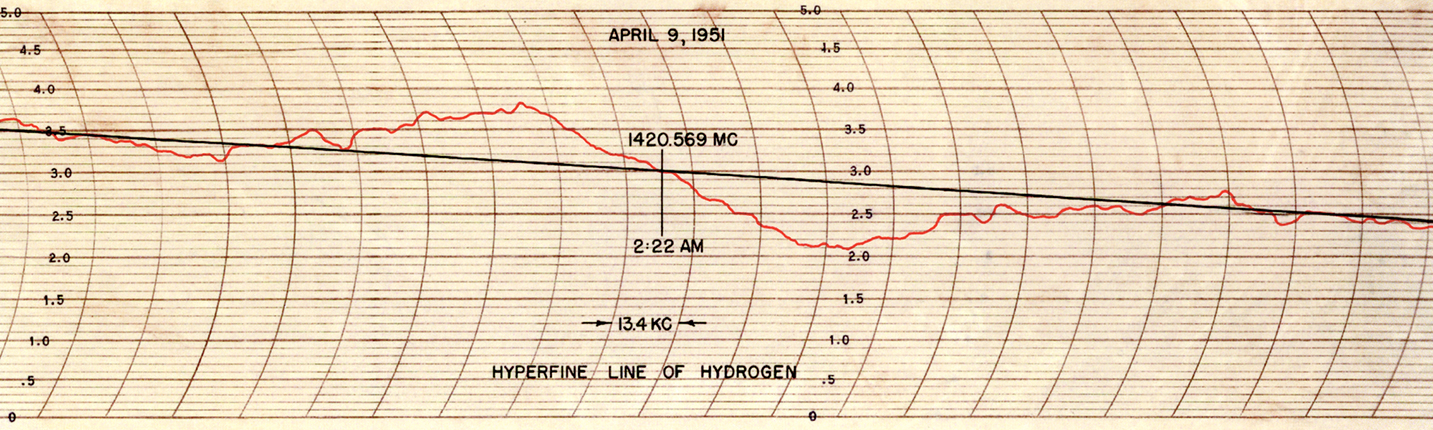
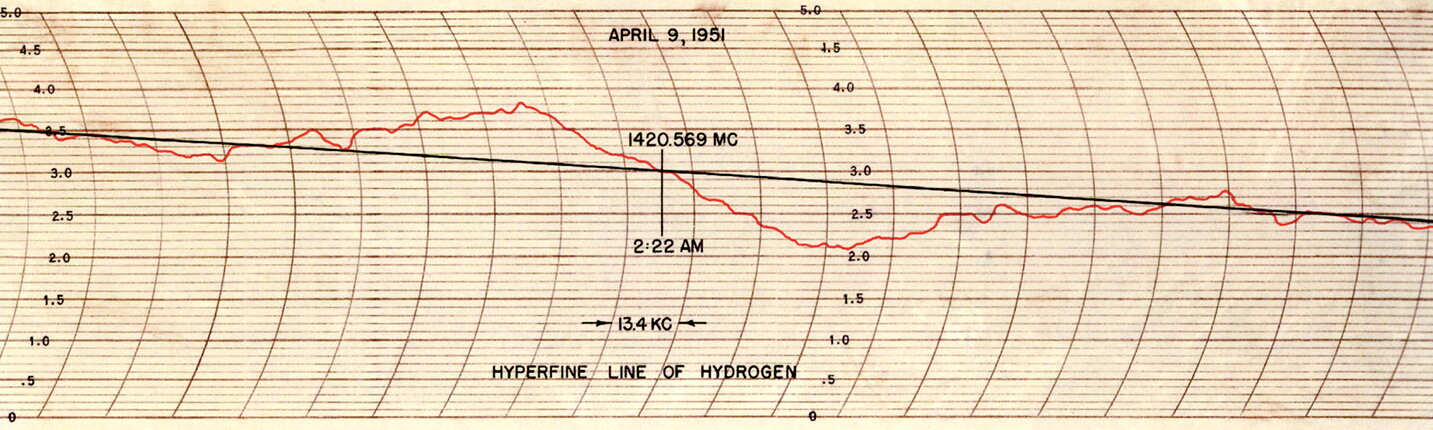
The galactic hydrogen emission signal at 1420 MHz (21 cm), as traced in red on an electromechanical chart recorder less than three weeks after its discovery. The modulation technique causes the trace to have a positive and then a negative peak. The sloping black line approximates the receiver’s drift over the 20-minute observation. (Reproduced from H. I. Ewen, “Radiation from galactic hydrogen at 1420 megacycles per second,” PhD thesis, Harvard U., 1951, fig. 18.)
We regard the proposal as perfect because of its lofty goal, its clarity of vision, its transparency, its honesty, and its respect for other citizens of the scientific community. Anyone lucky enough to have known Purcell will recognize his voice and will delight in the grace and simplicity of his style.
Box. Radio astronomy circa 1951
Harold “Doc” Ewen provides scale for the microwave horn antenna, which was made from copper-clad plywood and set on the fourth-floor parapet of Harvard University’s Lyman Laboratory. Ewen added the canvas cover after the horn funneled a rainstorm into the lab (which Ewen remarked was his first “signal from space”). He and Edward Purcell used the horn to detect the 21-cm spectral line of interstellar atomic hydrogen.

CRUFT LABORATORY, HARVARD UNIVERSITY
On the other side of the plywood-covered window, signals carried in from the horn by the waveguide at left were mixed with the output of a war-surplus local oscillator and detected with an amateur communications receiver. The frequency was swept slowly by a gear motor and simultaneously modulated at 30 Hz to enable synchronous, “lock-in” detection.

CRUFT LABORATORY, HARVARD UNIVERSITY
References
1. E. Purcell, oral history interview, session 1, http://www.aip.org/history-programs/niels-bohr-library/oral-histories/4835-1 .
2. H. Ewen, oral history interview, http://www.aip.org/history-programs/niels-bohr-library/oral-histories/6659 .
3. W. T. Sullivan III, Cosmic Noise: A History of Early Radio Astronomy, Cambridge U. Press (2009).
More about the authors
Daniel Kleppner is the Lester Wolfe Professor of Physics Emeritus at the MIT–Harvard Center for Ultracold Atoms in Cambridge, Massachusetts. Paul Horowitz is a professor of physics and of electrical engineering, emeritus, at Harvard University in Cambridge, Massachusetts.