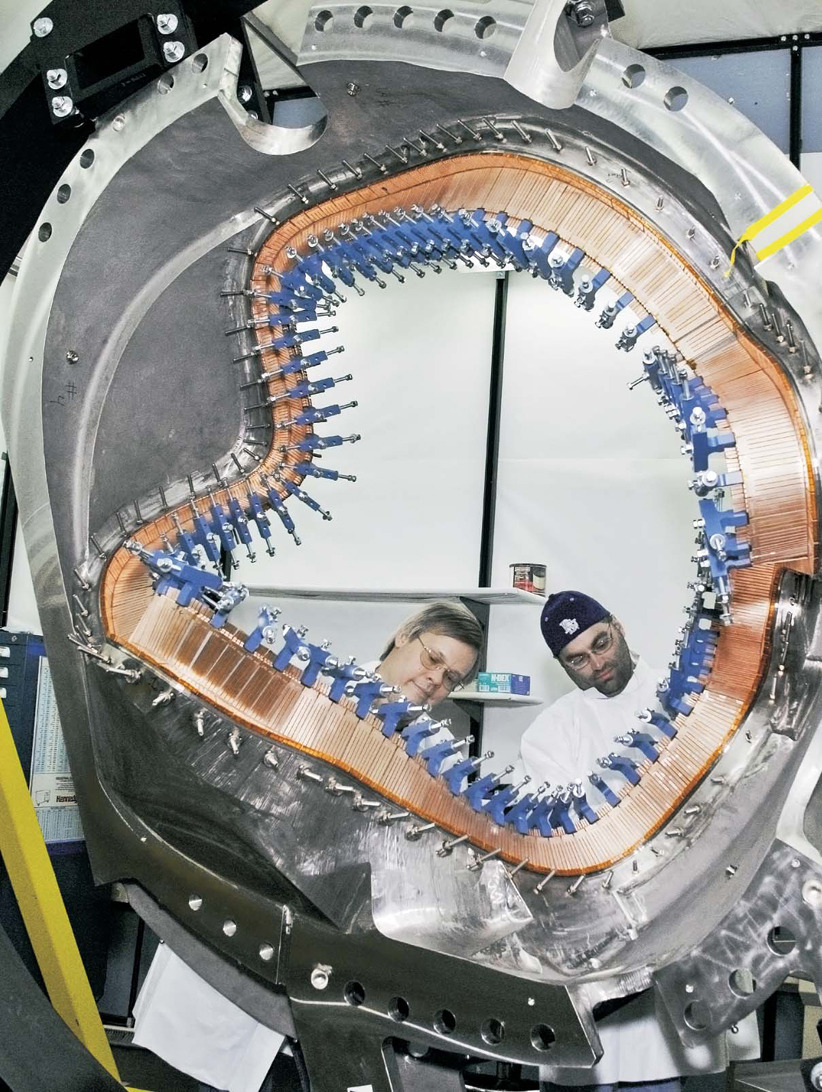
Stellarator coils
DOI: 10.1063/1.2812104
For magnetic fusion energy, researchers must find the best shape for the hot reacting plasma and the magnetic fields that hold it in place. Dramatic advances in magnetic-confinement physics and computation capabilities have yielded a promising new configuration: the compact stellarator. (For more about stellarators and the simulation of fusion plasmas, see the article by Don Batchelor in Physics Today, February 2005, page 35 .) A new experimental facility, the National Compact Stellarator Experiment (NCSX), is being built at the US Department of Energy’s Princeton Plasma Physics Laboratory, in partnership with Oak Ridge National Laboratory, to determine the compact stellarator’s potential as a fusion power reactor.
At the heart of the NCSX’s twisting, helical field are 18 modular coils, which are among the most complex electromagnets ever designed. Three different shapes of coils, the largest of which is 280 cm in diameter, are arranged in six sets. To achieve the desired confinement and stability, the coil forms have to be fabricated and wound to exacting tolerances—within half a millimeter. This photograph of one of the coils shows the stainless steel form wound with rectangular packs of about 60 m of flexible copper cable held in place with temporary clamps. (Image courtesy of Princeton Plasma Physics Laboratory.)
To submit candidate images for Back Scatter, visit