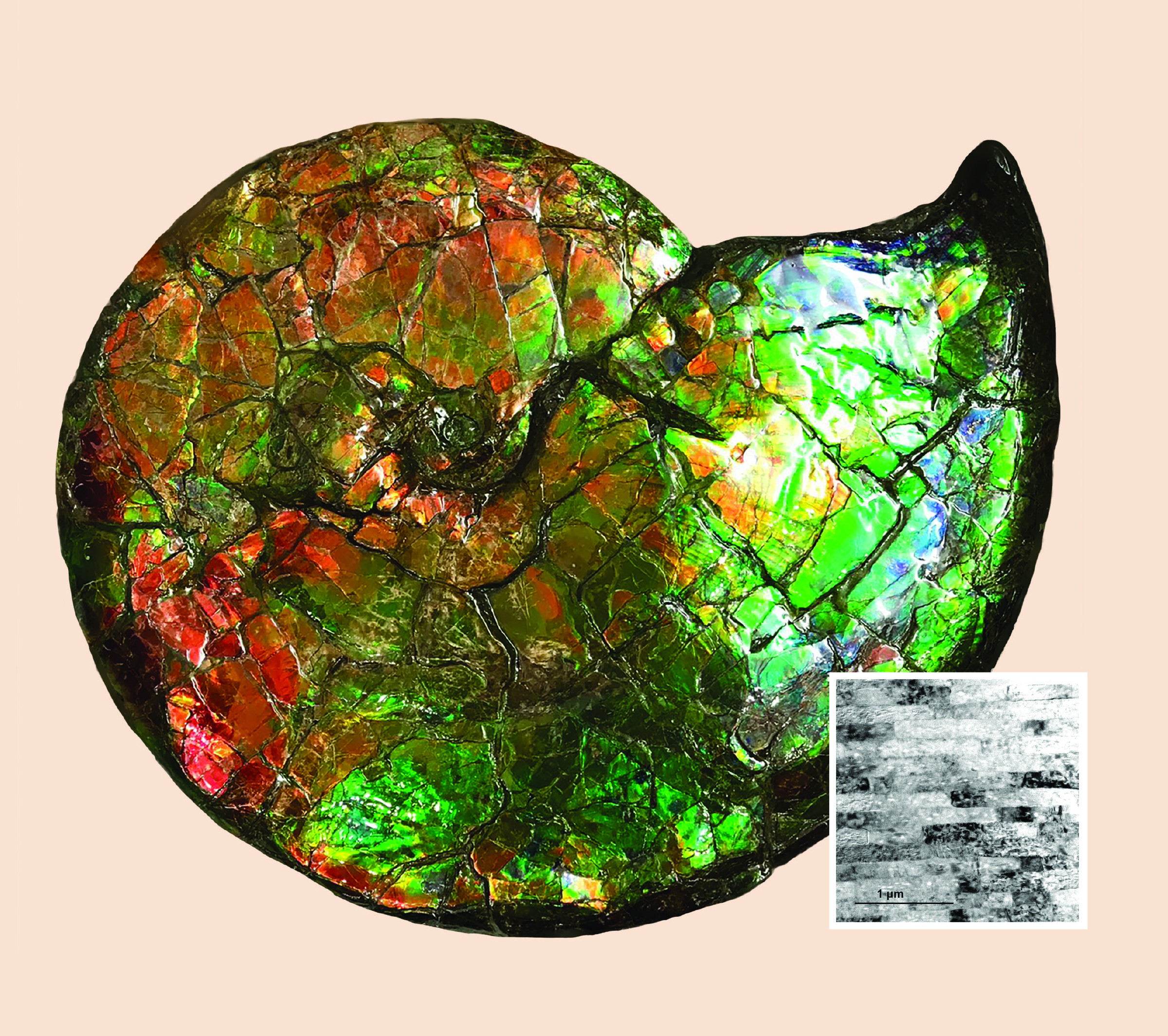
A marine shell’s brilliant colors


(Images courtesy of Hiroaki Imai.)

During the time of the dinosaurs, shelled squid-like organisms called ammonites lived in the oceans. Some fossilized ammonite shells—such as the one shown here that was mined in Alberta, Canada—have blue, green, and red colors that shimmer and vary in hue as the viewing angle changes. The iridescence arises because of interference between waves of visible light that have reflected off the top and the bottom of the shell surface. Even though ammonite fossils are found in abundance worldwide, few of them have the same brilliant colors as ones uncovered in Canada.
Using a transmission electron microscope, Hiroaki Imai of Keio University in Japan and colleagues found that the Canadian ammonite fossils have individual shell layers—a representative sample is shown in the inset—that are separated by air gaps of several nanometers. Incoming light rays are reflected at the gaps, and then interference leads to the distinct colors. The researchers found that the structures of the colorful shells are more consistent than those of other ammonite shells, which tend to have wider air gaps and more variable layer thicknesses.
The researchers then applied their findings to abalone shells from extant sea snails. After removing organic material and applying pressure to shrink the gaps between shell layers, the researchers found that the snail shells exhibited similarly brilliant iridescence. Imai and colleagues hypothesize that the color brilliance of the Canadian fossils results from either environmental factors that affect shell growth or the pressure at which the shells are fossilized.
Reference
1. N. Hizukuri et al., “Brilliant structural colors originating from reflection by nanogaps of nacreous layers in fossilized ammonite shells ,” Sci. Rep. 15, 37541 (2025).