Art and science of the snowflake
Cloud Crystals: A Snowflake Album, an illustrated volume of prose and poetry published in 1864, was the first widely circulated US work on the crystallography of the snowflake. One of the few things known about the author, Frances Chickering, is that she lived in Maine.
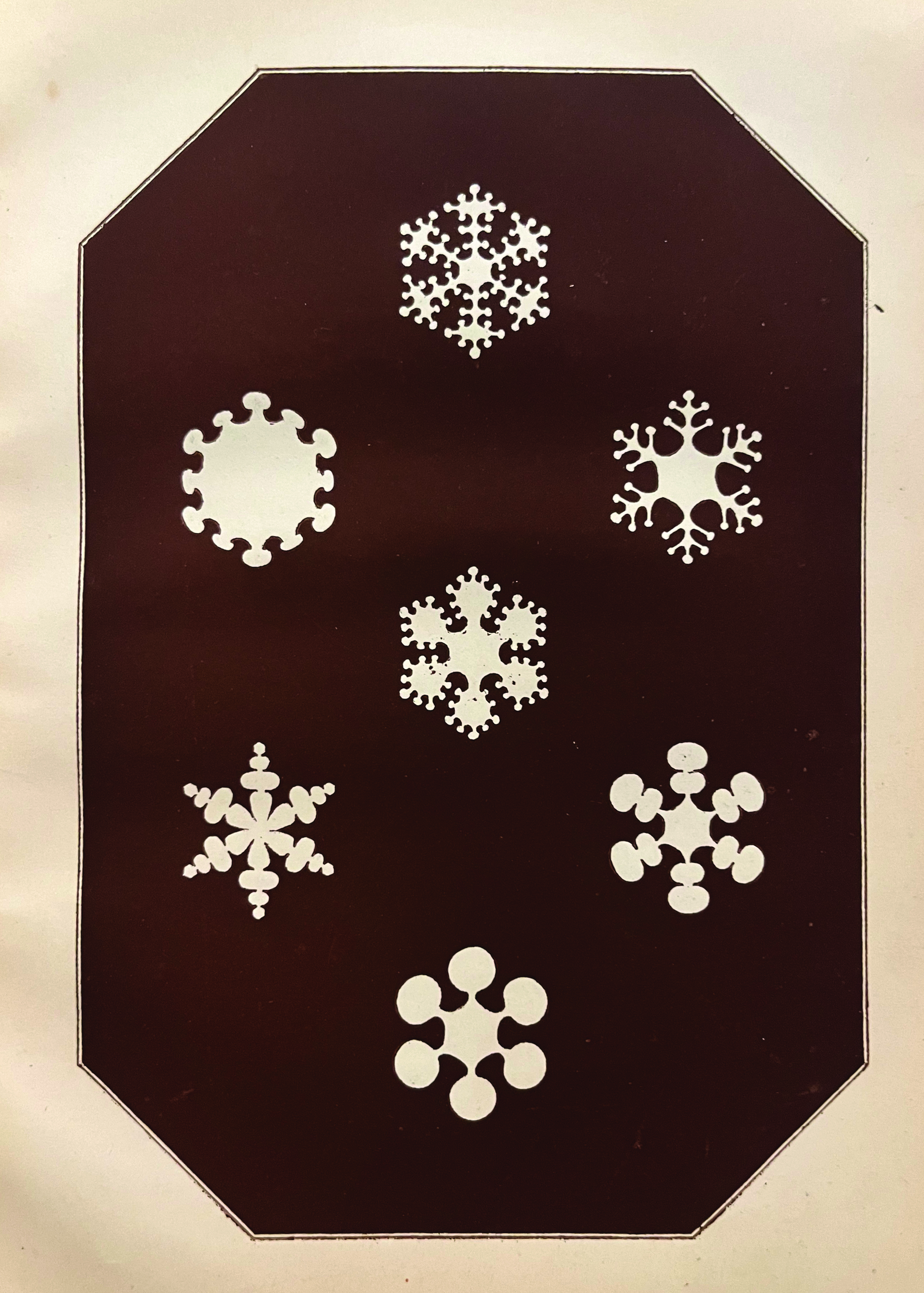
“The present collection originated in the accidental observation of the beauty of a snow crystal upon a dark window sill,” she writes. “It was copied, and the interest thus awakened grew, as successive winters sent their white-winged, aerial messengers, within the reach of human notice and admiration, till about two hundred forms were carefully observed and cut in paper.”


Chickering used dark fur or cloth to catch the snowflakes and a strong magnifying glass to see them, and then she quickly cut them out of paper from memory—several of them are shown here. She shared the work with Louis Agassiz, a Swiss-born natural scientist at Harvard University, who advised her to measure the air temperature and other environmental conditions as she examined the snowflakes. Chickering notes that a cold, still atmosphere is necessary for snowflake formation—any slight change in the temperature or humidity alters the shape of the crystals. Snowflakes that fall on warmer, humid days, she observes, have more rounded angles than snowflakes that fall on cooler, dry days. Her friends and Agassiz urged her to publish her observations, which eventually became this volume. A copy is held at the Niels Bohr Library & Archives of the American Institute of Physics (publisher of Physics Today) in College Park, Maryland.