GLAD nanospirals
DOI: 10.1063/1.2761820
Micro- and nanolithography often make use of masks, usually made from a polymer sensitive to and patterned by light or electron beams. The mask serves as the template for material being deposited (or for material being etched away). But if material is deposited at a sufficiently oblique angle (greater than 80° to the substrate surface), the evolving film can serve as its own mask: Atoms already deposited will cast shadows on the areas behind them and prevent film growth in those areas. Instead, incident atoms will join the structures already nucleated on the substrate.
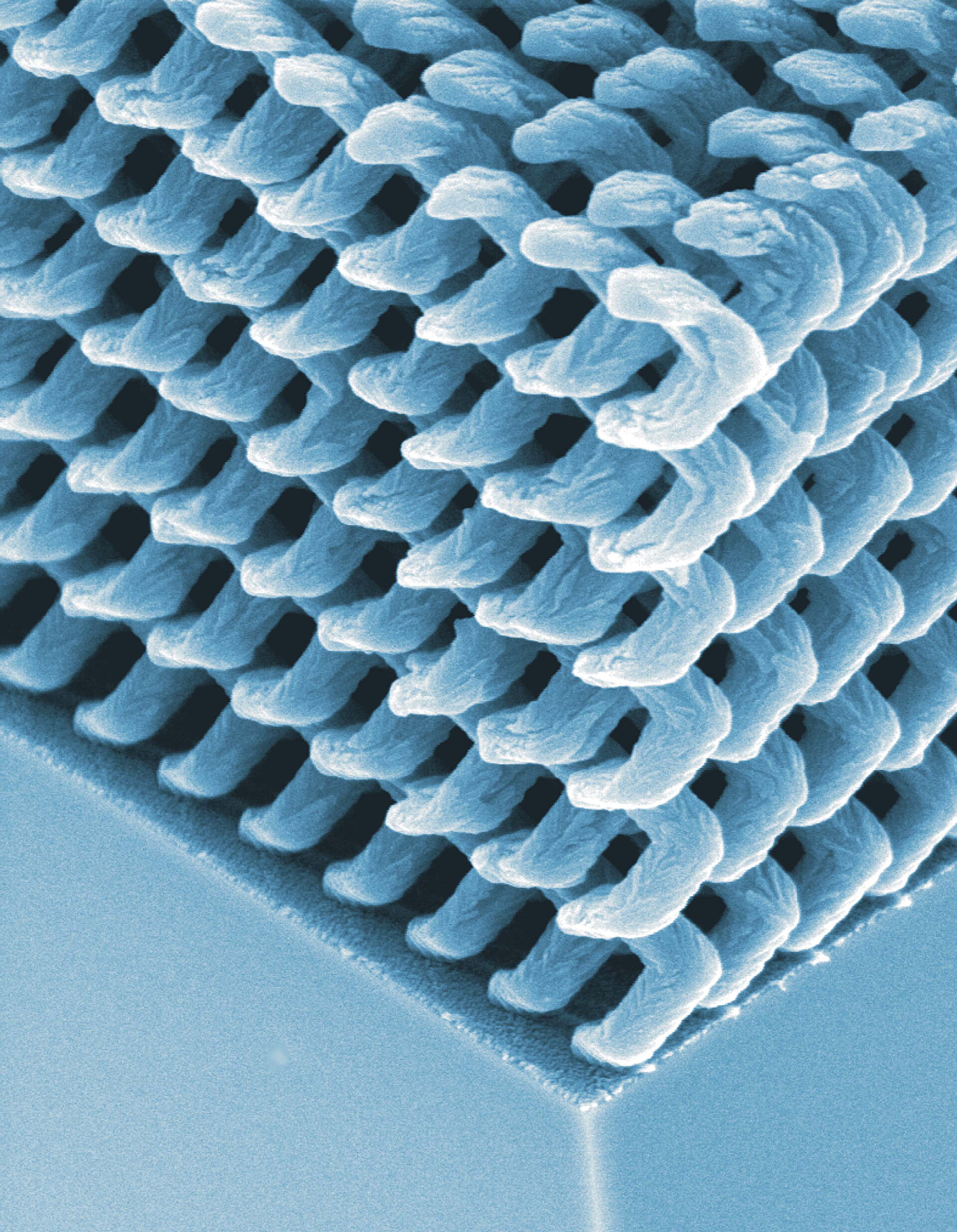
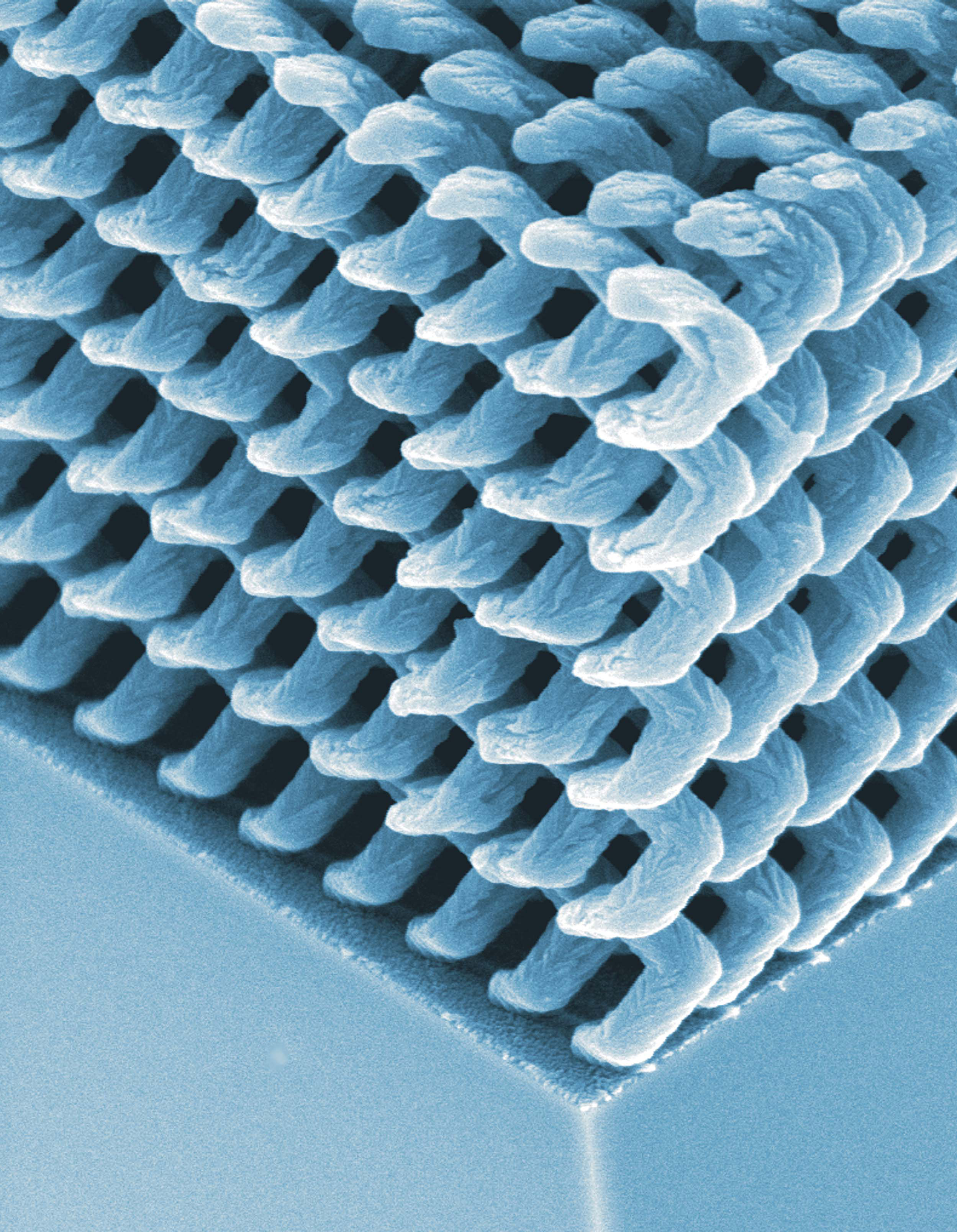
That’s the idea behind glancing angle deposition (GLAD). If the substrate is kept stationary, the result will be an array of slanted columns, like an oblique comb. Different structures can be obtained by rotating the substrate during the course of the deposition. This periodic array of square spirals was made by periodically rotating the substrate by 90°; the two-dimensional periodicity was established by an array of small initial seeds deposited on the substrate. The silicon spirals are 6 microns tall and about 500 nm apart. Structures such as this one may find use as three-dimensional photonic crystals. (Scanning electron micrograph by Jason Sorge, Mark Summers, and Michael Brett, University of Alberta.)
To submit candidate images for Back Scatter, visit http://www.physicstoday.org/backscatter.html .

Scanning electron micrograph by Jason Sorge, Mark Summers, and Michael Brett, University of Alberta.