A model atmosphere
DOI: 10.1063/PT.3.2254
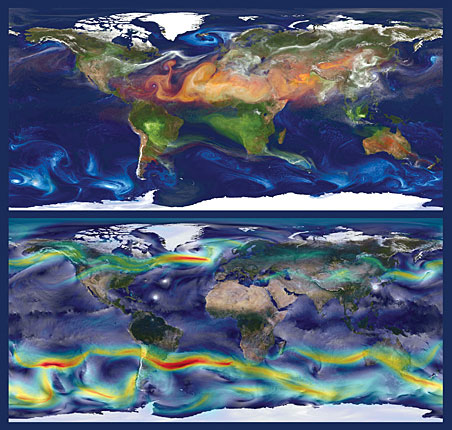
William Putman and colleagues at the agency’s Global Modeling and Assimilation Office have simulated two years of worldwide weather at 30-minute intervals with 10-km resolution. Drawing on numerous observations and prior analyses, the team seeded NASA’s Goddard Earth Observing System Model (GEOS-5) with a realistic depiction of atmospheric conditions in May 2005. The simulation then evolved freely, fed only actual measurements of external influences such as sea-surface temperatures and the emission of dust, soot, and other aerosols from wildfires, volcanoes, and fossil-fuel burning. As it numerically explored the complex interplay between temperature, cloud formation, evaporation and precipitation, winds, and aerosols, the “Nature Run” simulation produced its own weather, including hurricanes and other storm systems. The full simulation ran on 3750 processors at the NASA Center for Climate Simulation, took 3 million processor-hours, and produced 400 terabytes of data.
The upper visualization shows global aerosols at one point during the run. Dust (red) is lifted from the surface, sea salt (blue) swirls inside cyclones, smoke (green) rises from fires, and sulfate particles (white) stream from volcanoes and fossil-fuel emissions.

Images by William Putman/NASA Goddard Space Flight Center.

Winds are mapped in the
To submit candidate images for Back Scatter, visit http://contact.physicstoday.org .