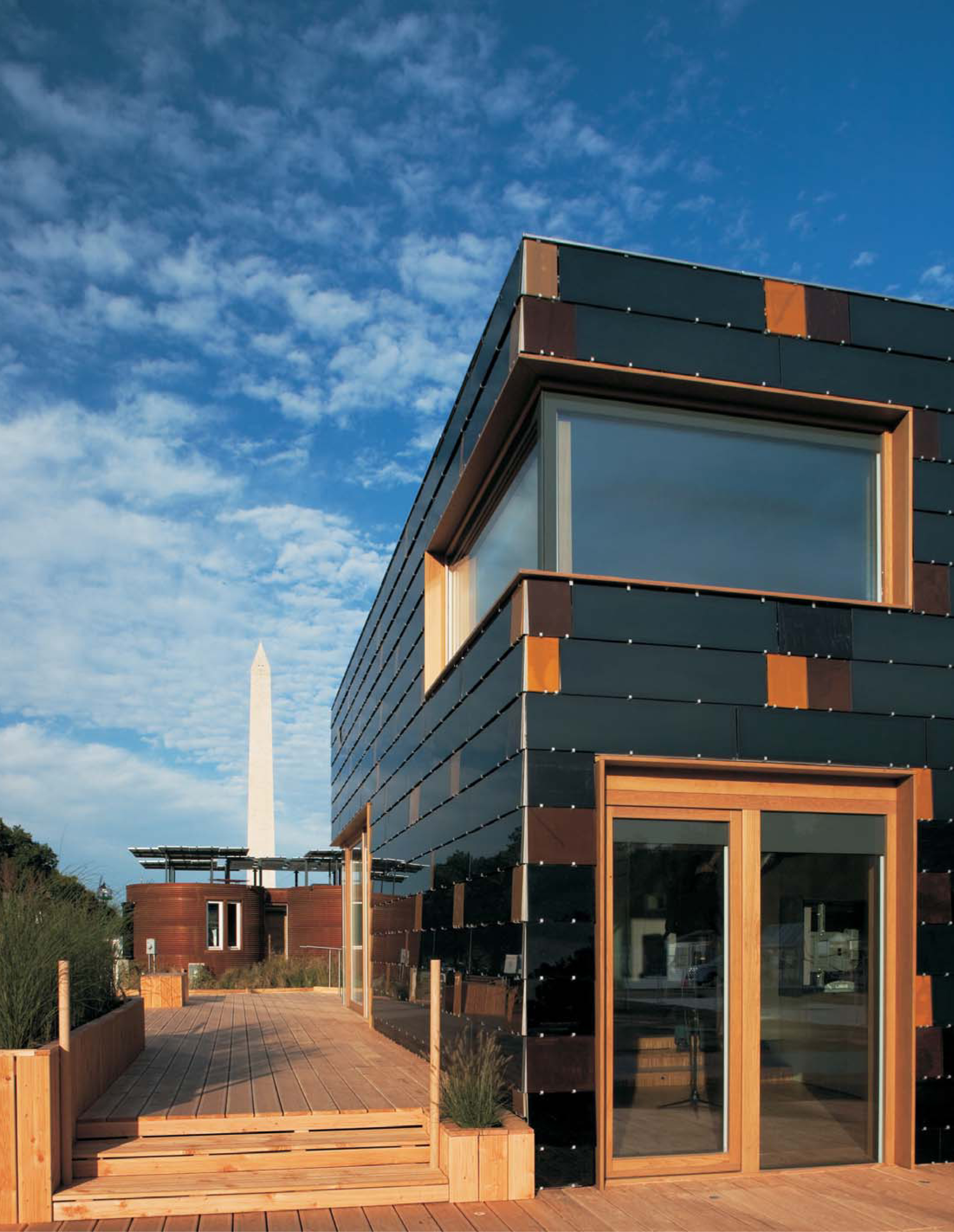
2009 Solar Decathlon
DOI: 10.1063/1.3273026
Over three weeks in October, teams from 20 colleges and universities worldwide competed on the National Mall in Washington, DC, in the fourth Solar Decathlon. Hosted by the US Department of Energy and organized by the National Renewable Energy Laboratory, the event challenged university students, assisted by faculty members, to design, build, and operate the most attractive and efficient solar-powered house.
This year’s entries were judged in 10 categories: architecture, market viability, engineering, lighting design, communications, comfort zone, hot water, appliances, home entertainment, and net metering—the extent to which the house would draw from or give back to the electricity grid each year.
Team Germany, which won the previous decathlon in 2007, again finished first; shown here is the winning house. The team comprised 25 students, mostly architects, from Technische Universität Darmstadt. Inside, the house features a single, multifunctional living area. Outside, the house is almost totally covered with a 19-kilowatt peak photovoltaic system—40 single-crystal silicon panels on the roof and about 250 thin-film copper indium gallium diselenide panels, able to utilize indirect light, on the sides. Together, the panels are expected to produce twice as much energy as the house needs. Heat losses are minimized through the house’s nearly cubic shape, custom vacuum insulation panels, and phase-change materials in the walls and ceiling.
Europe and the US will alternate hosting subsequent decathlons, with Spain hosting Solar Decathlon Europe 2010 next fall. For more about the 2009 decathlon, see http://www.solardecathlon.org .
To submit candidate images for Back Scatter, visit http://www.physicstoday.org/backscatter.html .

(Photo by Jim Tetro, US Department of Energy Solar Decathlon.)