Understanding the Mayans on their own terms
DOI: 10.1063/PT.3.5178
The works of Mayan astronomers have long been an object of popular fascination. Their impressive feats include a base-20 system for calculating large numbers, which included the number zero and negative quantities; a 365-day calendar system based on an accurate measurement of the solar year that the Mayans diligently corrected on a 52-year cycle; and another 260-day calendar created for ritual and divination purposes. They used the two calendars to create their famous long count, a system that numbered every day from some remote, mythical origin date. All those achievements were made before 900 CE, when Mayan civilization in major towns collapsed.

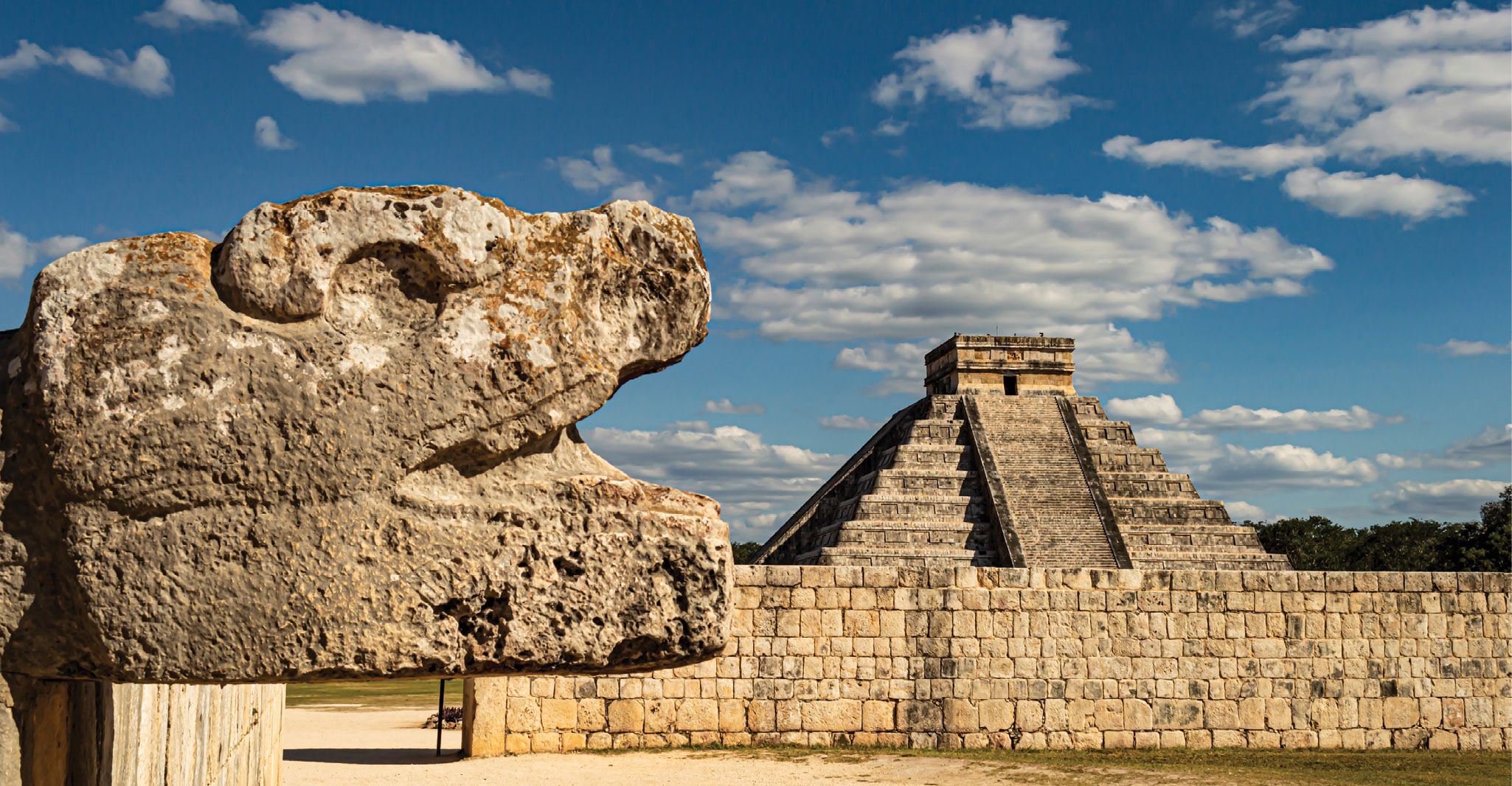
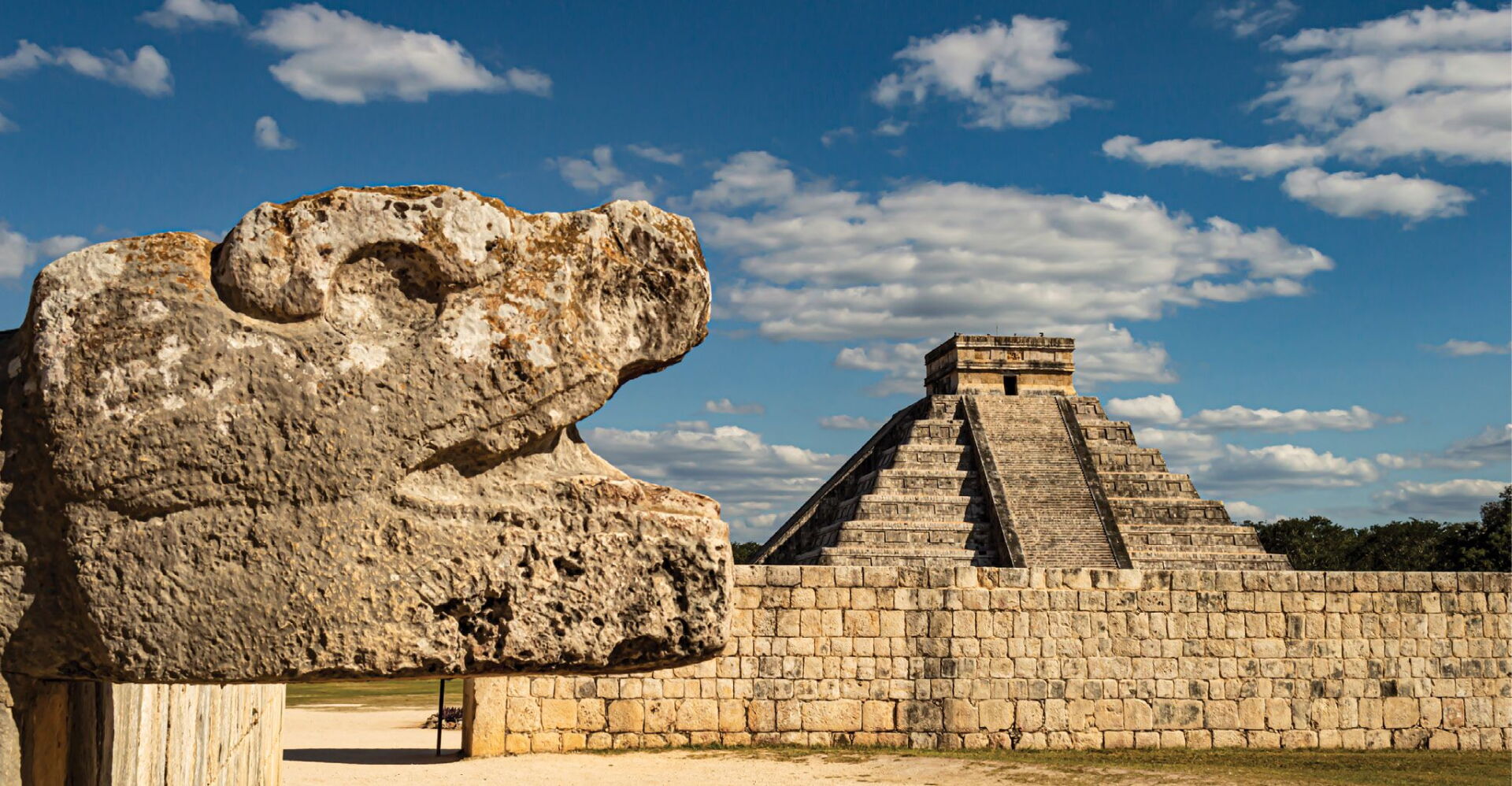
The famous step pyramid at the center of Chich’en Itza (background) was dedicated to the feathered serpent deity (foreground).
ZUYUAT/WIKIMEDIA COMMONS/CC BY-SA 4.0
As Gerardo Aldana y Villalobos, a historian of science, details in his new book, Calculating Brilliance: An Intellectual History of Mayan Astronomy at Chich’en Itza, Western scholars long focused their attention on those intricate Mayan calendar systems because they aimed to determine how the Mayan system corresponded with the Western calendar. That type of Eurocentrism in Mayan studies, he argues, has led to a flawed understanding of Mayan astronomy that removes it from its cultural context.
In Calculating Brilliance, Aldana aims to rectify that situation by outlining the history of our understanding of Mayan astronomy and presenting a daring conclusion of his own: that a female astronomer named K’uk’ul Ek’ Tuyilaj who worked in the city of Chich’en Itza likely obtained data relating to Venus’s orbital trajectory.
As Aldana details, the looting and dispersion of Mayan documents following the Spanish conquest of Mesoamerica delayed the systematic study of Mayan science and society for centuries. It was only at the end of the 19th century that the German librarian Ernst Förstemann made a foundational contribution to the understanding of Mayan culture by deciphering part of the Dresden Codex, possibly the most significant collection of Mayan hieroglyphic texts. Förstemann was able to unravel the Mayan number system and tried to decode a portion of the codex that contained what appeared to be records of appearances of Venus—which is now known as the Venus table.

The 20th century saw many breakthroughs in the study of Mayan astronomy, including a better appreciation of the relationship between Mayan architecture, inscriptions, and astronomical observations. During that time, however, few scholars attempted to decipher Mayan hieroglyphic writings and inscriptions, which prevented them from analyzing astronomy in the context of broader Mayan society. It was only in the second half of the 20th century that the Russian American archaeologist Tatiana Proskouriakoff decoded the hieroglyphs and revealed what the inscriptions on Mayan monuments tell us about historical events.
That was when Aldana, who teaches at the University of California, Santa Barbara, entered the field. He began working on Mayan astronomy during his doctoral studies at Harvard University under Owen Gingerich. At that time, he also began engaging with historical and archaeological work on Mayan history and archaeology. In Calculating Brilliance, Aldana connects the Dresden Codex’s Venus table—which is now more fully understood because of Proskouriakoff’s work deciphering the hieroglyphs—with the inscriptions on Chich’en Itza’s buildings, where a mural prominently depicts K’uk’ul Ek’ Tuyilaj.
Following the work of Anthony Aveni, who in the 1980s suggested that the observations for the Dresden Codex’s Venus table were made in a structure at Chich’en Itza called the Caracol, Aldana argues that K’uk’ul Ek’ Tuyilaj likely made corrections to the table to account for data she and other astronomers had collected on the planet’s orbital trajectory. Those corrections were intended to cope with the small difference between Venus’s 584-day orbit and what we call the synodic period of Venus. That allowed her to predict how morning appearances of Venus would coincide with certain dates from the 260-day divinatory calendar.
But unlike prior scholars, Aldana isn’t interested in assessing the accuracy of Mayan astronomy according to contemporary Western standards. Using historical and anthropological records, he aims to illuminate the role astronomy played in Mayan society. As he emphasizes, K’uk’ul Ek’ Tuyilaj’s discoveries not only helped build calendars but were integral to ceremonial and ritual events. Aldana also notes that the Mayans mastered the Venus table around the same time that the feathered serpent, a god worshipped by other Mesoamerican societies, became a popular deity for Mayans to revere. That may have led the Mayans to identify the serpent with Venus.
Unfortunately, the print version of the book suffers from poor-quality images, which look much better in the digital version. Nevertheless, Calculating Brilliance is a tribute to humanity’s cultural diversity. The book marks a milestone in our understanding of Mayan astronomy and culture by illustrating how they were inherently intertwined.
More about the authors
Olival Freire is a professor of physics and history of science at the Federal University of Bahia in Salvador, Brazil. He is the author of the 2015 book The Quantum Dissidents: Rebuilding the Foundations of Quantum Mechanics (1950–1990).
Olival Freire, Federal University of Bahia, Salvador, Brazil.