Discover
/
Article

Why can’t you separate interleaved books?

JUN 01, 2016
Because of the way interpenetrating sheets deform, the harder you pull, the greater the friction force resisting separation.
PTO.v69.i6.74_1.d1.jpg
Kari Dalnoki-Veress
PTO.v69.i6.74_1.d2.jpg
Thomas Salez
PTO.v69.i6.74_1.d3.jpg
Frédéric Restagno

Friction has a long scientific pedigree. Leonardo da Vinci established that the friction force, or traction, 𝒯 applied when an object begins to slide is given by the simple formula 𝒯=μN, where N is the load, or normal force, and μ is the coefficient of friction. Leonardo had suggested that μ=¼ always, but Guillaume Amontons and Charles Augustin Coulomb later showed that μ is not universal; rather, it depends on the nature of the sliding object and the surface on which it slides. In total, the classic Amontons–Coulomb laws state that the friction force during sliding is independent of both the area of contact and the sliding velocity and that it is proportional to the load.

The independence of 𝒯 from the contact area is hardly intuitive; indeed, it was not fully explained until the mid-20th century, in work by David Tabor and Frank Philip Bowden. More recently, theoretical and computational progress, in conjunction with technological advances such as the atomic force microscope, surface forces apparatus, and quartz crystal microbalance, have renewed interest in friction and improved scientists’ understanding. Many systems, we now know, exhibit behavior much more complex than envisioned in the Amontons–Coulomb laws—particularly at or near the nanoscale. Multiwalled nanotubes furnish an example. In stunning experiments (see the final two additional resources), inner and outer tubes were slid along each other to study true molecular friction. Those investigations and others have shown area dependence and vanishing friction. Nevertheless, the classic laws apply in many cases.

A simple, striking experiment

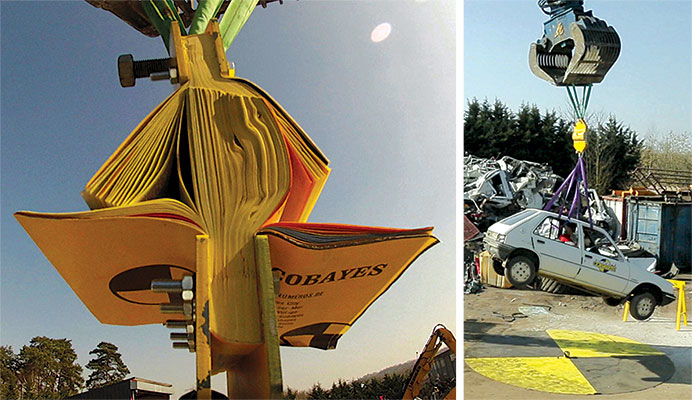
Take two phone books, interleave their sheets, and attempt to separate the books by pulling on their spines. You cannot do it. The accumulated friction between the pages is so great that, as figure 1 shows, even the weight of a car cannot pull the phone books apart.

PTO.v69.i6.74_1.f1.jpg

Figure 1. The friction force generated by the two interleaved phone books on the left is enough to support a car, as illustrated in the scene at right from the show On n’est pas que des cobayes!, aired in France on 2 May 2014. (© France 5/2P2L, used with permission.)

View larger

Less spectacular than lifting a car, but more instructive, is a pair of experiments you can try with two perfect-bound notebooks (that is, having rigid spines) whose sheets can be easily removed. Interleave the sheets and you will find that the traction force needed to separate the two books is immense. Next, remove every other sheet in each notebook and repeat the experiment. In that case you will have no trouble separating the notebooks.

If you want to go one step further, set up a simple traction-measuring device such as a spring balance. If your device is sensitive enough, you will find that when alternating sheets are removed from each notebook and the remaining sheets are all parallel to each other, the traction force scales linearly with the number of sheets. The friction at each interface is small, so it is easy to separate the books. In contrast, when sheets are not removed, they fan out as they approach the overlap region. As a result, the traction force is greater than in the sheets-removed case, and it increases dramatically with the number of sheets. In fact, our research team—which includes Héctor Alarcón, Christophe Poulard, Jean-Francis Bloch, and Élie Raphaël—showed that in some cases a 10-fold increase in the number of sheets results in a traction force that is increased by more than four orders of magnitude.

The enigma of the interleaved phone books, though often demonstrated, had not received much quantitative and theoretical attention, a circumstance that delighted, perplexed, and, at times, frustrated us. As we will now discuss, the secret to the amplification of friction lies in the angles the sheets make as they approach the overlap region.

The Hercules number

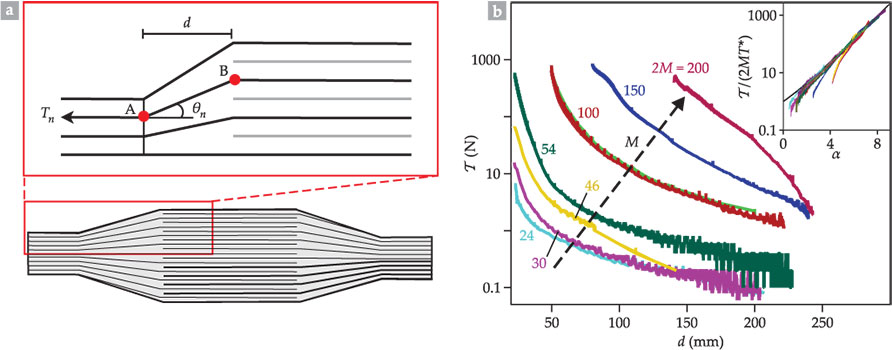
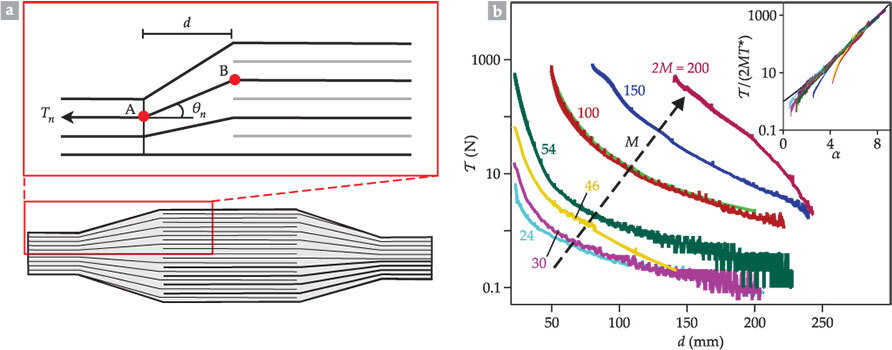
In our laboratory experiments, we prepared booklets from identical sheets of paper having a width w = 12 cm, length L = 25 cm, and thickness ε = 0.01 mm. The total number 2M of sheets ranged from 24 to 200. A tensile tester measured the total traction force as the notebooks were pulled vertically at a constant velocity, typically 1 mm per minute. We stopped pulling intermittently so that we could probe the coefficient of friction at various distances d separating the clamp of one book from the overlap region. Figure 2a shows the geometry of the interleaved books and some of the important parameters used in our analysis. Figure 2b presents our measurements. It clearly shows the nonlinear variation of 𝒯 with both the number of sheets and the separation distance.

PTO.v69.i6.74_1.f2.jpg

Figure 2. When suitably scaled, the friction of interleaved books obeys a universal law. (a) As this schematic shows, when interleaved books are separated by a distance d, the nth sheet makes an angle θn as it goes from the overlap region to a binding clamp. Here, Tn denotes the local traction force on the nth sheet. (b) Total traction force 𝒯 is measured as a function of distance d. From bottom to top, the number 2M of sheets in each book is 24, 30, 46, 54, 100 (two data sets), 150, and 200. As the inset shows, when the total traction is appropriately scaled and plotted as a function of the Hercules number α=2μεM2/d, all the curves from the unscaled-traction plot coincide. The solid black line corresponds to the expression for 𝒯 given in the text.
View larger

The mechanism leading to amplified friction can be understood with the help of figure 2a. The index n labels individual sheets in a booklet, and the nth sheet makes an angle θn as it goes from the clamp at the end of the notebook to the overlap region. Therefore, a component of the local traction Tn exerted on a sheet by an external operator at point A results in a local normal force Tntanθn exerted on the stack of sheets below it at point B. The result is a self-amplified friction force that resists the traction: The harder the operator pulls, the greater the local loads and frictional resistance.

Summing over all the local tractions yields the total traction 𝒯. To proceed analytically, we use a continuum description corresponding to a large M. Introducing the quantities z=n/M, T(z)=Tn, and the dimensionless amplification parameter α=2μεM2/d yields the ordinary differential equation T(z)+2αzT(z)=0, where the prime denotes differentiation with respect to z. To integrate and solve that equation, one needs a boundary condition T for the traction on the outermost sheet of the stack. The source of that bounding traction could be friction introduced by the elasticity of the paper as it bends or by any tiny adhesion. Upon integration, we obtain the total traction force 𝒯=2MT·(π/4α)1/2·eα·erf(α), where “erf” denotes the error function.

Note that as α approaches zero, which corresponds to parallel sheets and small angles, 𝒯=2MT. That makes sense: As the angles tend to zero, the friction force is due to all the independent sheets, each experiencing local friction T. In general, however, the total traction force depends nearly exponentially on a single quantity—the dimensionless amplification parameter α, which has been given the lovely name “Hercules number.” And as the inset to figure 2b shows, when the appropriately normalized traction is plotted against α, the results of all our experiments collapse onto a single master curve.

Not just a compelling muse

We began our phone-book study because we wanted to solve an intriguing popular mystery. But the effect we have studied can be seen in many other systems in which a pulling force results in an orthogonal load that enhances friction. An example is a toy known as the Chinese finger trap. Fingers inserted into the trap—a braided tube—are difficult to extract because tension tightens the tube. Surgeons use so-called finger-trap sutures based on that principle. Likewise, a ship can be moored to a capstan because the rope can tighten around the capstan and thereby increase friction. The friction-amplifying mechanism also recalls catch bonds, biomolecular links that strengthen with tensile stress and facilitate cell adhesion. We hope that our study, in addition to elucidating the long-standing and fun phone-book puzzle, will help to clarify the mechanical behavior of more complex interleaved systems involving textiles, biological entities, and nanoscale mechanical devices.

References

  1. 1. ”Mythbusters—Phone Book Friction,” www.youtube.com/watch?v=AX_lCOjLCTo .

  2. 2. Q. J. Wang, Y.-W. Chung, eds., Encyclopedia of Tribology, Springer, (2013).

  3. 3. A. A. Pitenis, D. Dowson, W. G. Sawyer, “Leonardo da Vinci’s friction experiments: An old story acknowledged and repeated,” Tribol. Lett. 56, 509 (2014). https://doi.org/10.1007/s11249-014-0428-7

  4. 4. H. Alarcón et al., “Self-amplification of solid friction in interleaved assemblies,” Phys. Rev. Lett. 116, 015502 (2016). https://doi.org/10.1103/PhysRevLett.116.015502

  5. 5. J. Cumings, A. Zettl, “Low-friction nanoscale linear bearing realized from multiwall carbon nanotubes,” Science 289, 602 (2000). https://doi.org/10.1126/science.289.5479.602

  6. 6. A. Niguès et al., “Ultrahigh interlayer friction in multiwalled boron nitride nanotubes,” Nat. Mater. 13, 688 (2014). https://doi.org/10.1038/nmat3985

More about the Authors

Kari Dalnoki-Veress is a professor in the department of physics and astronomy at McMaster University in Hamilton, Ontario, Canada. Thomas Salez is a CNRS research associate at ESPCI ParisTech in Paris. Frédéric Restagno is a CNRS research associate at Université Paris–Sud in Orsay, France.

Related content
/
Article
Fibrous materials that can reversibly twist and coil can be coaxed to contract and elongate as part of lightweight exoskeletons and other bioinspired structures.
/
Article
Although plants often rely on wind and water to carry their seeds and spores, some have evolved extraordinary launch mechanisms to disperse them.
/
Article
How hitting just 4 pins can result in knocking down all 10, over and over.
/
Article
The physics behind the unique instrument lets players turn hand gestures into music.
This Content Appeared In
pt_cover0616_for_Lalena.jpg

Volume 69, Number 6

Get PT in your inbox

pt_newsletter_card_blue.png
PT The Week in Physics

A collection of PT's content from the previous week delivered every Monday.

pt_newsletter_card_darkblue.png
PT New Issue Alert

Be notified about the new issue with links to highlights and the full TOC.

pt_newsletter_card_pink.png
PT Webinars & White Papers

The latest webinars, white papers and other informational resources.

By signing up you agree to allow AIP to send you email newsletters. You further agree to our privacy policy and terms of service.