Turning points in physics education
DOI: 10.1063/1.2930747
The decades following World War II were times of rapid expansion and change for physics and for education. 1 The expansion in education was driven by population factors such as the GI Bill of 1944 and the baby boom, by the increased recognition of the importance to the nation of education in the sciences, and by the availability of federal funds for support of educational projects. A driving force in physics education was the leadership of prominent physicists and physics teachers in the creation of new physics curricula at both precollege and college levels. The postwar years saw the development of a whole acronym zoo of curricula at the elementary, secondary, and postsecondary levels, various influential textbooks, and the establishment of the Commission on College Physics. It was in that atmosphere of curriculum change that Arnold Arons undertook to bring improvement at all levels to the teaching of physics. (See the obituary in Physics Today, September 2001, page 76 .)
Researcher and teacher
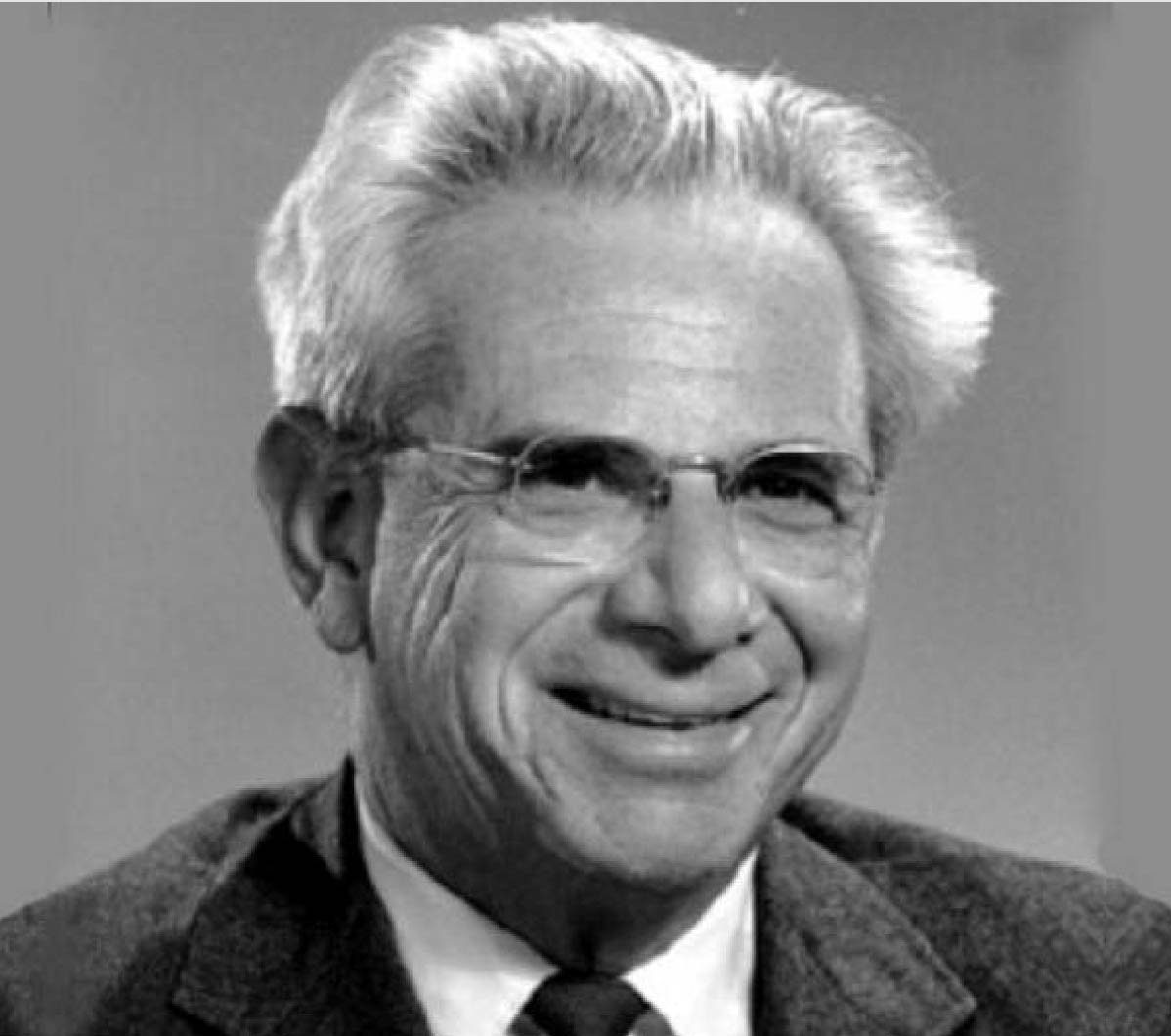
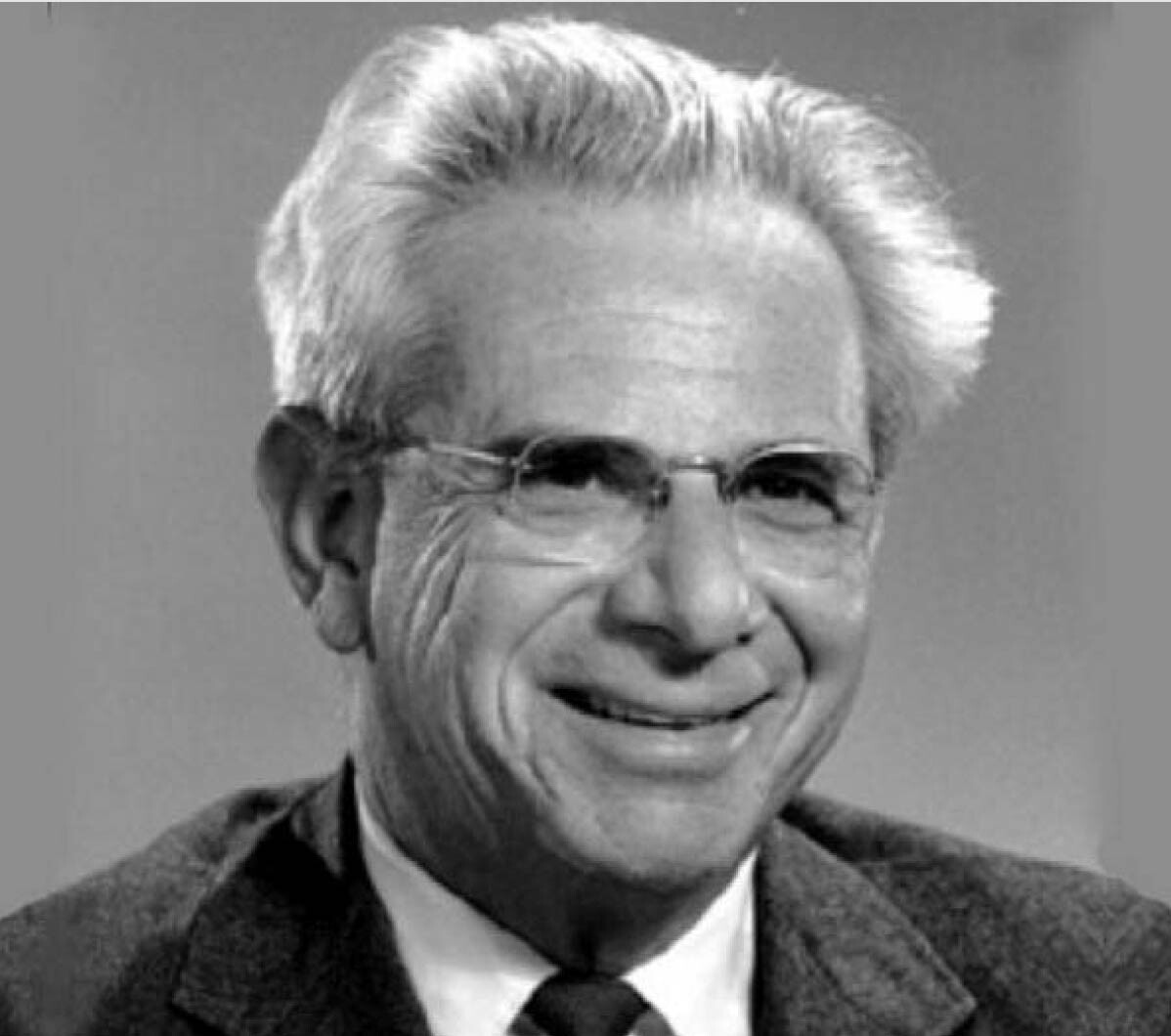
Arons, who is depicted in the figure, came to physics with a degree in physical chemistry from Stevens Institute of Technology and a PhD in physical chemistry received in 1943 from Harvard University. In June of that year, he joined the staff of the Woods Hole Oceanographic Institution as a member of the underwater explosives research laboratory. There he studied explosion phenomena and shock waves and later became well known for his studies, with Henry Stommel and Alfred Woodcock, of abyssal oceanic circulation and cloud physics.
In 1946 he left Woods Hole to return to Stevens as an assistant professor of physics. As he tells it,
I quickly began to see, (having an ego deflating experience which most of you probably share with me) to discover that my lucid lectures and demonstrations are depositing virtually nothing in the minds of the students…. I quickly discerned, for example, in one of the elements we had just dwelled on so much in the concept of force—Newton’s Third law—that the students couldn’t comprehend that an inanimate object like a table could exert a force. This came out of office discussions—listening to the students—and so I began to make them verbalize, recognize when they didn’t know or understand the definition of a term, define terms, write explanations on tests, interpretation of results, and not just make calculations. I began to see some at least marginal development in the directions I wanted to go.
2
I quickly began to see, (having an ego deflating experience which most of you probably share with me) to discover that my lucid lectures and demonstrations are depositing virtually nothing in the minds of the students…. I quickly discerned, for example, in one of the elements we had just dwelled on so much in the concept of force—Newton’s Third law—that the students couldn’t comprehend that an inanimate object like a table could exert a force. This came out of office discussions—listening to the students—and so I began to make them verbalize, recognize when they didn’t know or understand the definition of a term, define terms, write explanations on tests, interpretation of results, and not just make calculations. I began to see some at least marginal development in the directions I wanted to go. 2
“How do you know? Why do you believe? What is the evidence?” became his trademark questions. Like those of Socrates, such questions were not always appreciated either by his students or by many of his colleagues. However, unlike Socrates, who left no written account of his work, Arons has left us a rich legacy of writings well worth remembering and revisiting.
Amherst’s Arons
In 1952, after six years at Stevens, Arons moved to Amherst College, where he directed a calculus physics course required of all students. He provided a detailed description of it in the December 1959 issue of the American Journal of Physics . The content of the course and his teaching style got him on the cover of Time magazine’s great teachers issue as “Amherst’s Arons.” 3 The text said of him:
Taskmaster. In a sense—computers, films, labs and TV notwithstanding—nothing much has come along in 2,400 years that essentially improves the Socratic pattern of a learned man plus a group of students, but the pattern can work out in sharply varied and instructive styles….
Arons’ sweeping course ranges from Galileo and Faraday to Voltaire and John Stuart Mill. He starts his lectures by locking the door at the opening bell—to encourage promptness, he says; to keep the kids from fleeing, they say. As he carefully shows how a scientific theory can affect man’s own view of himself, and requires students to explain such notions as velocity and inertia in their own words, the relevance hits them. The course, recalls Amherst Graduate Evan Snyder, “was absolute hell—but one of the most valuable intellectual experiences I’ve been through.” One student slipped a note under Arons’ door, reading “I can’t help wondering if physics is really as interesting as you make it seem.”
One of his aims, says Arons, is to help students realize that science does not have absolute answers, that “it is a creation of human imagination and intelligence like everything else we do.” Arons requires many essays of his students, considers this “feedback” vital to good teaching. “You can’t just get up there and say something crisply and clearly and think that it has registered,” he says. He has been personally grading papers for 20 years, and “almost every session I learn something new about the obstacles that arise in the students’ minds.” To their amazement, those students who muster enough courage to ask his help have found Arons pleased, patient, and wholly effective in overcoming obstacles.
Taskmaster. In a sense—computers, films, labs and TV notwithstanding—nothing much has come along in 2,400 years that essentially improves the Socratic pattern of a learned man plus a group of students, but the pattern can work out in sharply varied and instructive styles….
Arons’ sweeping course ranges from Galileo and Faraday to Voltaire and John Stuart Mill. He starts his lectures by locking the door at the opening bell—to encourage promptness, he says; to keep the kids from fleeing, they say. As he carefully shows how a scientific theory can affect man’s own view of himself, and requires students to explain such notions as velocity and inertia in their own words, the relevance hits them. The course, recalls Amherst Graduate Evan Snyder, “was absolute hell—but one of the most valuable intellectual experiences I’ve been through.” One student slipped a note under Arons’ door, reading “I can’t help wondering if physics is really as interesting as you make it seem.”
One of his aims, says Arons, is to help students realize that science does not have absolute answers, that “it is a creation of human imagination and intelligence like everything else we do.” Arons requires many essays of his students, considers this “feedback” vital to good teaching. “You can’t just get up there and say something crisply and clearly and think that it has registered,” he says. He has been personally grading papers for 20 years, and “almost every session I learn something new about the obstacles that arise in the students’ minds.” To their amazement, those students who muster enough courage to ask his help have found Arons pleased, patient, and wholly effective in overcoming obstacles.

Arnold Boris Arons (1916–2001). Arons could be acerbic, but he also had a good sense of fun.
Seattle and beyond
In 1968 Arons was invited to the University of Washington, where he led in establishing programs for the preparation of physics teachers. His book The Various Language: An Inquiry Approach to the Physical Sciences (Oxford University Press, 1977) evolved from a physical science course designed for nonscience majors and to prepare elementary-school teachers.
In 1973 he was joined by Lillian McDermott; under her direction, the University of Washington Physics Education Group that Arons helped found has been a leader in programs of curriculum development and physics education research.
Arons received the Oersted Medal—the highest honor the American Association of Physics Teachers bestows. In his Oersted Lecture, entitled “Toward Wider Public Understanding of Science,” 4 he noted,
Wider understanding of science will be achieved only by giving students a chance to synthesize experience and thought into knowledge and understanding. Such a chance is not available in the deluge of unintelligible names and jargon precipitated at unmanageable pace and volume in so large a portion of our college courses, and it is not available in the absence of humanistic, historical, or philosophical perspectives within these courses. Neither will salvation be found in topical courses on currently “popular” matters such as the energy crisis, environmental problems, or social impact—so long as these problems are plunged into without any genuine prior understanding of the underlying scientific ideas.
Wider understanding of science will be achieved only by giving students a chance to synthesize experience and thought into knowledge and understanding. Such a chance is not available in the deluge of unintelligible names and jargon precipitated at unmanageable pace and volume in so large a portion of our college courses, and it is not available in the absence of humanistic, historical, or philosophical perspectives within these courses. Neither will salvation be found in topical courses on currently “popular” matters such as the energy crisis, environmental problems, or social impact—so long as these problems are plunged into without any genuine prior understanding of the underlying scientific ideas.
The lecture dates back 35 years to 1973, and it is interesting to see how prescient Arons’s remarks were.
His textbook, Development of Concepts of Physics (Addison-Wesley, 1965), produced while he was at Amherst, is, unfortunately, out of print, but does illustrate the ideas he had in mind.
Arons’s formal retirement from teaching in 1982 was just that—formal. He continued to lecture, conduct workshops around the country, and write about the teaching of physics, constantly reminding his audience of what he termed unpalatable truths about how we teach and how students learn physics.
In 1990 Arons wrote A Guide to Introductory Physics Teaching (Wiley). Four years later he followed up with Homework and Test Questions for Introductory Physics Teaching (Wiley). In 1997 those texts were revised and combined with a new section called “Introduction to the Classical Conservation Laws” into a single volume, Teaching Introductory Physics (Wiley). The book is currently available and is an outstanding candidate for every physics teacher’s library.
“The same ideas,” Aristotle reminds us, “recur in men’s minds not once or twice but again and again.” Arons was preeminent in his generation in calling attention to the limitations and failures of traditional methods of instruction and in focusing on what and how students learn. He knew quite well the work of predecessors such as John Dewey and Alfred North Whitehead, and he drew on their writings. But the conviction and energy that he poured into his work throughout his life came from his personal experiences. His questions—How do you know? Why do you believe? What is the evidence?—were the questions all scientists ask each other about their work, and Arons asked them not only of his students about their learning but also of his colleagues about their teaching. His persistence in asking those questions, his dogged insistence on pointing out unpalatable truths about the results of traditional teaching methods, and his constant inveighing against “complex instructional programs whose costs are real and whose benefits imaginary” were not always kindly received, but they were important in laying the groundwork for the development of physics education research programs whose fruits we enjoy today. For his many contributions and most especially for having been the “gadfly” of his generation, the physics community owes much to Arnold Arons.
References
1. American Physical Society,A Century of Physics, http://timeline.aps.org/aps .
2. A. Arons, in Physics Education Research Conference, 1998 Proceedings, T. C. Koch, R. G. Fuller, eds., U. Nebraska Press, Lincoln (1998), p. 7, available at http://physics.unl.edu/~rpeg/perc98/PERCpdfs.html .
3. “To Profess with a Passion,”Time, 6 May 1966, p. 18, available at http://www.time.com/time/magazine/article/0,9171,901871,00.html .
4. A. Arons, Am. J. Phys. 41, 769 (1973).https://doi.org/10.1119/1.1987384
More about the authors
E. Leonard Jossem is an emeritus professor of physics at the Ohio State University in Columbus.
E. Leonard Jossem, Ohio State University in Columbus, US .