Single-electron cyclotron radiation
DOI: 10.1063/PT.3.3060

Students of electromagnetism learn a lot about electromagnetic wave propagation long before they learn about electromagnetic wave sources; indeed, they often see their first source problems in graduate school. Nevertheless, undergraduate students will almost certainly hear that a classical orbiting electron emits radiation, as if that fact were obvious. Let’s look more closely. How does a classical orbiting electron emit radiation? Is that radiation something physicists can observe?
Collecting radiation from a large ensemble of electrons is as easy as building a loop antenna. But single-electron cyclotron emission evaded detection until 2014, when the Project 8 collaboration measured it in preparation for a neutrino-physics experiment.
Cyclotron versus synchrotron
In a uniform magnetic field
Note that
Is a measurement of an orbiting electron’s radiation frequency the same thing as a measurement of the cyclotron frequency? Not necessarily. After all, when the electron’s orbit is helical, the detected radiation may be Doppler shifted away from
One can understand the difference between cyclotron and synchrotron radiation by means of a laborious classical calculation, but a quantum mechanical picture is actually more intuitive. A magnetically trapped electron—what Nobel laureate Hans Dehmelt called a geonium atom—has quantized energy and angular momentum states, just like a regular atom. If one ignores fine structure, geonium’s energy levels are the Landau levels,
Synchrotron radiation, though, is the emission of high-energy photons,
Message in a bottle
The multi-institutional Project 8 collaboration, for which I am co-spokesperson, set out to detect single-electron cyclotron radiation and thus measure the electron’s energy via the Lorentz
We wanted the electrons to orbit in a strong magnetic field and stay there long enough to be detected. So we let the 83mKr decays occur in a shallow magnetic bottle—a region where a
It’s complicated. An electron that starts with a small velocity component parallel to the field will spend some of its time in the higher-field areas; the oscillating trajectory is a source of uncertainty in
Project 8’s first single-electron detections were from 83mKr decays occurring in a waveguide. We created a uniform 1-T magnetic field within the waveguide and introduced trapping nonuniformities by winding a small coil of copper wire around it. When an electron is born in the trap, it radiates about 10−15 W of power into one of the waveguide modes. The waveguide itself carries the low-power signal away from the trap region, to cryocooled amplifiers. To minimize noise, we would have liked to cool our system to about 15 K, but we couldn’t do that because the Kr would freeze onto the waveguide walls.
Electrons revealed
We finally saw electrons. To be more precise, we were the first to see cyclotron radiation from a single electron. Physicists had long before observed cyclotron radiation from electron ensembles, synchrotron radiation from single electrons, and single-electron energy losses attributed to unseen cyclotron radiation.
The electrons we spotted had many of the features we anticipated. Most importantly,

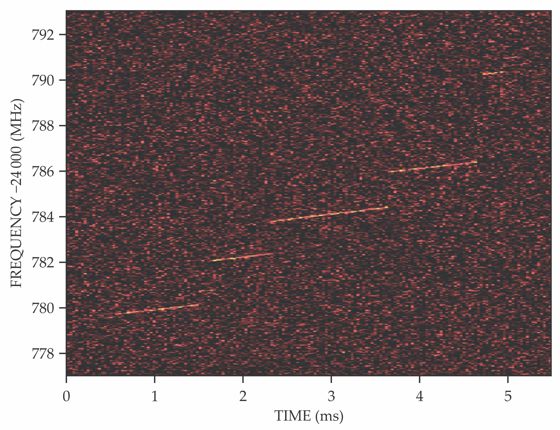
The Project 8 experiment measured the cyclotron radiation emitted by single electrons. This spectrogram shows that as an electron radiates energy away, its emission frequency increases due to relativistic effects. In addition to that gradual increase, Project 8 scientists were able to observe a series of 10-eV jumps due to collisions of electrons with residual gas atoms. Brighter colors indicate more detected power.

The sudden frequency jumps visible in the figure are evidence of electron scattering off of a residual gas atom, probably hydrogen. The characteristic 10-eV scale of the jumps is determined by the energy necessary to electronically excite the atom.
In fact, we were surprised to see the jumps at all. We had originally imagined that a trapped electron would orbit for a while, then scatter and usually escape due to its direction change. Contrary to our expectations, the typical direction change is small, and except in the shallowest traps, the electron usually remains in the trap after many visible scattering events. The resulting spectrograms are packed with information—and they’re also pretty to look at!
In measuring a
Beta decay is a nuclear transformation that emits an electron and an antineutrino. Because those two particles have to share the energy available from the nucleus, a measurement of the electron energy is also a measurement of the neutrino energy. When the electron has nearly all of the energy, the neutrino has nearly none of it. In extreme cases, the neutrino’s total energy may be so low that a nonzero neutrino mass begins to have an effect on the shape of the electron energy probability distribution near the high-energy endpoint. Exactly how the distribution is affected depends on the still-unknown neutrino mass scale, but the distribution itself is a straightforward observable quantity.
Tritium is the best isotope for a Project 8 investigation, because the maximum electron energy in tritium beta decay occurs at around 18.6 keV, near what seems to be our sensitivity sweet spot. The Project 8 team is working on incorporating a small tritium source into its current apparatus and designing the future large experiment that will use cyclotron radiation for a high-statistics, high-precision measurement of the neutrino-mass effect near the endpoint.
References
1. B. Monreal, J. A. Formaggio, “Relativistic cyclotron radiation detection of tritium decay electrons as a new technique for measuring the neutrino mass,” Phys. Rev. D 80, 051301 (2009). https://doi.org/10.1103/PhysRevD.80.051301
2. D. M. Asner et al. (Project 8 collaboration), “Single-electron detection and spectroscopy via relativistic cyclotron radiation,” Phys. Rev. Lett. 114, 162501 (2015). https://doi.org/10.1103/PhysRevLett.114.162501
3. P. Huber, “Viewpoint: Cyclotron radiation from one electron,” https://physics.aps.org/articles/v8/36 .
More about the authors
Ben Monreal is an assistant professor of physics at the University of California, Santa Barbara.