Indestructible plasma optics
DOI: 10.1063/PT.3.4234

The everyday concept of optics is of transparent elements, such as glass lenses, that bend beams of light in useful ways. The small lenses in our smartphones are now almost as ubiquitous as the lenses in our eyes. In both cases, the lenses redirect the rays of light scattered from, say, a tree and project them to form an image of the tree on the camera’s photosensitive chip or on our retinas.
Suppose you directed a laser beam into your smartphone lens. (Don’t even think about doing the same with your eye.) The lens redirects the beam to a near-point-like focal spot on the chip. The milliwatts of power delivered by common laser pointers is more than enough to damage your smartphone. But what if you dialed up the beam’s power enough that the beam damaged the lens before arriving at the focus? For a high-average-power continuous-wave beam, the small fractional optical absorption that always takes place inside transparent dielectric materials would eventually heat and thermally stress the lens until it fractures and melts. The lens would be ruined.
Another type of beam, though, has a radically different effect on the lens: That beam is an ultrahigh-peak-power laser pulse formed by packing a modest amount of energy into an extremely short-duration pulse. Half of the 2018 Nobel Prize in Physics was awarded for precisely that feat of compression (see Physics Today, December 2018, page 18 ). If such a now-routine pulse—typically of a peak intensity up to 1022 W/cm2 and a duration shorter than 100 fs—is incident on the lens, the laser electric field would cause electrons to nearly instantaneously tunnel out of the bound states of surface atoms. The laser-induced tunneling would form a solid-density plasma with optical properties akin to a highly polished metal mirror, and the pulse would specularly reflect from the surface.
To generate the plasma, one would need to focus the beam on the surface, and the interaction would need to take place in vacuum to prevent the laser ionization of air that would defocus the pulse well before it arrived at the surface. Long after the pulse is gone, damage follows on a nanosecond acoustic time scale as the dense hot plasma (with temperature on the order of 106 K and a pressure of 107 atmospheres) launches an impulsive pressure spike into the bulk of the glass and causes significant local damage.
Plasma mirror
I have just described the simplest kind of plasma optic: a plasma mirror. And I wouldn’t waste a lens for the job. A glass slide would work fine; it could be translated to a fresh location after every laser pulse. The first experiment to do such a thing simply aimed to understand the optical properties of a hot, solid-density plasma by measuring its reflection of ultrashort, intense pulses.
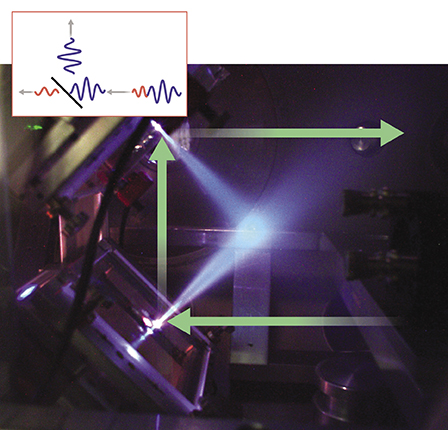
Plasma mirrors were later used to sharpen the leading edge of short pulses and eliminate an undesirable feature known as “prepulse”—laser energy that precedes the steeply rising main pulse. Tuning the focal spot size at the surface can ensure that the early, lower-intensity portion of the pulse is below the threshold for ionization and transmits through the glass, whereas the intense portion ionizes the surface and reflects from its self-generated plasma mirror, as shown in the figure. Having a prepulse-free laser pulse is essential to several high-intensity laser–matter interaction experiments, including the laser-driven acceleration of protons, widely pursued as a potential radiation therapy. (See the article by Jerimy Polf and Katia Parodi, Physics Today, October 2015, page 28 .)

A double plasma mirror in action. A focused 50 fs, 3 J titanium–sapphire laser pulse reflects from self-generated plasma mirrors on two 10 cm × 10 cm quartz plates in an experiment at the École Polytechnique in Paris. The two mirrors eliminate the beam’s prepulse—its temporal leading edge (red in the inset, its amplitude greatly exaggerated for clarity)—before the main pulse (blue) is recollimated for experiments downstream. The intense part of the pulse forms the plasma mirror it reflects from. The photograph shows plumes of plasma ejected normal to the mirror surfaces; the plumes accompany impulsive shock waves launched into the bulk of the quartz, long after the pulse has gone. The green arrows show the beam path. (Adapted from R. Marjoribanks et al., in Conference on Lasers and Electro-Optics/Quantum Electronics and Laser Science and Photonic Applications Systems Technologies, Optical Society of America, 2005, paper JFA7.)

In the plasma mirror, the intense pulse is reflected from the surface rather than transmitted, because the plasma electron density exceeds the wavelength-dependent critical density. You can see the true pallor of your face in the morning (assuming you want to) because the electron density of the aluminum layer on your bathroom mirror, at roughly 1023 cm−3, greatly exceeds the critical density and ensures reflection for all wavelengths in the visible spectrum. At densities above critical—for hot plasma mirrors and for bathroom mirrors—the incident wave undergoes a phase shift that favors reflection over forward propagation, or transmission. To understand that behavior, note that at densities above critical (or, equivalently, for laser frequencies below the plasma frequency) the plasma electrons can follow the swings of the laser electric field and short it out. When the wave is “shorted out,” its response is to reflect rather than transmit.
Gratings, fibers, and waveplates
What about other common optical elements, such as curved mirrors, gratings, optical fibers, and waveplates? They all have plasma analogues. The curved mirror is straightforward: The plasma generated on a curved surface can redirect an intense pulse to converge or diverge, and it can serve as both a prepulse filter and a focusing element for proton acceleration. As for gratings, intersecting two laser beams in a gas or subcritical-density plasma generates an interference pattern, which is a volume distribution of alternating bright and dark fringes. If the beams are intense, the bright fringes generate localized ionization and form a volume plasma grating.
The grating can diffract each beam in the direction of the other and, depending on the beams’ polarizations and wavelengths, acts as a controllable birefringent element, or waveplate, on one or both beams. Because of the diffractive scattering, plasma gratings can also mediate energy transfer from one beam to another and are used to balance the laser flux across multiple high-energy beams focused inside fusion targets at the National Ignition Facility. Plasma gratings can even be used to make holograms: Object-encoded two-beam interference patterns can be imprinted on solid surfaces; a third intense beam reflects from the patterned plasma mirror to read the hologram.
An essential use of plasma optics is in laser-driven electron acceleration, which requires propagation of extremely intense pulses through long distances L >> z0 of subcritical-density plasma, where the Rayleigh length z0 is the characteristic distance over which the beam’s intensity would normally drop by a factor of two due to diffractive divergence.
At low laser intensities, glass-fiber waveguides defeat beam divergence and form the backbone of today’s global communications systems. In a glass fiber, the refractive index is bigger on axis than off, which makes the light wave slowest on axis and curves its phase fronts inward, canceling the outward curvature from diffraction. Unfortunately, the high intensities—greater than 1018 W/cm2—needed for laser-based accelerators are at least six orders of magnitude beyond the glass fibers’ destruction threshold.
An optical fiber made of subcritical-density plasma would work quite nicely as a waveguide. Because the free electrons of a plasma reduce the refractive index, the fiber’s on-axis density must be lower than off axis. Two techniques do the job, and future accelerators will likely depend on them: the electric-discharge capillary waveguide and the laser-driven hydrodynamic plasma fiber.
In the electric-discharge capillary, the desired waveguiding profile results from plasma cooling near the capillary inner wall, which increases the density there. In the plasma fiber, a long, 10-µm-diameter, hot plasma is generated in a gas by a short laser pulse. The hot, thin plasma cylinder explodes radially into the background gas and creates an electron-density minimum on axis with high outer walls. That is exactly the refractive-index profile suitable for the injection and guiding of a separate high-intensity pulse that accelerates electrons. Although the cylindrical explosion is transient, the guide appears stationary to an intense speed-of-light pulse propagating along it.
Although plasma optics are seemingly highly exotic, they may soon become routine. Laser technology has advanced to a stage where the widely available, compact, short-pulse lasers used for machining and materials processing can also induce plasma optics, where even relativistic effects are important. No longer an exotic application, plasma optics will become a tool in the optical toolbox.
References
► H. M. Milchberg et al., “Resistivity of a simple metal from room temperature to 106 K,” Phys. Rev. Lett. 61, 2364 (1988). https://doi.org/10.1103/PhysRevLett.61.2364
► P. Michel et al., “Dynamic control of the polarization of intense laser beams via optical wave mixing in plasmas,” Phys. Rev. Lett. 113, 205001 (2014). https://doi.org/10.1103/PhysRevLett.113.205001
► S. H. Glenzer et al., “Symmetric inertial confinement fusion implosions at ultra-high laser energies,” Science 327, 1228 (2010). https://doi.org/10.1126/science.1185634
► A. Leblanc et al., “Plasma holograms for ultrahigh-intensity optics,” Nat. Phys. 13, 440 (2017). https://doi.org/10.1038/nphys4119
► C. G. Durfee III, H. M. Milchberg, “Light pipe for high intensity laser pulses,” Phys. Rev. Lett. 71, 2409 (1993). https://doi.org/10.1103/PhysRevLett.71.2409
► Y. Ehrlich et al., “Guiding of high intensity laser pulses in straight and curved plasma channel experiments,” Phys. Rev. Lett. 77, 4186 (1996). https://doi.org/10.1103/PhysRevLett.77.4186
More about the authors
Howard Milchberg is a professor of physics and electrical engineering at the University of Maryland in College Park.