Gravitational-wave detection via radio-pulsar timing
DOI: 10.1063/1.3293421
Gravitational waves are fluctuations in the fabric of spacetime; as they pass, they distort distances between objects. For example, a gravitational wave passing through this page would alter it so that it became wider, then taller, then wider, and so forth. Predicted by Einstein’s theory of general relativity, gravitational waves are analogous to the electromagnetic waves predicted by Maxwell’s equations. Unlike electromagnetic radiation, which is caused by accelerated charge, gravitational radiation is caused by accelerated mass.
Astronomers have already seen compelling, indirect evidence of gravitational waves in the energy loss and orbital decay of PSR B1913+16, the binary neutron star system whose discovery earned Russell Hulse and Joseph Taylor the 1993 Nobel Prize in Physics. Now, in the 21st century, the hope is to detect gravitational waves directly and to exploit them as a tool for learning about the cosmos.
As with electromagnetic waves, one can specify a gravitational wave by giving its frequency, amplitude, and polarization. In ongoing experiments designed to detect gravitational waves, changes in the travel time of light between a source and a detector would reveal the spacetime distortions induced by the wave. The challenge is that the extremely feeble gravitational force means that gravitational waves have tiny amplitudes and produce only minuscule changes in length: A relatively large change might be one part in 1015, equivalent to changing the size of this page by an amount less than the diameter of a proton. If fluctuations in light’s travel time are to become at all detectable, an experimenter must monitor a large distance.
At laser interferometer facilities such as LIGO (the Laser Interferometer Gravitational-Wave Observatory) and similar projects around the world, and at the proposed LISA (the Laser Interferometer Space Antenna ), a single coherent light source is split and then traverses two paths oriented at right angles to each other. Recombining the light creates an interference pattern that shifts according to the difference of the two path lengths. A passing gravitational wave would change the lengths of the two paths, in turn causing observable time-varying changes in the interference pattern. This Quick Study focuses on a second approach: determining gravitational waves with pulsar timing. The principle behind both approaches is similar, but with pulsar timing the light travels along a path from a pulsar to a radio telescope here on Earth; it is the precise timing of pulse arrivals by which the fluctuations in path length are revealed.
Sources of gravitational waves
The weakness of the gravitational force means not only that gravitational waves yield small distance distortions but also that a body must have a large mass or high velocity to create a potentially detectable gravitational wave in the first place. Astronomers have identified several potential sources; here we focus on galaxy mergers and cosmic strings, the two most relevant for a pulsar gravitational-wave observatory.
Mergers appear to be an essential part of galaxy formation and evolution. Moreover, the nuclei of most, if not all, large galaxies contain a supermassive black hole with a mass of at least 106 solar masses (M ☉). Consequently, the product of at least some mergers will contain two SMBHs that will sink toward the center of the resulting galaxy and form a binary. If the separation of the SMBHs becomes less than a few light-years, they will inevitably continue to spiral toward each other as the system loses energy to gravitational-wave emission.
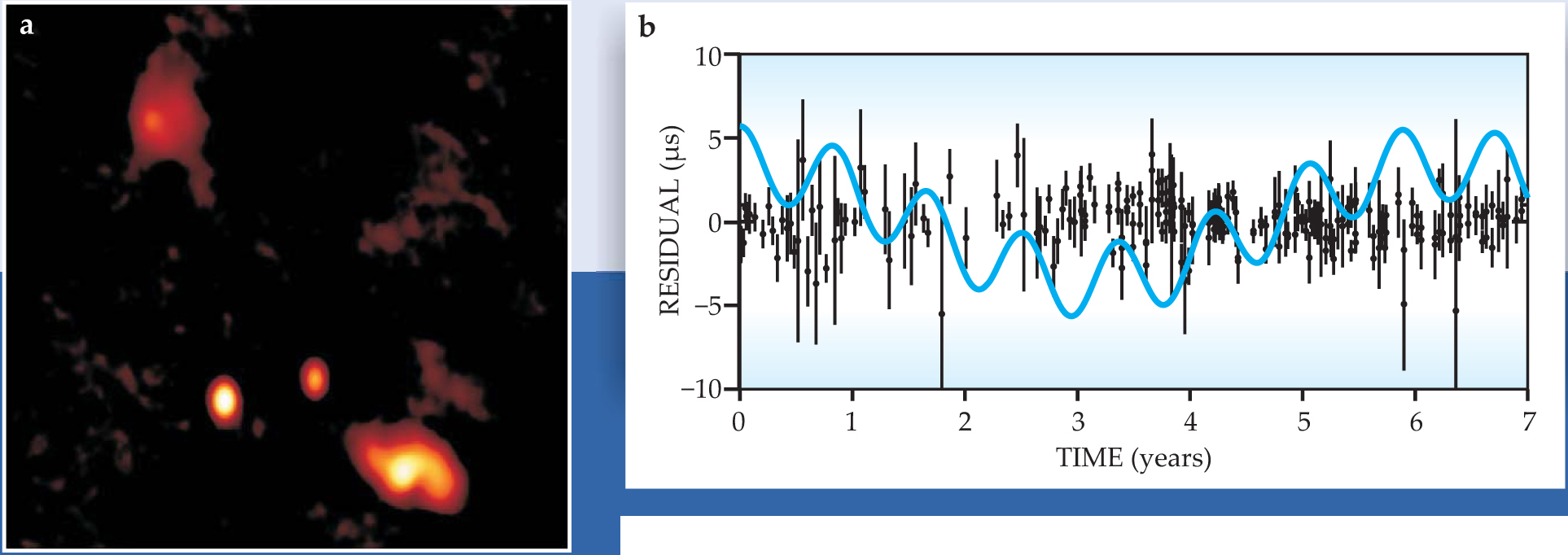
High-resolution radio imaging reveals dramatic evidence for an SMBH binary in the galaxy B0402+379. Panel a of the figure shows two SMBHs separated by only about 20 light-years. Additionally, indirect evidence comes from doubly ionized oxygen emission, which is thought to originate in the environment of an SMBH: A small number of galaxies display dual O++ lines whose wavelength difference arises, presumably, because the O++ lines from the two SMBHs exhibit different Doppler shifts as the SMBHs orbit each other.

Sources and signals of gravitational waves. (a) The central region of the galaxy B0402+379, as observed by the Very Long Baseline Array. The two bright, compact features toward the bottom center of the image likely represent two supermassive black holes in orbit about each other. The other emission, below and to the right of the SMBHs, is due to jets of plasma expelled from the environments of the SMBHs.(b) Even absent gravitational waves, the timing of pulsar signals will not agree perfectly with models. The solid points with error bars here show the timing differences (residuals) for the millisecond pulsar PSR B1855+09. The blue line shows the expected residuals that would arise if PSR B1855+09 were influenced by gravitational-wave emission from a nearby SMBH.
((a)(Courtesy of G. B. Taylor.)

Cosmic strings are analogous to the cracks that form in ice as water freezes. Theoretically, they may have formed during phase transitions that took place as the early universe rapidly cooled. Indeed, cosmic string production is probably generic in “supersymmetric” theories that unify bosons (particles with integer spin) and fermions (particles with half-odd-integer spin). If cosmic strings exist, they would have extremely high mass densities and their vibrations would yield gravitational waves.
A pulsar gravitational-wave observatory
Neutron stars are the remnants of supernova explosions, the spectacular finales of the collapse of stars heavier than about 8 M ☉. Typically, neutron stars are about as massive as the Sun, but only 20 km across. They often possess strong magnetic fields that can generate a lighthouse-like beam of radio emission. If such a beam sweeps over Earth, radio telescopes can detect a neutron star as a radio pulsar. Some neutron stars occur in binaries and can “spin up” if they accumulate mass and angular momentum from their companion. The resulting millisecond pulsars have rotation rates approaching 1000 Hz, and their large moments of inertia allow their rotational stability to sometimes rival that of atomic clocks.
Pulsar timing consists of monitoring the arrival times of pulsar signals at one or more radio telescopes. One then subtracts a model arrival time that depends on the rotation rate of the pulsar, its motion relative to Earth, interstellar propagation effects, and so forth. The difference, or residual, could be the result of an imperfect model, systematic effects in the measurement process, or a passing gravitational wave. Panel b in the figure shows the contribution of a gravitational wave to the residual and also gives a feel for the noise from which that contribution would need to be extracted.
The millisecond pulsars spread throughout the Milky Way galaxy can serve as a network of cosmic clocks. If a gravitational wave were to pass over Earth, timing residuals from different pulsars would be correlated in a way that depends on the angular separation of the pulsars and on the wave’s polarization. A pulsar gravitational-wave observatory, also called a pulsar timing array (PTA), monitors the residuals for a set of millisecond pulsars across the sky. Its sensitivity is determined by the number and distribution of the pulsars, how often the pulsars are observed, and the typical magnitude of a timing residual. A PTA is most sensitive to gravitational waves whose periods are comparable to the total observation time, typically 1–10 years. The corresponding frequency range of 3–30 nHz encompasses frequencies that are lower than but complementary to those for which laser interferometer detectors are sensitive.
Astronomers worldwide are constructing PTAs, including the Parkes PTA in Australia, the European PTA, and the North American Nanohertz Observatory for Gravitational Waves (NANOGrav) consortium. Together, the PTAs monitor about 40 millisecond pulsars spread over the entire sky. They are aided by some of the largest single-dish radio telescopes in the world, including the 300-m Arecibo telescope in Puerto Rico and the 100-m Green Bank Telescope in West Virginia. The impressive sensitivity of those instruments allows pulse arrival times to be measured with a precision as low as 100 ns, equivalent to tracking the distance to the pulsar with a precision of 30 m. With so many millisecond pulsars that can be observed with such sensitivity, astronomers estimate that PTAs are approaching the ability to detect nanohertz-frequency gravitational waves.
Four hundred years ago, Galileo turned his telescope to the night sky and opened up an entirely new view of the universe. During the 20th century, astronomers broadened their use of telescopes to include essentially the entire electromagnetic spectrum. Now astronomers are turning their attention to gravitational waves, which will present an entirely different view of the universe—one that probes the fundamental spacetime structure of the cosmos. We expect that gravitational waves will be detected within a decade. Inasmuch as most of the matter in the universe is “dark,” that is, does not emit electromagnetic radiation, the astronomical community may be surprised by what it sees.
References
1. Information on the worldwide pulsar timing arrays is at NANOGrav, http://www.nanograv.org ;
the Parkes Pulsar Timing Array, http://www.atnf.csiro.au/research/pulsar/ppta ;
and the European Pulsar Timing Array, http://www.astron.nl/~stappers/epta .
Pulsar timing is one of the key science areas for the Square Kilometre Array, http://www.skatelescope.org .2. Information on some of the telescopes used in pulsar timing is at the National Radio Astronomy Observatory, http://www.nrao.edu ,
and the National Astronomy and Ionosphere Center, http://www.naic.edu .3. I. Stairs, “Testing General Relativity with Pulsar Timing,” Living Rev. Relativity 6, 5 (2003).
4. D. Lorimer, M. Kramer, Handbook of Pulsar Astronomy, Cambridge U. Press, New York (2004).
5. É. É. Flanagan, S. A. Hughes, “The Basics of Gravitational Wave Theory,” New J. Phys. 7, 204 (2005). https://doi.org/10.1088/1367-2630/7/1/204
6. G. Hobbs et al., “The International Pulsar Timing Array Project: Using Pulsars as a Gravitational Wave Detector,” http://arxiv.org/abs/0911.5206 .https://doi.org/10.1088/0264-9381/27/8/084013
More about the authors
Paul Demorest is a Jansky Fellow at the National Radio Astronomy Observatory in Charlottesville, Virginia. Joseph Lazio is a research scientist at the US Naval Research Laboratory in Washington, DC. Andrea Lommen is an associate professor of physics and astronomy at Franklin and Marshall College in Lancaster, Pennsylvania.
Paul Demorest, 1 National Radio Astronomy Observatory, Charlottesville, Virginia, US .
Joseph Lazio, 2 US Naval Research Laboratory, Washington, DC, US .
Andrea Lommen, 3 Franklin and Marshall College, Lancaster, Pennsylvania, US .