Collaboration and precision in quantum measurement
DOI: 10.1063/PT.3.1372
Collaboration makes possible what individual action cannot. French author Antoine de Saint-Exupéry is said to have put it this way: “One man may hit the mark, another blunder; but heed not these distinctions. Only from the alliance of the one, working with and through the other, are great things born.” Examples, from a win by the local football team to a global project like Wikipedia, are all around us. Does the principle still apply when the actors are quantum entities, not people? It seems it does. Atoms, being quantum objects, behave randomly when considered as individuals; yet in interacting groups they form wonderfully ordered things: crystals, DNA, and so forth.
Over the past several years, the technique of engineering interactions among quantum objects has emerged as a promising way to reduce quantum randomness in precision measurement. Of course, one way to increase the precision of a measurement is to increase the size of the system. That strategy works whether or not the system particles interact. But collections of interacting particles—quantum collaborations, if you will—show an unexpected relationship between scale and randomness, and they allow for measurements whose precision improves with increasing particle number more dramatically than was previously thought possible.
Interacting and entangled systems
Imagine you have two different recipes for beer and you’d like to know which one will be more popular. How would you measure the difference? You might ask a random sample of people to taste the two beers and tell you which they prefer. The results would show how many prefer A versus B, with some statistical error. Is there a better strategy? Consider that beer drinkers are social and like to drink with other people. With that in mind, you could set up two bars next to one another, one serving beer A and the other serving beer B, and see which bar attracts more customers. On the one hand, individual people will be drawn toward their preferred beer. On the other hand, the vast majority would prefer to drink in a lively, crowded bar. So if one bar becomes more popular than the other because the beer is better, then others will move to that bar because it is more crowded. In that scenario, interactions among people magnify the effect of the beers’ quality. A small difference between the beers leads to a large difference in how many people drink it.
In the case in which you conduct a simple poll, each person makes an independent assessment of the two beers. As in any poll, the more people you ask, the more accurate your result will be. In fact, the so-called central limit theorem shows that the error, or uncertainty, of a measurement involving N people is proportional to 1/√N. In the case with the neighboring bars, the people no longer act independently of one another. And the more people there are, the more the interaction helps to clarify which is the superior beer recipe; the accuracy of the measurement improves faster than 1/√N. We say it has an improved scaling with N, relative to that for independent trials.
It turns out that a 1/√N scaling is the best possible for any measurement made with independent particles. However, someone who uses particles such as photons to make a measurement can exploit quantum mechanics to improve that scaling. For example, an experiment can take advantage of one of the theory’s stranger features: entanglement. That feature enables the experimenter to collect N photons into a highly correlated state that acts as a single large probe rather than as many individual probes. In that case the precision of the measurement improves as 1/N, a scaling known as the Heisenberg limit. The difficulty in following the entanglement strategy from an experimental point of view is that entangled states are notoriously difficult to produce and very fragile once produced.
For a long time, metrologists thought the Heisenberg limit defined the best possible scaling for any measurement. But in the past few years, several authors have noticed that if one could effectively engineer interactions among the probe photons analogous to those among the bar patrons in the beer-tasting example, then the 1/N sensitivity of the Heisenberg limit could be surpassed. Moreover, the interaction strategy does not require fragile entangled states.
An interaction-based magnetometer
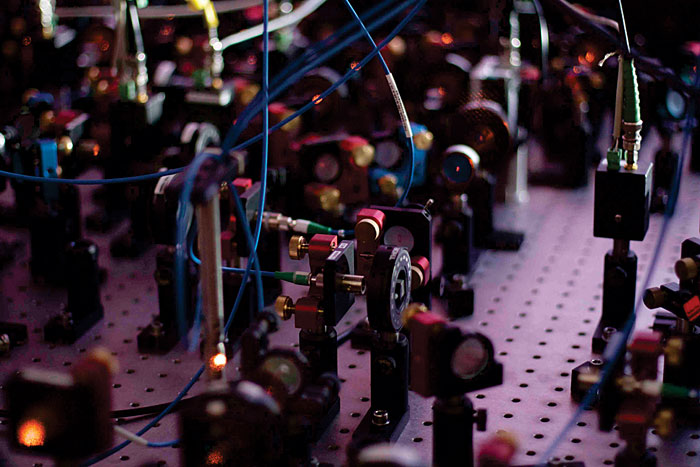
Our research group demonstrated the improved scaling in an experiment carried out last year at the Institute of Photonic Sciences in Barcelona, Spain. The figure shows part of our setup. Previously, Carlton Caves and colleagues at the University of New Mexico had worked out the theory of exactly the type of interaction-based measurement strategy that we implemented in the lab.

This optical arrangement is part of a magnetometer in which laser pulses travel through a cloud of cold rubidium gas during a precise measurement of the atoms’ magnetization. In an experiment run last year, our research group tuned the laser to a particular wavelength that, in essence, caused the photons to interact with each other as they passed through the gas. That nonlinear optical effect yields a fundamental change in the precision of the magnetization measurement; it allows the sensitivity to surpass not only the shot-noise limit applicable to independent probe particles but also the so-called Heisenberg limit, the best precision obtainable with entangled quantum states.

Our experiment is a type of optical magnetometer, a device that uses resonant laser light to measure the magnetization of an atomic gas via an effect called paramagnetic Faraday rotation. We pass pulses of linearly polarized laser light through the atomic gas. Interaction with the atoms causes the laser pulses to undergo a polarization rotation ϕ = a(ω)M, which is proportional to the quantity we want to measure, the magnetization M of the gas. The prefactor a(ω) is the gain of the measurement, which depends on the frequency ω of the laser. We measure the angle of rotation of the polarized light with a tool called a balanced polarimeter, and from that measurement we determine the atomic magnetization.
Similar optical magnetometers currently hold the record for the most accurate measurement of magnetic fields; they have obtained a sensitivity very close to the quantum limit of those devices. In our experiment we study techniques for surpassing that limit—techniques that may help to improve state-of-the-art precision magnetometers.
In our work we laser cool an atomic gas to 20 µK or so, which amplifies the quantum effects we want to study above the noise floor imposed by other technical limitations. But how do we introduce interactions into the measurement? After all, photons do not interact with one another on their own. The trick is that the atomic gas can act as a nonlinear medium for the photons. For example, a photon can be absorbed by an atom and thus change the atomic energy state. As a result of the interaction, when a second photon comes along, its interaction with the atom will differ from the first photon’s interaction. In that case the rotation angle depends not just on the atomic magnetization M but also on the number of photons used to make the measurement: ϕ = b(ω)NM.
Strictly speaking, the photons interact in a nonlinear way with the atoms, but the result is equivalent to having photon–photon interactions. Crucially in our experiment, a simple change in the frequency of the laser light enables us to choose whether to use the regular or the nonlinear paramagnetic Faraday effect in making our measurement. That switching ability allows us to carefully calibrate our results.
Sensitivity
Any measurement necessarily has some uncertainty associated with it. The fundamental source of error in experiments like ours is shot noise, which arises because of the randomness introduced when our polarimeter is used to make a projective measurement of the polarization of the laser pulses. Shot noise introduces an error in estimating the rotation angle Δϕ = 1/√N.
The fractional uncertainty in the magnetization measurement is ΔM/M = Δϕ/ϕ. When M is determined via the regular paramagnetic Faraday effect, ϕ is independent of N, and so ΔM scales as 1/√N. The rotation angle ϕ is also independent of N when it is measured with an entangled state. But in that case the measurement is made with what is, in essence, one large probe. Thus the error Δϕ and the measurement sensitivity ΔM both scale like 1/N. On the other hand, in experiments exploiting the nonlinear paramagnetic Faraday effect, the usual shot noise determines the error in the rotation angle, but the angle itself increases with the number of photons; thus the measurement sensitivity ΔM scales as 1/N3/2. For large enough N, the improved scaling associated with the nonlinear interactions enables a better determination of the unknown magnetization.
Historically, physicists have considered interactions to be an undesirable feature of many precision measurements. They go to great lengths to avoid interactions in order to build devices such as atomic clocks and interferometers—in some cases they are even planning to send such devices into space at great expense, in part to avoid unwanted interactions. Our experiment, and the theoretical work that inspired it, offers a different perspective: Interactions can be a resource to improve quantum measurements, one that may eventually find a role in improving the most sensitive of instruments.
The authors acknowledge Mario Napolitano, who led the research described in this Quick Study and provided many useful comments on the manuscript.
References
1. V. Giovannetti, S. Lloyd, L. Maccone, “Quantum-enhanced measurements: Beating the standard quantum limit,” Science 306, 1330 (2004). https://doi.org/10.1126/science.1104149
2. S. Boixo et al., “Generalized limits for single-parameter quantum estimation,” Phys. Rev. Lett. 98, 090401 (2007). https://doi.org/10.1103/PhysRevLett.98.090401
3. D. Budker, M. Romalis, “Optical magnetometry,” Nat. Phys. 3, 227 (2007).
4. S. Boixo et al., “Quantum metrology: Dynamics versus entanglement,” Phys. Rev. Lett. 101, 040403 (2008). https://doi.org/10.1103/PhysRevLett.101.040403
5. M. Napolitano et al., “Interaction-based quantum metrology showing scaling beyond the Heisenberg limit,” Nature 471, 486 (2011). https://doi.org/10.1038/nature09778
More about the authors
Rob Sewell is a postdoc and Morgan Mitchell is an ICREA Research Professor, both at the Institute of Photonic Sciences in Barcelona, Spain.