Addressing the quantum measurement problem
DOI: 10.1063/PT.3.5046

What precisely happens when a quantum measurement is performed? That’s the quantum measurement problem, in broad strokes. There are optimistic folks, like David Mermin (see Physics Today, June 2022, page 62 ), who believe there is no measurement problem, but that’s because they think they know the answer to it. Unfortunately, despite almost a century of effort, no one solution has been completely accepted by a majority of physicists. The fairest thing is to admit that the measurement problem is still with us.
The awkwardness of the measurement problem is only enhanced by the undeniable empirical success of textbook quantum theory. According to that treatment, quantum systems are described using wavefunctions. Wavefunctions evolve according to the Schrödinger equation, at least when the system is not being observed. Upon measurement, the wavefunction collapses to an eigenstate of the measured observable.
That textbook version of quantum mechanics fits a wide variety of data, but it clearly isn’t the final answer. It is too vague and ill-defined to qualify as a rigorous physical theory. What exactly is a “measurement”? What kind of system is allowed to make a measurement, and when precisely does it happen? Are measuring apparatuses and observers themselves quantum systems? Do measurements reveal a pre-existing reality, or bring the world into existence?
Any plausible approach to the foundations of quantum mechanics would have to provide definite answers to those questions.
Lines of attack
The issue is not that no plausible solutions to the measurement problem exist, but that several reasonable lines of attack are available, all of which come with obvious drawbacks. In particular, each seems to demand a significant leap away from our traditional intuitive view of the world. Perhaps that is to be expected—quantum mechanics differs profoundly from classical mechanics—but opinions vary about which leaps are worth taking and which are just too wild to countenance.
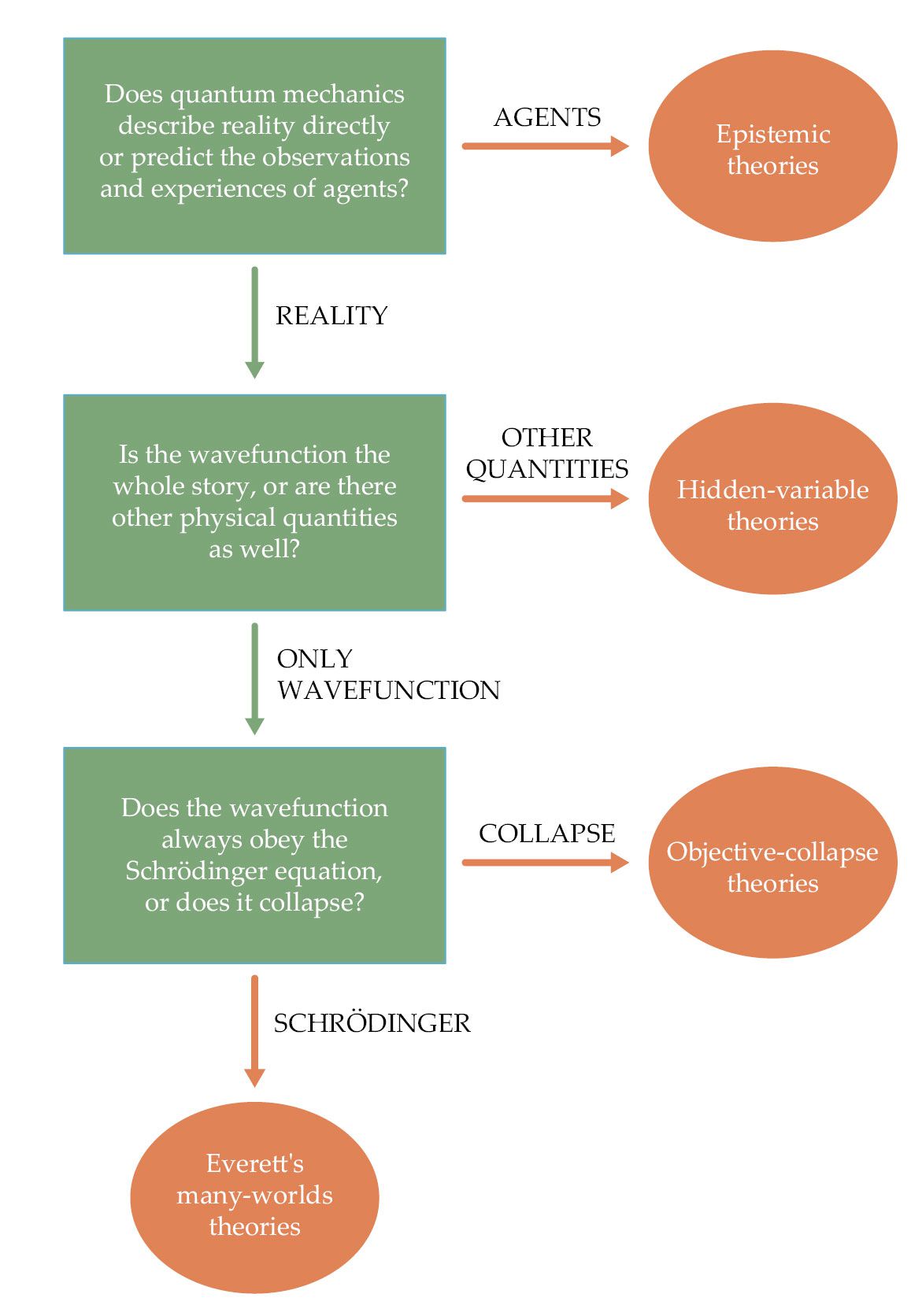
One strategy, descending from Niels Bohr and Werner Heisenberg, is to take the notion of measurement as central, rather than as an annoying technicality. The basic focus of analysis is not the physical world itself, but rather a set of agents within it, and the experiences and knowledge that those agents accrue. That approach is known as epistemic, because the wavefunction doesn’t represent physical reality but is simply a device for tracking what agents know about it. The Copenhagen interpretation falls into this category, as does the QBism approach favored by Mermin and others (see the Commentary by Mermin, Physics Today, July 2012, page 8 ).
The idea that physics isn’t about objective reality, but about the experiences of agents, would certainly be a dramatic shift. It seems counter to the general progression of science, which has acted to remove human beings from a central role in the workings of the universe. More substantively, one would still presumably like a rigorous mathematical definition of what the physical world really is, and for that matter what agents are. But perhaps the radicalness of that change in perspective is simply what quantum mechanics demands of us.
It’s not the only option, however. A second strategy is to posit that the wavefunction represents reality, entirely and exactly—an ontic rather than epistemic role. The wavefunction of an electron interferes with itself when it passes through a double-slit experiment; that kind of behavior seems characteristic of physical stuff, not of a knowledge representation. For that matter, things like the solidity of materials are explained in terms of the energies of wavefunctions of atoms; again, a very stuff-like property for something to have.
But we don’t see wavefunctions when we measure properties of quantum systems. We see specific values of the quantity being measured. That’s what inspired quantum pioneers to think differently. How can we explain that feature if the world is nothing but wavefunction?
Life in a superposition
One bold version of the ontic strategy is to simply erase all of the textbook rules pertaining to observation. Remove measurements from the formalism entirely, accept that the wavefunction describes reality fully, and insist that all it ever does is obey the Schrödinger equation. From those postulates we find that a measuring apparatus does not collapse the state of a measured system; rather, it becomes entangled with it. When an electron’s spin is measured, one component of the universal wavefunction describes the electron as spin-up and the observer as having measured it as such, while another component does the same for spin-down. Both components continue to exist if we simply take the Schrödinger equation at face value.

A flowchart illustrates different theories of quantum foundations.

The problem with that perspective is that we never feel like we’re in a superposition; empirically, we report definite measurement outcomes. The solution proposed by Hugh Everett, founder of the many-worlds interpretation of quantum mechanics, was to note that we can treat different components of the wavefunction as distinct, noninteracting worlds. Modern decoherence theory puts meat on those bones, explaining how worlds are chosen and why they never interact.
Problems, no doubt, remain. How do you recover the Born rule—the probability that an outcome is given by its amplitude squared—if every outcome comes true in some branch? At a more philosophical level, are we really prepared to accept the existence of countless copies of ourselves, living in slightly different worlds? That approach is arguably as metaphysically dramatic as putting agents at the center of our theories of physics.
Yet another tactic is possible—still accepting that a wavefunction exactly represents reality, but denying that it always obeys the Schrödinger equation, and instead introducing genuine collapses into the dynamics. Rather than invoking measurements, however, we can allow such collapses to be spontaneous (every particle has a probability per unit time of suddenly localizing) or triggered (collapse happens when branches of the wavefunction become sufficiently distinct). In either case the collapse is imagined to be genuinely stochastic, with frequencies that recover the Born rule.
In effect, those objective collapses prune off the extra worlds implied by Everett’s approach. At the same time, doing stochastic violence to the deterministic beauty of the Schrödinger equation might seem ad hoc, as is the choice of what the wavefunction collapses to. The good news is that such modifications are generally experimentally testable, though the experiments generally involve keeping large numbers of particles in a coherent superposition.
Hidden variables
The last strategy could be thought of as a middle ground: Accept that the wavefunction is part of reality, but not the whole thing, and not the part we see when we perform a measurement. We see particles, in this view, because particles exist as distinct entities, in addition to the wavefunction. Those extra degrees of freedom are known as hidden variables, even though they are what we observe. The wavefunction acts as a “pilot wave,” guiding particles into the right positions to be measured. That guidance is a nonlocal effect, which allows such theories to be compatible with Bell’s theorem. Louis de Broglie pioneered the approach, and it has been championed by David Bohm and John Bell.
Pilot-wave theories, like objective-collapse theories, seem a bit contrived. The wavefunction guides the particles, but the particles exert no influence on the wavefunction whatsoever. Perhaps more worryingly, it is hard to generalize that strategy from theories of particles to more modern quantum field theories, and much harder still to imagine how quantum gravity might ultimately be incorporated. Needless to say, proponents of the approach have ideas about addressing those problems, as do partisans of the above theories for the problems of their own.
So there are a number of different approaches to the quantum measurement problem, all of which are legitimately distinct and well-defined physical theories. (And there are others we don’t have space to mention.) But at the end of the day their experimental predictions are seemingly identical, or pretty close to it. Should we care?
Yes, we should care, because physics isn’t finished. As Richard Feynman noted, theories can be formally equivalent but psychologically different. As we try to construct more comprehensive theories of grand unification, quantum gravity, and emergent spacetime, the ideas we come up with might be strongly influenced by our attitude toward quantum foundations. Questions that seem hardly worth addressing in one approach might merit intense concern in another.
Besides, are we sure that those approaches are experimentally equivalent? My own view is that the theories are not quite developed enough, and we haven’t yet put sufficient effort into understanding them, to say for sure. Only by knowing exactly what the options are and how they fit in with the rest of physics can we be certain. There might be new experiments that we haven’t thought of, which could distinguish between them. And that is what physics is all about.
References
► S. Carroll, Something Deeply Hidden: Quantum Worlds and the Emergence of Spacetime, Dutton (2019).
► T. Maudlin, Philosophy of Physics: Quantum Theory, Princeton U. Press (2019).
► T. Norsen, Foundations of Quantum Mechanics: An Exploration of the Physical Meaning of Quantum Theory, Springer (2017).
► D. Wallace, The Emergent Multiverse: Quantum Theory According to the Everett Interpretation, Oxford U. Press (2012).
More about the authors
Sean Carroll (seancarroll@gmail.com) is the Homewood Professor of Natural Philosophy at Johns Hopkins University in Baltimore, Maryland, and a member of the Fractal Faculty at the Santa Fe Institute in New Mexico.