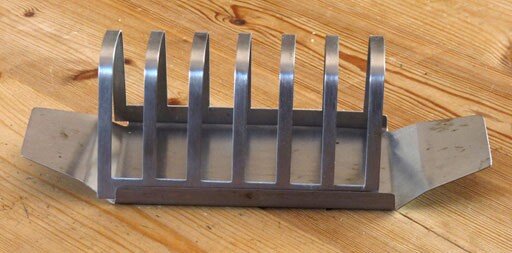
When I was in high school, I took a class in what my Welsh high school called metalwork and what an American high school calls shop. I made a toast rack out of aluminum, a candelabrum out of brass, and a coat hook out of steel. The class was enjoyable. If I remember correctly, I earned an A for it.
I never worked again with drills, countersinks and hacksaws, but I do enjoy wielding kitchen tools to cook dishes for my family and friends. Rellenong manok, the Filipino dish of pork-stuffed deboned chicken, was a recent creation.
I made a toast rack just like this one in my high school metalwork class.
I mention my distant experience with metalwork and my present experience with cooking to make the point that I like working with my hands. Still, ever since I took my first physics class at the age of 14, I’ve had little interest in doing physics experiments. Why is that?
When I was in high school in the late 1970s and early 1980s, the grades that mattered were the ones you received when you took a set of national examinations at the age of 16 and 18. For physics, those exams were wholly written. Although my physics class included experiments, they were not integrated into the course nor were they essential for mastering it.
Imperial College London, where I did my bachelor’s degree in physics, had a mandatory lab course, which was so uninspiring that I have all but forgotten it. As soon as I could, I stopped doing any lab work. When I went to graduate school at Cambridge University’s Institute of Astronomy, I specialized in the analysis of x-ray data. Although that choice required me to understand how the instruments that gathered the data worked, I didn’t have to build one.
The question that I ponder now is whether I might have become an experimental physicist if only the lab experiments I’d been exposed to had been somehow better and more interesting. As I said, I can barely remember my lab experiments, but I vaguely recall them having one thing in common: They required me to measure something whose value one could calculate in advance.
Granted, students need to become familiar with lab equipment. Doing routine experiments accomplishes that goal. But in retrospect, what I think might have sparked my interest in experiments are the lab equivalents of the open-ended questions that Peter Kapitza devised in the 1940s for his students at the Moscow Institute of Physics and Technology.
Kapitza’s questions were based on natural phenomena. They included no numerical values and could be addressed in more than one way. His goal was to teach his students how to solve problems like physicists. Here’s the 11th question of the 224 questions:
Explain why, for a bow of a given size, there is a certain size of arrow which yields the longest flight. Estimate this size for a bow of a given shape.
I have never taught physics. I’m not sure of the feasibility of open-ended questions whose solutions would require students to devise and perform experiments. But my hunch is that some of my readers might have already done that, and with great success. If so, let’s hear from you!