The most popular Physics Today stories of 2025

The list below highlights some of the most read and shared articles that were published this year in Physics Today.
A year of quantum
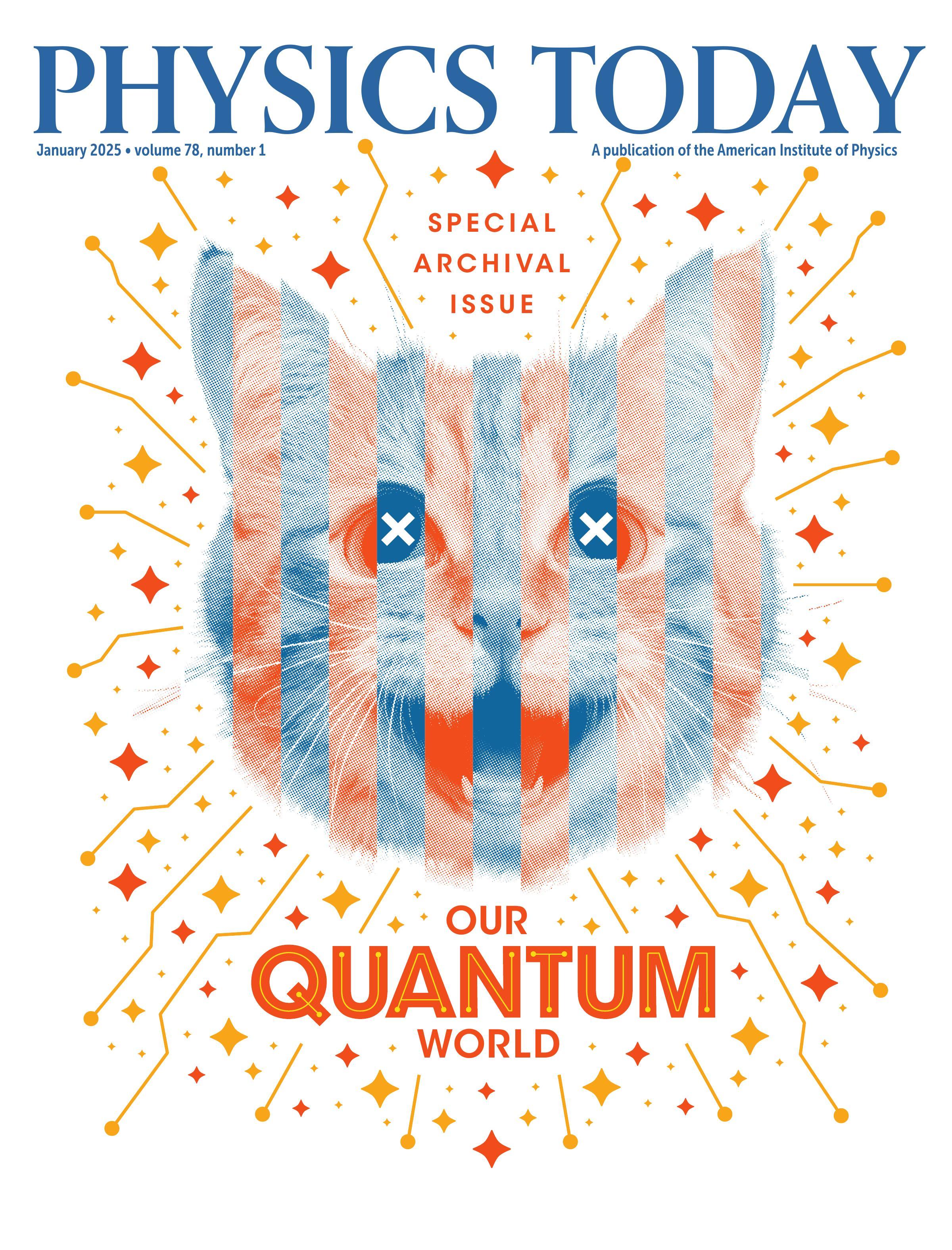
This year is the United Nations–designated International Year of Quantum Science and Technology (IYQ), and to celebrate, PT published a special archival issue in January with classic articles about quantum physics from the magazine’s 77-year archive. Popular stories from the issue include I. I. Rabi’s recollections from 1979 of the early quantum era, a 2021 primer on quantum computer architecture , and David Mermin’s 1985 “Is the Moon there when nobody looks? Reality and the quantum theory ”—one of the best-known PT articles of all time.

PT’s January 2025 special archival issue.
(Cover design by Three Ring Studio.)

PT’s other IYQ coverage features perspectives on the history of quantum mechanics. Historian of science David Kaiser describes how the research that went into his 2011 book How the Hippies Saved Physics led him to codevelop a novel test of quantum entanglement . In excerpts from an American Institute of Physics oral history, computer scientist Peter Shor recalls the development of his factoring algorithm , which escalated researchers’ interest in quantum computing and cryptography. PT’s Ryan Dahn highlights quantum physicists Laura Chalk Rowles, Katharine Way, and others featured in a recent book about women who made important contributions to the field but are frequently overlooked. And in an essay, Dahn sorts through the mythologizing and hero worship that have worked their way into historical analyses of the dawn of the quantum era.
Overall, quantum content new and old makes up half of PT’s 20 most read stories of the year.
US science policy
Stories about the Trump administration’s impact on science policy and funding dominate the list of this year’s most shared PT articles on social media. Among them are stories by PT’s Jenessa Duncombe about efforts to profile government scientists who lost their jobs , to track federal grant cancellations , and to preserve and update government research databases .
In an October essay that is also among PT’s most shared articles, John Doyle, president of the American Physical Society, sums up the uncertainty facing the physical sciences community in the US and abroad: “To be a physicist right now means to plot a future for our shared scientific enterprise in which we’ve invested our time and passion, because—make no mistake—its future is at serious risk.”
Magnetic fields and static electricity
In PT’s most-read feature article , geophysicist John Tarduno lays out the growing body of evidence suggesting that animal life on Earth actually flourished when the planet’s magnetic field—which protects organisms from harmful cosmic radiation—was exceptionally weak between roughly 591 and 565 million years ago. “The prolonged interlude when the field almost vanished,” he writes, could have been “a critical spark that accelerated evolution.”
The Quick Study by Ignaas Jimidar and Joshua Méndez Harper about static electricity also sparked readers’ interest. Although it is “an everyday phenomenon and has been studied for millennia,” the authors write, “researchers still lack a fundamental understanding of why and how charge transfers between two or more interacting surfaces.” Jimidar and Méndez Harper review what we do know about the phenomenon and describe how researchers hope to exploit it to design coatings, solar panels, and more.
What can physicists do?
In October, PT launched a Q&A series that profiles physicists who are thriving in nonacademic careers. Conducted by PT’s Toni Feder, the interviews highlight a high school teacher , a scientific instrument developer , a sports scientist , a financial analyst , and more. Multiple interviews, particularly one with Joyful Mdhluli at the International Astronomical Union, are among PT’s most read stories of the year. Look for new short profiles to appear weekly online and monthly in the pages of the magazine in 2026.