Earlier this week Nature‘s David Cyranoski reported on a new plan to reform the Chinese Academy of Sciences. Like the Soviet Academy of Sciences on which it was based, the CAS serves both as a learned society of elite scientists and as a research organization with its own labs and research centers.
Thanks in part to its size—the CAS employs 60 000 people—the CAS regularly tops Nature‘s Asia–Pacific publishing index, which ranks institutions based on how many papers they publish in Nature and its sister journals. But with 195 papers in the latest index, the academy’s 104 institutes are only 53% more productive than the second-ranked institution, the University of Tokyo, which employs 8000 people.
Indeed, the inefficiency of the CAS when it comes to converting resources into results was one of the two principal motivations behind the recent reform push. The other was Chinese president Xi Jinping’s ambition that China become a world leader in science.
Economists have studied the efficiency of institutions for centuries, the pioneer being Scotland’s Adam Smith (1723–90), whose book, An Inquiry into the Nature and Causes of the Wealth of Nations, remains valid, relevant, and in print. One theme of Smith’s analysis is that specialization promotes efficiency. On the other hand, Harvard University’s César Hidalgo and Ricardo Hausmann found in 2009 that the most prosperous countries tend to have the most complex and diverse domestic economies and trade networks. Insofar as a country’s economy and its research enterprise both entail the allocation of resources for future gain, how should China—or any other country—seek to maximize the scientific return on its financial investment?
Physicist Giulio Cimini of Sapienza University of Rome and two colleagues tackle just that question in a new analysis posted last week on the arXiv eprint server. The researchers used the SCImago database to tally the citations of papers from researchers in 238 nations in 26 broad scientific disciplines. To compare small countries and big countries, they also used a metric called the higher education expenditure on R&D (HERD).
Cimini and colleagues found, not surprisingly, that the greater a country’s HERD is, the more total citations its scientists’ papers garner. The relationship between the two is almost linear. Averaged over the 40 countries whose HERD values were available, total citations turned out to be proportional to HERD raised to the power of 0.94 ± 0.02.
Although the correlation was strong, Cimini’s group cited countries that lay above and below the fit. The UK, Switzerland, Israel, and New Zealand stood out as being significantly more efficient than the average at converting R&D funding into citable science. Japan, China, Mexico, and Turkey were significantly less efficient.
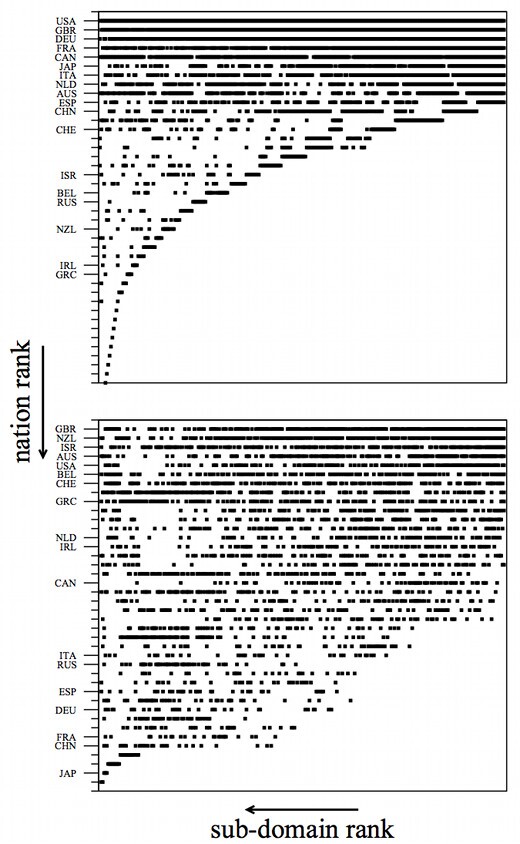
But the most interesting aspect of Cimini and his colleagues’ study—at least to me—was their investigation into what might be called the structure of national research portfolios. The researchers identified which countries were in the top 10 (or other number; the exact threshold was immaterial as long as it was not too low or too high) for each of the 26 disciplines. They then derived two statistical metrics. “Fitness” embodies a country’s strength in multiple disciplines. “Complexity” (not perhaps the best word choice) embodies the extent to which a discipline is pursued well by a small number of countries: The nicheier the discipline, the larger the complexity value.
The accompanying matrices show countries ranked by fitness and disciplines ranked by complexity. Black indicates a country is in the top 10; white indicates that it is not. The top plot is for absolute fitness values; the bottom plot normalizes fitness by HERD. The broad pattern is quite clear: The fittest countries undertake the broadest range of research.
Countries (rows) are ranked by their fitness in disciplines (columns). The disciplines (“sub-domans” in the plot) are ranked by complexity. The countries are labeled by their three-letter ISO codes. CHE is Switzerland. CREDIT: Cimini et al.
As for disciplines, the nicheiest are all in biomedicine, which requires considerable resources to excel at. By contrast, physics is practiced at a high level in a wider range of countries than, say, neuroscience. But that’s ranking in absolute terms. Dividing by HERD reveals that research strength in social sciences and the arts and humanities is not widely distributed around the world. Cimini and colleagues conclude that strength in, say, history serves as good marker for research strength in general, because, as they put it,
only highly competitive nations, in terms of scientific research, can have the necessary human and financial resources for the development of these disciplines.
So what lessons should Bai Chunli, the electron microscopist who presides over the CAS, and Chinese President Xi take from Cimini and colleagues’ study? First, as Cimini notes, the most scientifically successful countries devote around 3% of the their GDP to R&D. China currently spends 2%. Second, China should diversify its research enterprise. To quote Cimini and colleagues:
Our analysis thus points diversification out as the key element for nations to achieve a successful and competitive research system, suggesting that excellence comes out as a natural side effect of a complex, very heterogeneous, diversified, and therefore healthy, system. It is interesting to note that a recent quantitative study of the distribution of grants to research groups concluded that it is more effective to award small grants to many researchers rather than to give large grants to a few groups of elite researchers. This conclusion is coherent with our results, namely that strategies targeting diversity, rather than excellence, are likely to be more effective.
China does have a source of small, peer-reviewed small grants, the National Science Foundation of China (NSFC), but it is dwarfed in size and funding by the CAS and the Ministry of Science and Technology. Reforming the CAS could well boost China’s scientific success, but if the country is to match the US, the UK, and Germany, expanding NSFC might be the more effective measure.