On Monday Science magazine’s website published a news story with the attention-grabbing headline, “Exclusive: Secretive fusion company claims reactor breakthrough.” Reporting from a suburban industrial park in a Los Angeles suburb, Daniel Clery told readers that
Tri Alpha Energy has built a machine that forms a ball of superheated gas—at about 10 million degrees Celsius—and holds it steady for 5 milliseconds without decaying away. That may seem a mere blink of an eye, but it is far longer than other efforts with the technique and shows for the first time that it is possible to hold the gas in a steady state—the researchers stopped only when their machine ran out of juice.
That nuclear fusion might serve as a potent source of energy became apparent once Francis Aston had determined in 1920 that the helium-4 nucleus is less massive than its constituents, the difference being liberated as rest-mass energy when the constituents combine. Aston’s Cambridge University contemporary, Arthur Eddington, grasped the significance of the measurement and proposed soon after that fusion could power the Sun. For identifying solar fusion’s underlying processes in 1939, Hans Bethe was awarded the 1967 Nobel Prize in Physics.
Concepts for harnessing fusion as a source of useful energy arose in the 1940s. The difficulty in implementing any of them remains the same: creating and maintaining the extreme conditions under which protons, deuterons, and tritons overcome their mutual electrostatic repulsion to get close enough to fuse.
Wikipedia’s list of fusion experiments runs to 76 entries in two broad categories, magnetic confinement and inertial confinement. Given that global effort and news reports, such as Clery’s, of progress, I’m optimistic that the engineers, scientists, and mathematicians who are working on fusion power will one day make it practical.
What would future generations do with an abundant, cheap, and inexhaustible supply of energy? Processes that currently consume too much energy to be cost-efficient could become widespread and beneficial. For example, the desalination of seawater would relieve Earth’s water shortages. Trash could be recycled on a massive scale to extract valuable trace elements, such as rare earths. Carbon dioxide could be sucked out of the atmosphere to mitigate climate change. People could live comfortably in Earth’s polar regions.
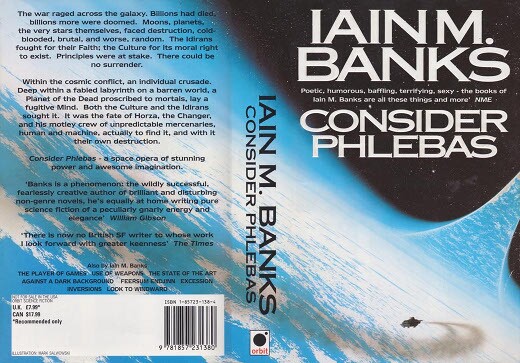
Mark Salwowski’s artwork for 1988 UK edition of Iain M. Banks‘s first science fiction novel depicts the Vavatch Orbital, a vast artificial ring-shaped world. CREDIT: Orbit Books
My incomplete list might seem like science fiction for now. Indeed, my favorite writer of science fiction, the late Iain M. Banks, set nine of his novels amid an interstellar civilization known as the Culture, whose energy sources and other technologies are so advanced that every good and service is free. Plots unfold when the Culture’s humanoids and artificial intelligences interact to dramatic effect with other civilizations that inhabit the galaxy.
Fantasy aside, access to energy and the devices that it powers is essential to civilization. In rich countries, ready availability of cheap lighting, heating, refrigeration, and transport is taken for granted. In poor countries that lack reliable and bountiful sources of energy, those technological amenities are luxuries.
Meeting the energy needs of the world’s poor is a challenge, especially given our reliance on fossil fuels and the additional greenhouse gas emissions that would entail. Still, it’s surely an easier, more attainable goal than building the world’s first practical fusion-powered generator.