On 2 May 1964 Britain’s newest TV channel, BBC2, broadcast “The World of Buckminster Fuller,” the debut episode of a science documentary series called Horizon. After more than 50 seasons and more than 1100 episodes, Horizon and its PBS imitator and production partner, Nova, are still on the air.
How the long-lived show was conceived is the topic of a paper published in March by Timothy Boon of London’s Science Museum. Boon’s paper appears in the March 2015 issue of the British Journal for the History of Science.
In the BBC of the 1950s and early 1960s, Boon recounts, science programming was divided among three production departments called Documentaries, Talks, and Outside Broadcast. Outside Broadcast, whence Horizon sprang, already had a science series, Eye on Research, which ran from 1957 to 1961. Presenter Raymond Baxter and the mobile crew would visit laboratories and other centers of scientific research. Standing before the camera, Baxter simplified and translated the science for the viewers—in a way, Boon noted, that was “heavy on the explanation of science.”
Aubrey Singer, who led the Outside Broadcast department at the time, wanted Horizon to be different. In an internal memo, one of the writers on the Horizon team, Gerald Leach, set out the show’s goals:
Apart from books, science is nearly always presented as a set of impersonal facts and discoveries and what we can do with them, almost as if they were produced by magic out of a vacuum. There is rarely any recognition of the vital facts that any scientific discovery or idea is a personal creation, stamped by the character of the scientist and his age; that they are as different in kind as (say) a play by Brecht and one by Ionesco; that there are fashions in science and that fashions change for the same extraordinary reasons as anywhere else . . . In short there is rarely any attempt to place new developments in their total context—personal, social, historical, political.
One series that Singer looked to as a model was the wide-ranging and successful magazine-style arts program, Monitor. Produced by the Talks department, Monitor typically covered three topics per episode. Its editor and anchor was Huw Wheldon, who introduced and linked the topics.
Horizon‘s pilot followed the same format. The three topics consisted of an interview with Manhattan Project physicist Philip Morrison about scientists’ moral responsibilities, a profile of biologist John Maynard Smith, and a set of short segments about the psychology of aggression. Serving as anchor was nuclear physicist Roger Blin-Stolye of the University of Sussex.
The pilot failed to impress BBC2 programming chief Michael Peacock, who dismissed it as “derivative” and suggested dispensing with an anchor. It was never aired.
Given that one of the anchor’s roles was to link topics, doing without one meant that each episode could devote all of its 45 minutes of running time to just one topic. “The World of Buckminster Fuller” and subsequent episodes relied on off-screen narration, on-screen interviews, and footage of science in action.
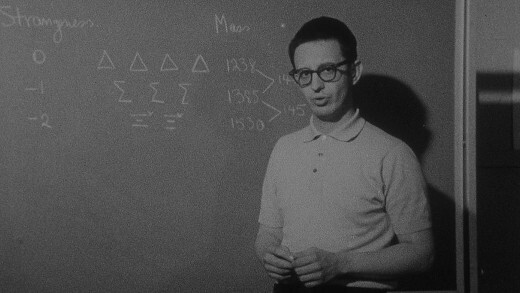
This frame from the Horizon episode “Strangeness Minus Three” shows Nicholas Samios in his office at Brookhaven National Laboratory. CREDIT: BBC
Particle physics was the subject of the program’s fourth episode, which aired on 25 July 1964. “Strangeness Minus Three,” which you can watch on YouTube, tells the story of the discovery at Brookhaven National Laboratory earlier that year of the first baryon made wholly of strange quarks, the Ω−.
In the episode, narrator Christopher Chataway interviewed the two physicists, Murray Gell-Mann and Yuval Ne’eman, who predicted the particle’s existence and mass two years earlier, and Nicholas Samios, who led the team that discovered it. Also interviewed—and the first scientist to appear on screen—was Richard Feynman, who delivered a characteristically charismatic performance.
The fuzzy black-and-white footage of “Strangeness Minus Three” looks dated now, but it’s still effective television. The episode’s approach was to let the physicists themselves tell the story—but only so far. Location shots added visual interest; interjections by the narrator added context. Eleven years later, when Horizon and Nova ran an episode, “What Einstein Never Knew,” about efforts to unify the forces of nature in one theoretical framework, the approach remained the same. It was just as effective.
What accounts for the longevity of Horizon and Nova? Foremost, perhaps, is the fact that science keeps changing and expanding. A series about, say, the American Civil War or the birds of the world would eventually run out of interesting, substantial topics. Another source of longevity was Singer and the originators’ recognition that television is a distinctive medium. Despite the large numbers of interviews, “Strangeness Minus Three” and “What Einstein Never Knew” avoid seeming like filmed lectures or panel discussions. Those episodes and others exploited the features and techniques of television to the full.
Finally, there’s the fact that Horizon and Nova are neither patronizing nor didactic. From the start, the producers recognized that the science is mostly about the evolution of ideas—ideas, which, if presented effectively, interest nonscientists and scientists alike.