One the perks of writing about physics and its diverse manifestations is that I can obtain press passes for Comic-Con, WonderCon, and other celebrations of popular culture, where physics does indeed appear. This past weekend my adopted hometown of Washington, DC, hosted Awesome Con. Physics, I’m happy to report, was much in evidence.
“Colonization and beyond: The science and fiction of exoplanets and what it would really take to get there” was the title of a panel discussion held at the convention on Saturday morning. Deftly moderated by astronautical engineer Mason Peck of Cornell University, the panel lived up to its long, descriptive title.
Panelist Anthony Del Genio of the Goddard Institute for Space Studies in New York City recounted meeting Clyde Tombaugh in the 1980s, half a century after Tombaugh had discovered Pluto. At that time, Del Genio told the audience, he believed he would never meet another planet discoverer in his lifetime.
Del Genio’s pessimism was dispelled within a decade when the first confirmed exoplanets were discovered in 1992. Now, thanks mostly to NASA’s Kepler mission, the count stands at 1928 exoplanets in 1219 planetary systems. The number of planets in our galaxy on whose surfaces liquid water could exist is estimated to be 10 billion.
Unlike the authors of science fiction, scientists are often surprisingly unimaginative, said Del Genio. Our solar system contains no planets whose mass lies in the range between that of Earth and Neptune, which is 17 times more massive. Yet few, if any, astronomers anticipated that exoplanets in that mass range would turn out to be the most abundant.
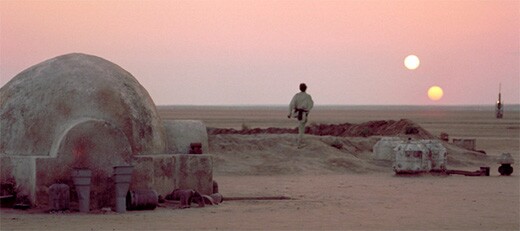
The possibility that an exoplanet could orbit a binary star was anticipated before such a planet, Kepler-16b, was discovered in 2011. But, as Del Genio wryly pointed out, the anticipator was not an astronomer; it was George Lucas, whose 1977 movie Star Wars featured a planet, Tatooine, that has two suns.
The fictional Tatooine is a desert planet that orbits a binary system consisting of a G-type star and a K-type star. The planet’s real-life counterpart, Kepler-16b, is likely a gas giant. It orbits a binary system consisting of a K-type star and an M-type red dwarf.
One of the other panelists, Michael McDonnell, has a physics degree. He’s also among the 100 volunteers who have passed the third selection round for Mars One, a quixotic private project to establish a permanent human colony on Mars by 2027. “Volunteer” is apt. The project’s goal is remotely feasible because the colonists will be making a one-way trip. McDonnell told the audience he was motivated by the opportunity to explore humankind’s only near-term alternative planetary home.
The two science fiction authors on the panel, Charles Gannon and Kristen Lippert-Martin, made complementary observations about the role of science in science fiction. Gannon writes novels that are rooted in the science of the nearly possible. NASA, he noted, has already solved one of the medical problems associated with spending long periods in microgravity: bone loss. At least one other problem remains, however: visual impairment and intracranial pressure syndrome. Solving that and other problems will likely entail genetic engineering. It might also influence spaceship design. If, Gannon speculated, microgravity’s harmful effects disappear at accelerations as low as 0.2g, simulating gravity with rotation becomes easier.
Lippert-Martin’s debut young-adult novel, Tabula Rasa (Egmont USA, 2014), centers on a girl, Sarah, whose memory has been wiped clean by a sinister authority. The plot unfolds in a hospital complex, not on an exoplanet. Lippert-Martin did, however, evoke exoplanets to make a general point. The journey from discovering exoplanets to colonizing them is likely to take as long as the construction of a medieval cathedral: centuries.
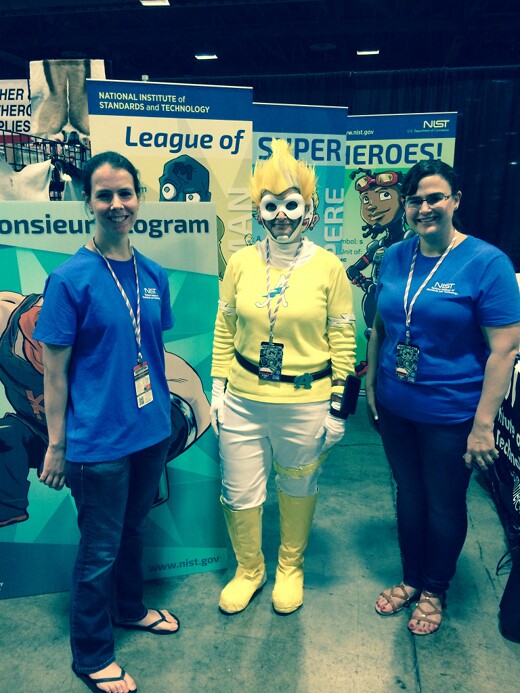
Awesome Con’s exhibit hall featured the usual mix of comic-book vendors, artists, toy shops, fan clubs, and so on. Among the booths in a prime spot on aisle 200 was one from the National Institute of Standards and Technology. There, I met two scientists from NIST’s Gaithersburg campus: Joan Dreiling of the atomic spectroscopy group and Lisa Fredin of the chemical informatics group.
Joan Dreiling (left) and Lisa Fredin (right) flank SI superhero Ms. Ampere at NIST’s Awesome Con booth.
Dreiling and Fredin told me about NIST’s League of SI Superheroes, a campaign to teach children about the metric system. To promote the effort, NIST’s director of public affairs, Gail Porter, dressed up as one of the superheroes, Ms. Ampere. Donning a costume and attending Awesome Con is part of Porter’s job. But Dreiling and Fredin volunteered to staff the booth. I was impressed by their dedication and enthusiasm.
The US Department of Energy also had a presence at the convention. On Friday afternoon, three DOE scientists and one DOE outreach officer took part in a panel discussion, “Energy at the movies: From science fiction to science fact.” The connections the panelists made between DOE research and science fiction movies were real but somewhat tenuous.
For example, the National Ignition Facility at Lawrence Livermore National Laboratory appeared in the 2013 movie Star Trek Into Darkness—because of what it looks like, not because of what it does. That said, the panelists succeeded in conveying to the audience how science fiction inspired them to become scientists. And the research they described was important, interesting, and engaging.
One member of the audience sought the panelists’ advice on fostering her six-year-old son’s growing interest in science. Some of the advice was not unexpected: Get a chemistry set. But to my surprise, the panelists stressed the importance of art and literature. Joyce Yang of Pacific Northwest National Laboratory said her early love of drawing helped her scientific career. Drew Bittner of DOE advised: “Read anything that gets you asking, Could I make that? Start writing stories. What if I could fly to the Moon?”
The mother stood her son on a chair to give him a better view of the panelists. When he was asked about what got him interested in science in the first place, he replied “space.”