Lessons from Stuart Freedman: Six scientists share their stories


Stuart Freedman has been mentioned in Physics Today several times in recent years for his efforts, with John Clauser, on the first experimental Bell test. 1 Done as Freedman’s thesis, it provided evidence that local hidden-variable theories, proposed as alternatives to quantum mechanics, were incorrect. His paper was referenced in several 2025 PT pieces: the feature “Hippies, Bell tests, and a career studying quantum entanglement ,” by David Kaiser; a letter from Robert Cahn responding to the feature “Chien-Shiung Wu’s trailblazing experiments in particle physics ,” by Chon-Fai Kam, Cheng-Ning Zhang, and Da Hsuan Feng; and the republished story “Magic moments with John Bell ,” by Reinhold Bertlmann. In 2022, it was referenced in PT’s coverage of that year’s Nobel Prize in Physics, awarded for experiments with entangled photons. Seeing those recent references has prompted us to bring to light Freedman’s contributions in another area: his mentorship and inspiration to students and younger colleagues.
Before his sudden death in 2012, Freedman lived an extraordinary physicist’s life. His experimental acumen left its imprint on many areas, including fundamental nuclear physics, quantum entanglement, and neutrino oscillations. He performed world-class research and held positions at Princeton University, Stanford University, Argonne National Laboratory, the University of Chicago, Lawrence Berkeley National Laboratory, and the University of California, Berkeley. We present the case here that his contributions to developing human capital in physics were as profound as his contributions in advancing its research agenda.

Stuart Freedman making adjustments to his PhD apparatus at Lawrence Berkeley National Laboratory in 1971.
(Photo courtesy of Lawrence Berkeley National Laboratory.)

We believe that Freedman has had an inordinately undervalued reputation, which possibly was because he had a self-effacing manner and neither the time nor the inclination for self-promotion.
Here we’ve compiled, from the two of us and four other scientists, stories that exemplify the value Freedman provided to the human side of science. We all went on to complete PhDs in physics (although none directly supervised by Freedman). Rather than simply extending his own research agenda through those he mentored, Freedman supported them in pursuing their own paths.
These stories illustrate core aspects of Freedman’s mentorship at critical stages of a scientist’s development: as an undergraduate student, as a graduate student making career choices, and as a young experimental physicist forming their own professional foundation.
Let physics drive you
Jim Napolitano
Jim Napolitano met Stuart on the first day Napolitano arrived at Stanford in 1977 to begin graduate school. The nuclear-physics experiments that they conducted together at Stanford were only the beginning of a decade of collaboration. Stuart worked with Napolitano on his PhD thesis experiment at SLAC, and Napolitano was a postdoc and then scientific staff member in Stuart’s group at Argonne.
Stuart’s manner, Napolitano says, was approachable and welcoming. In addition to the wealth of physics knowledge he imparted, Stuart provided lessons in technical writing, flying sailplanes, keeping things in perspective, and exercising good judgment in interactions with research groups and the scientific community.

Freedman in a sailplane.
(Photo courtesy of Joyce Freedman.)

Napolitano recalls that one of those lessons was “Beware of becoming too attached to a ‘program.’” In other words, Stuart urged Napolitano and others to always let physics drive their efforts and to not get pigeonholed by a specific field or technology.
Indeed, Napolitano’s career has involved many fields, including nuclear physics, high-energy physics, and advanced computing. He has taught in the classroom and instructional laboratory. A tribute to Stuart appears in the preface of a textbook that Napolitano coauthored. 2 He continues to realize that so much of what he teaches his students are lessons that Stuart taught him, which is about as close as one can get to immortality.
Be a guide, not a guard
Jill Marshall
Jill Marshall met Stuart when he was the instructor of her undergraduate mechanics class at Stanford. She vividly recalls a casual hallway conversation during her senior year when Stuart, dressed as always in blue jeans, asked about her plans. The inquiry itself was memorable. Stuart was the only physics department faculty member who she remembers ever asking about her plans as if they mattered.
Marshall told Stuart that she was applying to graduate school at Stanford, although she thought it unlikely that she would be admitted there, and that she was also applying to several other schools, including the University of Texas at Austin. Stuart offered a profound response: “Well, would you rather go to a school like Texas where they build people up or one like Stanford where they don’t want you unless you already have a Nobel Prize?” It seemed to her that his advice was based on his own experience.
Stuart’s candor about what might (and what should) be valued by a physics department left a strong impression on Marshall. His practice of being the “guide on the side,” helping students identify their interests and abilities, rather than the “guard at the gate,” deciding who was worthy of being a physicist on the basis of their prior achievement, became a hallmark of her teaching philosophy and a theoretical underpinning of her research in physics education.
After PhD work focused on nuclear particles, Marshall went into space science and physics-education research. She has served as a codirector of UTeach, a teacher preparation program at UT Austin, and the 2012 president of the American Association of Physics Teachers.
Embrace your role, whether leading or assisting
Robert Cousins and John Greenhalgh
As a freshman at Princeton, Robert Cousins was placed into an honors discussion section that was led by Stuart, fresh from earning his PhD from Berkeley. “Several times a week, about 15 of us spent an hour with Stuart, digging deep into physics concepts and problems, and also discussing cultural differences between California, Kentucky (my home), and the Northeast,” Cousins says. “We learned to appreciate Stuart’s quirky, ironic sense of humor, as well as his warmth and patience with us.”
Stuart and fellow Princeton faculty member Gerry Garvey planned to collaborate on experiments using the cyclotron, which provided senior thesis opportunities for Cousins and classmate John Greenhalgh. Cousins reports, “It turned out to be an amazing experience, as John and I became completely immersed in the cyclotron group, reinforcing my decision to become an experimentalist, while meeting and discussing physics and techniques with superb grad students and visiting faculty.” Cousins also remembers that Stuart was “incredibly patient” while he dealt with students making “various blunders in the lab.” A consummate experimentalist, Stuart was able to see their mistakes as growth opportunities.
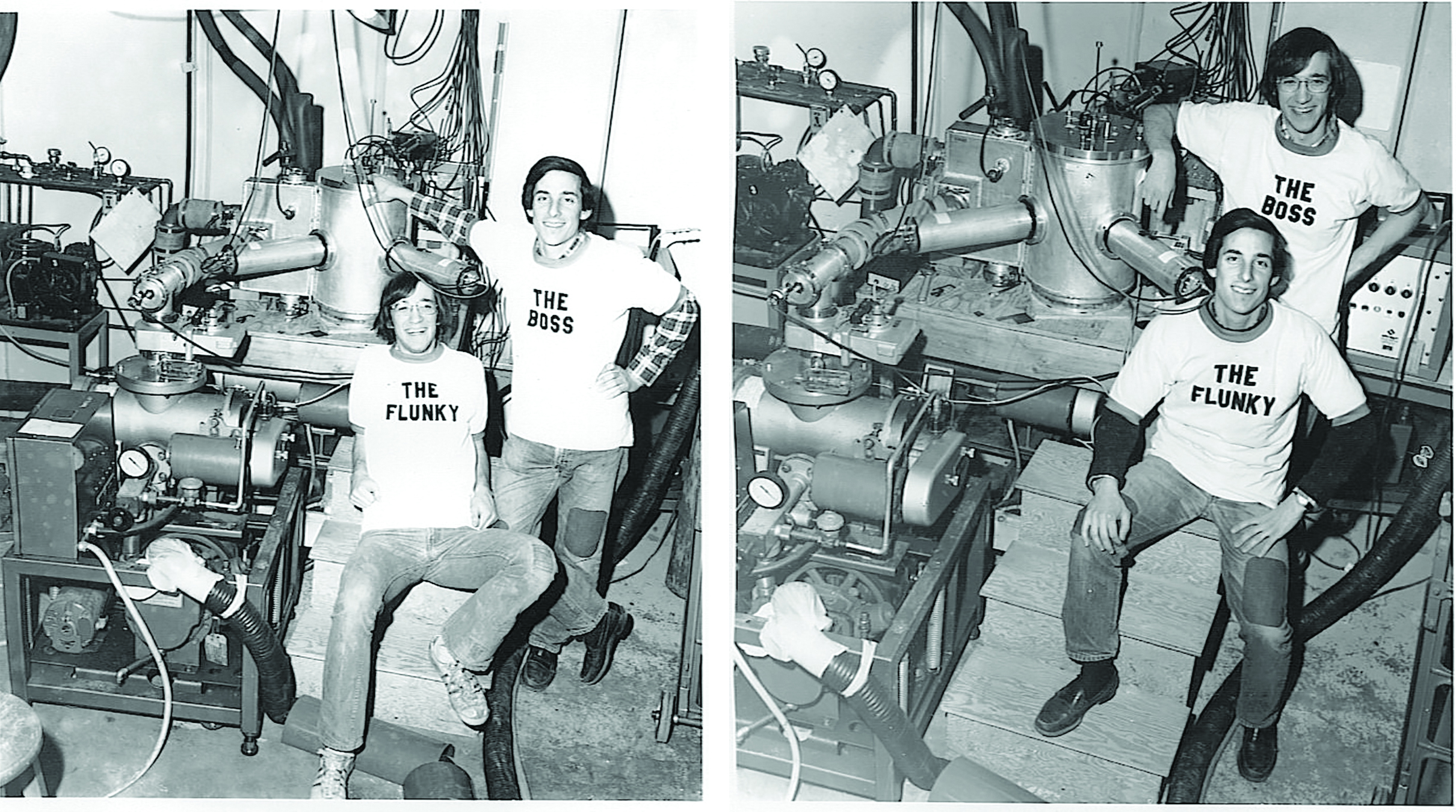
Cousins remembers how Stuart handled a situation in the cyclotron lab when he and Greenhalgh were “bickering” about details of the execution of their joint senior thesis experiment. Stuart told them that it really didn’t matter who was right because they were bickering about things that did not really matter. He gave them sticky notes and eventually T-shirts with “THE BOSS” written on one and “THE FLUNKY” on the other and instructed them to trade roles each day.

Robert Cousins and John Greenhalgh (left and right, respectively, in the left photo) in shirts that Stuart Freedman gave them in spring 1976. After the seniors were arguing about a joint experiment, Freedman instructed them to switch roles every day.
(Photos by Princeton University physics department, courtesy of Robert Cousins.)

In 1976, Cousins and Greenhalgh both began grad school at Stanford, while coincidently, Stuart became an assistant professor there. Although enrolled in Stuart’s graduate seminar on nuclear physics, they both leaned toward research in high-energy physics and explored opportunities at SLAC. “Then, in the fall of 1977, Mel Schwartz gave a colloquium about his forthcoming experiment at Fermilab (studying pi–mu atoms). Afterward, Stuart told us that we should talk to Mel about working with him,” Cousins says. That changed the course of their careers. By January, Cousins and Greenhalgh were on their way to Fermilab, for another “wonderful experience” completing their dissertation work.
Greenhalgh feels fortunate to have been mentored by Stuart, whose approach to physics (and life) has served him well in his career. He notes, “He impressed upon me the beauty of experiments that touched upon the most fundamental questions . . . If there is such a thing as having taste in physics, he had it.”
Following Stuart’s advice, Cousins moved into high-energy physics. He is now a professor emeritus at UCLA. After a postdoc at Princeton, Greenhalgh went on to a career in MRI. He is now vice president of R&D at FONAR and a consulting medical physicist for West Physics.
See potential, despite errors
David B. Kaplan
David Kaplan recalls sitting in the office of Schwartz, who was his undergraduate adviser at Stanford, when Stuart came in and announced that “Helen [Quinn] and Roberto [Peccei] have a theory that predicts a new light particle [now known as the axion] in the standard model.” Stuart described the particle to Schwartz, “who snorted and said it would have been seen already.” Stuart convinced Schwartz otherwise, and then “the two of them went at it on the blackboard, going through various existing experiments and designing new ones to test the theory.” Says Kaplan, “I sat on Mel’s couch like a fly on the wall, very excited by what I was seeing, although not at the prospect of being an experimentalist like them but by the idea that as a theorist I could predict new particles!” Kaplan credits the interaction with strengthening his belief in the power of theory and solidifying his career trajectory.
Kaplan remembers an interaction in which Stuart guided him and Ann Nelson in their senior project, for which they were to design, build, and conduct an experiment. Stuart suggested that they repeat Richard Cox’s precocious 1928 discovery of parity violation in the weak interactions. Kaplan describes the experience as “an ambitious and exciting project which Stuart supervised with a light touch, allowing me to mess it up by flooding the box with helium to reduce background counts, in the process destroying six phototubes on loan from SLAC.” Kaplan recalls, “We both agreed—he with his usual understated sardonic wit—I was not experimentalist material, but I was nevertheless allowed to graduate from Stanford and took with me a profound respect for Stuart’s intelligence and passion for physics.” Stuart saw Kaplan’s potential despite his blunder in the lab.
Kaplan followed his commitment to theory. He is now a senior fellow at the Institute for Nuclear Theory at the University of Washington.
Own up to your mistakes
Jane “Xan” Alexander
Jane “Xan” Alexander, one of Stuart’s undergraduate students at Stanford, remembers a time when he modeled a capacity for self-reflection and growth rarely observed in physics faculty. Stuart made a teasing remark in class about her having left “an article of clothing” (a jacket) in the TA’s office, and the male students laughed. At the time, Alexander and Marshall shared an office. On a large strip of paper taped to the wall, they recorded things said to them by faculty (for example, “You obviously should be in the liberal arts” and “Gentlemen, let’s begin class”), statistics they came across (for example, that the Stanford physics department awarded more BS degrees to women in 1949 than it would be awarding in 1980), and so on, to help them process what it meant to be female physics majors in a department that did not uniformly welcome them. Alexander wrote “an article of clothing” on the paper. Later, she came into the office and found Stuart staring in silence at what she had written. She braced for an angry defense, to be told she should recognize a joke, but he turned to her and simply, sadly said, “I’m sorry.”
Alexander valued her interactions with Stuart. She says, “I remember him as one of the few professors who didn’t care that I was female, only that I was a student to mentor and to respect as a junior colleague.”
Alexander pursued research policy and administration. She has served as deputy director of the Defense Advanced Research Projects Agency, executive director for science and technology at the Office of Naval Research, and deputy director of the Homeland Security Advanced Research Projects Agency.
A human legacy

Stuart Freedman in 2005 with a copy of The Neutrino Matrix, which summarized a neutrino-physics study he co-chaired with Boris Kayser.
(Photo by Roy Kaltschmidt, courtesy of Lawrence Berkeley National Laboratory.)

As these recollections show, Freedman made a lasting impact on those around him. He mentored by example, in how he interacted with students and other more junior members of the physics community. He taught the importance of building a rewarding career and of seeing and valuing the potential in other people.
To recognize Freedman’s legacy as a mentor, the American Physical Society in 2016 established the Stuart Jay Freedman Award in Experimental Nuclear Physics, awarded annually to an early-career experimentalist. Shortly after his death, the American Physical Society April Meeting featured a talk on his scientific legacy, and UC Berkeley hosted a symposium, called Measuring Nothing and Getting It Right , to honor him. Freedman indeed worked on many groundbreaking experiments, but his guidance as a mentor had an equally lasting impact.
References
1. S. J. Freedman, J. F. Clauser, “Experimental test of local hidden-variable theories ,” Phys. Rev. Lett. 28, 938 (1972).
2. J. J. Sakurai, J. Napolitano, Modern Quantum Mechanics , 3rd ed., Cambridge U. Press (2020).
More about the authors
Jill Marshall is a former STEM education professor at the University of Texas at Austin. She has served as a codirector of UTeach, the university’s secondary STEM teacher preparation program. Her research interests include high-energy nuclear physics, space particle physics, and physics education.
Jim Napolitano is a physics professor at Temple University in Philadelphia. He conducts research in experimental nuclear and particle physics, is passionate about developing experiments for undergraduates, and has authored several advanced physics textbooks.