On 28 September 1957 a new eight-car electric train pulled out of Fujisawa Station in Japan to embark on the last of a series of test runs. Known as the Romance Car SE3000, the lightweight streamlined train reached a top speed of 145 km/h (91 mph), thereby setting a world record for narrow-gauge rail vehicles.
The recording-breaking feat was all the more remarkable because just 12 years earlier Japan had suffered a devastating, demoralizing defeat in World War II. The US occupation that followed had ended just five years earlier. How Japan came to develop such a train and its successor, the famous Shinkansen “bullet train,” is the subject of a fascinating book by Takashi Nishiyama, Engineering War and Peace in Modern Japan, 1868–1964 (Johns Hopkins University Press, 2014).
The first, “0 Series,” Shinkansen high-speed train made its debut in 1964. Note the small, drag-reducing separation between the cars.
I’m not, nor have I ever been, an aficionado of trains. But having spent two years living in Japan as a postdoc, I acquired an enduring interest in the country’s history and culture. And even if I weren’t a Japanophile, as someone who writes about physics, I’m obliged to pay attention to the country’s scientific enterprise: Of the 40 physicists who have been awarded the Nobel Prize in Physics this century, seven (17.5%) are Japanese.
Physics or any other science is not the focus of Nishiyama’s book. When Japan embarked on a modernization program in 1868 to catch up with the West, engineering was the priority. Japan’s first and most prestigious university, Tokyo Imperial University (later named Tokyo University), was founded with a king-sized engineering department from the outset.
Japan indeed caught up. By 1897 its technologically superior military had defeated China in a two-year war. Each successive conflict—the Russo–Japanese War (1904–5), World War I (1914–18), the Invasion of Manchuria (1931–32)—resulted in Japanese victory and reinforced the relationship between academic engineering and military power.
As Nishiyama tells it, by the time Japan attacked Pearl Harbor in December 1941, the best and brightest engineers were the ones who designed aircraft for the Imperial Japanese Navy or the Imperial Japanese Army. Both military branches competed to identify and recruit the top engineering students, the navy being the more successful. Until the US Navy began deploying the Grumman F6F Hellcat in June 1942, the Mitsubishi A6M Zero was the most effective carrier-based fighter in the Pacific theater.
When the US occupation of Japan began on 28 August 1945, demilitarization was a top priority. The research institutes that had developed the Zero and other aircraft were disbanded; their engineers became unemployed. Some of the most accomplished aeronautical engineers eventually found work at the Railway Technical Research Institute, where research for the Romance Car SE3000 and the Shinkansen took place. Others entered Japan’s nascent automobile industry.
Physicists do make an appearance in Nishiyama’s book—albeit in a brief yet surprising context. For cultural, financial, and other reasons, Japan’s aeronautical engineers couldn’t, or wouldn’t, emigrate to continue pursuing their vocation. By contrast, Japan’s physicists were much more mobile. Although he doesn’t mention them by name, two of Japan’s 21st-century physics laureates—Masatoshi Koshiba and Yoichiro Nambu—left Japan for the US in the early 1950s.
I spent my postdoc at Japan’s Institute of Space and Astronautical Science (ISAS) in Sagamihara, an industrial city that abuts Tokyo’s western suburbs. The institute sprang from a group at the University of Tokyo that began experimenting with miniature rockets in the late 1940s. Its leader and the eventual founder of ISAS was a former aeronautical engineer, Hideo Itokawa. He led the team that designed the Imperial Japanese Army’s most successful fighter of World War II, the Nakajima Ki-43 Hayabusa.
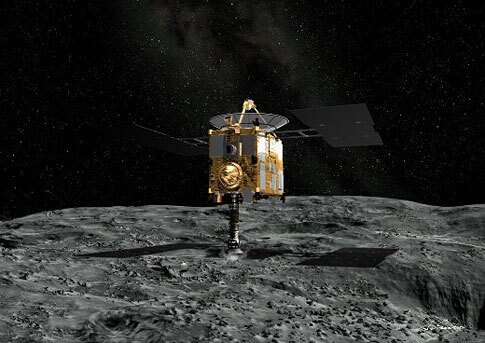
An artist’s impression of Japan’s Hayabusa probe scooping up a sample from the surface of asteroid Itokawa.
The names Itokawa and Hayabusa, which means peregrine falcon, might seem familiar to you. On 19 November 2005 the Japanese spacecraft Hayabusa landed on an asteroid named after Itokawa. The probe scooped up some dust from the asteroid’s surface and successfully brought the sample back to Earth for analysis.
Japan’s space program lies outside the scope of Nishiyama’s book—which leaves me to hope that he or some other historian will tell its story.