Artificial photosynthesis, flexible electronics, and some other areas of research are intrinsically interdisciplinary. A physicist might devise a new photonic metamaterial, but he or she might need the help of a chemist to make it and an engineer to turn it into a device.
Some individual researchers are interdisciplinary. By the early 1990s, Roderick MacKinnon had been working for two decades on the membrane proteins that control the flow of potassium ions in and out of neurons. He had identified the protein’s genetic sequence, but to understand how the protein did its job—in particular, how it blocked the passage of chemically similar yet physically smaller sodium ions—he would have to see the protein’s structure. So MacKinnon, whose expertise lay mostly in electrophysiology, set about learning how to become an x-ray crystallographer. He succeeded—and went on to receive the 2003 Nobel Prize in Chemistry.
I encountered another interdisciplinary scientist at the 20th annual Science in Japan Forum, which was held last Friday at the Cosmos Club in Washington, DC. The forum, which is organized by the Japan Society for the Promotion of Science, has a different scientific theme each year. This year’s was marine biological science.
In his native Japan, Katsumi Tsukamoto of Nihon University is known as Unagi Sensei (Doctor Eel). “Unagi” is Anguilla japonica, a relative of the American eel, Anguilla rostrata, and the European eel, Anguilla anguilla. At the start of his talk, Tsukamoto noted that grilled eel is among the most popular dishes in Japan. He also noted that the eel’s life history had baffled humans for millennia. Until the 1910s, no one had seen a larval eel. And it remains the case that no one has observed female eels in the act of spawning eggs nor male eels in the act of fertilizing them.
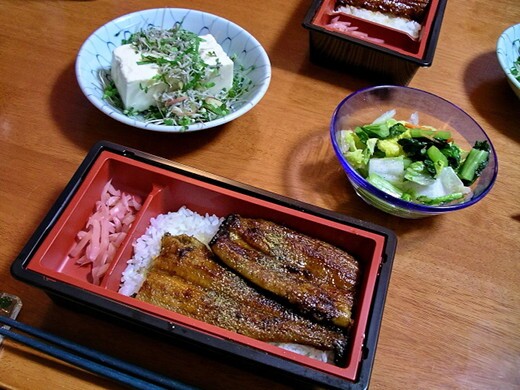
Grilled eel is the main dish in this boxed lunch.
The mystery was solved, at least for the American and European eels, in 1912 by the Danish biologist and oceanographer Johannes Schmidt. As Tsukamoto explained, Schmidt fished for eels in the Atlantic Ocean, measured them, and drew a contour map of their body size. The contours of gradually decreasing size eventually led Schmidt to the Sargasso Sea, which occupies the center of gyre between the Gulf Stream to the north and the Canary Current to the south.
In 1992 Tsukamoto used Schmidt’s method to identify the spawning grounds of the Japanese eel, which turned out to lie in the western North Pacific Ocean near the Mariana Islands. Since then, Tsukamoto has used—and continues to use—diverse scientific means to discover why and how the anguillid eels, leave their freshwater riverine habitats to spawn in distant salty seas.
The order that contains the eel-shaped fish, Anguilliformes, contains four suborders and 20 families. The Anguillidae family contains just one genus, the freshwater eel Anguilla. All eels are predators. Thanks to phylogenetic analysis, Tsukamoto and his collaborators have deduced that the first freshwater eel shared an ancestor with the today’s snipe eels, sawtooth eels, and other suborders of marine eels.
Phylogenetic analysis also identified the Borneo eel, Anguilla borneensis, as the species closest to the first freshwater eel. Most Anguilla species are found in the seas around Indonesia. Unlike the American, European, and Japanese eels, the various Indonesian eels spawn close to home.
How did the anguillid eels come to inhabit freshwater? And why do some species travel so far to spawn? Tsukamoto and his collaborators have developed a fascinating hypothesis. Facing competition from other eels, the ancestral anguillids colonized estuaries and then rivers, where rival predators were less abundant.
Anguillid eels are among the oldest extant species of fish. They were around when dinosaurs roamed Earth and when, in the Cretaceous period, what would become the Atlantic Ocean was narrower and what would become the Mediterranean Sea was open to the oceans.
Tsukamoto hypothesizes that larvae of what would become the American and European eels accidentally drifted westward to occupy new habitats. By the time they had colonized the rivers of Europe and North America, they had acquired adaptations, such as bigger bodies compared with their Indonesian relatives, that enable them to endure the long journey to spawn.
Elucidating the life history of the modern Japanese eel remains a focus of Tsukamoto’s research. By tagging eels with sensors, he and his collaborators have determined that the eels identify their spawning grounds, in part, by detecting a sharp salinity gradient that occurs in the southern part of the West Mariana Ridge.
Tsukamoto is also trying to determine what makes Japanese eels’ spawning ground so special. During his talk, he showed a short video of his collaborators wafting dry ice through a tabletop-sized three-dimensional model of the mountainous ocean floor around the Mariana Islands. When the gas reaches a steady state, it’s possible to discern vertical eddies around some seamounts. Those eddies could be important in enriching the spawning ground with nutrients.
I don’t know whether Tsukamoto will ever observe Japanese eels mating. But I’m sure he’s pursuing multiple approaches from multiple disciplines to achieve that elusive goal.