Perhaps because the 1970s are four decades behind us, reviewers of Rick Perlstein’s new book, The Invisible Bridge: The Fall of Nixon and the Rise of Reagan have felt obliged to remind readers of the decade’s miseries. Defeat in Vietnam, the Watergate debacle, the Arab oil embargo, rising unemployment and rising inflation—all befell the US in that period.
In the UK, where I grew up, the 1970s were even worse. Piled on top of economic misery we had domestic terrorism, power cuts, and debilitating strikes. But there was one consolation for teenagers like me in the 1970s: music. It was brilliant!
Genesis, Pink Floyd, Yes, and other progressive rock bands were making music of increasing artistry and complexity (or pomposity, depending on your point of view). David Bowie and Roxy Music were mixing pop, rock, and glamour. Punk rock, which exploded on the British music scene in 1976, provided short, sharp songs of protest and disaffection. And in the US, Stevie Wonder, having won the freedom from his record label to make whatever music he wanted, released a string of six magnificent albums that culminated in 1976 with his magnum opus, Songs in the Key of Life.
The publication of Perlstein’s book and the memories of the 1970s that it evoked made me wonder: What was physics like in the 1970s? Did it flourish like the music of the era or did it languish like the economies of the UK and US? Or was it perhaps like the decade’s fashions—strange, singular, and of mixed legacy?
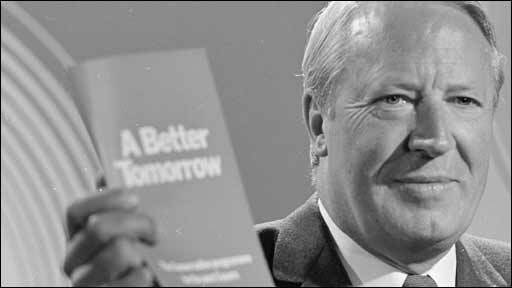
Soon after being elected Britain’s Prime Minister in 1970, Edward Heath gave a speech that promised a “quiet revolution” to remake the nation. A quiet revolution did indeed occur in the ensuing decade—but in physics, as the standard model of particle physics took shape.
To answer my question, I turned to my friend and former colleague, Bert Schwarzschild, who was a peripatetic postdoc during the 1970s. Bert worked in particle physics before he joined Physics Today in 1979, so that was the field we talked about. Besides Bert himself, my guide was the book that he considers to have been particularly useful during his career as an editor and reporter: Particle Physics: One Hundred Years of Discoveries (An Annotated Chronological Bibliography).
As Bert leafed through the book, the first papers of the 1970s that caught his eye were those of Gerard ‘t Hooft. Published in 1971, the papers showed that Abdus Salam’s and Steven Weinberg’s 1967 attempts at a unified field theory of the electromagnetic and weak nuclear forces were renormalizable—that is, the theory’s nonphysical infinities can be cancelled. Thereafter, the theory caught the serious attention of experimenters.
Next up was Makoto Kobayashi and Toshihide Maskawa’s 1973 paper that proved that CP violation can be accommodated by Salam and Weinberg’s theory, provided there are at least six flavors of quark organized in at least three generations of two quarks and one charged lepton. Remarkably, when Kobayashi and Maskawa published their paper, only three quark flavors—up, down, and strange—had been observed.
That same year, David Politzer and, independently, David Gross and Frank Wilczek proved that a field theory not unlike the one that Salam, Weinberg, and ‘t Hooft had worked on could have asymptotic freedom—that is, interactions between particles become asymptotically weaker as their separation shrinks. Given that quarks exhibit asymptotic freedom, the two papers gave birth to quantum chromodynamics, the now-standard theory of the strong nuclear force.
Yet another major discovery was made in 1973. Electroweak theory predicted the existence of a massive neutral boson, the Z, which mediates the weak nuclear force alongside the massive charged bosons, W+ and W−. A clear manifestation of the Z boson, neutrino interactions without charge exchange, was observed that year at CERN’s Gargamelle bubble chamber experiment.
This photo comes was taken at an American Physical Society meeting held at the Pennsylvania State University in the summer of 1974. Standing (left to right) are Martin Perl, Richard Lapidus, Stan Shepherd, and David Wolfe. CREDIT: AIP Emilio Segrè Visual Archives
In 1974 groups led by Samuel Ting at Brookhaven National Laboratory and Burton Richter at SLAC discovered the J/ψ meson. The 3.1-GeV/c2 particle turned out to be a bound state of the charm quark and its antiparticle. Its detection constituted the discovery of the fourth quark flavor, charm, whose existence had be predicted 10 years earlier by James Bjorken and Sheldon Glashow.
One year later saw the discovery of another elementary particle, the τ lepton, by a group at SLAC led by Martin Perl. Being the third charged lepton (after the electron and the muon), the τ lepton foreshadowed the eventual discovery of the corresponding third quark generation. Indeed, in 1977 a group at Fermilab led by Leon Lederman discovered the fifth quark flavor, bottom.
The 1970s ended with another much-anticipated discovery. The PETRA accelerator at DESY outside Hamburg, Germany, smashed electrons and positrons together at sufficiently high energy that jets of gluons were observed squirting from the debris. Quantum chromodynamics had passed a significant experimental test.
By the end of the decade, almost all the components of what became known as the standard model of particle physics were in place. Its field theoretic framework had proven capable of accommodating three of nature’s four fundamental forces. And of the model’s zoo of leptons, quarks, and force-mediating bosons, only the top quark, the τ neutrino, the W± and Z bosons, and the Higgs boson awaited discovery.