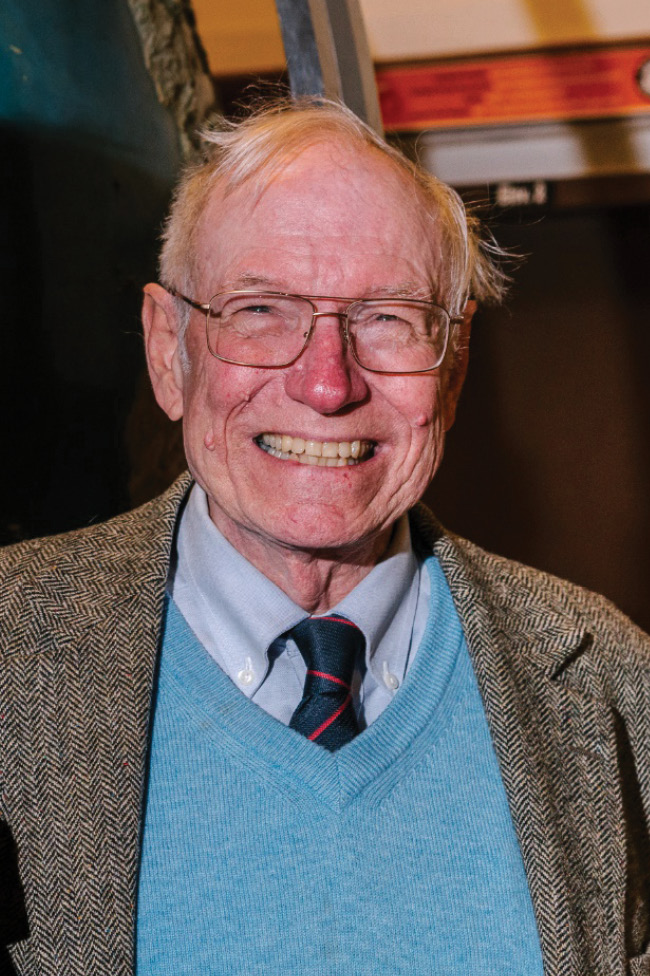
W. Jason Morgan
DOI: 10.1063/PT.3.5365
Renowned geophysicist W. Jason Morgan died peacefully in his sleep on 31 July 2023 at the home he shared with his daughter, Michèle, and her husband in Natick, Massachusetts.

W. Jason Morgan
JAKE NAUGHTON
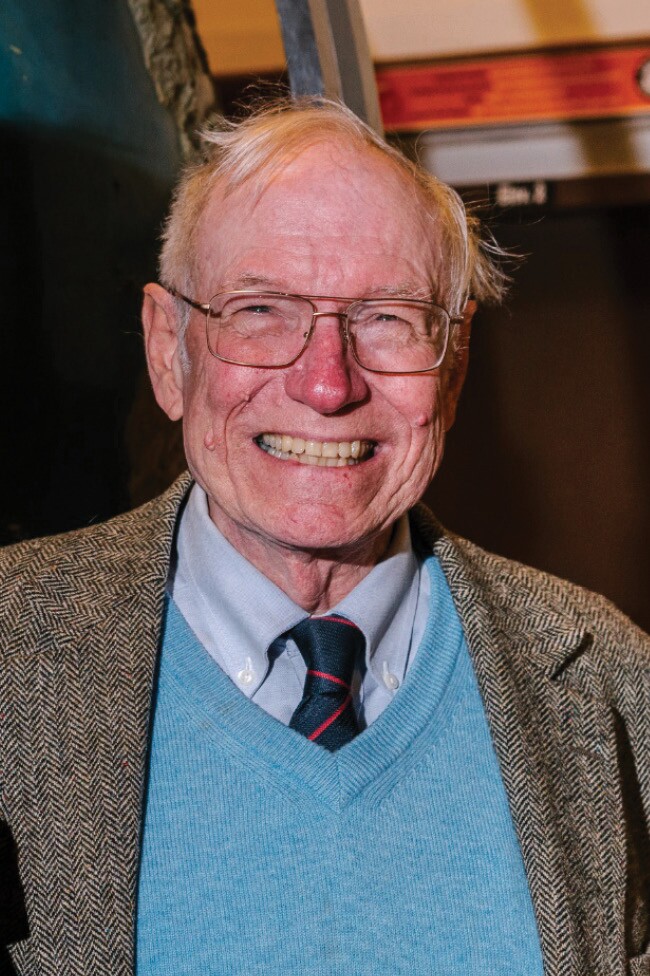
With Morgan we lose one of the leading figures of modern-day Earth and planetary science. His theoretical work and careful observations supported the hypotheses of continental drift, seafloor spreading, and deep mantle plumes, and he established plate tectonics as the reigning paradigm in the geophysical sciences.
By 1596 Flemish cartographer Abraham Ortelius had mapped the African and South American coastlines and suggested that the two continents had once been joined but were pulled apart by “earthquakes and floods.” By 1912 German meteorologist Alfred Wegener had gathered paleoclimatic and paleontological evidence for an ancient supercontinental landmass, Pangaea, and coined the term “continental drift.” By 1967 Morgan had unified and codified the theory of plate tectonics largely as we know it today. The mechanism for moving rigid lithospheric plates about Earth’s surface involves convection of the plastically deforming mantle. Convection was crucially missed by Lord Kelvin in his erroneous calculations of Earth’s age and dismissed by Harold Jeffreys and other physicists but is today as widely accepted as the notion that Earth revolves around the Sun.
Born 10 October 1935 in Savannah, Georgia, Morgan graduated from Georgia Tech in 1955 with a degree in physics and then did a two-year stint in the US Navy. He joined Princeton University’s department of physics as a graduate student under Robert Dicke and worked in the company of Jim Peebles and Rainer Weiss, among others. Morgan’s 1964 thesis, “An astronomical and geophysical search for scalar gravitational waves,” found no perceptible support for changes in the fundamental gravitational constant.
It was at Princeton, where Morgan would spend his career, that geologist and oceanographer Harry Hess enticed him to move into geophysics. As a postdoc, Morgan worked on convection currents in Earth’s mantle with the peripatetic Walter Elsasser. With the publication of two papers on gravity anomalies and convection currents, Morgan established himself as an original thinker unafraid of upsetting the scientific status quo. He worked out essential elements of the theory of density anomalies in a dynamic, viscous mantle and proposed a radically new interpretation for the structure of the deep Puerto Rico Trench, ideas that were widely controversial at the time.
Sharing an office with Frederick Vine, who linked marine geomagnetic anomalies to the process of seafloor spreading, proved to be pivotal for Morgan. He and Vine joined the faculty of the department of geology (now geosciences) in 1967. The next year Morgan published “Rises, trenches, great faults and crustal blocks,” which celebrated author John McPhee rightfully called “one of the last of the primal papers that, taken together, constituted the plate-tectonics revolution.” Incontrovertible evidence for seafloor spreading had been gathered by Hess and Vine, through the discovery of symmetric lineations of Earth’s remnant magnetic field recorded in alternating bands moving away from mid-ocean ridges.
In that 1968 landmark paper, Morgan formulated crucial insights on the mechanisms that linked together those and other geophysical observations and developed detailed computer calculations supporting the existence of tectonic plates and their motion across the globe’s surface. In a 1971 article, Morgan further postulated the existence of convectively upwelling “mantle plumes” to explain the presence of “hot spots” and the morphology of seamount chains in the oceans, which had not initially fit into the overarching theory.
The plate-tectonics theory ranks among the major scientific revolutions of the 20th century. Within a few years after Morgan’s paper was published, any debate was, essentially, over, and opponents of the theory were relegated to the distant corners of the scientific enterprise. The study of mantle plumes, which consumed many of Morgan’s later years, continues vigorously to this day.
Morgan’s research would earn him several major scientific accolades, culminating in a 2002 National Medal of Science. “I am definitely a theorist,” he recounted in an interview for the National Science and Technology Medals Foundation. “I’m not an experimentalist at all—I’m an observer of nature, and I participate on experimental projects. And as I say, it’s mainly for the chance of seeing the data firsthand.”
“And when you’re intimately involved with the data,” he continued, “you begin to see the patterns as they emerge. And being actively involved is a much better education than passively reading about somebody else’s experiment.” Even well past retirement and into his old age, Morgan participated in geological field trips and oceanographic expeditions and kept his passionate interest in teaching and education.
Patient, kind, soft-spoken, and perennially practically dressed, Morgan had none of the ego traditionally associated with men of his scientific stature. In conversation, he would take long pauses to formulate deep thoughts, fed from encyclopedic knowledge and profound insight. After retiring from Princeton, Morgan became a visiting researcher at Harvard University, where, for the next 20 years, true to his calling, he continued to mentor a new generation of solid-Earth researchers.
Loved by all who knew him, he will be missed.
More about the authors
Frederik J. Simons, Princeton University, Princeton, New Jersey.