Zero-gravity flights aim to boost interest in S&T careers
DOI: 10.1063/1.2364237
When you were young, did you ever dream you could fly? Florida science teacher Nicole Notz did, and the dream propelled her into an initial career as a helicopter pilot. Later, she switched to science education, but she always remembered her fantasy excursions. During the past few months—thanks to a defense and aerospace company’s program that sent teachers on weightless flights—Notz got to live her dream, and now she can’t wait to get back to her classroom.
Notz, who teaches science to students in grades 9 through 12, said that floating and flying around inside a specially outfitted aircraft during its zero- and low-gravity phases was unlike anything she’d ever experienced, even as a helicopter pilot.
“You’re sitting on the floor and you feel your whole body lift up. You can’t help but smile,” she said. “Does this boost your enthusiasm [for teaching]? Oh, gosh. We can show [students] all these things, not just talk about them.”
Notz’s reaction to going weightless, and her eagerness to bring her enthusiasm to her students, is what Northrop Grumman Corp was banking on when it helped create Weightless Flights of Discovery. Through the program, which began in June and wraps up this month, some 240 teachers from the US and other countries participated in flights that briefly created weightless and low-gravity environments. The company is hoping the teachers’ flight experiences, along with their participation in pre-takeoff workshops and onboard science experiments, will heighten their zeal for teaching science and in turn spur their students to pursue careers in space exploration, science, or technology.
“Dinosaurs and space are the two things that excite children, and we want to inspire our future generations,” said Sophia Kim, manager for strategic studies at Northrop Grumman’s integrated systems sector.
For the program, Northrop Grumman—which is not disclosing its costs—teamed up with Zero Gravity Corp of Fort Lauderdale, which operates a Federal Aviation Administration–approved aircraft that is able to fly in parabolas and was used in the program’s flights. Zero Gravity supplied the pilots for each of the program’s 12 short flights and led the teacher workshops, which are based on a NASA curriculum for educators. The company also shot video of each flight from the aircraft’s interior and gave copies to participating teachers.
Newton’s laws in space
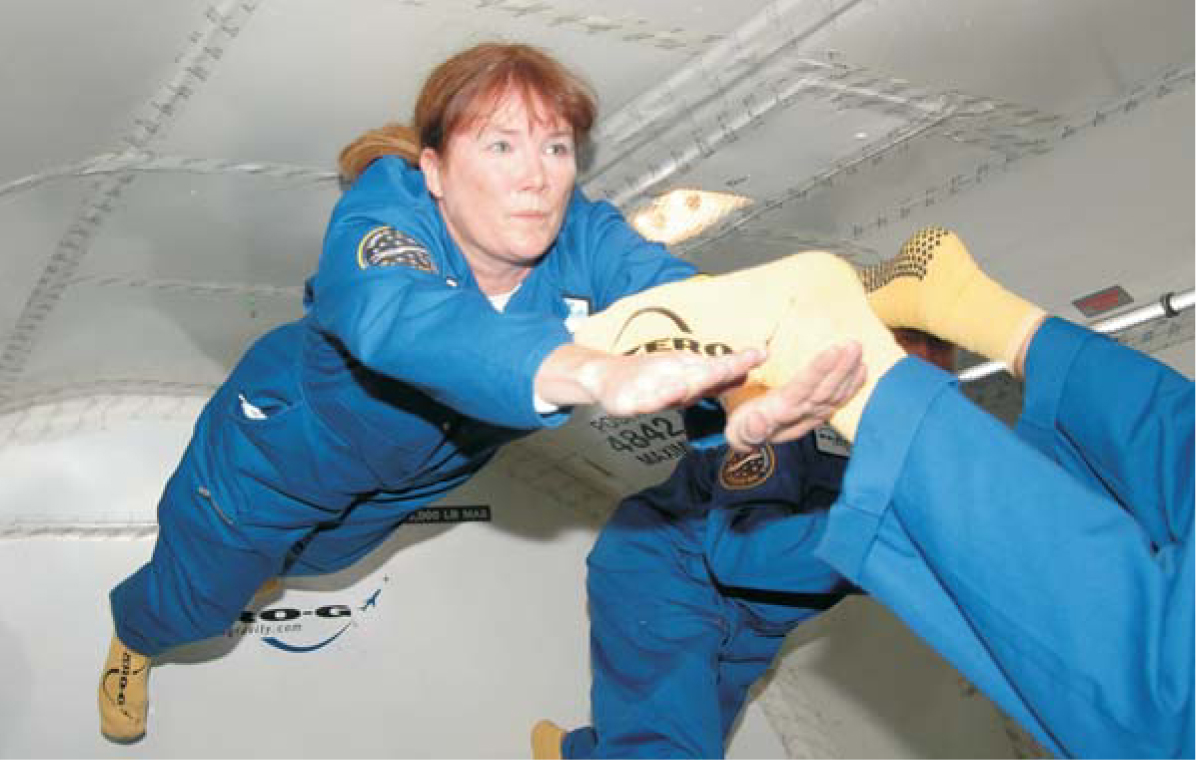
Deb Houts, another participant who teaches advanced chemistry and physics to Florida high-school students, is eager to convert her discoveries into tutorials. In one lesson, she’ll ask her classes to identify and apply Newton’s laws as they watch a video of M&M’s and other small objects floating around the plane’s interior during a weightless period. She said the third law, that every action has an equal and opposite reaction, is especially well illustrated in footage of teachers throwing each other around inside the aircraft.
Houts also used her weightless moments—which last about 15 seconds each as the plane plunges downward from the peak of a parabola and collectively total about 4 minutes per flight—to conduct oil-and-water experiments. In one, using a clear container, she showed how differently the two fluids interact with each other in a full-gravity environment versus in zero gravity. On Earth, the less-dense oil floats on top of the water. When gravity disappears, the oil gathers in the center of the water. After seeing a video of the experiment, her students will figure out what causes the oil to act as it does. “Removing the force of gravity, which would pull most dense material down, means you’re talking about intermolecular forces,” Houts said. “You get a ball of oil in the middle. It really is pretty cool.”

Science teacher Deb Houts floats inside a plane during a zero-gravity flight that’s part of a national industry program designed to redouble teachers’ enthusiasm for teaching science.
ZERO GRAVITY CORP