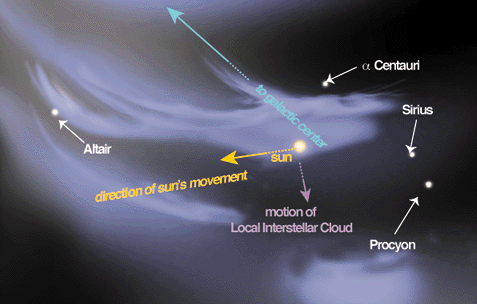
An artist’s concept of the Local Interstellar Cloud, also known as the “local fluff.” Credit: Linda Huff ( American Scientist) and Priscilla Frisch (University of Chicago)
“Using data from Voyager, we have discovered a strong magnetic field just outside the solar system,” explains co-author Merav Opher, a NASA heliophysics guest investigator from George Mason University. “This magnetic field holds the interstellar cloud together and solves the long-standing puzzle of how it can exist at all."The discovery has implications for the future when the solar system will eventually bump into other, similar clouds in our arm of the Milky Way galaxy.The local fluff is about 30 light-years wide and contains a wispy mixture of hydrogen and helium atoms at a temperature of 6000 °C.The existential mystery of the fluff has to do with its surroundings.About 10 million years ago, a cluster of supernovae exploded nearby, creating a giant bubble of million-degree gas. The fluff is completely surrounded by this high-pressure supernova exhaust and should be crushed or dispersed by it."The observed temperature and density of the local cloud do not provide enough pressure to resist the ‘crushing action’ of the hot gas around it,” says Opher.So how does the Fluff survive? The Voyagers have found an answer."Voyager data show that the fluff is much more strongly magnetized than anyone had previously suspected--between 4 and 5 microgauss,” says Opher. “This magnetic field can provide the extra pressure required to resist destruction."NASA’s two Voyager probes have been racing out of the solar system for more than 30 years. They are now beyond the orbit of Pluto and on the verge of entering interstellar space."The Voyagers are not actually inside the local fluff,” says Opher. “But they are getting close and can sense what the cloud is like as they approach it."The fluff is held at bay just beyond the edge of the solar system by the Sun’s magnetic field, which is inflated by solar wind into a magnetic bubble more than 10 billion km wide.Called the “heliosphere,” this bubble acts as a shield that helps protect the inner solar system from galactic cosmic rays and interstellar clouds. The two Voyagers are located in the outermost layer of the heliosphere, or “heliosheath,” where the solar wind is slowed by the pressure of interstellar gas. Voyager 1 entered the heliosheath in December 2004; Voyager 2 followed almost 3 years later in August 2007. These crossings were key to Opher and her team’s discovery.The size of the heliosphere is determined by a balance of forces: Solar wind inflates the bubble from the inside while the local fluff compresses it from the outside. The spacecraft’s crossings into the heliosheath revealed the approximate size of the heliosphere and, thus, how much pressure the local fluff exerts. A portion of that pressure is magnetic and corresponds to the ~5 microgauss Opher’s team has reported in Nature.The fact that the fluff is strongly magnetized means that other clouds in the galactic neighborhood could be too.Eventually, the solar system will run into some of them, and their strong magnetic fields could compress the heliosphere even more than it is compressed now.Additional compression could allow more cosmic rays to reach the inner solar system, possibly affecting terrestrial climate. Related LinkA strong, highly tilted interstellar magnetic field near the solar system