US Team Grabs Top Honors at Physics Olympiad
DOI: 10.1063/1.1629000
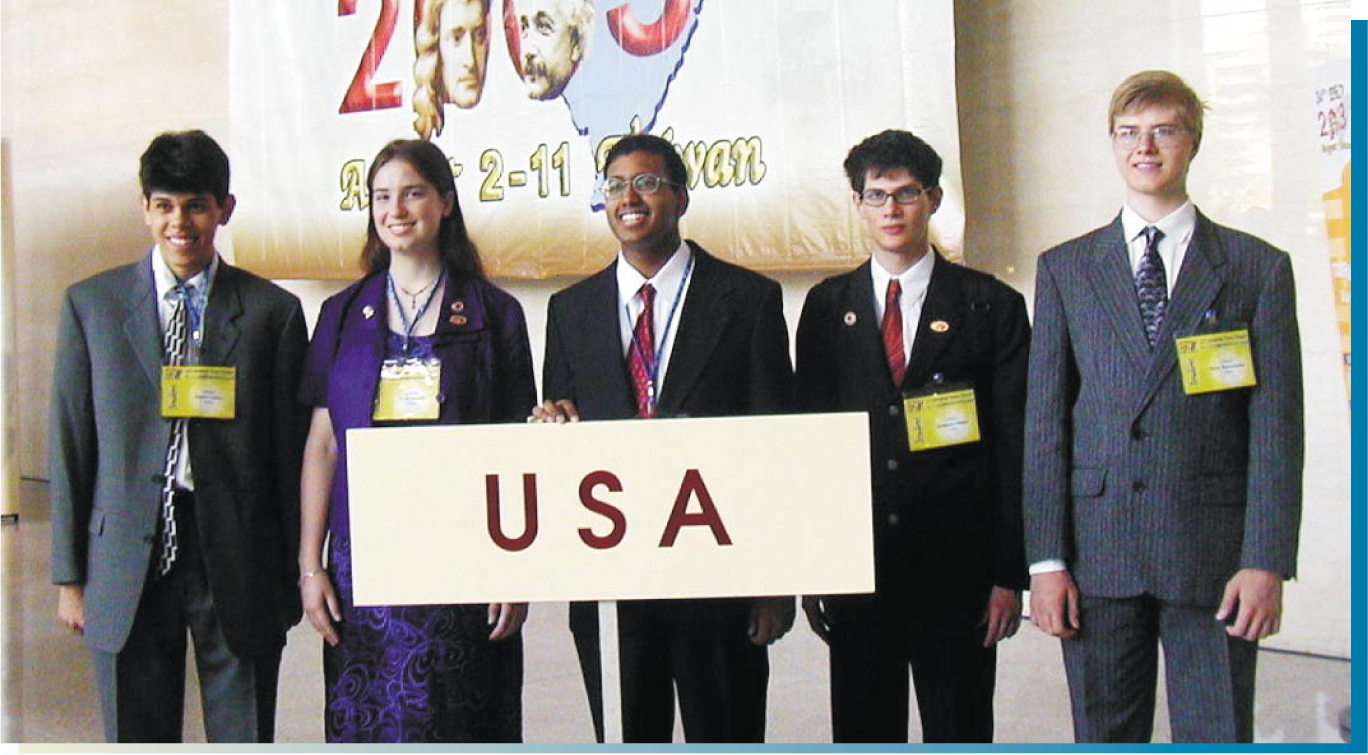
The US physics team achieved the top overall score of the 54 countries participating in the 34th International Physics Olympiad in Taipei, Taiwan, in August. The five high-school students won three gold and two silver medals and earned four special prizes. South Korea, with three gold and two silver medals, came in second, and Taiwan placed third.
Gold medalist Pavel Batrachenko of Rochester, Minnesota, was the overall winner at the Olympiad, and shared the prize for the best experimental score with a student from Thailand. Other US gold medal winners were Chintan Hossain of Wilmington, Delaware, and Daniel Gulotta of Doylestown, Pennsylvania. Gulotta also won the prize for the best score on the theoretical portion of the Olympiad. Emily Russell of Yorktown Heights, New York, won a silver medal and took the prize for the best score among female participants. Immanuel Buder of Alexandria, Virginia, took home a silver medal.
“We’re ecstatic about the success of the team—they worked really hard and they deserve it,” said Bernard Khoury, executive officer of the American Association of Physics Teachers. The association and the American Institute of Physics are the primary sponsors of the team. “We’ve never had this kind of confluence of great students before. It’s all the more remarkable, since the event might never have been held.”
The students’ participation in the Olympiad was uncertain because of the SARS outbreak in Taiwan (see Physics Today, July 2003, page 35 ). The team also lost two of its original members who, because of that uncertainty, decided to attend other competitions. The team was accompanied by academic director Mary Mogge of California State Polytechnic University, Pomona, and senior coach Bob Shurtz of the Hawken School in Gates Mills, Ohio.
As in previous years, the competition consisted of a five-hour theory section and a five-hour experiment section. For example, one of this year’s problems required that students observe and determine the optical properties of a nematic liquid crystal cell.
When not competing, students enjoyed colloquiums, sightseeing tours of landmarks in Taiwan, and social activities with participants from other countries. “It was an incredible experience to spend time with students from a dozen different countries in such a relaxed and friendly setting,” said Russell.
Next year, the Olympiad will be held in July in Pohang, South Korea.

The winning 2003 US physics team includes (left to right) Daniel Gulotta, Emily Russell, Chintan Hossain, Immanuel Buder, and Pavel Batrachenko.
MARY MOGGE/CAL STATE POMONA PHYSICS DEPARTMENT