Urban trees in Beijing have unexpected consequences for city ozone production

Trees lining a city street provide cooling shade and beautiful views and help absorb pollutants like carbon dioxide. But trees are also producers of volatile organic compounds (VOCs) that, when combined with both sunlight and nitrogen oxides produced by burning fossil fuels, can contribute to the production of ground-level ozone. In a new study of emissions from urban trees in Beijing, Bin Yuan of Jinan University in China and colleagues reported that although biogenic sources account for only about 10% of the city’s total VOC emissions, the biogenic pollutants contribute more to ozone production than do anthropogenic VOCs. 1
City infrastructure can make acquiring direct measurements of urban emissions challenging, but a 325 m meteorological tower near the center of Beijing offered a unique opportunity, Yuan says. The research team set up a monitoring system on a platform 102 m up the tower and measured chemical signatures and vertical wind speed between May and July 2021. By assessing the statistical relationships between wind-speed and pollutant-concentration measurements, the researchers calculated the emissions flux for various pollutants. To isolate the sunlight-dependent VOCs produced by urban vegetation from VOCs originating from human sources, such as vehicles and cooking, the team focused on chemical fingerprints left by emissions that peaked around midday and fell off after sunset.
Figure 1.

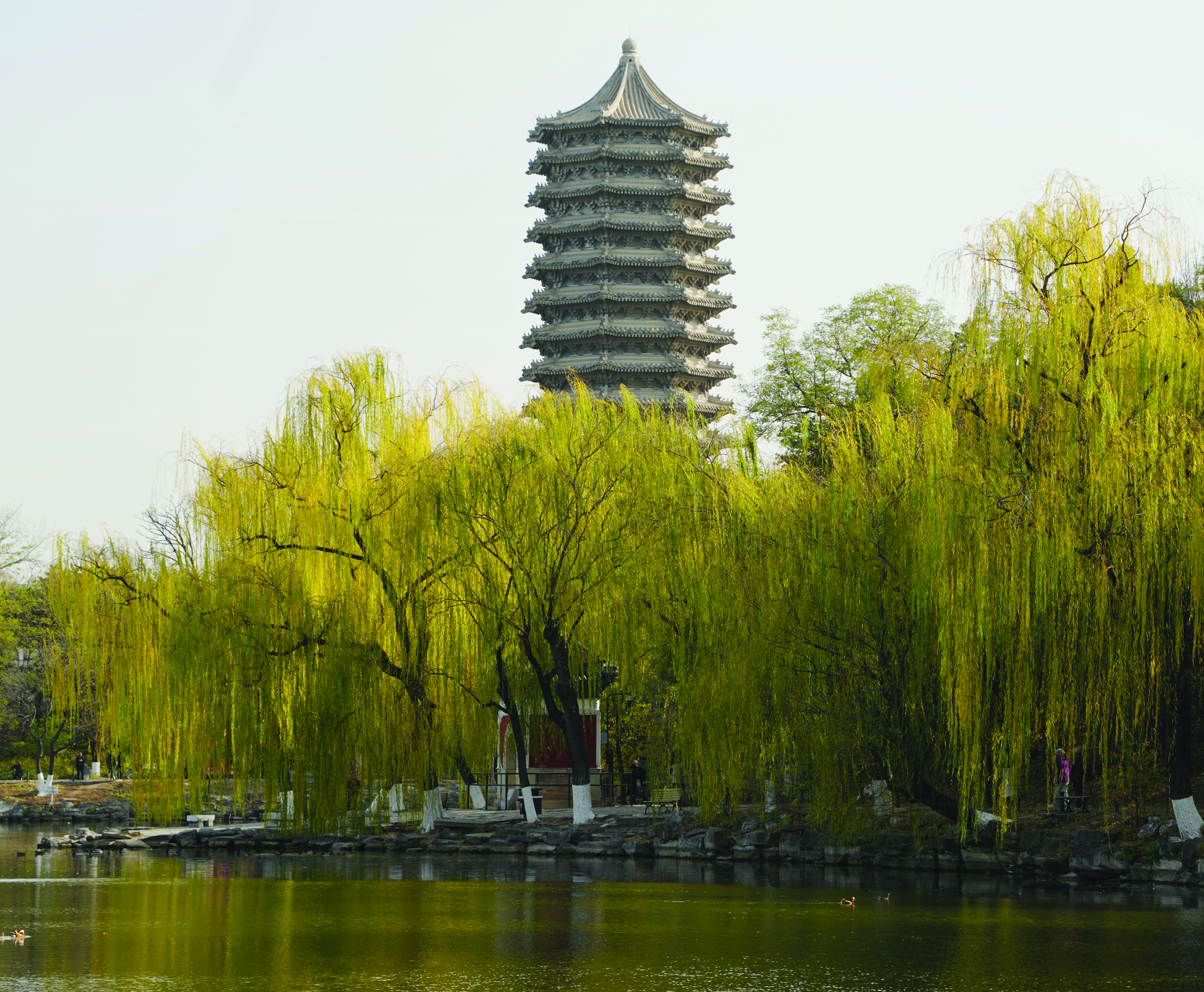
The weeping willow is a popular choice for urban tree planters in Beijing. New research reveals that high emission rates of the volatile organic compound isoprene by those and other trees in the city are contributing to the production of ground-level ozone.
(Photo by Xianjun He/CC BY-SA .)

The team identified that the compound isoprene accounts for most of the reactive biogenic VOC emissions in the city. A common byproduct of photosynthesis, isoprene is harmless on its own. But when it is exposed to sunlight, it reacts quickly with other urban pollutants to produce ozone. The researchers found that roughly 35% of urban trees in Beijing are isoprene emitters and that popular trees there, including weeping willows (shown in figure 1 ) and Chinese white poplars, are among the biggest producers.
The research team evaluated the impact of isoprene emissions on ozone by calculating the rate at which the isoprene flux reacted with hydroxyl radicals (OH); aided by a 3D chemical-transport model, the team determined that urban vegetation in Beijing accounts for approximately one-fourth of Beijing’s ozone, says Yuan. The researchers also found, as shown in figure 2 , that the flux’s OH reactivity scales with heat: Biogenic VOC reactivity rates at 35 °C are seven times as high as they are at temperatures closer to 20 °C, and in hot conditions, the rates are higher than the rates for anthropogenic VOCs.
Figure 2.

The flux of biogenic volatile organic compounds (VOCs) increase with temperature and at a rate higher than that of anthropogenic VOC sources. The fluxes are plotted in terms of their reactivity with hydroxyl radicals (OHRflux), which captures their potential for generating ozone. Overall, the researchers estimate that emissions from urban vegetation account for one-fourth of Beijing’s ground-level ozone concentration.
(Graph adapted from ref. 1 .)
Data are limited on how urban trees affect ozone in other cities. But direct measurements from the literature and simulations captured using the team’s model of tree emissions in cities have shown that popular urban trees—such as oak in Houston, Texas, and eucalyptus in Sydney, Australia—also exhibit high levels of isoprene emission. Despite the findings, cutting down trees that produce high amounts of isoprene is not the answer, Yuan says. Instead, the researchers recommend that urban greening initiatives focus on planting trees that emit lower levels of isoprene. Which species is best varies depending on the local climate, but examples include maple trees and conifers like cypress and pine.
Reference
1. X. He et al., “Tree selection in urban greening shapes air quality for global cities, ” Sci. Adv. 12, eaee5583 (2026).