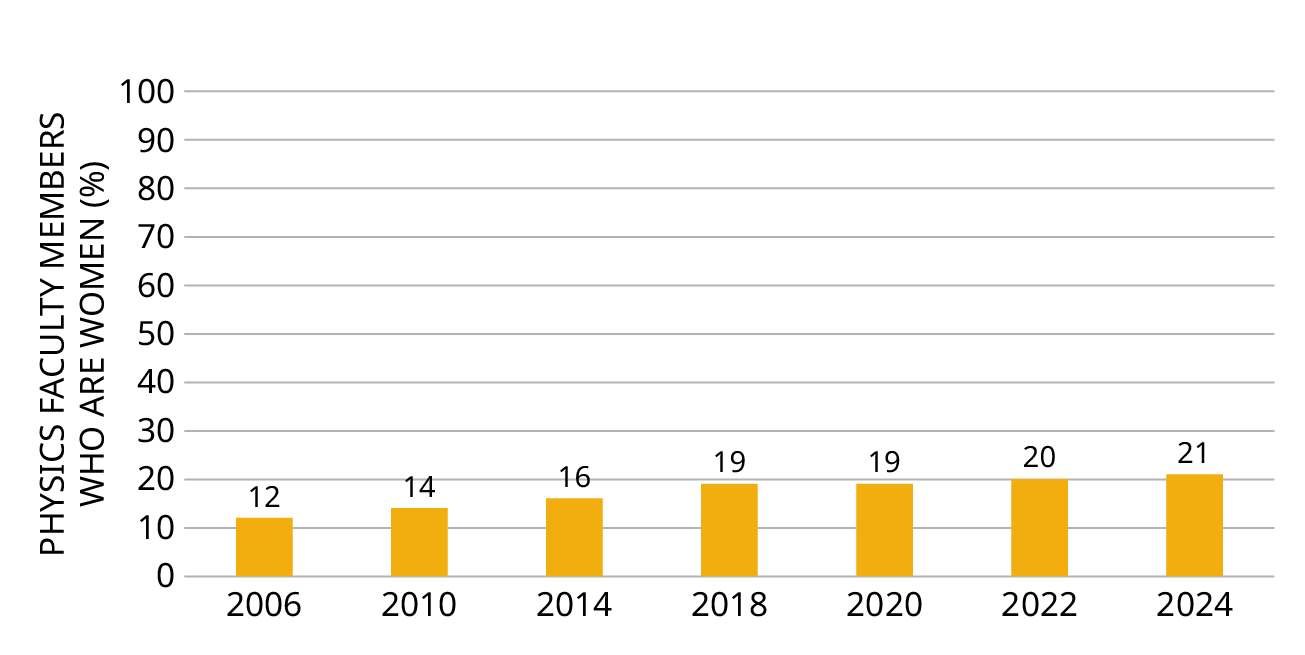
Upward trend in percentage of women physics and astronomy faculty in US

Women made up 21% of faculty members in US physics departments in 2024, up from 16% a decade earlier (see the figure). The percentage of women faculty members in the nation’s astronomy departments rose from 19% in 2014 to 25% in 2024. Those are among the findings in a recent report on the academic workforce by the statistical research team at the American Institute of Physics (publisher of Physics Today).
The report includes data on full-time-equivalent faculty members—full-time members were counted as one, and part-time members were counted as a fraction according to the amount of work performed—in the US. Overall, that number grew from 9800 in 2014 to 10 160 in 2024. From 2022 to 2024, faculty employment rose by 4% in the physics departments that grant PhDs and declined by 7% in the departments in which the highest degree awarded is a bachelor’s. The closing of some bachelor’s-only departments may have contributed to that drop.

(Figure adapted from A. M. Porter, J. Oman, J. Tyler, The State of the Academic Workforce in Physics and Astronomy, 2000–2024 , American Institute of Physics, 2025.)

Physics departments hired 611 new faculty members for the 2023–24 academic year and astronomy departments hired 42. The numbers of both hires and departures in physics and astronomy departments have increased over the past few years. In 2024, 29% of physics department new hires and 34% of astronomy new hires were women. Although those percentages are lower than those in 2020 and 2022, they remain greater than the current percentages of women faculty members overall.
Other metrics related to physics and astronomy faculty, including retirement trends and tenure status, can be found in the workforce report at https://doi.org/10.1063/sr.d25c029227 .