Twenty-Year Plan for US High-Energy Physics
DOI: 10.1063/1.1457256
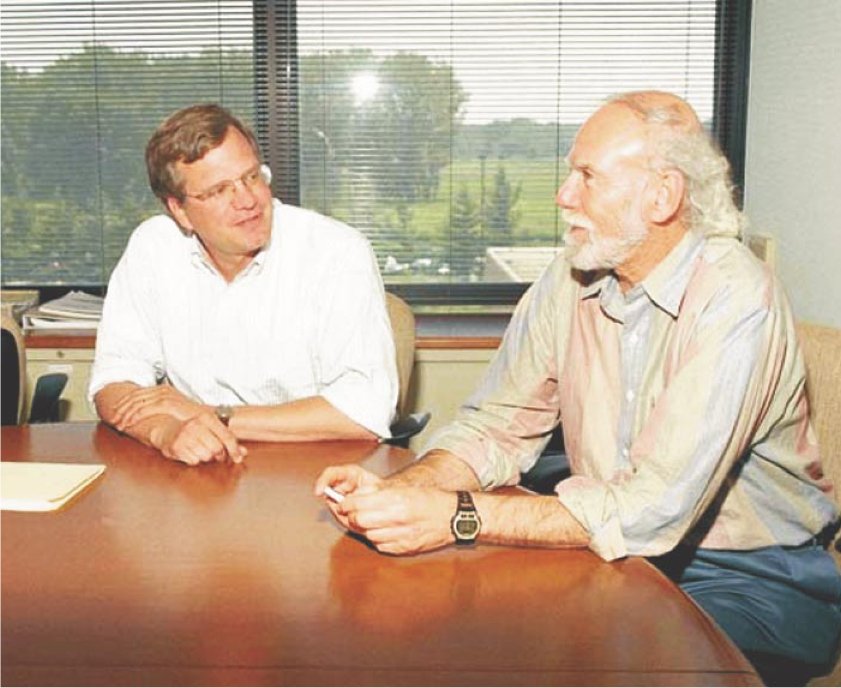
After a year of intensive consultation within the US particle-physics community, and with colleagues worldwide, the HEPAP subpanel on long-range planning for US high-energy physics will submit its much-anticipated report at the end of this month for transmittal to the funding agencies. (See Physics Today, September 2001, page 22 .) Last January, NSF and the Department of Energy had asked HEPAP, their high-energy-physics advisory panel, to create such a subpanel to lay out a 20-year “national roadmap” for particle physics. Theorist Jonathan Bagger (Johns Hopkins University) and experimenter Barry Barish (Caltech) were chosen to chair the 25-member HEPAP subpanel.
The subpanel’s report will be presented at HEPAP’s 28 January public meeting in Washington, DC. A provisional draft has been available on the Web (http://doe-hep.hep.net/home.html ) for comments since the end of October.
The highest priority
One of the report’s principal recommendations is no great surprise: “The highest priority of the US program [should] be a high-energy, high-luminosity, electron–positron linear collider, wherever it is built in the world. This facility is the next major step in the field, and should be designed, built and operated as a fully international effort.”
Urging that the US play a leading role in forming the international collaboration that will have to choose the final design, build, and operate the collider, the report considers two alternative scenarios, both of which would require increased funding. The “onshore” scenario, in which the e+e− collider is built in the US, would require a net increase of about 30% in total US funding for particle physics over the next 20 years, the subpanel estimates. Alternatively, if the collider is built “offshore”—presumably in Europe or Japan—funding for US particle physics would require a net increase of approximately 10% over those 20 years.
The subpanel estimates that the total cost of the 30-km-long collider would be about $5–7 billion, if it’s built in the US. The report expects about a third of that total to come from foreign contributions, and another $1–2 billion from “sacrifices and redirection” in the present US particle-physics program.
If decisions on the collider’s technology and siting can be reached in fiscal year 2003 or 2004, the eight-year construction project could begin in FY 2005. The principal rival to the copper radio-frequency linac design that has been the main focus of work in the US is the superconducting TESLA design proposed by the DESY laboratory in Hamburg (see Physics Today, May 2001, page 27 ). “The financial and intellectual scale of such facilities forces us to plan globally,” says HEPAP chair Fred Gilman (Carnegie-Mellon University).
In its estimates of the increased funding required for either scenario, the subpanel assumes strong participation by the US community in other important particle-physics programs here and abroad. Prominent among these is US participation in the Large Hadron Collider at CERN, which should begin doing physics in 2006. The LHC is a proton-proton collider that will concentrate on the same TeV energy regime of quark and lepton interactions as the proposed e+e− collider. This two-pronged assault by complementary high-energy accelerators is considered crucial to revealing the mechanism that gives the fundamental fermions their masses and breaks the underlying symmetry between the electromagnetic and weak interactions.
For all its discussion of accelerators at the highest energies, the report stresses the importance of maintaining a broad, balanced program that includes experiments at lower energies and nonaccelerator facilities underground and in space.
Who decides?
Charting a roadmap that sets priorities and calls for sacrifices will require the creation of a new mechanism for making choices, says the report. To that end, the subpanel recommends the formation of a Particle Physics Project Prioritization Panel. The nickname “P5” is inevitable. The P5 panel would be made up of particle physicists, astrophysicists, and accelerator specialists, to be chosen from US universities and national labs, and from the international community. In advising HEPAP and the funding agencies, P5 would be asked to take account of what’s going on in other countries and in related fields like nuclear physics and cosmology.
Though the report pays due respect to the offshore option for the e+ e− collider, it nonetheless makes a strong plea for building it here: “We recommend that the US prepare to bid to host the linear collider, in a facility that is international from the inception. … We believe that the intellectual, educational and societal benefits make this a wise investment of our nation’s resources. … If it is built in the US, the linear collider should be sited to take full advantage of the resources and infrastructure available at SLAC and Fermilab.”

Bagger and Barish
FERMILAB

More about the authors
Bertram M. Schwarzschild, American Center for Physics, One Physics Ellipse, College Park, Maryland 20740-3842, US .