Tropical soils could be accelerating global warming
DOI: 10.1063/PT.3.4587
Earth’s soils store about 1.5 trillion metric tons of organic carbon—more than is contained in the planet’s vegetation and atmosphere combined. But that soil carbon isn’t necessarily a permanent fixture: It can be lost when microbes digest it and respire CO2. In a mature forest in a stable climate, carbon released from the soil to the atmosphere is in equilibrium with carbon absorbed from the atmosphere. In a world warmed by climate change, though, the balance may tip.
Generally, an increase in soil temperature accelerates the rate of microbial respiration and therefore the rate of CO2 release to the atmosphere. However, climate models struggle to predict how much more CO2 soil microbes release in response to rising temperatures and that uncertainty is amplified by differences in the mean annual temperatures for different latitudes. Measurements in temperate and Arctic forests have shown that high-latitude soils—including permafrost—that contain vast amounts of carbon are part of a positive feedback mechanism that enhances global warming. That warming may cause increased CO2 emissions and yet more warming.
Partly because the tropics are warming more slowly than higher-latitude regions and their soils contain less carbon, Earth system models predict smaller relative increases in carbon emissions from tropical soils than from soils at higher latitudes. But those models remain untested, and they may underestimate a significant source of atmospheric CO2.
The tropics account for 30% of the world’s soil carbon—an amount approximately equivalent to the carbon contained in vegetation worldwide. Half of the world’s annual carbon exchange between ecosystems and atmosphere comes from tropical forests, and the processes of carbon exchange in the tropics dominate the interannual pattern of atmospheric CO2 concentrations.
Now, in a challenging two-year field experiment, Andrew Nottingham (University of Edinburgh) and colleagues provide evidence that warmed tropical soils may release as much, if not more, of their stored carbon than do temperate soils. 1 The findings suggest that tropical soils are less stable carbon stores in a warming world than previous expectations based on thermodynamic models. A relatively small perturbation to tropical forest carbon stores could have significant consequences for the concentration of atmospheric CO2.
Temperatures rising
Climate models predict that by the end of the 21st century the tropics will be 2 °C to 5 °C warmer than they are in 2020. Knowledge of how that warming affects microbial-respiration reactions in the soil is limited to laboratory experiments and theoretical predictions, which do not translate precisely to real-world settings. 2 Until now, no in situ experiments have tested the resilience of tropical soils and their huge stores of carbon to that expected amount of warming. Carrying out field studies in the tropics presents challenges due to the logistics of working in remote, dense forests and establishing electrical infrastructure. In addition, electronics are easily damaged by the tropical heat and humidity, and the clay-rich soils often found in tropical forests are difficult to dig into and manipulate.
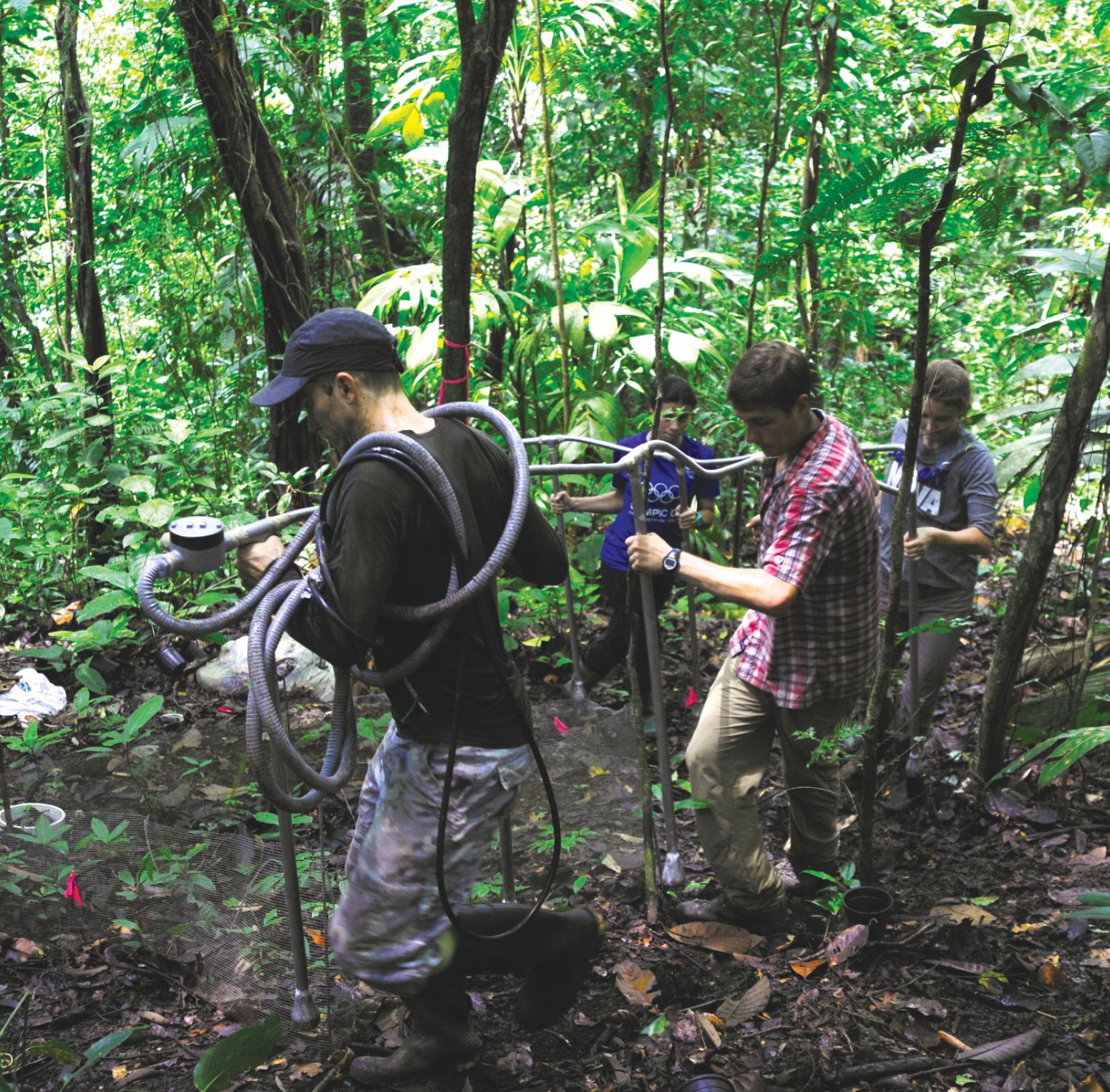
In an experiment that took two years to design and build, Nottingham and his colleagues overcame those challenges. They travelled to Barro Colorado Island, Panama, a nature reserve covered with tropical forest, shown in figure
Figure 1.

On Barro Colorado Island, in Gatun Lake in the middle of the Panama Canal, Andrew Nottingham and his colleagues hike through the forest with a handmade device for heating the soil. It and other instruments were buried in the ground and used to heat more than 120 cubic meters of soil by 4 °C as part of a two-year experiment to measure CO2 released from soil in a warming climate. (Photo by Geetha Iyer.)

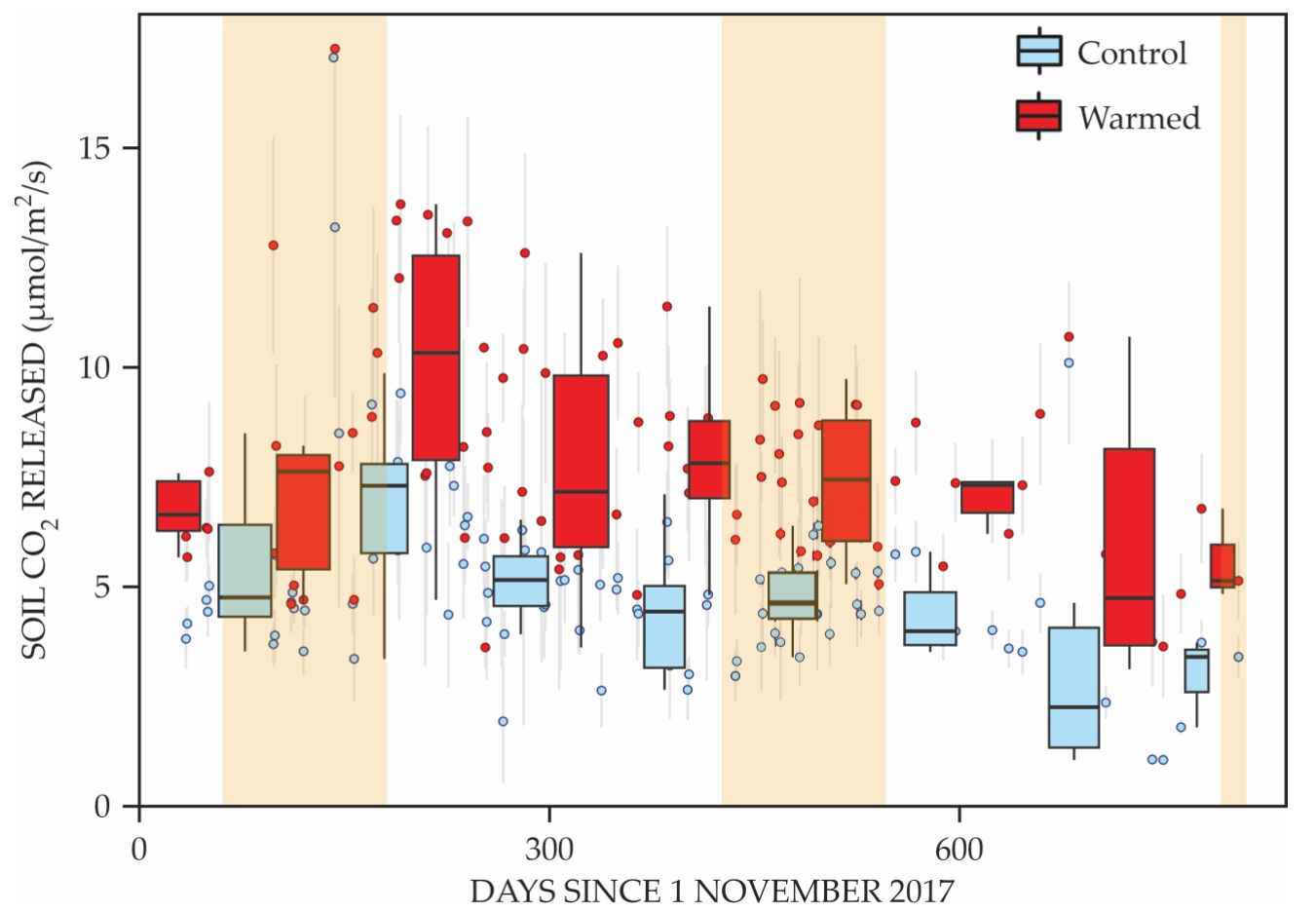
For two years, instruments placed in weatherproof boxes recorded the CO2 output over the warmed plots and nearby ambient-temperature control plots. The researchers found that the CO2 release rate increased substantially, shown in figure
Figure 2.

Tropical soils emit carbon dioxide as a result of microbial respiration. In a two-year field study, instruments measured the CO2 released from five plots warmed to 30 °C (red) and from five plots kept at 26 °C (blue). Heating began in full on 1 November 2017 after several months of testing. The boxes represent temporal variation in the CO2 release rate over sequential 100-day periods and indicate seasonal dynamics. The yellow shaded areas indicate dry seasons. The soil CO2 release rate was significantly higher in the warmed plots than in the control plots over the two-year period, and for the dry and wet seasons individually. (Adapted from ref.
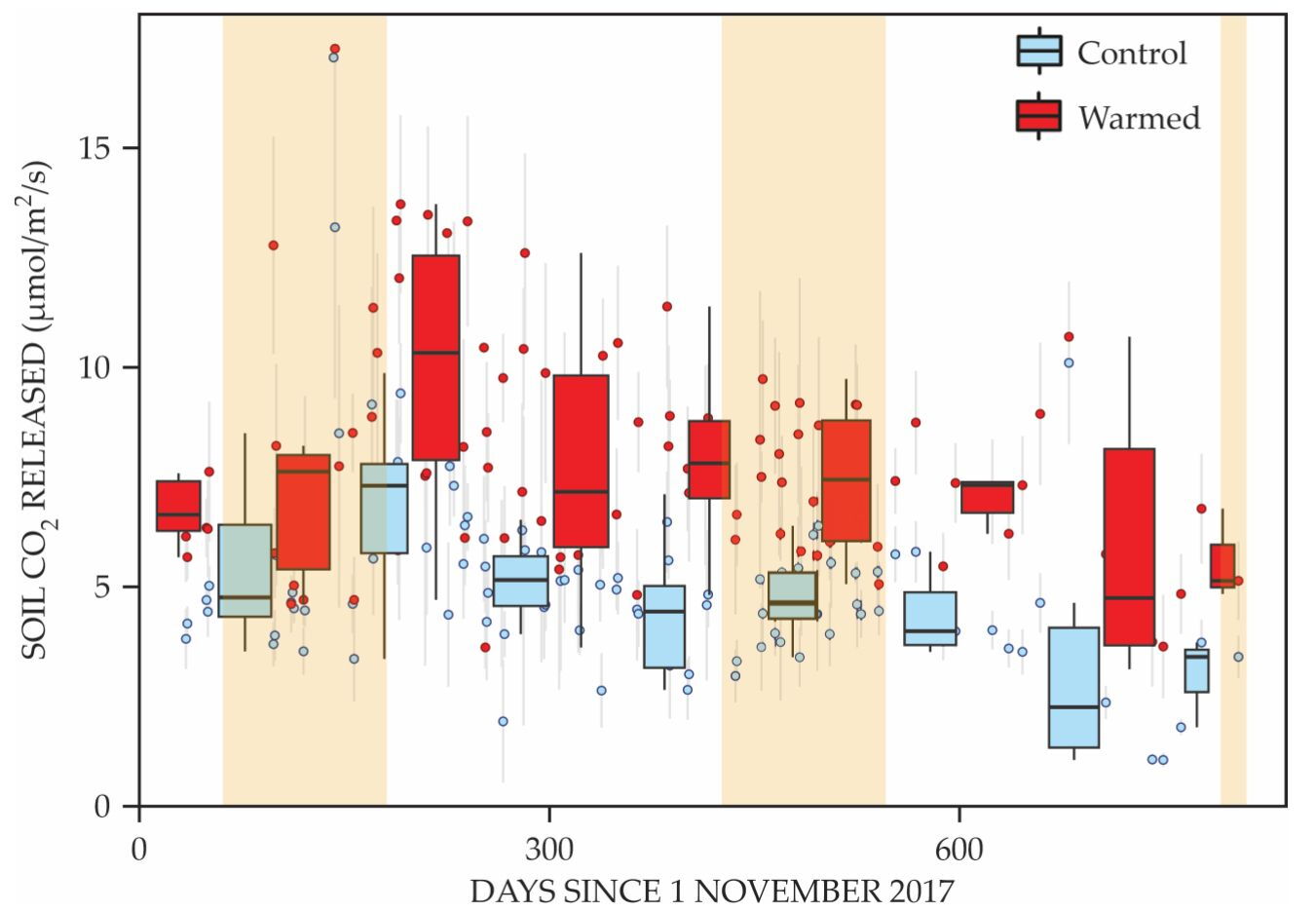
For comparison, an experiment that used the same method in a temperate forest in northern California found a 35% increase in emissions from heated soils. 3 The regular soil sampling and analyses by Nottingham’s team also provided information about the nutrient availability, carbon content, moisture, and microbial mass and enzymes in the soil.
Those analyses showed that carbon in the warmed soil was digested by microbes faster than in the ambient-temperature soil. But the microbes showed no chemical signs of compensating for the temperature change—for example, by changing enzyme activation energy or metabolic efficiency.
Carbon complexities
Nottingham’s results came as a surprise. The rate at which microbes metabolize and respire soil carbon depends on the rate at which enzymes break apart organic molecules. In Earth system models, that rate is governed by various versions of the Arrhenius equation. Proposed in 1889, the equation describes the dependence of chemical and enzymatic reaction rates on temperature. According to that equation, soil microbial respiration should increase more slowly in the warmer tropics relative to cooler, more northerly regions. 4
But Nottingham’s observations—that warm-climate soils increase the rate of release of their carbon stores more than do soils from cooler climates exposed to the same 4 °C warming—do not necessarily contradict the basic equations commonly used to describe enzymatic activities. Rather, the finding highlights the complexity of tropical forest soil ecology and the need to tease out other factors that may boost CO2 release in real-world conditions.
One possibility is that microbial communities grow quickly in warm soils. Emerging experimental evidence shows that describing soil warming processes will require complex models that incorporate microbial responses to temperature. 5 Nottingham’s soil sampling results contribute to that evidence by suggesting that the biomass of the microbes increases with warming, perhaps because certain types of detritus-eating microbes thrive at warmer temperatures.
Still, the measured increase in emissions should not be expected to continue indefinitely. Studies of temperate-forest warming suggest that increased emission rates may take a decade to decline. The observed lost carbon may represent a small, easily decomposable fraction of the entire carbon stock. Once that’s gone, the microbes may be unable to break down more stable organic matter. Alternatively, nutrients such as nitrogen or phosphorus might limit the activity of microbes at warmer temperatures. Or microbes may start to adapt to warm temperatures and decrease their carbon usage rate. The response of soil carbon to warming also depends on how vegetation responds to higher temperatures.
When using Nottingham’s findings to estimate large-scale effects by adapting climate models to represent global tropical soil contributions, one must consider differences in soil composition. In the short term, the results suggest that climate warming could lead to large additional CO2 emissions to the atmosphere, but the researchers cannot yet predict the long-term effects of warming. They are continuing their experiment in Panama to explore that uncertainty. Human development, such as new agricultural methods and changes in land use, should also be carefully evaluated to understand their impact on such vulnerable soils, especially in the context of future climate change.
References
1. A. T. Nottingham et al., Nature 584, 234 (2020). https://doi.org/10.1038/s41586-020-2566-4
2. R. T. Conant et al., Glob. Change Biol. 17, 3392 (2011). https://doi.org/10.1111/j.1365-2486.2011.02496.x
3. C. E. Hicks Pries et al., Science 355, 1420 (2017). https://doi.org/10.1126/science.aal1319
4. K. E. O. Todd-Brown et al., Biogeosci. 10, 1717 (2013). https://doi.org/10.5194/bg-10-1717-2013
5. M. A. Bradford et al., Nat. Clim. Change 6, 751 (2016). https://doi.org/10.1038/nclimate3071